
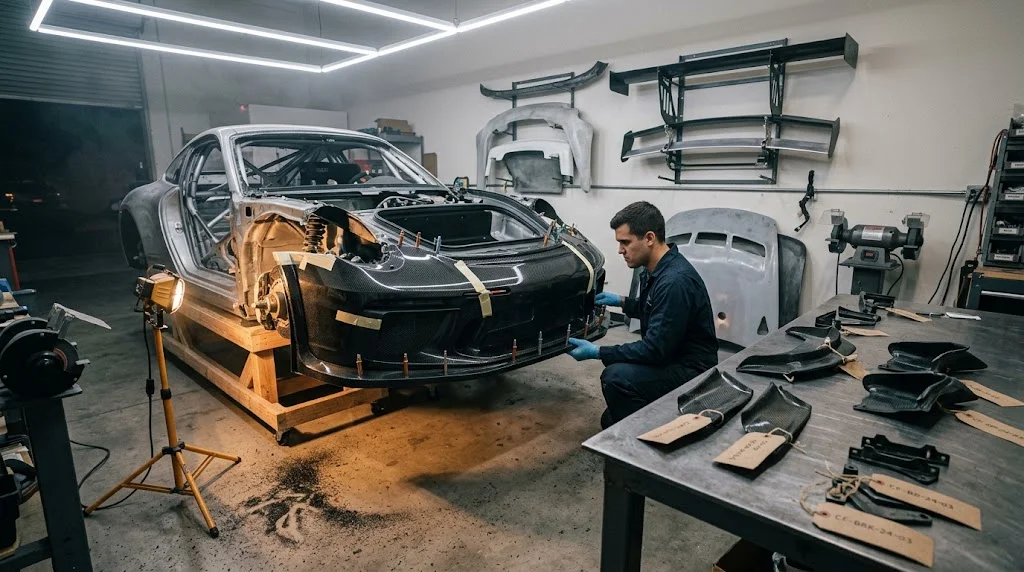
Sourcing spare parts carbon fiber for a race car, track-day build or classic restoration is different from buying raw sheet or tube: you are replacing a specific failed or outdated component, usually on a deadline, and the replacement must bolt onto the same mounting points as the piece it takes the
Introduction
Sourcing spare parts carbon fiber for a race car, track-day build or classic restoration is different from buying raw sheet or tube: you are replacing a specific failed or outdated component, usually on a deadline, and the replacement must bolt onto the same mounting points as the piece it takes the place of. The market for carbon fiber parts for cars splits into three tiers — direct-OEM-style replacements, aftermarket upgrades, and fully custom one-offs — and the price, lead time and quality gap between those tiers is large. This guide explains what is commonly stocked as spare parts, how to specify material and layup, what tolerance to demand from your supplier, and how carbon fiber auto parts pricing actually breaks down.
Whether you need a single replacement splitter or a recurring supply of carbon fiber small parts for a team's spares inventory, the same questions apply: which fiber grade, which resin system, what surface finish, and what documentation should come with the part.
Common Spare Parts Carbon Fiber Components in Racing
Most demand for replacement carbon sits in a short list of parts that either wear out, crack in contact, or get replaced when a car changes class or aerodynamic package. Typical stocked items include:
- Aero surfaces: front splitters, dive planes, rear wing endplates, diffuser strakes and undertrays — the parts most often damaged in track contact and the most common spares-carbon inventory line for race teams.
- Body and closure panels: hood vents, trunk lids, door cards, engine covers and hatch panels, usually specified when a car is converted from steel or fiberglass to save weight at a fixed point in the chassis.
- Interior and cockpit parts: dashboard shells, seat backs, shift paddles, fire extinguisher mounts and pedal boxes, where stiffness-to-weight matters and parts must clear homologation rules.
- Drivetrain and suspension ancillaries: brake ducts, cooling scoops, chain guards, sprocket covers and fairing brackets — small, high-cycle parts where cracked OEM plastic is a routine failure.
- Restoration pieces: unavailable OEM panels for classic race cars, reproduced in carbon as a stronger, lighter substitute when the original steel or fiberglass part is out of production.
The table below shows typical weight deltas between an OEM replacement and the carbon equivalent for a selection of commonly replaced components. Figures are representative of 2026 aftermarket catalogues for touring-car and GT applications.
| Component | OEM material | OEM weight (kg) | Carbon weight (kg) | Weight saved |
|---|---|---|---|---|
| Front splitter (1400 mm) | ABS plastic | 4.8 | 2.1 | 56% |
| Hood (lightweight) | Steel | 28.0 | 10.5 | 63% |
| Rear wing endplate (pair) | Fiberglass | 1.6 | 0.7 | 56% |
| Door card (each) | Steel + trim | 14.2 | 4.9 | 65% |
| Brake duct (each) | ABS plastic | 0.42 | 0.18 | 57% |
| Seat shell (FIA, fixed back) | Fiberglass | 9.5 | 6.2 | 35% |
Specifying Material and Layup for Replacement Carbon Fiber Parts
For spare parts, the specification should follow the loading of the original part rather than the most impressive fibre on the shelf. Body panels and interior shells are dominated by stiffness and surface quality: a quasi-isotropic layup of standard-modulus 3K twill at 1.5-2.5 mm, autoclave or vacuum-bag cured, is the default. Aero surfaces that see aerodynamic load — splitters, wings, diffusers — step up to intermediate-modulus fibre (T700 class) with local unidirectional reinforcement at the mounting zones, because those parts fail at the fastener rows, not in the open field.
Resin choice matters more than most buyers expect. Standard epoxy (Tg around 120-140 °C) is fine for interior and body parts. Anything mounted near exhausts, turbo plumbing or brake ducts should specify a high-Tg system (180 °C class) to avoid softening during a long stint. Prepreg and autoclave cure gives the most consistent void content (typically below 2%); vacuum-infused or hand-laid wet layup parts are cheaper but can run 5-8% void content, which shows up as lower interlaminar strength and, over heat cycles, surface blistering.
Tolerances, Fitment and Documentation You Should Demand
A replacement part that does not fit costs a race weekend, so tolerance and inspection paperwork are part of the product. Ask suppliers for:
- Dimensional report: overall dimensions checked against your drawing or the OEM part, typically ±1-2 mm on large panels, ±0.2-0.5 mm on CNC-machined mounting bosses.
- Cure record: cure cycle and lot number for the prepreg or resin batch, which also supports traceability if a part is later questioned under technical inspection.
- Finish definition: as-cured matte, one-side gloss, or UV-clearcoated — state it on the drawing, because "glossy both sides" roughly doubles the finishing cost.
- Fastener interface: inserts (bonded steel or titanium) installed and pull-out tested, rather than holes drilled for the customer to finish.
For repeat team orders, the practical move is to have one approved drawing revision and a first-article inspection before releasing the batch. It prevents the classic failure mode where ten identical spares arrive with ten slightly different hole patterns.
Where to Source Spare Parts Carbon Fiber: Pricing and Lead Times
Pricing for carbon fiber parts for cars follows the complexity curve more than the material curve. A simple flat part with two holes — a brake duct or a small cover — runs $40-120 per piece at quantity ten. Molded body panels start around $350-900 for a hood vent or engine cover and climb to $1,500-4,000 for a full hood or hatch. Full aero assemblies (splitter with canards, rear wing with endplates) land in the $800-2,500 range depending on mounting hardware and finish.
Lead times: stocked common parts ship in 3-7 days; parts produced against an existing mold run 2-3 weeks; a new mold adds 3-6 weeks including pattern and fixture work. For restoration one-offs where no mold exists, budget 6-10 weeks and expect the first article to be the expensive part of the exercise.
Regionally, buyers in Europe and the USA often pay a premium for short lead times and local stock, while Asian manufacturers win on unit price at quantities above roughly 20 pieces. Landed cost should include freight, customs duty (carbon fiber auto parts typically classify under HS 7019 or 3926 depending on construction — confirm with your broker) and any incoming inspection. For teams running a full season, a consignment or call-off arrangement with one qualified supplier usually beats per-order pricing.
Frequently Asked Questions
Can carbon fiber spare parts be repaired after a crack or impact?
Yes, most damage is repairable if the part is not deformed. A cracked aero surface is ground back past the damage, laminated with matching fibre orientation and re-cored where necessary, then re-finished. Expect the repair to restore function at 40-70% of the price of a new part. Parts that have folded or delaminated over a large area are usually cheaper to replace, because ensuring the original geometry without a jig is difficult.
Do carbon fiber auto parts need homologation for sanctioned racing?
It depends on the series. Many formulas allow carbon replacements freely for non-structural panels; others restrict changes to aerodynamic surfaces or require parts to match the homologated shape within a stated tolerance. Always check the current technical regulations before ordering — a part that is legal for track days may be rejected at scrutineering, and a rejected part is a sunk cost regardless of quality.
How many spares should a team carry for a race weekend?
A practical baseline for a single-car team: two front splitters or splitter leading edges, one set of dive planes, two brake ducts per corner position, and one spare of every small bracket that is removed during routine service. Small carbon fiber small parts are cheap relative to a non-finish, so the constraint should be transport volume rather than purchase price.
Conclusion
Spare parts carbon fiber is a mature market: the common racing and restoration components are stocked or tooled, tolerances are well understood, and pricing is predictable once you separate flat parts from molded assemblies. The buyers who get the best outcomes specify the part like an engineering component — grade, layup, resin Tg, finish and fastener interface defined on a controlled drawing — rather than ordering "a carbon version" of a broken plastic piece. For recurring team supply, that discipline also unlocks quantity pricing without the first-article surprises.
Browse our carbon fiber parts and panels or contact our team with your drawing or OEM sample — we manufacture replacement carbon fiber parts for racing teams and restorers, including custom molded panels, aero components and repeat supply of carbon fiber small parts.
Related Articles
- Carbon Fiber for Aerospace: Grade Selection for Flight-Critical Parts
- Carbon Fibre Sheet UK: Grades, Suppliers and Cutting Services
- Carbon Fiber Sheets Price: What You Pay by Grade, Thickness and Quantity
- Carbon Fiber Suppliers: How to Qualify and Compare Global Sources
- Carbon Fiber Rod NZ: Sourcing and Shipping for New Zealand Builders
- Price of Carbon Fiber in 2026: Tow, Prepreg and Part-Level Cost Benchmarks
Interested in Our Products?
Contact our team for competitive pricing and technical specifications.
Get a QuoteRelated Products
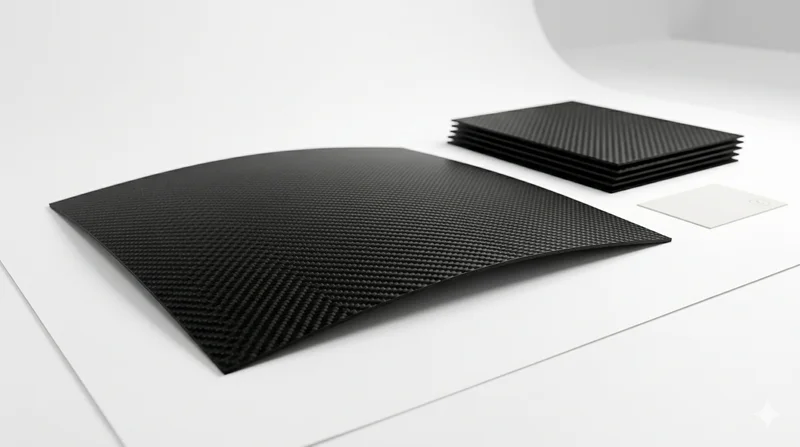
Carbon Fiber Plate — 3K Twill T700 1.5mm
Thin 1.5mm carbon fiber plate with 3K twill weave surface. Lightweight and stiff, commonly used for covers, panels, drone bodies, and applications requiring a premium aesthetic appearance.

Carbon Fiber Plate — 3K Twill T700 3.0mm
Medium-thickness 3.0mm carbon fiber plate offering significantly higher load capacity while maintaining attractive 3K twill finish. Suitable for structural brackets, reinforcement plates, and load-bearing panels.

Square Carbon Fiber Tube — 3K Twill T700
Square cross-section carbon fiber tube manufactured with 3K twill weave for torsional strength. Preferred for structural frames, trusses, and support columns where rectangular geometry offers design flexibility.

Carbon Fiber Pickleball Paddle
High-performance pickleball paddle with Toray T700 carbon fiber face and polypropylene honeycomb core. Delivers excellent power-to-weight ratio, spin generation, and vibration dampening for competitive play.

Carbon Fiber Trekking Pole
Lightweight carbon fiber trekking pole manufactured from high-grade carbon fiber tube. Weighs only 160g per pole while providing superior shock absorption and durability for hiking, trail running, and backpacking.