
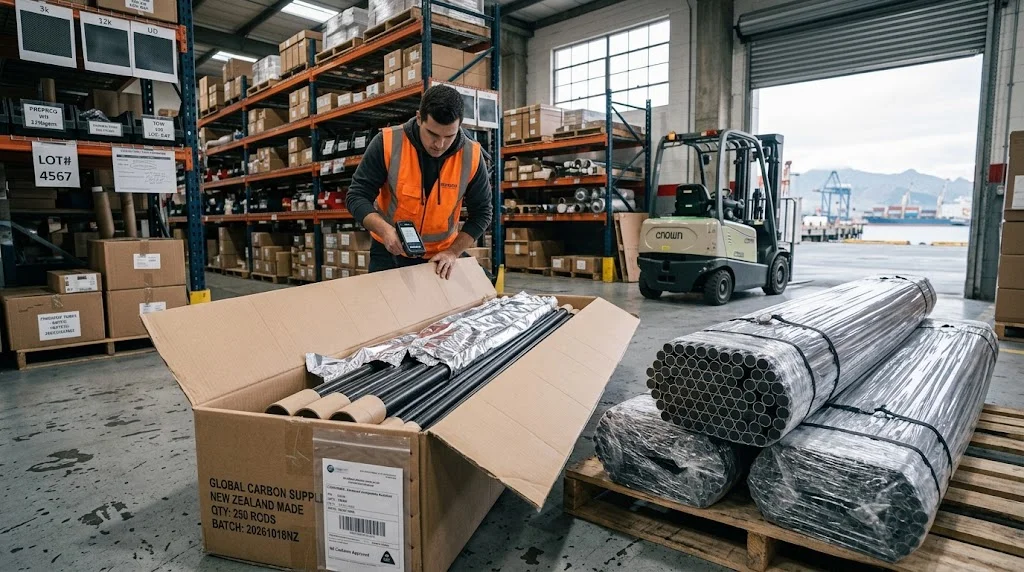
Finding a carbon fiber rod nz buyer can actually order comes down to three questions: what local stockists hold off the shelf, what it costs to bring stock in from overseas, and how to avoid paying twice for freight, duty and delay. New Zealand has a small but capable composites trade built around m
Introduction
Finding a carbon fiber rod nz buyer can actually order comes down to three questions: what local stockists hold off the shelf, what it costs to bring stock in from overseas, and how to avoid paying twice for freight, duty and delay. New Zealand has a small but capable composites trade built around marine hardware, antenna and mast makers, fishing rod builders and hobby workshops, and those users buy pultruded rod in the common diameters far more often than they buy exotic custom profiles. The gap appears as soon as a project needs a size, length or tolerance that nobody in the country keeps in the rack.
This guide sets out the two routes with real numbers: buying local stock for speed and certainty, or importing for price and specification control. It covers minimum order quantities, sea and air freight timelines to Auckland, Tauranga and Christchurch, GST at fifteen percent on the landed value, packaging that survives a long transit, and the checks to run before money moves, whether you are answering a carbon fiber rod for sale listing or searching for carbon fiber rod near me and calling the two shops that come up.
Carbon Fiber Rod NZ Sourcing: Local Stock Versus Importing
Local stock solves the two problems that cost New Zealand projects the most time: uncertainty and rework. A distributor or a rod builder with pultruded carbon fiber rod on the shelf will cut to length the same day, and you can check straightness, surface and finish in person before committing. Common local stock runs 3, 4, 5, 6, 8, 10 and 12 millimetre outside diameter in one or two metre lengths, in standard modulus fibre with a sanded or glossy finish, which covers fishing rod blanks and repairs, kite and model frames, antenna elements, mast sections, sensor booms and most workshop jigs. Lead time is measured in days rather than weeks, and a small order does not trigger tooling, minimum run or freight risk.
The premium is real but bounded. Expect to pay more per metre than an import price, because a local stockist carries inventory, cutting time and a small market, and expect less choice on wall thickness, fibre grade and surface. Importing flips the trade: unit price falls as quantity rises, specification opens up including high modulus fibre, coloured resin and tighter diameter tolerance, but minimum order quantities commonly land between one hundred and five hundred pieces per size, or a full carton, and lead time stretches to cover production, consolidation and transit. The table below frames the decision for a typical small programme.
| Route | Unit cost | Lead time | Minimum order | Best suited to |
|---|---|---|---|---|
| Local stockist, cut to length | Highest per metre | 2 to 7 days | Single lengths | Repairs, one-off builds, prototypes, urgent replacements |
| Regional distributor, AU or NZ held stock | High | 1 to 3 weeks | Carton quantities | Repeat sizes with local support |
| Direct import, sea freight | Lowest per piece | 6 to 10 weeks door to door | 100 to 500 pieces or full carton | Production runs, kit supply, price sensitive volumes |
| Direct import, air freight | Low per piece, freight costly per kilo | 2 to 4 weeks door to door | Same minimum, smaller shipment | Sampling, early production, urgent top-ups |
A third route is worth naming: buying from an Australian or New Zealand converter who imports raw tube in bulk and cuts, machines and finishes locally. You pay a local margin without paying the full import burden, you get machining and inserts done in country, and the supply chain stays short enough to fix when a drawing changes. For anything that must be validated or modified, this is often the cheapest total cost even when the per metre price looks higher on paper.
Freight, GST and Customs for Imported Carbon Fiber Rods
Landed cost is where import quotes mislead people. New Zealand goods and services tax of fifteen percent applies to the value of the imported goods including international freight, insurance and any customs duty, so a cheap ex-works price can move upward once it clears. Customs duty, where the classification calls for it, is calculated on the same customs value, and the final tariff treatment depends on how the rod is classified by your broker, which in turn depends on the resin system and the form of the article. Get the classification and the landed figure confirmed in writing before paying a deposit, because the difference between a quoted price and a cleared price is the difference between a sound margin and a project that quietly loses money.
Transit choices have their own arithmetic. Sea freight to Auckland or Tauranga is the cheapest per kilogram and suits cartons of pultruded rod well, since the material is light and voluminous, with door to door times commonly six to ten weeks including production. Air freight cuts that to roughly two to four weeks and makes sense for samples and first articles, but charged volumetric weight can hurt when long light rods are packed loosely. Biosecurity matters too: wood packaging and pallets have to be treated and marked under the international wood packaging standard, and cartons arriving with untreated timber, soil or plant residue can be held for inspection, so specify the packaging requirement with the supplier before dispatch.
- Confirm classification first: ask the broker for the tariff code and duty rate on your specific rod before quoting a landed price.
- Model the real landed cost: goods, freight, insurance, duty and fifteen percent GST together, not the ex-works figure alone.
- Specify packaging in the order: end caps, sleeve bundling and treated timber only, so nothing is stopped at the border.
- Protect straightness: bundle rods in a rigid tube or strapped carrier, because a bent rod is scrap regardless of price.
- Sample before volume: pay for air freight on a small lot to check straightness, finish and tolerance before committing to a container quantity.
- Keep a local buffer: hold a month of the critical size in country so a late shipment never stops a build.
Carbon Fiber Rod NZ: Choosing Diameter, Length and Tolerance
Sizing a rod starts with the load and the span, then checks three things: bending stiffness, buckling under compression, and the joint at each end. Second moment of area for a solid round section is pi times diameter to the fourth over sixty-four, so stiffness climbs steeply with diameter, and a rod that looks adequate on paper often fails on deflection rather than on strength. Marine booms, outriggers and antenna elements work close to their deflection limit in wind and swell, while kite frames, drone arms and sensor booms care about buckling when the member is slender and compressed. Pick the diameter from the stiffness requirement first, then confirm the mass suits the application, because a heavier rod that will not flex still costs payload on a mast or accuracy on a boom.
Environment should decide the finish and the resin system. New Zealand coastal service means salt spray and ultraviolet exposure, so a rod in an outdoor marine role wants a UV stable clear coat or a painted finish with sealed ends, not a bare sanded surface left to chalk. Sealed ends also stop moisture wicking along the fibre at a cut face, which is the same reason a cut rod should be finished square, lightly sanded and sealed before it is fitted. Tolerance matters more than buyers expect at the ends: a rod that locates into a ferrule or a socket should be ordered to a stated diameter tolerance rather than to nominal, since a pultruded part can sit at the low end of the range and rattle, or at the high end and not assemble at all.
Frequently Asked Questions
Where can I buy carbon fiber rod in New Zealand?
Three practical routes exist. Local composites distributors and fishing rod builders stock common diameters in short lengths and cut to length quickly, which suits repairs and one-off builds. Australian and New Zealand converters hold carton quantities and add machining, cutting and inserts locally for repeat sizes. Direct import from a manufacturer gives the lowest unit price at one hundred pieces or more per size, with lead times of six to ten weeks by sea or two to four weeks by air. Match the route to your volume: local for speed, converter for service, direct import for price.
How much does importing carbon fiber rods cost into New Zealand?
The landed figure is goods plus freight plus insurance plus any duty, plus goods and services tax at fifteen percent on that combined value. Freight by sea is cheapest per kilogram for light bulky cartons, air is faster but can be charged on volumetric weight for long rods, and duty depends on the tariff classification your broker assigns to the rod. Ask for the classification and a landed quotation in writing before committing, and compare that number with local pricing rather than comparing an ex-works price with a shelf price.
What sizes of carbon fiber rod are commonly stocked?
Pultruded rod is normally held from three millimetres up to about twelve millimetres outside diameter in solid section, in one or two metre lengths, with the common mid sizes turning over fastest. Hollow tube in the same range is stocked alongside it when the application needs stiffness per gram rather than a solid shaft. Outside those steps, or in intermediate and high modulus fibre, expect a made-to-order run with a minimum quantity and a longer lead time, so check whether the next stocked size up would do the job before specifying a special.
Conclusion
Sourcing carbon fiber rod in NZ rewards the same discipline as any supply decision: match the route to the volume, price the landed cost rather than the list price, and settle classification, packaging and tolerance before payment. Local stock wins on speed and certainty for one-off work, a converter wins on service for repeat sizes, and direct import wins on unit price once quantity justifies the freight and the customs process. YongXian supplies pultruded carbon fiber rod and tube in stocked diameters, cuts to length to your drawing, and ships to New Zealand with end protection and documentation prepared for customs. Browse our carbon fiber products or contact us with your diameter, length, annual volume and destination port, and we will quote a landed cost rather than a headline price.
Part of topic
Related Articles
- Price of Carbon Fiber in 2026: Tow, Prepreg and Part-Level Cost Benchmarks
- Pultruded Carbon Fibre: UK and EU Supply Chain for Continuous Profiles
- How Much Does It Cost to Make Carbon Fiber Parts? A Real Cost Breakdown
- Who Makes Carbon Fiber: The Global Producer Landscape from Precursor to Tow
- Custom Carbon Fiber Car Parts: From CAD to Finished Automotive Panels
- Where to Buy Carbon Fiber: Retail, Distributor and Direct-from-Factory Channels
Interested in Our Products?
Contact our team for competitive pricing and technical specifications.
Get a QuoteRelated Products

Carbon Fiber Plate — 3K Twill T700 1.5mm
Thin 1.5mm carbon fiber plate with 3K twill weave surface. Lightweight and stiff, commonly used for covers, panels, drone bodies, and applications requiring a premium aesthetic appearance.

Carbon Fiber Plate — 3K Twill T700 3.0mm
Medium-thickness 3.0mm carbon fiber plate offering significantly higher load capacity while maintaining attractive 3K twill finish. Suitable for structural brackets, reinforcement plates, and load-bearing panels.

Square Carbon Fiber Tube — 3K Twill T700
Square cross-section carbon fiber tube manufactured with 3K twill weave for torsional strength. Preferred for structural frames, trusses, and support columns where rectangular geometry offers design flexibility.

Carbon Fiber Trekking Pole
Lightweight carbon fiber trekking pole manufactured from high-grade carbon fiber tube. Weighs only 160g per pole while providing superior shock absorption and durability for hiking, trail running, and backpacking.

Carbon Fiber Pickleball Paddle
High-performance pickleball paddle with Toray T700 carbon fiber face and polypropylene honeycomb core. Delivers excellent power-to-weight ratio, spin generation, and vibration dampening for competitive play.