
Pultruded carbon fibre has quietly become one of the most cost-effective ways to put structural stiffness into long, constant-section parts, and the UK and EU market for continuous profiles is now mature enough that sourcing decisions matter as much as material selection. A pultruded carbon fibre ro
Introduction
Pultruded carbon fibre has quietly become one of the most cost-effective ways to put structural stiffness into long, constant-section parts, and the UK and EU market for continuous profiles is now mature enough that sourcing decisions matter as much as material selection. A pultruded carbon fibre rod or tube delivers consistent fibre alignment along the load path at a fraction of the labour cost of hand layup, which is why rail interior designers, facade contractors, marine builders and industrial OEMs specify it for parts measured in metres rather than millimetres.
The central point for a buyer is that the market has a clear tier structure. A handful of global producers supply the carbon fibre tow, a wider group of converters cuts fabric and rolls tape, and a relatively small number of profile specialists run the pultrusion lines that actually make the parts. Understanding where each tier sits, what it can certify, and how UK and EU trade rules cut across it is the difference between a smooth qualification and an expensive redesign after the first batch fails inspection.
What Pultruded Carbon Fibre Is and Why Profile Geometry Matters
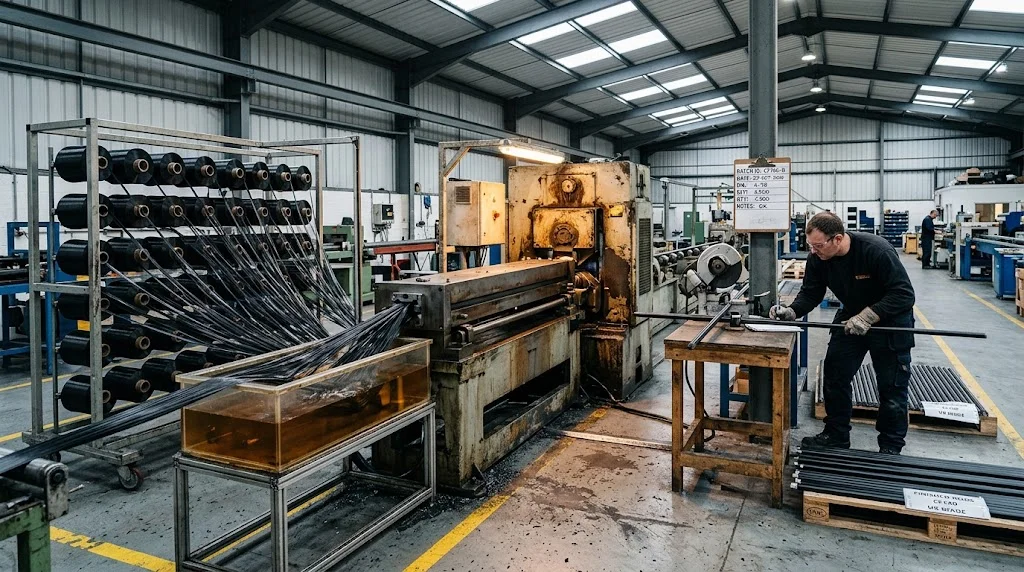
Pultrusion is a continuous process: rovings are pulled from creels through a resin bath or resin injection box, then through a heated steel die that shapes and cures the profile in one pass. Unlike moulding, there is no stop-start cycle, so a pultruded carbon fibre profile can be produced in practically unlimited lengths, limited only by the puller and downstream cutting equipment. Typical line speeds for carbon fibre profiles run between 0.3 and 1.0 metre per minute depending on section thickness and resin system, and fibre volume fractions of 55 to 60 percent are routine, which is what gives pultruded parts their high specific stiffness.
Datasheets often list the same product as a pultruded carbon fiber rod, so buyers searching either spelling should expect identical material. Profile geometry drives both cost and performance. Round tubes, square tubes, flat bars, angles and custom I-sections all run through the same basic process, but tolerance control gets harder as walls get thinner or as sections combine curves with flat faces. Buyers comparing a pultruded carbon fibre rod against a roll-wrapped tube should note that pultrusion wins on length consistency and unit price, while roll-wrapping and autoclave prepreg win on fibre placement precision and hoop strength. The table below summarizes where the main continuous-profile processes land on the metrics that matter to a UK or EU specification.
| Process | Typical fibre volume | Length flexibility | Tolerance on diameter or width | Relative unit cost at 500 units |
|---|---|---|---|---|
| Pultrusion | 55-60% | Continuous, cut to length | Plus or minus 0.1 to 0.2 mm common | Lowest, tooling amortized over the run |
| Roll wrapping | 50-58% | Cut lengths, typically to 3 m | Plus or minus 0.05 to 0.1 mm | Mid, labour intensive rolling step |
| Pultrusion with post-winding | 55-62% | Continuous with helical overlay | Plus or minus 0.1 mm | Mid to high, two processes combined |
| Autoclave prepreg | 58-62% | Fixed mould lengths | Plus or minus 0.05 mm | Highest, cycle time dominates |
For long, straight parts in structural secondary roles, pultrusion is almost always the right economic answer. The exception is parts that carry concentrated loads or require precise bond-line geometry, where a wound or laid-up construction earns its higher price.
Pultruded Carbon Fibre Supply Chain Across the UK and EU
The supply chain for pultruded carbon fibre in the UK and EU has three functional tiers, and each tier has a different geography. Precursor and tow production is concentrated in Japan, with meaningful capacity in the United States, South Korea, China and Germany. Conversion, where tow becomes woven fabric, stitched non-crimp fabric or unidirectional tape, happens closer to the moulding plants in Germany, Italy and the United Kingdom. Pultrusion itself is split between large continuous-profile producers on the continent and smaller job shops in the UK that run custom dies for one-off and low-volume work.
| Tier | What happens | Where it sits | Lead time to UK buyer | What to certify |
|---|---|---|---|---|
| Tow producer | PAN precursor, oxidation, carbonization, sizing | Japan, US, Korea, China, Germany | 8-16 weeks for qualified grades | Producer name, lot number, size on certificate of analysis |
| Converter | Weaving, stitching, tape slitting, fabric inventory | Germany, Italy, UK, Benelux | 2-6 weeks from stock | Fabric construction, width, areal weight, sizing compatibility with resin |
| Profile specialist | Die design, pultrusion line, cutting, finishing, assembly | UK job shops and continental profile producers | 4-10 weeks including die work | Die tolerance report, cure schedule, batch traceability, inspection data |
Import arrangements matter more than many buyers expect. Carbon fibre tow and finished composite profiles entering the UK face different paperwork after Brexit: CE marking under the EU Construction Products Regulation may still be accepted, but UKCA marking requirements apply for products placed on the Great Britain market, and the two regimes continue to diverge. Continental suppliers with a UK stockholding or a UK authorised representative smooth this transition considerably, which is one reason the mid-tier converters with British operations win a disproportionate share of specification work.
Two further compliance threads run through the market. Dual-use export controls apply to certain high-modulus fibres and finished parts intended for aerospace or defence end uses, so suppliers serving marine, industrial and architectural customers generally work with standard-modulus grades that stay outside licensing thresholds. Waste and circularity rules are also tightening: the EU Waste Framework Directive pushes producers toward take-back schemes for cutting scrap, and several UK pultruders now regrind their own offcuts into chopped-fibre applications rather than sending them to landfill.
Demand Segments for Pultruded Carbon Fibre Rods and Profiles
Demand in the UK and EU sorts into a few clear segments, each with its own buying pattern. Rail and transit interiors take extruded-style profiles for luggage racks, seat frames and cable trays where weight reduction translates directly into energy savings per carriage. Architectural and facade engineering uses pultruded carbon fibre rods and sections as visible or hidden reinforcement in glass fins, tension rods and retrofit strengthening. Marine builders consume tube and rod stock for masts, booms, fishing gear and high-end deck hardware. Industrial OEMs account for the balance, using profiles in robotic arms, measurement equipment and lightweight frames for automation cells.
- Rail and transit: repeat programmes with long qualification cycles, strong documentation requirements, and volume that justifies dedicated die sets.
- Architecture and retrofit: engineer-specified, small batches, heavy reliance on test reports and declared mechanical properties.
- Marine and sporting goods: shorter cycles, price-sensitive, tolerant of standard stock sections ordered to length.
- Industrial automation: growing fastest in the UK and Germany, usually standard profiles cut and machined in house by the OEM.
Sourcing Checklist for UK and EU Buyers
Qualifying a new pultrusion supplier is less about price and more about evidence. The checklist below reflects the issues that most often cause trouble after an order is placed, and it applies equally to a UK job shop and to a continental producer exporting into Britain.
- Material traceability: request the upstream tow producer and furnace lot on the certificate of analysis, not only the pultruder's internal grade code, so a lot change can be traced before it reaches your assembly line.
- Tolerance report: ask for measured cross-section data over a full production length rather than a datasheet maximum, because die wear over long runs is where tolerance drifts.
- Resin system disclosure: epoxy, vinyl ester and polyester systems behave differently under moisture and UV, and the resin choice drives secondary bonding and painting procedures downstream.
- Die ownership: confirm who owns custom tooling, where it is stored, and what it costs to transfer, which protects you if the relationship ends.
- Compliance file: for construction and rail applications, verify UKCA or CE documentation, declared properties, and any fire or smoke tests required by the end market.
Buyers who complete this checklist before the first purchase order routinely report fewer first-article failures and shorter requalification cycles when the programme moves from prototype to series supply.
Frequently Asked Questions
What is the difference between a pultruded carbon fibre rod and a rolled carbon fibre tube?
A pultruded carbon fibre rod is produced by pulling fibres continuously through a heated die, which gives excellent straightness and consistent fibre alignment along the length at a low unit cost, but limited control over circumferential strength. A rolled tube is made by winding or laying prepreg onto a mandrel and curing it, which costs more per part but delivers tighter dimensional tolerance and better hoop properties. For structural rods, stiffeners and linear reinforcements the pultruded route is usually preferred; for pressure-bearing or impact-loaded tubes the rolled route earns its premium.
Can pultruded carbon fibre profiles be supplied to UKCA and CE standards for construction use?
Yes, provided the supplier provides a proper technical file. Profiles used in construction in the UK generally require UKCA marking under the applicable construction product rules, while EU placed products use CE marking under the Construction Products Regulation, and the technical file must cover declared mechanical properties, manufacturing plant identification, factory production control, and the test reports supporting the declarations. Ask your supplier which regime they currently certify to, whether their testing was carried out by a notified or approved body, and whether the documentation covers the specific profile geometry you are buying rather than a generic family description.
What lead times should I expect for custom pultruded carbon fibre sections in the UK?
Allow four to six weeks for die design and first trials plus another two to four weeks for qualified production, so a realistic first delivery sits around eight to ten weeks from drawing approval. Standard stock sections cut to length can ship in two to three weeks. The usual delay is not the pultrusion line itself, which runs fast, but the engineering loop around die correction, cure validation and inspection sign-off, so building that loop into your own schedule avoids most of the slippage.
Conclusion
The UK and EU market for pultruded carbon fibre is a working three-tier chain: global tow producers, European converters, and a mix of continental profile specialists and British job shops that turn qualified material into finished parts. Buyers who understand where each tier sits, what evidence each tier can produce, and how UKCA, CE and export-control requirements cut across the chain consistently get better parts at lower total cost than buyers who price-shop individual quotations.
YongXian supplies qualified carbon fibre tow and fabric into that chain and works with profile partners on custom continuous sections for rail, marine and industrial programmes. Explore our carbon fibre products or contact our team with your section drawing, annual volume and compliance requirements for a sourced quotation.
Part of topic
Related Articles
- How Much Does It Cost to Make Carbon Fiber Parts? A Real Cost Breakdown
- Who Makes Carbon Fiber: The Global Producer Landscape from Precursor to Tow
- Custom Carbon Fiber Car Parts: From CAD to Finished Automotive Panels
- Where to Buy Carbon Fiber: Retail, Distributor and Direct-from-Factory Channels
- Where to Buy Carbon Fiber Tubes: Stock Sizes, Lead Times and Minimum Orders
- Fiberglass vs Carbon Fiber Supplier: Choosing Reinforcements for Your Application
Interested in Our Products?
Contact our team for competitive pricing and technical specifications.
Get a QuoteRelated Products

Carbon Fiber Plate — 3K Twill T700 1.5mm
Thin 1.5mm carbon fiber plate with 3K twill weave surface. Lightweight and stiff, commonly used for covers, panels, drone bodies, and applications requiring a premium aesthetic appearance.

Carbon Fiber Plate — 3K Twill T700 3.0mm
Medium-thickness 3.0mm carbon fiber plate offering significantly higher load capacity while maintaining attractive 3K twill finish. Suitable for structural brackets, reinforcement plates, and load-bearing panels.

Carbon Fiber Trekking Pole
Lightweight carbon fiber trekking pole manufactured from high-grade carbon fiber tube. Weighs only 160g per pole while providing superior shock absorption and durability for hiking, trail running, and backpacking.

Carbon Fiber Pickleball Paddle
High-performance pickleball paddle with Toray T700 carbon fiber face and polypropylene honeycomb core. Delivers excellent power-to-weight ratio, spin generation, and vibration dampening for competitive play.

Square Carbon Fiber Tube — 3K Twill T700
Square cross-section carbon fiber tube manufactured with 3K twill weave for torsional strength. Preferred for structural frames, trusses, and support columns where rectangular geometry offers design flexibility.