
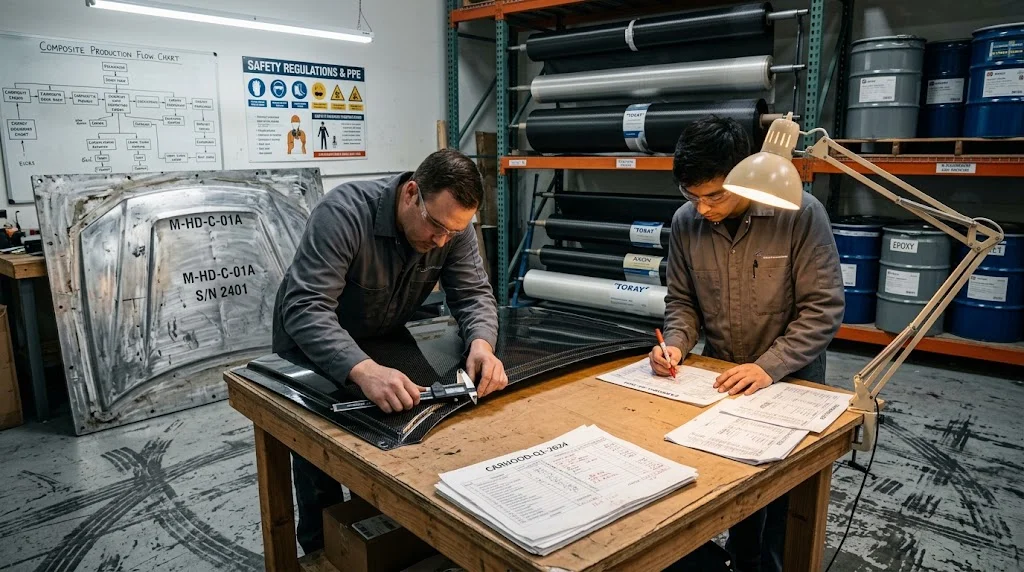
Ask ten shops how much does it cost to make carbon fiber parts and you will get ten answers, because a unit price without a volume, a process and a tooling assumption is not a price at all. A single hood-sized panel built by hand layup with a one-off mold can land in the thousands of dollars, while
Introduction
Ask ten shops how much does it cost to make carbon fiber parts and you will get ten answers, because a unit price without a volume, a process and a tooling assumption is not a price at all. A single hood-sized panel built by hand layup with a one-off mold can land in the thousands of dollars, while the same geometry produced by resin transfer molding in a hardened tool at five thousand pieces can cost less than a hundred and fifty dollars per unit. The difference is not markup. It is tooling amortization, cycle time, labor content and scrap rate, and all four can be estimated before you commit to a program.
This article breaks the real cost of custom carbon fiber fabrication into its components, shows how the stack changes with volume, and lists the practical levers that move unit cost the most. The figures reflect typical 2026 pricing for automotive aftermarket, industrial and low-volume OEM work, structured so a buyer can rebuild the calculation for their own geometry.
How Much Does It Cost to Make Carbon Fiber Parts? 2026 Benchmarks
For a representative panel of roughly two and a half kilograms of finished laminate, about one square meter of surface area, the cost stack looks like this when the process and tooling are matched to the volume.
| Volume | Process route | Tooling cost per part | Material per part | Labor and machine per part | Typical total per part |
|---|---|---|---|---|---|
| 1 piece, prototype | Hand layup, vacuum bag, composite mold | 600-1,500 | 110-180 | 280-450 | 990-2,100 |
| 50 pieces | Hand layup or infusion, aluminum mold | 40-120 | 105-165 | 160-280 | 320-520 |
| 500 pieces | Infusion or light resin transfer molding | 8-25 | 95-150 | 70-140 | 190-300 |
| 5,000 pieces | Resin transfer molding or compression molding | 3-12 | 60-110 | 25-60 | 90-170 |
Two readings of that table matter. First, below about fifty pieces, tooling dominates: a five thousand dollar mold spread over one part makes the part expensive, and no amount of process optimization fixes that arithmetic. Second, above roughly five hundred pieces, material becomes the largest single line, which is why resin system, fiber grade and waste rate are the levers that matter at scale.
Cost to Make Carbon Fiber Parts: Material, Tooling, and Labor
Material pricing is the most quoted number and the least decisive at low volume. Typical 2026 ranges for the inputs that go into a structural or Class A panel are shown below.
| Input | Typical 2026 range | Unit | Notes that move the price |
|---|---|---|---|
| Prepreg, standard modulus tow | 30-60 | USD per kilogram | Tow size, width, cure chemistry and order size |
| Dry woven fabric, 200 gsm twill | 20-35 | USD per meter of 1.0-1.25 m width | Weave style, sizing and whether it is narrow goods |
| Infusion epoxy resin | 8-18 | USD per kilogram | Order volume, pot life and Toughened systems |
| Consumables per part | 8-25 | USD per part | Breather, release film, peel ply, bagging tape |
| Core materials | 20-90 | USD per part | Foam vs honeycomb, thickness and bonding prep |
| Scrap allowance | 5-15% prototype, 2-5% series | of material value | Fixturing quality and operator skill |
Tooling is the second component and the one most often underestimated. A plug plus composite mold for prototypes typically runs four hundred to fifteen hundred dollars and survives tens of layups. A CNC machined aluminum mold for a single curvature panel lands between two thousand and eight thousand dollars, while a matched metal die for a complex two-sided geometry starts around fifteen thousand and can pass fifty thousand once Class A surface requirements, lifting hardware and production cycle targets are added. Tooling ownership terms carry real cost: exclusivity, second-source runs and storage fees belong in the quotation.
Labor is the third component, and it is where craft differences show up. Hand layup of a one square meter panel with careful ply orientation typically takes two to six hours, trimming and edge finishing add one to three hours, and paint-ready finishing adds two to four more. At shop rates of twenty-five to sixty dollars per hour, labor alone can exceed material cost on prototypes. Machine time is priced separately: autoclave cycles run two to four hours at 120-180 C and 0.6-0.7 MPa, infusion cures take six to twelve hours including post cure, and resin transfer molding compresses the cycle to eight to fifteen minutes of injection plus twenty to forty minutes of cure once a production tool exists.
How Process Choice Changes What It Costs to Make Custom Carbon Fiber Parts
The same part can be routed three ways, and the unit cost can differ by a factor of five at low volume and still by a factor of two at a thousand pieces. The comparison below is the decision most buyers should make first, before negotiating material prices.
| Process | Tooling entry | Cycle | Unit cost at 100 pieces | Where it wins |
|---|---|---|---|---|
| Hand layup plus vacuum bagging | 400-2,000 | 3-6 hours labor plus room temperature cure | 420-650 | Prototypes, one-offs, large low-curvature panels |
| Prepreg and autoclave | 1,500-8,000 | 2-4 hours under pressure and heat | 380-560 | Class A surfaces, repeatable laminates, premium parts |
| Vacuum infusion | 800-4,000 | 6-12 hours including post cure | 260-420 | Large panels, moderate volumes, lower material waste |
| Light resin transfer molding | 6,000-20,000 | Injection 8-15 minutes, cure 20-40 minutes | 180-280 | Complex 3D shapes, stable repeat production |
| Compression molding | 15,000-50,000 | 1-3 minutes per cycle | 110-190 | Series parts above five thousand, brackets and structures |
Read across the row, not down the column. A shop that quotes only prepreg is not necessarily expensive, it may simply be quoting the wrong route for your volume, and compression molding quoted for a two hundred piece order is expensive in the worst way: high tooling, low utilization.
Why It Costs More to Make Carbon Fiber Parts at Low Volume
Low volume is expensive for structural reasons, and naming those reasons is the fastest way to control them.
- Tooling amortization: mold cost divided by order quantity is mathematically brutal at one to fifty pieces, and it is the single largest line in that range.
- Setup and scheduling: small orders consume the same machine scheduling overhead as large ones, so oven slots, autoclave capacity and fixture changes land on fewer parts.
- Scrap absorption: a first article failure on a ten piece order costs ten percent of the batch, not one percent, and the rework cycle repeats the tooling learning.
- Premium material buys: small quantities cannot take manufacturer volume discounts, and converting a full roll of prepreg into scrap because a part tore during debulk is a real and common loss.
- Finishing share: trim, bond and paint steps scale with part count more weakly than layup does, so they occupy a larger fraction of the cost stack.
How to Make Custom Carbon Fiber Parts Cost-Effective Across Volumes
Cost reduction is mostly program design, not negotiation. The levers below are ordered by typical impact for custom carbon fiber fabrication programs.
- Freeze geometry early and keep the mold simple: reducing two-sided curvature to a single-sided part can move the tooling line from five figures to four, and usually shortens layup time too.
- Match process to volume before quoting material: choosing infusion for two hundred pieces instead of prepreg can cut unit cost by twenty to thirty percent without touching fiber grade.
- Design for the process: consistent flange widths, defined trim lines and thickness changes that respect minimum bend radii reduce labor hours and scrap.
- Standardize the laminate: one fabric, one resin system and one cure cycle across a family of parts cuts changeover time and lets you consolidate material orders.
- Stage the tooling decision: composite tooling for prototypes and first articles, then hard tooling only when the order book justifies it, is almost always cheaper than committing to a production die on day one.
- Buy the documentation once: dimensional reporting, material certificates and inspection plans cost roughly the same for a fifty piece order as for a five hundred piece order, so extending volume converts that fixed cost into a lower per-unit figure.
Frequently Asked Questions
How much does a single custom carbon fiber part cost with no tooling?
For simple geometry such as a small duct, a mirror cap or a bracket, a single part built on existing or composite tooling typically lands between three hundred and eight hundred dollars including trim, and paint-ready parts with Class A surface expectations usually start around five hundred dollars. Large panels built by hand layup without a dedicated mold can exceed a thousand dollars per piece, largely because of labor hours rather than fiber cost. Evaluate a one-off quote by asking which tooling it assumes and how many labor hours it carries.
Why do quotes for the same part differ so much between suppliers?
Because the quotes rarely describe the same product. One supplier may price a hand-layup prototype, another a resin transfer molding series part, and a third may include paint, hardware and inspection while others stop at a trimmed part. Fiber grade, fabric construction, cure route, scrap allowance and the treatment of tooling ownership all vary. The reliable comparison is a normalized request: identical geometry, identical material specification, identical finish class, identical inspection requirements, with tooling quoted as a separate line.
At what volume does custom carbon fiber fabrication beat metal?
For structural brackets and stiffeners, carbon fiber parts typically become competitive against aluminum in the five hundred to two thousand piece range when tooling is amortized and cycle time is controlled, and they win outright on weight-driven programs where every kilogram saved has a defined value. For large cosmetic panels, the crossover arrives earlier because aluminum stamping tooling is far more expensive than composite tooling at similar volumes. The calculation that matters is total installed cost per unit, including finishing and assembly, not material price per kilogram.
Conclusion
How much does it cost to make carbon fiber parts is a volume question before it is a material question. Below fifty pieces, tooling rules the stack; between a hundred and a thousand pieces, labor and cycle time decide; above five thousand, material efficiency and scrap rate determine whether you land near ninety dollars or near two hundred. Build the calculation in that order, match the process to the volume before negotiating fiber prices, and treat tooling ownership and documentation as priced items, and the numbers stop being a mystery.
YongXian manufactures carbon fiber parts for prototype and series programs, with composite and aluminum tooling, infusion, resin transfer molding and prepreg capacity, and quotations that separate tooling, material and process so you can see exactly where the cost sits. Explore our carbon fiber product range or contact our engineering team with your geometry, volume forecast and finish class for a line-by-line costed quotation.
Related Articles
- Pultruded Carbon Fibre: UK and EU Supply Chain for Continuous Profiles
- Who Makes Carbon Fiber: The Global Producer Landscape from Precursor to Tow
- Custom Carbon Fiber Car Parts: From CAD to Finished Automotive Panels
- Where to Buy Carbon Fiber: Retail, Distributor and Direct-from-Factory Channels
- Where to Buy Carbon Fiber Tubes: Stock Sizes, Lead Times and Minimum Orders
- Fiberglass vs Carbon Fiber Supplier: Choosing Reinforcements for Your Application
Interested in Our Products?
Contact our team for competitive pricing and technical specifications.
Get a QuoteRelated Products

Carbon Fiber Plate — 3K Twill T700 1.5mm
Thin 1.5mm carbon fiber plate with 3K twill weave surface. Lightweight and stiff, commonly used for covers, panels, drone bodies, and applications requiring a premium aesthetic appearance.

Carbon Fiber Plate — 3K Twill T700 3.0mm
Medium-thickness 3.0mm carbon fiber plate offering significantly higher load capacity while maintaining attractive 3K twill finish. Suitable for structural brackets, reinforcement plates, and load-bearing panels.

Carbon Fiber Trekking Pole
Lightweight carbon fiber trekking pole manufactured from high-grade carbon fiber tube. Weighs only 160g per pole while providing superior shock absorption and durability for hiking, trail running, and backpacking.

Carbon Fiber Pickleball Paddle
High-performance pickleball paddle with Toray T700 carbon fiber face and polypropylene honeycomb core. Delivers excellent power-to-weight ratio, spin generation, and vibration dampening for competitive play.

Square Carbon Fiber Tube — 3K Twill T700
Square cross-section carbon fiber tube manufactured with 3K twill weave for torsional strength. Preferred for structural frames, trusses, and support columns where rectangular geometry offers design flexibility.