
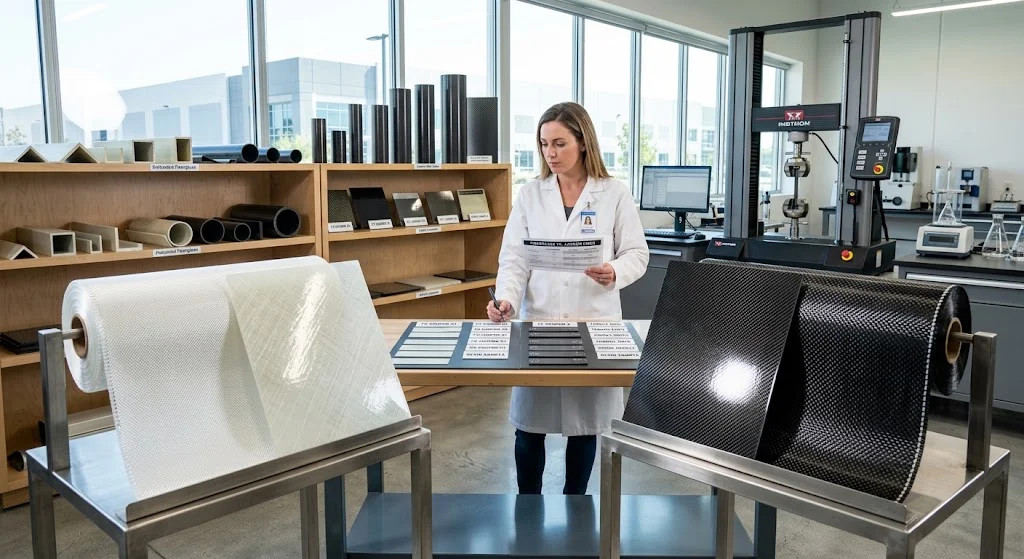
Every composite sourcing decision begins with the same question: fiberglass or carbon fiber? The answer shapes everything downstream — mechanical design, manufacturing process, unit cost, and ultimately which fiberglass carbon fiber supplier fits the program. Yet the choice is rarely black and white
Introduction
Every composite sourcing decision begins with the same question: fiberglass or carbon fiber? The answer shapes everything downstream — mechanical design, manufacturing process, unit cost, and ultimately which fiberglass carbon fiber supplier fits the program. Yet the choice is rarely black and white. Fiberglass offers excellent electrical insulation, corrosion resistance, and impact toughness at a fraction of carbon fiber's cost. Carbon fiber delivers two to five times the specific stiffness and strength, enabling weight-critical designs that fiberglass cannot achieve. Understanding where each material wins — and where hybrid approaches make sense — is the foundation of smart reinforcement selection.
This article provides a structured comparison of fiberglass and carbon fiber for engineering and procurement teams. It covers mechanical property trade-offs, cost benchmarks, process compatibility, and the supplier qualification questions that matter when sourcing carbon fiber sheets, tubes, and custom assemblies alongside traditional glass fiber products.
Mechanical Properties: Where Fiberglass and Carbon Fiber Diverge
The mechanical gap between fiberglass and carbon fiber is the primary driver of material selection. The table below compares typical properties of E-glass/epoxy and standard-modulus carbon fiber/epoxy laminates at comparable fiber volume fractions (55-60%):
| Property | E-Glass / Epoxy | Carbon Fiber / Epoxy | Ratio (CF:G) |
|---|---|---|---|
| Density (g/cm³) | 1.85-2.0 | 1.55-1.60 | ~0.83× (lighter) |
| Tensile strength (MPa) | 800-1,200 | 1,500-2,500 | ~2× |
| Tensile modulus (GPa) | 35-45 | 130-180 | ~3.5× stiffer |
| Compressive strength (MPa) | 500-700 | 1,200-1,800 | ~2.5× |
| Interlaminar shear (MPa) | 35-50 | 60-90 | ~1.6× |
| Elongation at break (%) | 2.0-3.5 | 1.2-1.8 | lower (more brittle) |
| Fatigue endurance limit | Good | Excellent | CF: ~10× life at same stress |
| Electrical conductivity | Insulator | Conductive | critical for EMI-sensitive apps |
Carbon fiber's modulus advantage — roughly 3.5 times stiffer than E-glass — means carbon fiber structures achieve the same deflection limits with less material and lower weight. For aerospace, racing, and high-performance robotics, this stiffness-to-weight ratio justifies the 3-10× material cost premium. For marine hulls, wind turbine blades, storage tanks, and industrial corrosion protection, fiberglass's combination of adequate stiffness, corrosion resistance, and low cost remains hard to beat.
Fiberglass vs Carbon Fiber Supplier Cost Structures
Cost differences between the two reinforcement families drive sourcing strategy more than performance differences for most commercial programs:
- Fiberglass raw material: E-glass chopped strand mat costs $2-5 per kg; woven roving $3-8 per kg; S-glass (higher strength) $15-25 per kg. Epoxy resin systems add $8-15 per kg. Finished fiberglass laminate costs are typically $15-40 per kg depending on process and labor content.
- Carbon fiber raw material: Standard modulus (T300-class) tow costs $15-25 per kg at volume; intermediate modulus (T800-class) $40-80 per kg; high modulus $100-200 per kg. Prepreg formats add 30-50% over dry fiber. Finished carbon fiber laminate costs typically range $80-250 per kg for structural applications.
- Hybrid architectures: Glass-carbon hybrid laminates — carbon plies carrying primary loads, glass plies handling impact and handling — reduce material cost 20-40% versus all-carbon layups while retaining most of the stiffness benefit. This approach is increasingly popular in wind turbine blades and marine structures.
A fiberglass carbon fiber supplier that stocks both material families enables hybrid designs and single-source procurement, simplifying inventory management and reducing qualification overhead across two supply chains.
Process Compatibility and Manufacturing Considerations
Both reinforcements process through similar composite manufacturing methods, but process windows differ:
- Hand layup and infusion: Fiberglass dominates these labor-intensive processes due to lower material cost and greater tolerance to moisture and handling. Carbon fiber also processes via infusion but demands tighter moisture control (prepreg-grade drying) and more careful fiber alignment to realize its property advantages.
- Prepreg and autoclave: Carbon fiber's high performance applications concentrate in prepreg-autoclave processing, where precise fiber placement, controlled cure cycles, and void content below 1% extract maximum properties. Fiberglass prepreg exists but is less common — most fiberglass production uses wet layup, pultrusion, or filament winding.
- Pultrusion: Both materials pultrude well. Pultruded fiberglass profiles ($2-6 per meter for standard sections) compete with steel and aluminum in corrosion-resistant structural applications. Pultruded carbon fiber profiles deliver higher stiffness at 5-10× the cost, targeting precision instrumentation, robotics, and aerospace secondary structure.
- Filament winding: Fiberglass filament-wound tubes and pressure vessels dominate commercial markets (pipes, tanks, utility poles). Carbon fiber winding appears in Type III/IV hydrogen pressure vessels and rocket motor cases where weight is critical.
When evaluating a fiberglass carbon fiber supplier, verify their process capability matches your intended manufacturing route. A supplier experienced only in fiberglass hand layup may lack the autoclave control, cleanroom discipline, or CNC finishing capability your carbon fiber components require.
Application Decision Framework: Which Reinforcement Fits
Use this framework to match reinforcement choice to application requirements before engaging suppliers:
- Choose fiberglass when: stiffness requirements are moderate; corrosion resistance is primary (chemical tanks, marine hulls, cooling towers); electrical insulation is required; impact toughness matters; unit cost targets are aggressive; parts are large (wind blades, boat hulls) where material cost dominates.
- Choose carbon fiber when: weight savings directly enable performance (aerospace, racing, drones); stiffness-to-weight is the governing design driver; fatigue life under cyclic loading is critical; dimensional stability over temperature range matters (optical benches, satellite structures); EMI shielding or conductivity is required.
- Consider hybrid when: budget constraints rule out all-carbon designs but stiffness targets exceed pure fiberglass capability; impact zones need glass toughness while load paths need carbon stiffness; progressive material qualification allows phased carbon fiber adoption.
Leading carbon fiber sheet supplier and fiberglass fabric producers increasingly offer both product lines, letting procurement teams consolidate sourcing while preserving material choice flexibility at the design stage.
Frequently Asked Questions
Is carbon fiber always better than fiberglass for structural applications?
No. Carbon fiber offers superior specific stiffness and strength, making it the right choice for weight-critical applications. However, fiberglass provides better electrical insulation, higher impact toughness, and comparable corrosion resistance at 3-10× lower material cost. For large structures where weight is not the primary constraint — wind turbine blades, boat hulls, storage tanks, corrosion-resistant industrial equipment — fiberglass often delivers better overall value. The optimal choice depends on the governing design driver: weight, stiffness, corrosion, impact, or cost.
Can one supplier provide both fiberglass and carbon fiber products?
Yes, and dual-material capability offers real procurement advantages. A fiberglass carbon fiber supplier with both product lines can support hybrid laminate designs, consolidate purchase orders and incoming inspection, and provide consistent quality documentation across material families. When evaluating such suppliers, verify they maintain separate process controls for each material — carbon fiber contamination of fiberglass parts (or vice versa) during shared processing is a quality risk that dedicated handling procedures must address.
How do I qualify a new fiberglass or carbon fiber supplier for production use?
Supplier qualification follows a structured process: (1) desk audit of quality system certificates (IATF 16949, AS9100, or ISO 9001 depending on industry); (2) material testing of incoming samples against your specification (tensile, ILSS, fiber volume fraction per ASTM D3039/D2344); (3) process capability review for your part family (Cpk on critical dimensions, cure cycle repeatability); (4) first-article inspection and, for critical applications, witness testing at the supplier's facility. Aerospace and automotive programs typically require 3-6 months for full qualification before production release.
Conclusion
The fiberglass versus carbon fiber decision is not about which material is universally better — it is about which material matches your application's governing requirements and which supplier can deliver it consistently. Fiberglass wins on cost, corrosion resistance, and impact toughness for large commercial structures. Carbon fiber wins on specific stiffness, fatigue life, and weight savings for performance-critical applications. Hybrid architectures bridge the gap when both stiffness and cost constraints apply. By structuring material selection around mechanical requirements and then evaluating fiberglass carbon fiber supplier candidates on process capability, certification scope, and dual-material quality controls, procurement teams make sourcing decisions that hold up from prototype through production.
YongXian supplies both carbon fiber and fiberglass reinforcement products — sheets, tubes, rods, fabrics, and custom cut-to-size formats — from a single qualified supply chain. Explore our carbon fiber and composite product range or contact our engineering team to discuss fiberglass versus carbon fiber selection for your specific application.
Part of topic
Related Articles
- Where to Buy Carbon Fiber Tubes: Stock Sizes, Lead Times and Minimum Orders
- Carbon Fiber Connecting Rods: High-Performance Engine Components
- Carbon Fibre or Fiber: Spelling, Terminology and Search Behavior
- Carbon Fibre Explained: What It Is and How It Is Made
- Carbon Fiber Road Bikes Closeout: Deal Evaluation and Value Guide
- Carbon Fiber Raw Material: Precursors, Resins and Additives
Interested in Our Products?
Contact our team for competitive pricing and technical specifications.
Get a QuoteRelated Products

Carbon Fiber Plate — 3K Twill T700 1.5mm
Thin 1.5mm carbon fiber plate with 3K twill weave surface. Lightweight and stiff, commonly used for covers, panels, drone bodies, and applications requiring a premium aesthetic appearance.

Carbon Fiber Plate — 3K Twill T700 3.0mm
Medium-thickness 3.0mm carbon fiber plate offering significantly higher load capacity while maintaining attractive 3K twill finish. Suitable for structural brackets, reinforcement plates, and load-bearing panels.

Carbon Fiber Trekking Pole
Lightweight carbon fiber trekking pole manufactured from high-grade carbon fiber tube. Weighs only 160g per pole while providing superior shock absorption and durability for hiking, trail running, and backpacking.

Square Carbon Fiber Tube — 3K Twill T700
Square cross-section carbon fiber tube manufactured with 3K twill weave for torsional strength. Preferred for structural frames, trusses, and support columns where rectangular geometry offers design flexibility.

Carbon Fiber Pickleball Paddle
High-performance pickleball paddle with Toray T700 carbon fiber face and polypropylene honeycomb core. Delivers excellent power-to-weight ratio, spin generation, and vibration dampening for competitive play.