
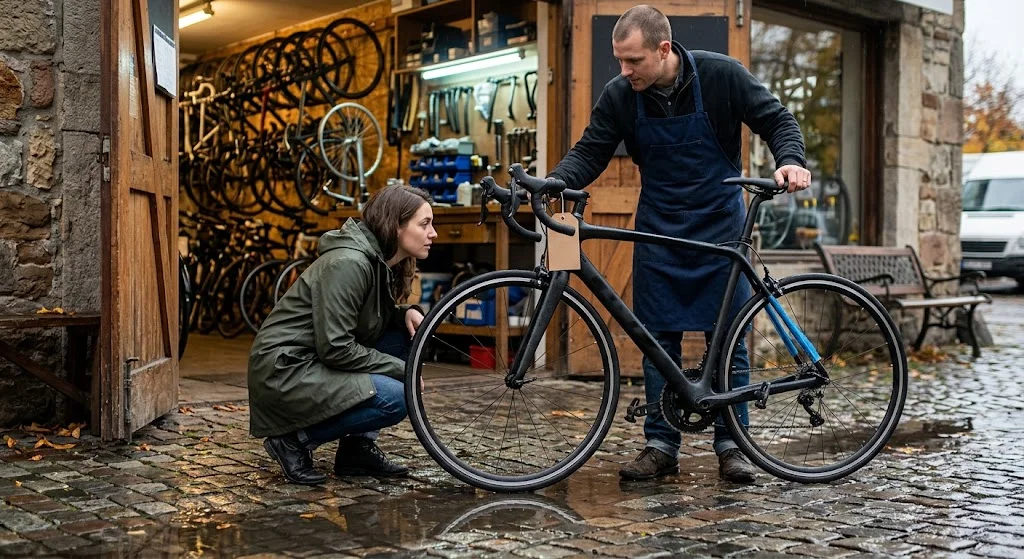
A carbon fiber road bikes closeout sale is where last season's inventory becomes this season's best value — but only if you know what you are buying. Closeout frames and complete bikes are not defective goods; they are typically previous-model-year stock, overstock colorways, or demo units that shop
Introduction
A carbon fiber road bikes closeout sale is where last season's inventory becomes this season's best value — but only if you know what you are buying. Closeout frames and complete bikes are not defective goods; they are typically previous-model-year stock, overstock colorways, or demo units that shops need gone before new arrivals consume floor space and cash. The discount is real, often 30-50% off original retail, and the frame underneath is the same frame that sold at full price twelve months earlier. The risk is not the carbon — it is the fine print: warranty transfer, proprietary standards, and parts that date faster than the frame.
This guide explains how a carbon fiber road bikes closeout actually works, the inspection checklist that separates a genuine deal from expensive clearance, how carbon fiber road e bikes complicate the picture with battery and motor lifecycles, and why parts availability — including specialized items like carbon fiber road glide parts in the broader aftermarket — often decides whether a cheap frame was cheap for a reason.
How the Carbon Fiber Road Bikes Closeout Market Works
Closeout inventory comes from four sources, and knowing which one you are looking at tells you most of what to expect:
- Model-year rollover: the dominant source. When the next year's frame lands, shops discount the old colorways to clear rack space. Geometry may be unchanged from the new model — sometimes the frames are identical except for paint — which makes the discount pure arbitrage.
- Overstock and special orders: a shop ordered six of a size that sells one per quarter. The unsold units get bundled into closeout pricing before they become carrying costs.
- Demo and media fleet units:
- Cancelled or distressed dealer stock: shop closures, brand exits, or distributor failures. Legitimate, often the deepest discounts, but the paper trail for warranty support can get thin.
What closeout is not: crash-damaged frames sold with disclosure problems, counterfeit frames free-riding on legitimate channels, or current-model stock sold as "closeout" to anchor a fake reference price. Those exist, and the checklist below is how you route around them.
Evaluating a Carbon Fiber Road Bikes Closeout Deal: The Inspection Checklist
A carbon fiber road bikes closeout should be judged on five axes. A deal that scores well on all five is a genuine value; a deal that fails two of them is usually a signal to walk:
| Axis | What to verify | Deal-breaker |
|---|---|---|
| Frame provenance | Serial number check with the brand; original purchase paperwork; box and original spec sheet match | Brand cannot confirm the serial; seller resists verification |
| Warranty status | Whether the frame warranty transfers to the second owner; remaining duration | Brand policy is original-owner-only and the frame has years of service left |
| Standards and compatibility | Seatpost diameter, bottom bracket standard, brake interface (flat-mount disc, rim), thru-axle sizes, internal routing generation | Proprietary seatpost or cockpit that no aftermarket supports, priced at scarcity rates |
| Groupset generation | Electronic shifting generation, cassette speed count, rotor standard | Discontinued electronic generation with no upgrade path and priced as current |
| Actual condition (demo/used) | Dropouts, hanger threads, bottom bracket face, chainstay paint lines that betray chain suck, tap-test on suspect zones | Any structural repair history without documentation |
The economics get interesting once the checklist passes. A frame that cost $4,500 last year at $2,600 closeout, with transferable warranty and current-standard interfaces, is not a gamble — it is the same frame a review already scored, bought at a used-frame price with new-frame support.
Carbon Fiber Road E-Bikes: Closeout With a Clock on It
Carbon fiber road e bikes enter the closeout market with two lifecycle clocks that acoustic bikes do not have: the battery and the motor. A closeout e-road bike at 40% off can still be the smart buy, but the evaluation shifts:
- Battery health, not battery presence: ask for cycle count and storage-voltage history. A battery stored at full charge in a hot warehouse for eighteen months has aged chemically even at low mileage. Replacement battery pricing should be part of the purchase math — $500-900 typical — because you are buying it eventually.
- Firmware and support window: brands phase motor firmware support as generations retire. Confirm the motor generation is still inside the support window before assuming a five-year service life.
- Integration penalty: integrated carbon e-road frames make battery replacement and motor service frame-dependent. Unlike a bolt-on system, there is no "swap to another brand later." The discount must cover the lock-in.
- Weight reality check: a carbon e-road closeout at 8.5 kg is a different machine than a 7 kg acoustic closeout at a similar price. Decide which bike you are actually buying.
Priced correctly — deep enough to pre-fund a replacement battery and with a motor generation still supported — a closeout carbon road e-bike is one of the better values in the segment. Priced like an acoustic closeout with an e-badge, it is not.
Carbon Fiber Bike Parts: The Second half of the Value Equation
The frame is only part of what a closeout must justify. Owners who keep a closeout bike for years discover that parts availability determines the ownership experience as much as frame quality did:
- Consumables first: rotors, cassette, chain, bar tape, cables and housing are generation-sensitive. A closeout with a current-generation groupset means consumables stay cheap and stocked; a previous generation means hunting and premiums.
- Carbon contact points: seatposts, stems, bars and wheels are where carbon fiber bike parts get interesting after purchase. Proprietary D-shaped or aero seatposts turn a $200 upgrade into a $400 brand-specific search. Check aftermarket support before you commit, not after.
- The broader aftermarket: the same dynamics play out beyond bicycles. Carbon fiber road glide parts and other model-specific carbon components share the pattern: the more standardized the interface, the healthier the aftermarket, and the cheaper your second and third season of ownership.
A closeout bike with open standards invites a healthy parts market. A closeout bike with one-off interfaces moves that margin from the frame discount into the proprietary column.
Frequently Asked Questions
Is a closeout carbon frame the same as a used frame?
Usually no. Most closeout stock is new-old-stock: never ridden, never registered, sold at a discount because it is a previous model year or an overstock colorway. Demo fleet units are the exception — ridden but typically low-mileage and sold with disclosure. Ask which category the bike falls into and price accordingly; new-old-stock should carry full structural integrity and often a transferable warranty, while demo units warrant a closer inspection and a deeper discount.
How much discount makes a carbon fiber road bikes closeout a real deal?
As a working rule: 20-25% is marketing theater, 30-40% is a genuine model-year closeout on current-standard equipment, and 50%+ usually means previous-generation standards, an overhang of less-desirable sizes, or a demo unit. The deeper the discount, the more precisely you should verify standards compatibility and warranty transfer — the discount is compensation for friction, and you need to confirm the friction is real and priced in.
Can I upgrade a closeout e-road bike's battery later?
For current-generation integrated carbon e-road platforms, replacement batteries are available but model-specific and priced at $500-900 plus installation on most systems. What you cannot do is retrofit a newer battery generation into an older frame — the mechanical and firmware interfaces change. Before buying, get the replacement battery price and availability window in writing; a closeout price that looks great against a $200 assumed replacement is a mirage against the real $750 number.
Conclusion
A carbon fiber road bikes closeout is one of the strongest values in cycling when it is evaluated rather than impulse-bought: verify provenance and warranty transfer, confirm the standards are open and current, run the battery-and-support math on any carbon fiber road e bikes in the mix, and price the parts ecosystem — including the availability of carbon fiber bike parts — into the multi-year ownership cost. Do that, and the discount is real; skip it, and clearance pricing is just a discount on someone else's problem. YongXian manufactures carbon fiber frames, forks and component parts for OEM and aftermarket programs, applying the same laminate and layup discipline across the product range. Explore our carbon fiber product lines or contact our team to discuss frame, fork or component supply programs.
Part of topic
Related Articles
- Carbon Fibre or Fiber: Spelling, Terminology and Search Behavior
- Carbon Fibre Explained: What It Is and How It Is Made
- Carbon Fiber Raw Material: Precursors, Resins and Additives
- Carbon Fiber Sheet Scrap: Recycling and Surplus Buying
- Carbon Fiber Sheets Home Depot: Retail Availability Guide
- Carbon Fibre Tube UK: Suppliers and Sourcing Guide
Interested in Our Products?
Contact our team for competitive pricing and technical specifications.
Get a QuoteRelated Products

Carbon Fiber Plate — 3K Twill T700 1.5mm
Thin 1.5mm carbon fiber plate with 3K twill weave surface. Lightweight and stiff, commonly used for covers, panels, drone bodies, and applications requiring a premium aesthetic appearance.

Carbon Fiber Plate — 3K Twill T700 3.0mm
Medium-thickness 3.0mm carbon fiber plate offering significantly higher load capacity while maintaining attractive 3K twill finish. Suitable for structural brackets, reinforcement plates, and load-bearing panels.

Carbon Fiber Trekking Pole
Lightweight carbon fiber trekking pole manufactured from high-grade carbon fiber tube. Weighs only 160g per pole while providing superior shock absorption and durability for hiking, trail running, and backpacking.

Square Carbon Fiber Tube — 3K Twill T700
Square cross-section carbon fiber tube manufactured with 3K twill weave for torsional strength. Preferred for structural frames, trusses, and support columns where rectangular geometry offers design flexibility.

Carbon Fiber Pickleball Paddle
High-performance pickleball paddle with Toray T700 carbon fiber face and polypropylene honeycomb core. Delivers excellent power-to-weight ratio, spin generation, and vibration dampening for competitive play.