
Carbon fibre explained simply is carbon in fibre form: strands of almost-pure carbon atoms arranged in crystal planes along the fibre axis, giving a material that is lighter than aluminium, stiffer than steel, and immune to rust. But the simple definition hides the engineering. Every structural carb
Introduction
Carbon fibre explained simply is carbon in fibre form: strands of almost-pure carbon atoms arranged in crystal planes along the fibre axis, giving a material that is lighter than aluminium, stiffer than steel, and immune to rust. But the simple definition hides the engineering. Every structural carbon fibre in an aircraft, race car or bicycle frame started life as a synthetic polymer textile, was cooked in ovens at temperatures that would melt most metals' neighbours, and emerged as a black filament that behaves nothing like its origin. Understanding what it is and how it is made explains its cost, its properties, and why "just make more of it" is harder than it sounds.
This article walks the full chain: what carbon fibre is at the atomic and market level, why spelling varies between "fibre" and "fiber," what raw materials feed the process, and how the handful of carbon fiber manufacturing companies in the world turn polyacrylonitrile into the material that modern lightweight engineering depends on.
Carbon Fibre Explained: What the Material Actually Is
At the fibre level, carbon fibre is 90-99% carbon by weight, organized in graphitic basal planes aligned along the fibre axis. That alignment is the whole trick: carbon-carbon bonds within the planes are among the strongest in nature, and when the planes run along the fibre, that strength becomes axial. A single standard-modulus filament — about 5-7 micrometres in diameter, thinner than a human hair — can carry loads that would stretch a steel wire of the same size past its limit.
What people call "carbon fibre" in engineering is almost always carbon fibre reinforced polymer (CFRP): thousands of these filaments bundled into tows or yarns, impregnated with resin, laminated, and cured into a solid structure. The fibre provides strength and stiffness; the matrix keeps fibres in alignment, transfers load between them, and protects them. Neither component alone is the composite — the interface between them decides whether the part performs or delaminates.
Carbon Fibre or Fiber: Spelling, Standards and the Global Market
"Carbon fibre or fiber" is a spelling question with a market dimension. Fibre is British and international English; fiber is American. The material is identical — the same PAN precursor, the same graphitization chemistry, the same property tables — and specification sheets from Japanese, European and American producers list both spellings interchangeably in cross-referenced documents. Technical buyers should search both terms; a supplier that only answers to one is usually signaling which market it was built for.
Under the spelling, grades split by performance rather than language. The market reads roughly like this:
| Grade class | Tensile modulus | Tensile strength | Typical use |
|---|---|---|---|
| Standard modulus (e.g. T300-class) | 230-240 GPa | 3,500-3,700 MPa | General industrial, automotive, sporting goods |
| Intermediate modulus (e.g. T700/T800-class) | 230-300 GPa | 4,900-5,900 MPa | Aerospace primary structure, pressure vessels, high-performance composites |
| High modulus | 350-600 GPa | 2,400-3,500 MPa | Satellite structures, antennae, spacecraft — stiffness-driven |
| Ultra-high modulus | 600-900+ GPa | 2,000-3,000 MPa | Space optics, precision instrumentation; strength traded away for stiffness |
The pattern in the table matters: modulus and strength do not rise together. Pushing crystal plane alignment further stiffens the fibre while consuming the flaw-sensitive strength margin. Grade selection is therefore a question of which property the structure is short on, not a ladder to climb.
Carbon Fibre Explained: From Acrylic Textile to Structural Fibre
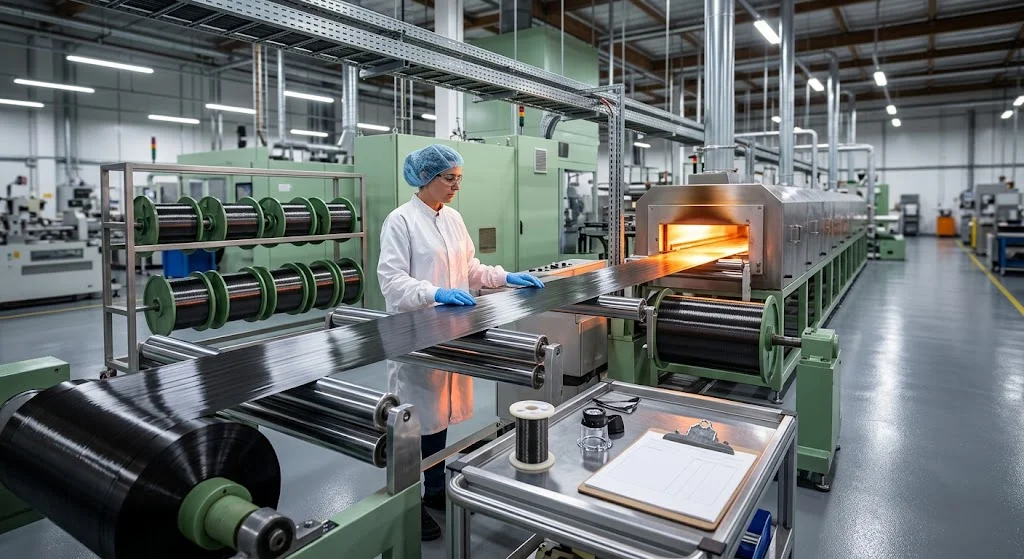
The industrial route to carbon fibre runs through polyacrylonitrile (PAN), and the process has five stages that every major producer follows in some variation:
- Precursor production: acrylonitrile is polymerised into PAN, wet-spun into fine filaments, washed, drawn and stabilised into a textile-grade precursor tow. Precursor quality sets the ceiling for everything downstream — industry practitioners say the fibre is 90% precursor.
- Stabilisation: the PAN tow is heated in air at 200-300 °C for tens of minutes to an hour. The molecules cyclise and crosslink into a ladder polymer structure that will survive the heat to come. This step is exothermic — control it poorly and the tow burns.
- Carbonisation: the stabilised tow passes through inert-atmosphere furnaces at 1,000-1,500 °C, driving off hydrogen, nitrogen and oxygen until the fibre is more than 90% carbon. Residence time is minutes; the fibre literally shrinks and tightens as non-carbon atoms leave.
- Surface treatment and sizing: fibres receive an electrolytic surface treatment to create reactive sites, then a thin coating — the "sizing" — that protects the filament during weaving and promotes adhesion to resin systems. The sizing chemistry is matched to the matrix: epoxy, vinyl ester or thermoplastic.
- Graphitisation (optional): for high- and ultra-high-modulus grades, the fibre sees 2,000-3,000 °C in another inert furnace, growing the graphitic crystals further along the axis. Strength may drop; stiffness climbs.
Output is a tow — a untwisted bundle of 1,000 to 50,000 filaments — wound onto bobbins and sold by the kilogram, or converted into woven fabric, prepreg, or pultrusion stock before reaching the moulder.
Carbon Fiber Raw Material: What Feeds the Chain
Carbon fibre raw material analysis starts with the precursor, because it dominates both cost and output:
- PAN (polyacrylonitrile): ~90% of world production. A petroleum-derived textile polymer whose purity and molecular orientation directly control fibre strength. PAN precursor cost tracks both acrylonitrile pricing and the specialised spinning needed for fibre-grade material — commodity acrylic textile fibre is not good enough.
- Pitch (petroleum or coal tar): the route to ultra-high-modulus fibre. Mesophase pitch can be spun into a highly oriented liquid-crystal structure that graphitises beautifully — modulus above 600 GPa is pitch's territory — but the process window is narrow and output is a fraction of PAN capacity.
- Rayon (regenerated cellulose): the historical route, now mostly retired. Low carbon yield made it expensive; a few specialty high-temperature applications still consume it.
Resin is the other half of the raw material picture for CFRP: standard epoxy dominates, with bismaleimide (BMI) for higher-temperature aerospace structures and thermoplastic matrices (PEEK, PEKK, polypropylene) growing in high-volume programmes. The fibre-matrix pairing is specified as a system, not selected independently.
Carbon Fiber Manufacturing Companies: Who Makes the World's Supply
Unlike aluminium or steel, carbon fibre production sits with a small number of large players, because the capital intensity of precursor plants and graphitisation lines — plus the decades of process know-how in stabilisation control — keep the field narrow. The commercial landscape groups roughly as:
- Japanese producers (Toray, Teijin, Mitsubishi Chemical) — the capacity leaders, covering aerospace-grade and industrial-grade fibre, with the deepest aerospace qualification track records.
- European producers (SGL Carbon, with historical operations tied to automotive programmes) — strong in industrial and automotive volumes, including dedicated lines built around single OEM programmes.
- American producers (Hexcel, and specialty suppliers) — significant aerospace qualified capacity, including intermediate-modulus grades flying on primary structure.
- Chinese producers (a fast-growing group including several state-backed manufacturers) — capacity has expanded sharply, with industrial-grade output increasingly competitive and aerospace qualification still maturing.
For buyers, the practical consequence of this concentration is lead time and qualification: standard-modulus industrial tow is a catalog purchase, while aerospace-qualified intermediate-modulus fibre sits inside change-control agreements with the producers. Downstream converters — sheet and plate manufacturers, prepreggers, tube and profile producers — sit between these producers and the end user, buying tow and building it into the forms engineers actually spec.
Frequently Asked Questions
Is carbon fibre the same as graphite?
No, but they are neighbours. Graphite is a bulk material with well-developed three-dimensional crystalline order; carbon fibre is a metastable filament with graphitic planes aligned along the fibre axis but turbostratic disorder between them. The fibre is typically 90-99% carbon by weight, compared with ~100% for graphite, and the alignment — not purity alone — is what produces the axial stiffness that structural engineers buy.
Why is carbon fibre expensive if it is just heated acrylic?
Three cost centres, in order: the PAN precursor must be a fibre-grade polymer with controlled molecular orientation, not commodity acrylic; stabilisation and carbonisation are long thermal processes with tight exotherm control and significant energy input; and yield losses plus limited global capacity keep pricing disciplined. Roughly two-thirds of production cost sits upstream in the precursor, which is why "make more fibre" really means "build more precursor plants."
Can carbon fibre be recycled?
Yes, through mechanical, thermal or chemical routes. Mechanical recycling grinds cured scrap into milled fibre or short-chopped reinforcement for less structural applications. Thermal routes (pyrolysis) recover fibre by burning off the matrix, and solvolysis chemically separates fibre from resin with better property retention. Recycled fibre typically lands at reduced mechanical properties — fine for secondary structures, brackets and non-primary parts, qualified only with testing for anything structural.
Conclusion
Carbon fibre explained in full is a chain: a textile-grade polymer precursor, a controlled exotherm through stabilisation, minutes in a 1,500 °C inert furnace, and a surface chemistry matched to the resin that will carry it into a structure. The material's axial stiffness lives in crystal-plane alignment, its grade classes trade strength against modulus on purpose, and its supply sits with a small set of manufacturers whose precursor capacity sets the ceiling for the whole industry. YongXian works with certified PAN-based carbon fibre from tier-one producers, converting tow into plates, tubes, rods and machined components for customers who need the material rather than the mythology. Browse our carbon fiber products or contact our team to discuss material grades and forms for your application.
Related Articles
- Carbon Fibre or Fiber: Spelling, Terminology and Search Behavior
- Carbon Fiber Road Bikes Closeout: Deal Evaluation and Value Guide
- Carbon Fiber Raw Material: Precursors, Resins and Additives
- Carbon Fiber Sheet Scrap: Recycling and Surplus Buying
- Carbon Fiber Sheets Home Depot: Retail Availability Guide
- Carbon Fibre Tube UK: Suppliers and Sourcing Guide
Interested in Our Products?
Contact our team for competitive pricing and technical specifications.
Get a QuoteRelated Products

Carbon Fiber Plate — 3K Twill T700 1.5mm
Thin 1.5mm carbon fiber plate with 3K twill weave surface. Lightweight and stiff, commonly used for covers, panels, drone bodies, and applications requiring a premium aesthetic appearance.

Carbon Fiber Plate — 3K Twill T700 3.0mm
Medium-thickness 3.0mm carbon fiber plate offering significantly higher load capacity while maintaining attractive 3K twill finish. Suitable for structural brackets, reinforcement plates, and load-bearing panels.

Carbon Fiber Trekking Pole
Lightweight carbon fiber trekking pole manufactured from high-grade carbon fiber tube. Weighs only 160g per pole while providing superior shock absorption and durability for hiking, trail running, and backpacking.

Square Carbon Fiber Tube — 3K Twill T700
Square cross-section carbon fiber tube manufactured with 3K twill weave for torsional strength. Preferred for structural frames, trusses, and support columns where rectangular geometry offers design flexibility.

Carbon Fiber Pickleball Paddle
High-performance pickleball paddle with Toray T700 carbon fiber face and polypropylene honeycomb core. Delivers excellent power-to-weight ratio, spin generation, and vibration dampening for competitive play.