
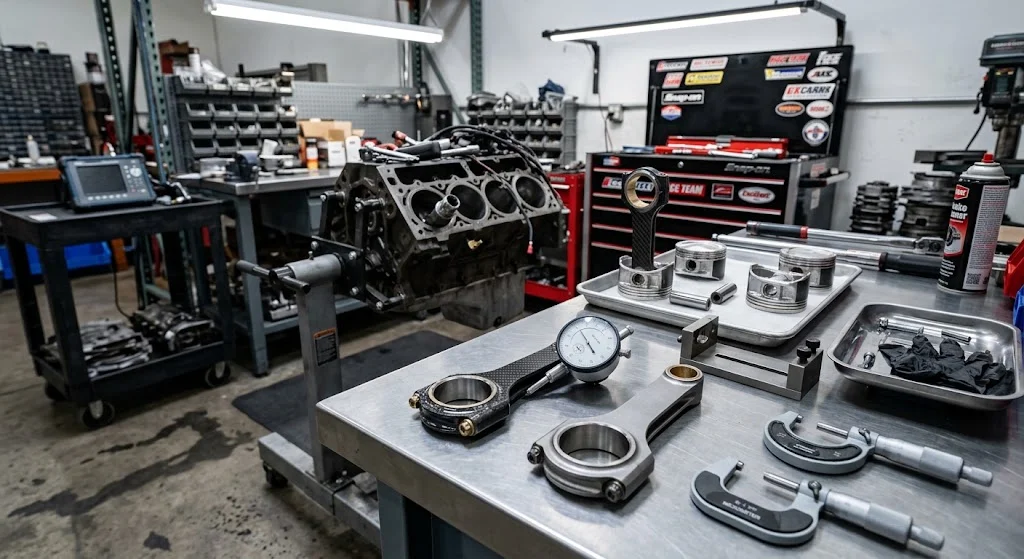
Carbon fiber connecting rods sit at the extreme end of motorsport materials engineering: every gram removed from the reciprocating assembly is a gram of piston acceleration the crankshaft no longer fights, and at 9,000+ RPM that reduction translates directly into faster throttle response, reduced be
Introduction
Carbon fiber connecting rods sit at the extreme end of motorsport materials engineering: every gram removed from the reciprocating assembly is a gram of piston acceleration the crankshaft no longer fights, and at 9,000+ RPM that reduction translates directly into faster throttle response, reduced bearing loads and higher sustainable engine speed. Formula 1 and top-fuel drag racing have run CFRP connecting rods for decades, and the design rules for carbon fiber rod connection interfaces are well documented.
This article examines the mechanical case for carbon fiber connecting rods, the rod-end bearing and fastener architectures that make them work, and how carbon fiber rod ends and solid rod stock are specified for reciprocating applications where failure is not an option.
Carbon Fiber Connecting Rods: The Reciprocating Mass Argument
A connecting rod in a high-RPM engine sees two load regimes: gas load during combustion (compressive, peaking at 8-12 kN) and inertia load during the intake stroke (tensile, driven by piston and rod mass at high RPM). Carbon fiber wins on the second regime decisively:
| Property | CFRP rod (autoclave) | 4340 steel (shot-peened) | Ti-6Al-4V (billet) |
|---|---|---|---|
| Density (g/cm³) | 1.55-1.60 | 7.85 | 4.43 |
| Specific tensile strength (kN·m/kg) | 400-550 | 100-130 | 230-280 |
| Tensile fatigue strength (MPa, R=0.1, 10⁷ cycles) | 350-450 | 550-650 | 450-550 |
| Axial stiffness (GPa) | 120-150 | 205 | 114 |
| Typical rod mass (50mm journal, 140mm centers) | 180-240 g | 450-550 g | 280-340 g |
The mass numbers are the headline: a CFRP rod weighs roughly half a steel rod and 30% less than titanium at the same geometry. In a V8 at 9,000 RPM, that cuts piston pin inertia load by 40-50%, allowing a higher redline or lighter wrist pins. The tradeoff is absolute fatigue strength — steel is stronger in absolute terms — which is why CFRP rods carry conservative gas-load limits and mandatory inspection, not drop-in replacement status.
Rod Architecture: Tube, Beam and Hybrid Designs
Carbon fiber connecting rods are not solid CFRP beams — the material works best in compression along the fiber axis and is vulnerable to interlaminar shear at load transitions. Three architectures dominate:
- Hollow tube beam: a roll-wrapped carbon fiber tube carries the shank, with bonded or co-cured metal big-end and small-end fittings. Tube diameter (28-38mm OD, 2-3mm wall) is sized against the gas load; metal ends carry the bearing press fits and oil passages. Most common architecture in professional racing.
- I-beam laminate: carbon skins over a foam or honeycomb core. Higher bending stiffness for the same mass but more complex to manufacture; used where rod buckling under peak compression is the binding constraint.
- Hybrid steel-carbon: carbon beam with forged steel big-end cap and small-end bushing, bolted or bonded at the transition. Retains steel's bearing press-fit reliability while capturing most of the mass saving; common where rules mandate steel bearing surfaces.
The rod-end interfaces are the critical design area: bonded metal inserts must transfer the full gas load without peeling the laminate, and co-cured inserts (pulled into the layup before cure) give the highest joint strength.
Fatigue Life and Inspection: The Governing Constraints
Carbon fiber is fatigue-sensitive differently than steel: steel develops a visibly growing crack; CFRP accumulates distributed micro-damage that can be invisible until sudden failure. This dictates the inspection regime:
- Design life and inspection: competition CFRP rods are rated for 40-80 hours of running (100,000-200,000 load cycles), versus 500+ hours for steel. C-scan ultrasonic inspection every 10-15 hours; bond-line visual inspection at every teardown.
- Failure modes and disposal: watch for bond-line debonding at the big-end insert and delamination at the small-end bushing. Most teams discard CFRP rods on a fixed hour count regardless of inspection — an in-race failure far exceeds replacement cost.
These constraints are why CFRP rods have not migrated to production engines, where 150,000-mile durability expectations make the inspection burden impractical.
Bearing Interfaces and Carbon Fiber Rod Connection Methods
Big-end and small-end bearings must run on metal surfaces — carbon's finish and thermal conductivity are wrong for a hydrodynamic oil film. Connection methods ranked by professional use:
- Co-cured metal inserts: steel or aluminum bearing shells inserted into the carbon layup before autoclave cure, creating a mechanical and chemical bond in one step. Highest joint strength; metal surface must be thermally matched to the cure cycle.
- Bonded inserts with mechanical backup: high-strength epoxy (DP420 or AF163) plus dowel pins or knurled sleeves that carry shear if the bond degrades. Standard for tube-beam rods in racing.
- Bolted end caps with carbon shank: the big-end cap is a separate forged steel piece bolted through the carbon beam with high-strength fasteners, re-torqued at every teardown. The carbon beam carries compression and tension; the bolts carry the split-load path.
The same rules apply to carbon fiber rod ends as replaceable interfaces — rod-end bearings (Heim joints) with carbon shanks need both adhesive and mechanical interlock at the transition, with controlled fastener preload to avoid crushing the laminate under the bolt head.
Manufacturing Tolerances and Quality Gates
Reciprocating components demand tighter process control than static structures:
| Dimension | Typical tolerance | Inspection method |
|---|---|---|
| Big-end bore diameter | +0.005 / -0.000 mm | Air gauge, 3-point |
| Small-end bore diameter | +0.008 / -0.000 mm | Plug gauge |
| Center-to-center length | ±0.02 mm | CMM, temperature-controlled |
| Bore parallelism | ≤0.01 mm | CMM |
| Rod mass (matched set) | ±2 g within set of 8 | Precision scale, 0.1g resolution |
Matched-set mass tolerance matters as much as absolute numbers: an unbalanced set creates vibration that accelerates bearing wear. Teams match rods to within 1-2 grams.
Frequently Asked Questions
Why don't production engines use carbon fiber connecting rods?
Durability expectations. A production engine must survive 150,000+ miles; a CFRP rod requires C-scan inspection every 10-15 hours and has a fatigue life measured in race weekends. The mass saving — worth 20-30 horsepower at high RPM — does not offset the warranty burden for a road car. The application remains confined to professional motorsport and specialty aerospace.
Can a carbon fiber connecting rod be repaired after a minor impact?
No. Any rod that has experienced an impact load — a thrown bearing, debris contact, over-rev — is condemned regardless of apparent condition. Undetected delamination at 9,000 RPM is catastrophic. Replace, do not repair.
How do carbon fiber rod ends handle thermal cycling in the crankcase?
CFRP's in-plane thermal expansion (2-5 µm/m·°C) is lower than steel (12) or aluminum (23), so the carbon beam stabilizes faster than the metal ends during warm-up. The critical interface is the bond line: qualified adhesives (AF163, DP420) are selected for a glass transition temperature above crankcase oil temperature (120-150°C).
Conclusion
Carbon fiber connecting rods are a mature application of CFRP to reciprocating structures: the mass saving is real, the architectures are proven, and the inspection regimes are understood. The design rules for carbon fiber rod connection interfaces — co-cured or bonded metal inserts with mechanical backup, matched-set mass tolerance, and mandatory ultrasonic inspection — apply equally to carbon fiber rod ends and to carbon fiber solid rod stock in smaller reciprocating linkages. YongXian manufactures roll-wrapped carbon fiber tubes and solid rod to motorsport and aerospace tolerances, with custom cutting, facing, bonding and insert installation to customer drawings. Browse our carbon fiber tube and rod catalog or contact our engineering team to discuss wall thickness, layup and rod-end interface details for your next engine program.
Related Articles
- Where to Buy Carbon Fiber Tubes: Stock Sizes, Lead Times and Minimum Orders
- Fiberglass vs Carbon Fiber Supplier: Choosing Reinforcements for Your Application
- Carbon Fibre or Fiber: Spelling, Terminology and Search Behavior
- Carbon Fibre Explained: What It Is and How It Is Made
- Carbon Fiber Road Bikes Closeout: Deal Evaluation and Value Guide
- Carbon Fiber Raw Material: Precursors, Resins and Additives
Interested in Our Products?
Contact our team for competitive pricing and technical specifications.
Get a QuoteRelated Products

Carbon Fiber Plate — 3K Twill T700 1.5mm
Thin 1.5mm carbon fiber plate with 3K twill weave surface. Lightweight and stiff, commonly used for covers, panels, drone bodies, and applications requiring a premium aesthetic appearance.

Carbon Fiber Plate — 3K Twill T700 3.0mm
Medium-thickness 3.0mm carbon fiber plate offering significantly higher load capacity while maintaining attractive 3K twill finish. Suitable for structural brackets, reinforcement plates, and load-bearing panels.

Carbon Fiber Trekking Pole
Lightweight carbon fiber trekking pole manufactured from high-grade carbon fiber tube. Weighs only 160g per pole while providing superior shock absorption and durability for hiking, trail running, and backpacking.

Square Carbon Fiber Tube — 3K Twill T700
Square cross-section carbon fiber tube manufactured with 3K twill weave for torsional strength. Preferred for structural frames, trusses, and support columns where rectangular geometry offers design flexibility.

Carbon Fiber Pickleball Paddle
High-performance pickleball paddle with Toray T700 carbon fiber face and polypropylene honeycomb core. Delivers excellent power-to-weight ratio, spin generation, and vibration dampening for competitive play.