
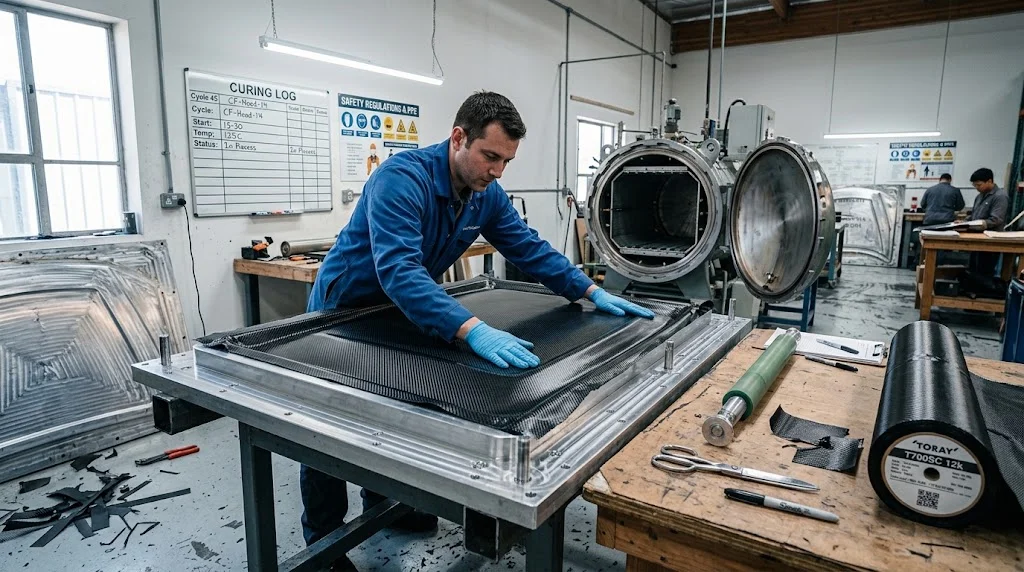
Custom carbon fiber car parts have moved from one-off show builds into a repeatable industrial supply chain, and the buyers who get the best results treat delivery as an engineering discipline rather than a purchase order. Whether the part is a replacement mirror cap, a full front-end panel set, or
Introduction
Custom carbon fiber car parts have moved from one-off show builds into a repeatable industrial supply chain, and the buyers who get the best results treat delivery as an engineering discipline rather than a purchase order. Whether the part is a replacement mirror cap, a full front-end panel set, or a structural reinforcement for a racing program, the path from a CAD file to a painted, ready-to-fit component passes through data capture, material selection, tooling, layup, cure, finishing and inspection. Each of those steps has its own lead time, cost structure and failure mode, and the suppliers who control them deliver predictable results.
This guide walks through that complete delivery chain for carbon fiber car parts, with the numbers a buyer needs: lead times by stage, cost bands by process, and the documentation that separates professional carbon fiber car parts manufacturers from a shop that can only produce one good sample.
Why Custom Carbon Fiber Car Parts Need a Controlled Delivery Chain
Unlike catalog components, custom carbon fiber car parts have no inherited tooling and no inherited tolerance scheme. Fit depends entirely on the quality of the digital or physical reference you supply, and a two millimeter error on a hood panel or a door skin is enough to scrap a finished part that already carries several hundred dollars of material and labor. The expensive asset is therefore not the fiber but the validated mold plus the process knowledge that keeps a batch consistent.
Weight is the reason buyers specify carbon fiber body parts at all. A typical carbon fiber car body panel weighs 40-60% less than the steel equivalent and 15-25% less than an aluminum panel of comparable stiffness, and those savings compound across a full panel set. The table below contrasts how a one-off show build and an industrial delivery chain handle the same program.
| Stage | One-off build | Industrial delivery chain | Owner on the buyer side |
|---|---|---|---|
| Reference data | Photos and hand measurements | 3D scan at 0.1-0.3 mm point accuracy, Class A surface reconstruction | Supply donor vehicle or existing scan data |
| Engineering | Visual mock-up, no laminate schedule | CAD release plus zone-based laminate definition and ply book | Approve CAD and load cases |
| Tooling | Foam plug, short life | CNC aluminum mold or matched metal tool, validated on a buck | Own or co-own the tooling |
| Production | Single skilled layup, no travelers | Batch production with per-part travelers and cure logs | Approve first article |
| Quality | Visual inspection | Dimensional report, ultrasonic scan, fit check on buck | Agree acceptance criteria in the PO |
From CAD to Tooling: The Custom Carbon Fiber Parts Workflow
Every custom carbon fiber parts program follows the same skeleton, and most delays come from skipping a step rather than from the composite work itself.
- Data capture and surfacing: the donor vehicle is scanned and a Class A surface is rebuilt in CAD, with flush and gap targets defined at every mounting point before any material is ordered.
- Laminate definition: fiber orientation is assigned per zone, with 0 degree plies for stiffness, plus or minus 45 degree plies for torsional rigidity, and core inserts in high-load areas. Typical panel laminates run 1.5-3 mm, which is four to ten plies of 200-300 gsm fabric.
- Tooling: a CNC machined aluminum mold is the workhorse for a few hundred to a few thousand parts, while a plug plus composite mold is faster and cheaper for prototypes and short runs.
- Layup and cure: prepreg in an autoclave at 120-180 C and 0.6-0.7 MPa gives the most stable Class A surface, vacuum infusion suits large panels at lower tooling cost, and resin transfer molding wins once volume justifies a production tool.
- Trimming and assembly: five-axis CNC trimming holds hole positions, and bonded studs or inserts replace field drilling by the installer.
- Inspection and fit check: structured light scanning compares the part to CAD, and a first article is fitted on a buck or on the donor car before the batch is released.
Lead time is dominated by tooling, not by layup. A realistic schedule from a frozen CAD release looks like this.
| Stage | Prototype, 1-5 parts | Small batch, 20-200 parts | Series, 1,000 plus |
|---|---|---|---|
| Data and CAD release | 3-5 days | 3-5 days | 5-10 days |
| Tooling | 7-14 days, composite mold | 15-25 days, aluminum mold | 25-45 days, matched metal tool |
| Layup and cure | 2-5 days total | 1-3 days per cavity | 20-60 parts per day |
| Trim and finish | 1-2 days per part | 0.5 day per part | Fixture driven, minutes per part |
| Inspection | 100% of parts | Sampling by AQL | First and last article plus SPC |
Material and Process Choices for Carbon Fiber Auto Parts
Process selection is where carbon fiber auto parts budgets are won or lost, because the same panel can be built three different ways with unit costs that differ by a factor of five. The comparison below reflects typical automotive aftermarket and low-volume OEM work.
| Process | Typical material | Cycle | Cost behavior | Best fit |
|---|---|---|---|---|
| Prepreg and autoclave | T700 class tow, 3K or 6K twill, 200-300 gsm | 2-4 hours at 120-180 C, 0.6-0.7 MPa | High cost at low volume, most repeatable surface | Class A hoods, roofs, door skins, 1-500 parts |
| Vacuum infusion | Dry twill plus epoxy infusion resin | 6-12 hours including room temperature cure and post cure | Low tooling cost, moderate labor, good for large areas | Spoilers, hatch panels, 10-1,000 parts |
| Light resin transfer molding | Woven preform, epoxy or vinyl ester | 8-15 minutes injection plus 20-40 minutes cure | Unit cost falls steeply above 100 parts | Mirror caps, brackets, 3D shapes, 100-50,000 parts |
| Compression molding | Carbon sheet molding compound | 1-3 minutes per cycle | Lowest unit cost, highest tooling entry price | Structural brackets, series parts above 5,000 |
Resin choice matters as much as fiber grade. Standard epoxy with a glass transition temperature near 120 C suits cabin-adjacent panels, while high-temperature systems near 180 C are required for paint bake ovens and exhaust-adjacent hardware. Void content below 1% and a consistent 0.2-0.35 mm ply thickness are the two numbers that most reliably predict whether a Class A panel will paint out cleanly.
Carbon Fiber Car Parts Manufacturers: How to Evaluate a Supplier
Choosing between carbon fiber car parts manufacturers is mostly a diligence exercise, and the questions below separate a production partner from a prototype shop that cannot scale.
- Process range: a supplier who can run prepreg, infusion and resin transfer molding can recommend the right route instead of selling the process they own.
- In-house capability: cutting, CNC trimming, surface finishing and non-destructive testing under one roof removes the handoff gaps where damage and schedule loss occur.
- Certification: ISO 9001 is the floor; IATF 16949 and PPAP capability matter as soon as a program touches series production, and batch traceability should be documented rather than promised.
- Tooling ownership: state in the contract who owns the mold, where it is stored, and whether a second supplier may run it. This single clause prevents the most expensive disputes in the industry.
- Sample and fit policy: a paid tooling sample fitted on your buck is cheap insurance compared with scrapping a batch, and a supplier who refuses fit checks is telling you something.
- Segment references: motorsport, aftermarket aero and EV programs stress a supplier differently, so ask for references in your segment.
Delivery, Packaging, and Quality Documentation
Logistics is the last place a good part gets ruined. Finished carbon fiber car body parts should ship in a foam cradle with edge protection, stacked without point contact, and photographed at pack-out to evidence transit claims. Sea freight suits production batches at four to six weeks door to door, while air freight is rational for a first article that gates a build.
The documentation pack that should accompany every shipment includes material certificates, cure logs, a dimensional report against CAD, ultrasonic results where specified, and a photo record. Acceptance criteria belong in the purchase order: for example, flush within 1.0 mm at defined check points and gap symmetry within 1.5 mm, measured on the buck. Written acceptance criteria in a supplier traveler prevent most fit disputes.
Frequently Asked Questions
How long does it take to order custom carbon fiber car parts?
From a frozen CAD file, a first article typically takes three to four weeks, including a composite mold for prototypes. Adding a validated aluminum mold adds two to three weeks, so a realistic total for a first production batch is five to seven weeks, and series first articles with PPAP documentation usually land at eight to ten weeks. The biggest schedule lever is scan data quality on day one: reworking a Class A surface after tooling starts is the most expensive delay in the chain.
What is the minimum order quantity for custom carbon fiber parts?
One-off parts are possible, and simple geometry such as a mirror cap or a small duct usually lands between 500 and 1,500 dollars per piece once labor and finishing are counted. Volume pricing starts to matter at twenty to fifty pieces, because that is the range where mold cost amortizes into an acceptable share of unit price. Below that, plug plus composite tooling keeps entry cost low; above a few hundred parts, aluminum tooling pays for itself quickly.
Can carbon fiber body parts be painted to match a factory color?
Yes, and the process is well established: scuff the clear surface, apply an epoxy primer compatible with the resin system, then spray a two-component polyurethane topcoat. Keep the paint bake conservative, typically 60-80 C for aftermarket work, because excessive temperature can soften a standard epoxy matrix even when the part itself was cured at a higher temperature. Always confirm the glass transition temperature of your specific laminate before approving a bake profile.
Conclusion
Custom carbon fiber car parts reward buyers who treat the program as an engineering chain rather than a product purchase. Freeze your CAD early, define laminate and acceptance criteria in writing, choose the process that matches your volume instead of the process your supplier already owns, and insist on a fitted first article before any batch is released. Those four habits are the difference between a panel set that installs in an afternoon and a container of expensive scrap.
YongXian manufactures carbon fiber car body parts, custom body panels and structural components for motorsport, aftermarket and low-volume OEM programs, with in-house tooling, autoclave and infusion capacity, and full dimensional reporting. Explore our carbon fiber automotive product range or contact our engineering team with your CAD data and volume forecast for a process recommendation and quotation.
Part of topic
Related Articles
- Pultruded Carbon Fibre: UK and EU Supply Chain for Continuous Profiles
- How Much Does It Cost to Make Carbon Fiber Parts? A Real Cost Breakdown
- Who Makes Carbon Fiber: The Global Producer Landscape from Precursor to Tow
- Where to Buy Carbon Fiber: Retail, Distributor and Direct-from-Factory Channels
- Where to Buy Carbon Fiber Tubes: Stock Sizes, Lead Times and Minimum Orders
- Fiberglass vs Carbon Fiber Supplier: Choosing Reinforcements for Your Application
Interested in Our Products?
Contact our team for competitive pricing and technical specifications.
Get a QuoteRelated Products

Carbon Fiber Plate — 3K Twill T700 1.5mm
Thin 1.5mm carbon fiber plate with 3K twill weave surface. Lightweight and stiff, commonly used for covers, panels, drone bodies, and applications requiring a premium aesthetic appearance.

Carbon Fiber Plate — 3K Twill T700 3.0mm
Medium-thickness 3.0mm carbon fiber plate offering significantly higher load capacity while maintaining attractive 3K twill finish. Suitable for structural brackets, reinforcement plates, and load-bearing panels.

Carbon Fiber Trekking Pole
Lightweight carbon fiber trekking pole manufactured from high-grade carbon fiber tube. Weighs only 160g per pole while providing superior shock absorption and durability for hiking, trail running, and backpacking.

Carbon Fiber Pickleball Paddle
High-performance pickleball paddle with Toray T700 carbon fiber face and polypropylene honeycomb core. Delivers excellent power-to-weight ratio, spin generation, and vibration dampening for competitive play.

Square Carbon Fiber Tube — 3K Twill T700
Square cross-section carbon fiber tube manufactured with 3K twill weave for torsional strength. Preferred for structural frames, trusses, and support columns where rectangular geometry offers design flexibility.