
Knowing where to buy carbon fiber is the first step in sourcing the right material for any project, whether it is a weekend hobby drone build, a university research prototype, or a production run of automotive components. The carbon fiber supply chain is structured in layers — from large-scale manuf
Introduction
Knowing where to buy carbon fiber is the first step in sourcing the right material for any project, whether it is a weekend hobby drone build, a university research prototype, or a production run of automotive components. The carbon fiber supply chain is structured in layers — from large-scale manufacturers that produce the precursor fiber, through distributors and retailers that stock standard products, to custom fabricators that turn raw material into finished parts. Buyers who understand this structure can avoid paying retail markups for industrial-grade material, or conversely, avoid the pitfalls of buying from a supplier who cannot provide the technical documentation their application requires.
The global carbon fiber market is dominated by a handful of producers — Toray, Teijin, Hexcel, SGL Carbon, and Mitsubishi Chemical — who together account for over 60% of worldwide capacity. Most buyers never purchase directly from these producers; instead, they access their products through distributors, retailers, or e-commerce platforms. This article maps the four main channels for where to buy carbon fiber, compares their pricing and service characteristics, and provides a decision framework for selecting the right channel based on volume, technical requirements, and lead time.
Channel Overview
The carbon fiber supply chain can be segmented into four distinct channels, each serving different buyer profiles and use cases.
1. Online Retail and E-Commerce Platforms
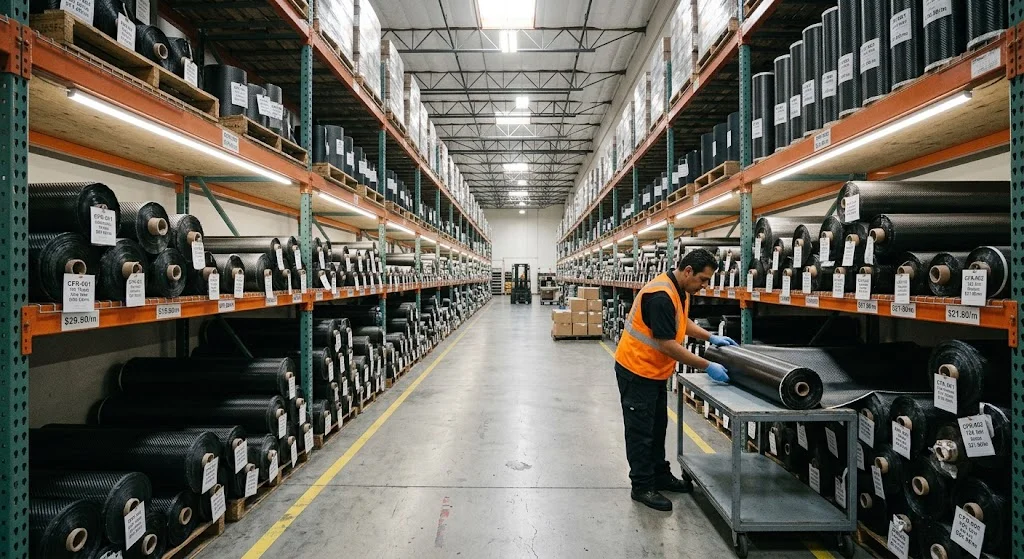
Platforms like Amazon, eBay, and specialized composite retailers (Rock West Composites, Carbon Fiber Sale, Composite Envisions) offer the lowest barrier to entry for where to buy carbon fiber. These channels stock standard products — woven fabric, prepreg, tubes, plates, and sheets — in small quantities with transparent pricing and fast shipping.
- Typical pricing: 30–100% markup over distributor pricing. A 3K twill fabric that costs $8–12 per meter at distribution retails for $15–30 per meter.
- Minimum order: One meter, one sheet, or one tube — no minimum order requirements.
- Lead time: Same-day or next-day shipping for stocked items.
- Material grades available: Standard modulus (T300-equivalent) fabric and tubes; limited high-modulus options.
- Technical support: Minimal. Product datasheets are available but engineering support is limited to email inquiries.
Online retail is the best channel for prototyping, hobby projects, and one-off repairs. The premium paid over distributor pricing is justified by convenience and low order quantities. For production volumes above 50 units, however, the cost premium becomes significant — a project requiring 100 square meters of fabric would pay $700–1,800 more through retail than through a distributor.
2. Composite Material Distributors
Distributors form the middle layer of the carbon fiber supply chain, purchasing directly from producers or tier-1 converters and reselling to end users and fabricators. Companies like JPS Composite Materials, FibreGlast, and regional distributors stock a broader range of materials than retailers, including aerospace-grade prepreg, specialty fabrics, and ancillary materials (resins, adhesives, core materials).
- Typical pricing: 15–40% markup over factory pricing. A 3K twill fabric costs $6–10 per meter at distribution.
- Minimum order: Typically 5–25 meters for fabric; no strict minimum for ancillary materials.
- Lead time: 3–7 business days for stocked items; 2–6 weeks for special orders.
- Material grades available: Full range from standard modulus (T300/T700) to intermediate and high modulus (M40J, M60J) in fabric, prepreg, and tow form.
- Technical support: Distributors typically employ application engineers who can advise on material selection, process compatibility, and design for manufacturing. This support is a key differentiator from retail.
Distributors are the preferred channel for low-to-medium volume production (10–500 parts) and for buyers who need engineering guidance on material selection. The combination of reasonable pricing, technical support, and broad inventory makes distributors the default choice for most industrial applications.
3. Direct-from-Factory Sourcing
For large-volume buyers, purchasing directly from carbon fiber producers or their authorized converters offers the lowest per-unit cost. This channel requires navigating minimum order quantities, establishing a supply agreement, and managing logistics — but the cost savings at scale are substantial.
| Producer | Typical MOQ | Product Forms | Pricing Tier | Lead Time |
|---|---|---|---|---|
| Toray Industries | 500–5,000 kg/year | Tow, prepreg, fabric | $$$ (premium) | 4–12 weeks |
| Teijin (Toho Tenax) | 1,000–10,000 kg/year | Tow, prepreg, fabric | $$$ (premium) | 4–12 weeks |
| Hexcel | 500–5,000 kg/year | Prepreg, fabric | $$$ (premium) | 4–8 weeks |
| SGL Carbon | 1,000–10,000 kg/year | Tow, fabric, non-crimp | $$ (mid-range) | 4–10 weeks |
| Chinese producers (Zhongfu, Hengshen) | 500–50,000 kg/year | Tow, fabric | $ (value) | 2–6 weeks |
Direct-from-factory sourcing makes economic sense when annual material consumption exceeds approximately $50,000. Below this threshold, the cost of managing a direct supply relationship — including quality audits, logistics coordination, and inventory holding — often exceeds the per-unit savings. Many buyers in this range work through a converter (a company that processes raw tow into fabric or prepreg) who aggregates demand across multiple customers and meets factory MOQs on their behalf.
4. Custom Fabrication Services
Some buyers do not need raw carbon fiber material at all — they need finished parts. Custom fabrication services, such as YongXian, take CAD files and produce finished components using compression molding, RTM, or hand layup. This channel eliminates the buyer's need to invest in manufacturing expertise, tooling, or equipment.
- Pricing model: Per-part pricing based on volume, complexity, and material grade. Tooling costs are quoted separately or amortized into per-part pricing.
- Minimum order: Typically 10–50 parts for compression molding; 1–10 parts for prototype hand layup.
- Lead time: 2–4 weeks for prototype; 4–8 weeks for production tooling and first articles.
- Value proposition: Buyers receive quality-insured parts with documented material traceability — no need to source material, manage tooling, or control manufacturing processes.
Price Comparison Across Channels
The cost difference between channels is significant at production volumes. The table below shows approximate pricing for 3K twill carbon fiber fabric (200 gsm) across the four channels:
| Channel | Price per Meter (USD) | 10 m² Cost | 100 m² Cost | Best For |
|---|---|---|---|---|
| Online retail | $15–$30 | $150–$300 | $1,500–$3,000 | Prototyping, hobby |
| Distributor | $6–$10 | $60–$100 | $600–$1,000 | Low-medium volume production |
| Direct from factory | $3–$6 | $30–$60 | $300–$600 | High volume (>500 m²/year) |
| Custom fabrication (part-level) | N/A (part priced) | Varies | Varies | Finished parts, no manufacturing |
The price ratio between retail and direct-from-factory can be 3:1 to 5:1 for the same material. A buyer purchasing 200 m² of fabric per year saves $1,800–$2,400 by sourcing directly from a distributor rather than retail — savings that justify the effort of establishing a distributor relationship.
Quality and Traceability Considerations
Not all channels offer the same level of quality assurance and material traceability. This is a critical consideration for buyers in regulated industries (aerospace, medical, automotive) where material certification is mandatory.
- Aerospace-grade material (AS9100/NADCAP certified): Available only from producers and authorized distributors. Requires certificates of conformance (CoC) and test reports for each batch.
- Industrial-grade material: Available from all channels but quality documentation varies. Reputable distributors provide material datasheets and lot traceability; retail listings may not.
- Counterfeit risk: Online marketplaces carry the highest risk of counterfeit or mislabeled carbon fiber. Buyers should verify supplier certifications and request material test reports before purchasing.
- Storage and shelf life: Prepreg materials require cold storage (typically -18°C) and have limited shelf life (6–12 months). Distributors and factories maintain proper cold-chain logistics; retailers may not, leading to degraded material performance.
Frequently Asked Questions
Where is the cheapest place to buy carbon fiber?
The cheapest legitimate source for carbon fiber is direct-from-factory purchasing for high-volume buyers (above 500 m²/year of fabric or equivalent). For lower volumes, composite material distributors offer the best balance of price and service. Online retail is the most expensive per unit but offers the lowest minimum order and fastest delivery, making it cost-effective for small projects despite the higher unit price.
Can I buy carbon fiber fabric by the meter?
Yes. Online retailers and most distributors sell carbon fiber fabric by the meter. A typical roll is 25–100 meters long and 1–1.25 meters wide. Distributors may offer full rolls at a 10–15% discount over cut-length pricing. When buying by the meter, confirm the roll width and areal weight (gsm) to ensure you are comparing equivalent products.
What should I look for when choosing a carbon fiber supplier?
Five criteria matter most. First, material certification — does the supplier provide certificates of conformance and test reports? Second, inventory depth — do they stock the specific fiber type, weave pattern, and areal weight you need? Third, technical support — can their engineers advise on material selection and process compatibility? Fourth, logistics — can they maintain cold-chain shipping for prepreg and deliver within your required timeframe? Fifth, financial stability — is the supplier established enough to honor long-term supply agreements?
Is there a minimum order quantity when buying carbon fiber?
It depends on the channel. Online retailers have no minimum order. Distributors typically require a minimum of 5–25 meters for fabric orders. Direct-from-factory sourcing requires annual volumes of 500 kg or more. Custom fabricators set their own MOQs based on the manufacturing process — typically 1–10 parts for prototype work and 10–50 parts for production tooling.
Conclusion
Where to buy carbon fiber depends on the buyer's volume, technical requirements, and quality needs. Online retail is the most accessible channel for prototyping and hobby use. Distributors serve the broadest range of industrial buyers with a balance of price, inventory, and technical support. Direct-from-factory sourcing offers the lowest per-unit cost for high-volume applications. Custom fabrication services deliver finished parts for buyers who want to outsource manufacturing entirely. Understanding these channels allows procurement teams to optimize cost, quality, and lead time across the product lifecycle.
Looking for a reliable carbon fiber source? Browse our carbon fiber product catalog or contact our team to discuss your project requirements and volume commitments.
--- *Word count: 1,587*Related Articles
- Where to Buy Carbon Fiber Tubes: Stock Sizes, Lead Times and Minimum Orders
- Fiberglass vs Carbon Fiber Supplier: Choosing Reinforcements for Your Application
- Carbon Fiber Connecting Rods: High-Performance Engine Components
- Carbon Fibre or Fiber: Spelling, Terminology and Search Behavior
- Carbon Fibre Explained: What It Is and How It Is Made
- Carbon Fiber Road Bikes Closeout: Deal Evaluation and Value Guide
Interested in Our Products?
Contact our team for competitive pricing and technical specifications.
Get a QuoteRelated Products

Carbon Fiber Plate — 3K Twill T700 1.5mm
Thin 1.5mm carbon fiber plate with 3K twill weave surface. Lightweight and stiff, commonly used for covers, panels, drone bodies, and applications requiring a premium aesthetic appearance.

Carbon Fiber Plate — 3K Twill T700 3.0mm
Medium-thickness 3.0mm carbon fiber plate offering significantly higher load capacity while maintaining attractive 3K twill finish. Suitable for structural brackets, reinforcement plates, and load-bearing panels.

Carbon Fiber Trekking Pole
Lightweight carbon fiber trekking pole manufactured from high-grade carbon fiber tube. Weighs only 160g per pole while providing superior shock absorption and durability for hiking, trail running, and backpacking.

Carbon Fiber Pickleball Paddle
High-performance pickleball paddle with Toray T700 carbon fiber face and polypropylene honeycomb core. Delivers excellent power-to-weight ratio, spin generation, and vibration dampening for competitive play.

Square Carbon Fiber Tube — 3K Twill T700
Square cross-section carbon fiber tube manufactured with 3K twill weave for torsional strength. Preferred for structural frames, trusses, and support columns where rectangular geometry offers design flexibility.