
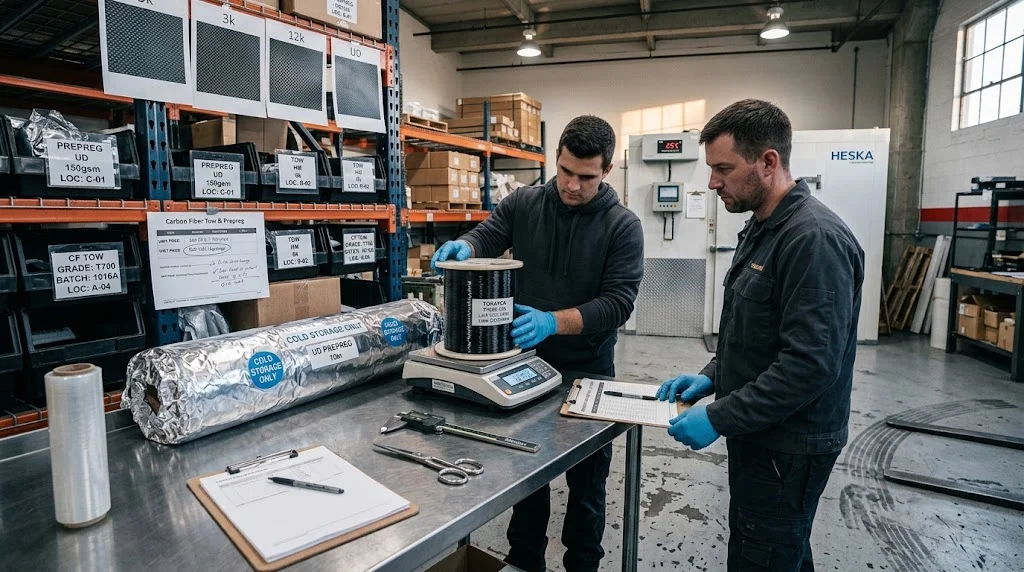
The price of carbon fiber in 2026 is not one number but three, and confusing them is the fastest way to misread a quotation. A kilogram of industrial tow, a square metre of prepreg and a finished machined bracket sit orders of magnitude apart in unit price, and each tier carries its own cost drivers
Introduction
The price of carbon fiber in 2026 is not one number but three, and confusing them is the fastest way to misread a quotation. A kilogram of industrial tow, a square metre of prepreg and a finished machined bracket sit orders of magnitude apart in unit price, and each tier carries its own cost drivers. A buyer who asks what carbon fiber costs and receives a single figure per kilogram is usually being quoted raw material for a part that will cost several times more once it is cut, laid up, cured and inspected.
This article sets out planning benchmarks for the price of carbon fiber at the tow, fabric, prepreg and finished-part levels, then explains which variables move each one. The ranges are indicative mid-2026 figures meant for budgeting and comparison, not a substitute for a quotation tied to a specific grade, volume and delivery term.
Price of Carbon Fiber by Raw Material Form
The first tier is the fiber itself, sold as tow, woven fabric or prepreg, and it is priced by weight. Grade and tow size dominate the spread: large tow used for pressure vessels and wind blades costs a fraction of small aerospace tow, because line speed, precursor yield and qualification burden all scale with specification. The table below gives planning ranges for mid-2026.
| Raw material form | Typical grade | Mid-2026 price (USD/kg) | Primary use |
|---|---|---|---|
| Large tow, 48K to 50K | Industrial standard modulus | 12 to 16 | Pressure vessels, wind blades, pultruded profiles |
| Standard tow, 12K | Industrial standard modulus | 18 to 26 | Pultrusion, tubing, sheet, sporting goods |
| Small tow, 3K to 6K | Aerospace or cosmetic | 55 to 95 | Visible weave, aerospace structures, motorsport |
| Woven fabric, 200 gsm | Standard modulus 3K | 32 to 48 | Cosmetic sheet, plate, laminated panels |
| UD prepreg, 150 gsm | Industrial epoxy | 38 to 58 | Roll-wrapped tubes, plates, layup parts |
| UD prepreg, aerospace | Qualified epoxy or BMI | 95 to 170 | Autoclave structures, primary aircraft parts |
Two features of this tier surprise buyers new to composites. First, the fiber is rarely the largest line in a finished part, so an eight percent move in tow price changes a finished quote by far less than its headline suggests. Second, price falls as tow size grows but stiffness does not fall at the same rate: a 12K standard modulus tow delivers a modulus close to a small aerospace tow for a third of the material cost, which is why most industrial tubes, rods and sheets are built from large or standard tow rather than aerospace fiber.
Price of Carbon Fiber at the Part Level
The second and third tiers are the ones a buyer actually purchases, and here the price of carbon fiber is expressed per piece rather than per kilogram. Part cost adds conversion, tooling, labour, finishing and inspection on top of material, and at low volume the material line can be less than a third of the total. The table below shows how the same material family lands at very different unit prices depending on the part.
| Part level | Typical volume | Indicative unit price | Dominant cost line |
|---|---|---|---|
| Cut-to-size sheet or plate | 1 to 100 panels | 40 to 120 USD per kg of finished panel | Material and nest yield |
| Pultruded tube or rod by the metre | 10 to 1000 m | 8 to 45 USD per metre, size dependent | Material and die amortisation |
| CNC-machined bracket under 10 cm | 10 to 500 pieces | 25 to 90 USD per piece | Programming, fixturing, machine time |
| Roll-wrapped structural tube | 50 to 2000 pieces | 30 to 150 USD per piece | Mandrel handling and cure cycle |
| Autoclave cosmetic panel | 1 to 50 pieces | 250 to 1500 USD per piece | Mould, layup labour, autoclave time |
The gap between the raw material line and the finished price is not margin; it is the cost of turning fiber into a part. At one piece, a hand-laid cosmetic panel can carry several thousand dollars of mould and labour before any carbon is counted, while the same geometry made by resin transfer moulding at five thousand pieces can fall below one hundred and fifty dollars. That spread is why an honest answer to what carbon fiber costs always starts with volume, process and tolerance grade rather than a rate per kilogram. When a buyer has to compare on one number, the honest benchmark is for the form actually needed, whether that is a carbon fiber sheet cost per panel, a carbon fiber rod price per metre or a carbon fiber tube price per length.
What Moves the Price of Carbon Fiber in 2026
Six inputs move the number more than anything else, and three of them sit under the buyer's control:
- Fiber grade and tow size: the single largest lever; stepping from aerospace small tow to industrial 12K tow can cut the material line by two thirds with little stiffness penalty.
- Order volume and minimum order quantity: tow and prepreg are quoted with minimums, and a pallet quantity often prices twenty to thirty percent below a single case because the supplier spreads qualification and setup across the run.
- Precursor and energy costs: PAN precursor and the energy used to carbonise it set the floor of the fiber price, so tow tracks electricity and acrylonitrile markets rather than composite demand alone.
- Certification and traceability: aerospace and motorsport grades carry batch records, mechanical testing and lot traceability that can double the price of an otherwise identical tow.
- Yield and nest efficiency: a part that consumes sixty percent of a sheet at one unit and eighty percent at four units changes the material cost more than any negotiation on machine rate.
- Freight, currency and delivery term: tow is a low-density, bulky commodity, so shipping and the quoted Incoterm can swing the landed price by ten to twenty percent.
Frequently Asked Questions
Is the price of carbon fiber falling or rising?
Industrial tow has drifted downward for a decade as large-tow capacity expanded, with large tow now available in the low teens per kilogram, while aerospace-grade small tow has held firm because qualification cost does not scale with production volume. In 2026 the split is widening: commodity grades are pressed by new capacity, and qualified grades stay expensive because there are few approved suppliers. Expect the raw material trend to be flat to slightly down, and the part-level trend to fall faster as automated layup and machining spread.
Why is aerospace carbon fiber so much more expensive than industrial tow?
An aerospace small tow is not simply a finer fiber; it carries a qualified process window, batch mechanical data, traceability from precursor to spool, and a supplier base audited for consistency. That overhead is spread over a small production volume, so a kilogram can cost four to six times an industrial tow of similar stiffness. Unless the application demands certification, an industrial standard-modulus tow is the better economic choice, and most tubes, rods, sheets and brackets use exactly that.
Should I buy tow, prepreg or finished parts?
Buy tow only if you already run weaving, pultrusion or a layup line, because the fiber is an input to a process rather than a product. Buy prepreg when you have tooling and a cure cycle and want consistent resin content. Buy finished cut parts, tubes and plates when the value is in the geometry, tolerance and edge finish rather than the fiber itself, because at low volume the conversion cost dominates and a specialist supplier will beat your in-house cost. Most buyers of carbon fiber sheet, rod or tube should be buying the finished form, not the raw tow.
Conclusion
The price of carbon fiber is a three-tier question, and answering it well means quoting each tier separately: raw tow and fabric by the kilogram, prepreg by the roll, and finished parts by the piece. Once the tiers are separated, the drivers become visible and the negotiation moves from a headline rate to the variables that actually matter, which are grade, volume, yield and finishing. YongXian supplies carbon fiber sheet, plate, rod and tube in the finished forms buyers actually use, and our team will map your volume and tolerance onto the right tier before you commit to a process. Browse our carbon fiber products or contact us with your part drawing, annual volume and delivery requirement.
Part of topic
Related Articles
- Carbon Fiber Rod NZ: Sourcing and Shipping for New Zealand Builders
- Pultruded Carbon Fibre: UK and EU Supply Chain for Continuous Profiles
- How Much Does It Cost to Make Carbon Fiber Parts? A Real Cost Breakdown
- Who Makes Carbon Fiber: The Global Producer Landscape from Precursor to Tow
- Custom Carbon Fiber Car Parts: From CAD to Finished Automotive Panels
- Where to Buy Carbon Fiber: Retail, Distributor and Direct-from-Factory Channels
Interested in Our Products?
Contact our team for competitive pricing and technical specifications.
Get a QuoteRelated Products

Carbon Fiber Plate — 3K Twill T700 1.5mm
Thin 1.5mm carbon fiber plate with 3K twill weave surface. Lightweight and stiff, commonly used for covers, panels, drone bodies, and applications requiring a premium aesthetic appearance.

Carbon Fiber Plate — 3K Twill T700 3.0mm
Medium-thickness 3.0mm carbon fiber plate offering significantly higher load capacity while maintaining attractive 3K twill finish. Suitable for structural brackets, reinforcement plates, and load-bearing panels.

Square Carbon Fiber Tube — 3K Twill T700
Square cross-section carbon fiber tube manufactured with 3K twill weave for torsional strength. Preferred for structural frames, trusses, and support columns where rectangular geometry offers design flexibility.

Carbon Fiber Trekking Pole
Lightweight carbon fiber trekking pole manufactured from high-grade carbon fiber tube. Weighs only 160g per pole while providing superior shock absorption and durability for hiking, trail running, and backpacking.

Carbon Fiber Pickleball Paddle
High-performance pickleball paddle with Toray T700 carbon fiber face and polypropylene honeycomb core. Delivers excellent power-to-weight ratio, spin generation, and vibration dampening for competitive play.