
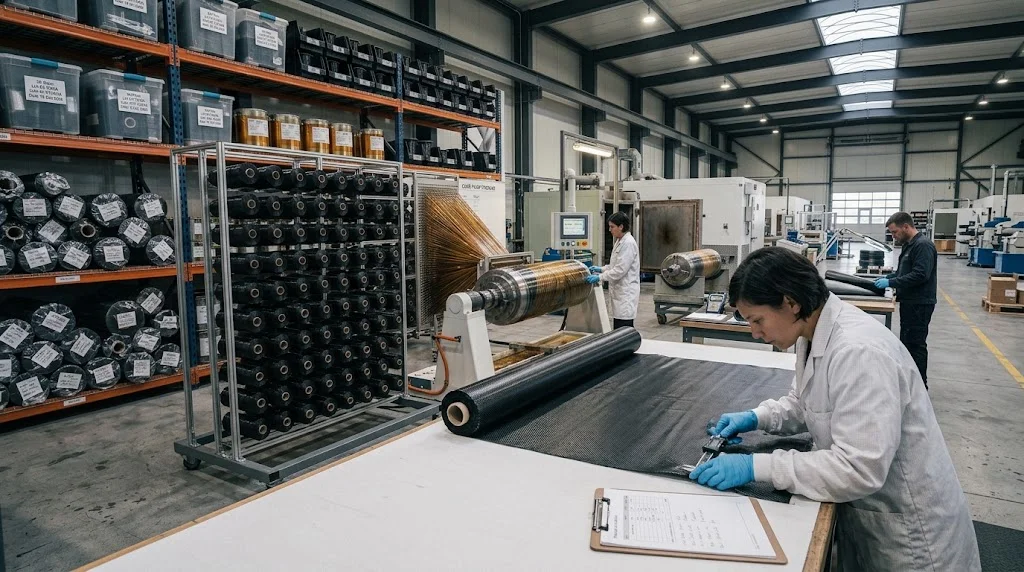
Carbon fiber suppliers range from tier-one producers like Toray and Hexcel running integrated pan-to-prepreg lines, to regional distributors holding a few hundred kilograms of cut fabric, to trading houses that source from multiple mills without ever inspecting a roll. For a B2B buyer — an aerospace
Introduction
Carbon fiber suppliers range from tier-one producers like Toray and Hexcel running integrated pan-to-prepreg lines, to regional distributors holding a few hundred kilograms of cut fabric, to trading houses that source from multiple mills without ever inspecting a roll. For a B2B buyer — an aerospace integrator, a sporting-goods brand, an automotive Tier 1 — the gap between a well-qualified supplier and an unvetted one is the difference between a stable production ramp and a line stoppage six weeks into a program.
This article sets out a qualification framework that works across geographies: what documents to request, what tests to run on a first lot, what capacity signals separate a real manufacturer from a reseller, and how to score a shortlist of carbon fiber suppliers — whether they sit in the USA, Canada, China or elsewhere — on the criteria that actually drive delivery reliability and lot-to-lot consistency.
What Makes a Carbon Fiber Supplier "Qualified"
Qualification is not a single certificate. It is a set of verifiable facts about who the supplier is, what they actually produce, and how they control quality from lot to lot. A qualified supplier can answer all three without hesitation:
- Identity and scale: How many employees, what annual tow or fabric output, what production lines (tow spreading, weaving, prepreg, pultrusion, CNC cutting). A supplier who claims 500 tonnes/year but runs two spreading machines and five CNC routers is a distributor with a cutting service, not a manufacturer — which is fine if you know it, and a problem if you don't.
- Certification stack: ISO 9001 is table stakes. For aerospace or defense programs, AS9100 is required; for automotive, IATF 16949. UL, RoHS and REACH declarations matter for electrical and consumer applications. Ask for the actual certificates with expiry dates, not a logo on a website.
- Material traceability: A qualified supplier can tell you which mill produced the tow (Toray, SGL, Formosa, Zhongfu, or a domestic Chinese producer), the lot number, the batch date, and the certificate of analysis for that batch — tensile strength, filament count, sizing type, resin content if it is pre-impregnated fabric.
Suppliers who cannot produce a lot-specific certificate of analysis within one business day are, in practice, buying from a spot market and reselling. That works for prototypes; it fails when a production line needs the same tensile modulus week after week.
Qualification Checklist: Documents and Tests
A practical qualification runs in two stages — document review, then material verification on a first lot. The table below is the checklist we recommend using with any new carbon fiber supplier, in any region.
| Stage | Check | What "pass" looks like | Red flag |
|---|---|---|---|
| Document | ISO 9001 / AS9100 / IATF 16949 | Valid certificate, scope covers composites manufacturing | Logo only, expired cert, or scope covers unrelated products |
| Document | Material certificate of analysis | Lot number, tensile strength, modulus, filament count, sizing type | Generic datasheet with no lot reference |
| Document | Capacity declaration | Annual output in tonnes, number of production lines, lead time in weeks | Vague answers, "we can source anything" |
| Material | Tensile test (first lot) | Within ±8% of declared tensile strength (ASTM D3039) | More than 15% below declared value |
| Material | Fiber areal weight | Within ±5% of declared gsm (e.g. 200 gsm ±10) | Inconsistent across three random rolls |
| Material | Weave / orientation check | Consistent tow alignment, no gaps or tight spots in fabric | Visible waviness, broken tows, edge damage |
| Logistics | Packaging and storage | Moisture barrier bag, desiccant, cold-chain if prepreg | Bare rolls shipped in cardboard, no humidity control |
For a first order, request 20-50 kg of material and run the tensile and areal-weight checks on three separate rolls. Consistency across rolls tells you more about a supplier than any single-pass test.
Comparing Carbon Fiber Suppliers in the USA, Canada and Asia
Geography matters for lead time, tariff exposure and technical support, but the qualification criteria are the same everywhere. What changes is the typical profile of the supplier you find in each region.
Carbon fiber suppliers in the USA tend to be either domestic converters (slitting, spreading, cutting to size) or authorized distributors of the major mills. Strengths include short domestic lead times, easy audit access, and compliance documentation aligned with ITAR and DFARS requirements for defense work. The trade-off: material cost is typically 15-30% higher than direct Asian sourcing, and the converter's lot control depends on what the upstream mill provides.
Carbon fiber suppliers in Canada often occupy a middle ground — proximity to US defense and aerospace programs, competitive labor costs, and in some cases favorable trade terms under USMCA. A few Canadian firms operate weaving and layup operations; most are distributors and converters serving the North American market.
Asian suppliers — Chinese, Japanese and Korean producers — dominate global tow and fabric output. Direct sourcing from a qualified Chinese mill can deliver 30-50% cost savings versus US distribution, with the trade-off of longer transit times (3-5 weeks ocean freight), higher minimum order quantities, and the need for third-party inspection or an on-site audit before the first large order. Japanese mills (Toray, Toyobo, Mitsubishi) set the quality benchmark but price accordingly.
Scoring Framework: How to Rank a Shortlist
When you have three to five candidates on the table, a weighted scoring model keeps the decision objective. The weights below reflect a typical structural-composites program; adjust them to your own priorities.
- Material quality and consistency (30%): Lot certificate availability, tensile test results, areal-weight tolerance. This is the heaviest weight because a quality failure stops the line.
- Certification and compliance (20%): ISO/AS/IATF status, REACH/RoHS declarations, traceability depth.
- Capacity and lead time (20%): Annual output relative to your annual demand, lead time in weeks, ability to scale with your program.
- Total landed cost (15%): Unit price plus freight, duty, inspection cost and payment terms — not just the FOB price.
- Technical support and responsiveness (15%): Engineering support for layup design, answer time on technical questions, willingness to provide samples and test data.
Score each supplier 1-5 on each criterion, multiply by the weight, and total. A supplier scoring above 4.0 on quality and certification but slightly higher on cost is usually the safer long-term choice than the reverse — a cheap supplier that fails a tensile check on lot three costs more in downtime than the unit-price savings ever recover.
Frequently Asked Questions
How do I verify a carbon fiber supplier is a manufacturer and not a trading company?
Ask for a factory audit visit or a live video tour of the production floor. A genuine manufacturer will show spreading machines, weaving looms or pultrusion lines in operation. Also request the ISO 9001 certificate scope — if it lists "wholesale trade" or "import and export" rather than manufacturing, you are dealing with a trading company. Finally, check whether the supplier can produce a lot-specific certificate of analysis for the material you are ordering, which requires in-house testing capability.
What is a reasonable minimum order quantity from a qualified carbon fiber supplier?
For standard 3K or 12K plain-weave fabric in common areal weights (200-400 gsm), MOQs from qualified manufacturers typically run 100-500 kg per lot, though many will accept 50 kg for a first qualification order. Distributors and converters in the USA and Canada often have lower minimums — sometimes 10-20 kg — because they are slitting larger rolls. Custom weaves, specialty resins or non-standard sizes carry higher MOQs, often 500 kg or one full roll.
Should I dual-source carbon fiber or is one qualified supplier enough?
For a production program expected to run more than two years, dual-sourcing is strongly recommended. The second supplier does not need to be the cheapest — it needs to be already qualified, holding enough material or capacity to cover 30-50% of your demand for three to six months, and familiar with your specifications. Qualifying a backup supplier during a crisis takes four to eight weeks and almost always costs more than qualifying one in advance.
Conclusion
Qualifying a carbon fiber supplier is a structured process, not a negotiation trick: verify identity and scale, review the certification stack, demand lot-specific test data, and run a physical check on the first order. A weighted scoring framework then turns a shortlist into an objective decision, balancing material quality against total landed cost and technical support. Whether your shortlist includes carbon fiber suppliers in the USA, Canada or Asia, the criteria are the same — what changes is the lead time, the tariff exposure, and the cost of getting it wrong.
Browse our carbon fiber products or contact our team for material specifications, lot certificates and sample requests — we supply qualified carbon fiber fabric, sheet and pultruded profiles to buyers in North America, Europe and Asia.
Part of topic
Related Articles
- Carbon Fiber for Aerospace: Grade Selection for Flight-Critical Parts
- Carbon Fibre Sheet UK: Grades, Suppliers and Cutting Services
- Spare Parts Carbon Fiber: Replacement Components for Racing and Restoration
- Carbon Fiber Sheets Price: What You Pay by Grade, Thickness and Quantity
- Carbon Fiber Rod NZ: Sourcing and Shipping for New Zealand Builders
- Price of Carbon Fiber in 2026: Tow, Prepreg and Part-Level Cost Benchmarks
Interested in Our Products?
Contact our team for competitive pricing and technical specifications.
Get a QuoteRelated Products
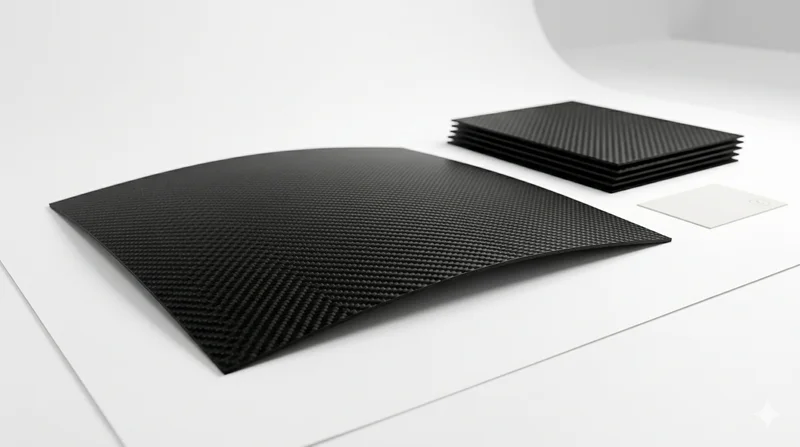
Carbon Fiber Plate — 3K Twill T700 1.5mm
Thin 1.5mm carbon fiber plate with 3K twill weave surface. Lightweight and stiff, commonly used for covers, panels, drone bodies, and applications requiring a premium aesthetic appearance.

Carbon Fiber Plate — 3K Twill T700 3.0mm
Medium-thickness 3.0mm carbon fiber plate offering significantly higher load capacity while maintaining attractive 3K twill finish. Suitable for structural brackets, reinforcement plates, and load-bearing panels.

Square Carbon Fiber Tube — 3K Twill T700
Square cross-section carbon fiber tube manufactured with 3K twill weave for torsional strength. Preferred for structural frames, trusses, and support columns where rectangular geometry offers design flexibility.

Carbon Fiber Pickleball Paddle
High-performance pickleball paddle with Toray T700 carbon fiber face and polypropylene honeycomb core. Delivers excellent power-to-weight ratio, spin generation, and vibration dampening for competitive play.
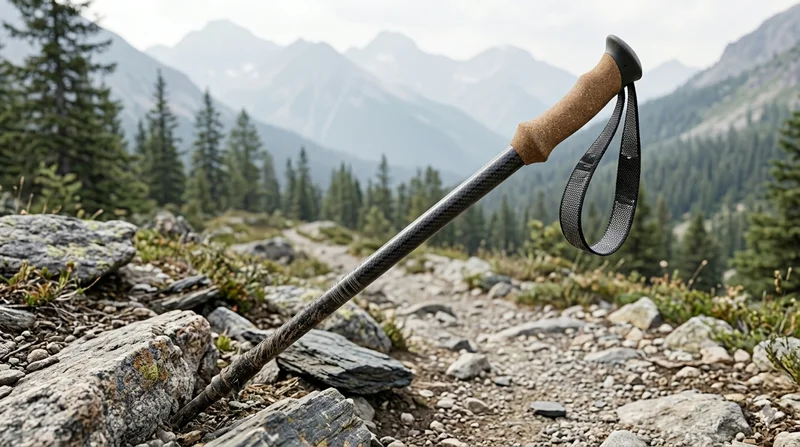
Carbon Fiber Trekking Pole
Lightweight carbon fiber trekking pole manufactured from high-grade carbon fiber tube. Weighs only 160g per pole while providing superior shock absorption and durability for hiking, trail running, and backpacking.