
Introduction Carbon fiber sheet 4x8-foot panels occupy a specific niche in the composites supply chain: large-format flat stock used for composite tooling, mold construction, architectural cladding, and precision industrial fixtures where weight savings and dimensional stability matter more than per
Introduction
Carbon fiber sheet 4x8-foot panels occupy a specific niche in the composites supply chain: large-format flat stock used for composite tooling, mold construction, architectural cladding, and precision industrial fixtures where weight savings and dimensional stability matter more than per-square-foot cost. Unlike small hobby-grade plates sold on consumer marketplaces, industrial 4x8 carbon fiber sheets are engineered products with specified fiber architectures, resin systems, and flatness tolerances that determine whether a mold surface stays true through hundreds of cure cycles or a facade panel remains flat under thermal loading.
This guide covers the full specification landscape for 4x8-foot carbon fiber sheets — from pressed and infused manufacturing methods to thickness selection, surface finish options, and real-world applications — so procurement teams and engineers can specify the right panel for their application rather than defaulting to whatever ships fastest from a stock catalog.
Manufacturing Methods for Large-Format Carbon Fiber Sheets
Two primary manufacturing routes produce industrial-grade 4x8 carbon fiber sheets, each with distinct properties and cost profiles:
- Press-molded (autoclave or press-cured):** Prepreg carbon fiber plies are laid up in a matched mold and cured under heat and pressure (typically 120-180°C, 4-7 bar). This produces the highest fiber volume fractions (58-62%), lowest void content (<1%), and best surface finish — Class A on the mold side. Press-molded sheets command premium pricing ($180-400 per panel depending on thickness and fiber grade) but deliver the flatness and consistency required for production tooling.
- Infusion-molded (VARTM or vacuum infusion):** Dry carbon fiber fabric is placed in a single-sided mold, sealed under vacuum bag, and resin is drawn through by vacuum pressure. Lower capital cost per panel ($80-200) makes infusion attractive for architectural cladding and non-critical fixtures, but fiber volume fractions run lower (45-55%) and void content is typically 1-3%. Surface finish on the bag side requires post-processing for optical flatness.
- Sheet molding compound (SMC) / compression molding:** Chopped carbon fiber in a resin matrix is compression-molded into flat sheets. Economical for high-volume non-structural panels but with mechanical properties 30-50% below continuous-fiber laminates. Not recommended for tooling applications requiring dimensional stability over thermal cycles.
For composite mold construction and precision fixtures, press-molded continuous-fiber sheets remain the standard. Infused panels suit applications where cost per square meter dominates and secondary finishing is acceptable.
Thickness, Flatness, and Surface Finish Specifications
Industrial 4x8 carbon fiber sheets are available in standard thickness ranges with specification tolerances that vary significantly by manufacturing method:
| Thickness | Typical Use | Press-Molded Flatness | Infused Flatness | Weight (approx.) |
|---|---|---|---|---|
| 3-6mm | Architectural cladding, cosmetic panels | ±0.3mm | ±0.8mm | 4.5-9 kg/panel |
| 8-12mm | Composite tooling, vacuum bag base plates | ±0.2mm | ±0.6mm | 12-18 kg/panel |
| 15-20mm | CNC fixture plates, jigs, drill templates | ±0.15mm | ±0.5mm | 22-30 kg/panel |
| 25mm+ | Heavy-duty tooling blocks (usually multi-layer bonded) | ±0.1mm | Rarely produced | 37+ kg/panel |
Surface finish options range from as-molded gloss (press-molded tool side) to matte peel-ply texture (infusion bag side) to CNC-machined and polished optical flat. For autoclave tooling applications, specify mold-side surface roughness of Ra 0.8-1.6μm to ensure proper gel coat adhesion and part release. Architectural facade panels often specify UV-stable clear coat over exposed weave for aesthetic applications.
Applications in Tooling, Construction, and Industry
The 4x8-foot format maps directly onto standard sheet-goods logistics — plywood, aluminum plate, and MDF all ship in this footprint — making carbon fiber sheets a drop-in replacement in existing workflows:
- Composite mold construction: 8-15mm press-molded sheets serve as base plates and crown structures for female molds in aerospace and marine programs. Low CTE (typically 1-2 ppm/°C in-plane) ensures dimensional stability across cure cycles.
- CNC fixture plates: 15-20mm machined sheets become drill jigs, inspection fixtures, and assembly templates where aluminum plates would induce thermal drift or magnetic interference.
- Architectural cladding: 3-6mm infused or prepreg panels with exposed weave finish provide lightweight, corrosion-resistant facade elements for high-end commercial and residential projects.
- Industrial machine components: Gantry cross-beams, laser cutter beds, and precision guide rails benefit from carbon's stiffness-to-weight ratio and vibration damping.
- Sporting goods and marine hardware: 4x8 sheets are CNC-cut into racing boat components, board sports cores, and high-performance cycling parts.
Handling logistics matter: a single 12mm press-molded 4x8 panel weighs approximately 18kg but spans 2.2 square meters — two-person lift recommended, with edge protection during transport to prevent delamination from impact.
Frequently Asked Questions
How much does a 4x8 carbon fiber sheet cost?
Pricing varies significantly by manufacturing method and thickness. Infused architectural panels run $80-150 per 4x8 sheet in 3-6mm thickness. Press-molded tooling-grade panels range from $180-400+ depending on fiber grade (standard vs high-modulus), thickness, and surface finish specification. High-modulus aerospace-grade panels with certified material documentation can exceed $600. Always request quotes with material certificates and flatness inspection reports included.
Can 4x8 carbon fiber sheets be cut with standard woodworking tools?
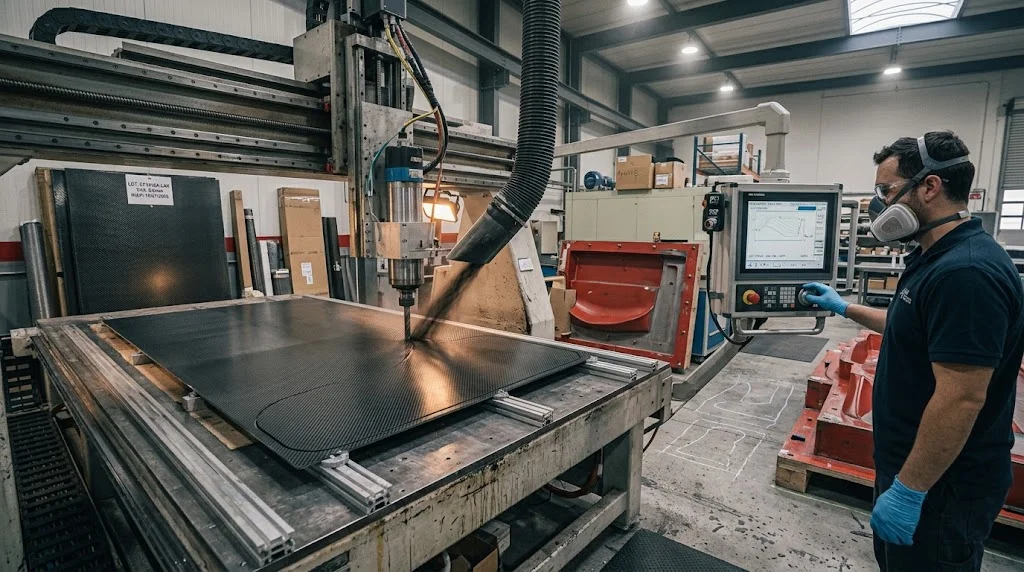
No. Carbon fiber is abrasive and generates conductive dust that damages standard saw blades quickly and poses inhalation hazards. Use CNC routing with diamond-coated or carbide tooling, or waterjet cutting for production quantities. Always cut with dust extraction and wear appropriate PPE — carbon dust requires respiratory protection rated for fine particulate.
What is the difference between press-molded and infused 4x8 sheets for tooling applications?
Press-molded sheets offer higher fiber volume (58-62% vs 45-55%), lower void content (<1% vs 1-3%), better flatness (±0.2mm vs ±0.6mm on 10mm panels), and superior thermal stability — critical for production tooling that experiences hundreds of cure cycles. Infused sheets are 30-50% less expensive but may require secondary machining or bonding to achieve tooling-grade flatness. For one-off or low-cycle fixtures, infused panels with post-machined surfaces can be cost-effective; for production molds, press-molded is the standard.
Conclusion
Carbon fiber sheet 4x8-foot panels bridge the gap between small-format carbon plate stock and full composite structure fabrication. Press-molded continuous-fiber sheets deliver the flatness, thermal stability, and mechanical consistency required for production tooling and CNC fixtures; infused panels offer architectural and non-critical applications at lower cost. Specifying the right manufacturing method, thickness, and surface finish for your application — rather than defaulting to the cheapest catalog option — determines whether the panel performs as a precision tool or becomes an expensive flat surface that warps under its first thermal cycle.
For engineers and procurement teams sourcing large-format carbon fiber sheets with certified material documentation, controlled flatness tolerances, and custom CNC cutting services, explore our carbon fiber sheet product range or contact our sales engineering team to discuss panel specifications, surface finish options, and volume pricing for your program.
Part of topic
Related Articles
- Carbon Fiber Tubes USA: Domestic Suppliers and Lead Times
- Carbon Fiber Rod Supplier: Pultruded vs Roll-Wrapped Quality Comparison
- Carbon Fiber Suppliers in UAE: Sourcing for Aviation, Oil and Gas and Construction
- Carbon Fiber Tubes: Stock Range, Fiber Orientation and Joint Design
- Carbon Fiber Rod Price: Volume Discounts and Custom Diameter Economics
- Carbon Fiber Suppliers USA: Domestic Sourcing for Defense, Aerospace and Motorsport
Interested in Our Products?
Contact our team for competitive pricing and technical specifications.
Get a QuoteRelated Products

Round Carbon Fiber Tube — 3K Plain Weave T700
Standard round carbon fiber tube manufactured from Toray T700 grade fiber with 3K plain weave. Offers balanced strength and stiffness for general industrial applications including robotics, automation, sports equipment, and aerospace structures.

Square Carbon Fiber Tube — 3K Twill T700
Square cross-section carbon fiber tube manufactured with 3K twill weave for torsional strength. Preferred for structural frames, trusses, and support columns where rectangular geometry offers design flexibility.

Carbon Fiber Trekking Pole
Lightweight carbon fiber trekking pole manufactured from high-grade carbon fiber tube. Weighs only 160g per pole while providing superior shock absorption and durability for hiking, trail running, and backpacking.

Carbon Fiber Pickleball Paddle
High-performance pickleball paddle with Toray T700 carbon fiber face and polypropylene honeycomb core. Delivers excellent power-to-weight ratio, spin generation, and vibration dampening for competitive play.

Round Carbon Fiber Tube — 3K Twill
Lightweight and ultra-stiff round tubes ideal for drone frames, robotics, and structural applications.