
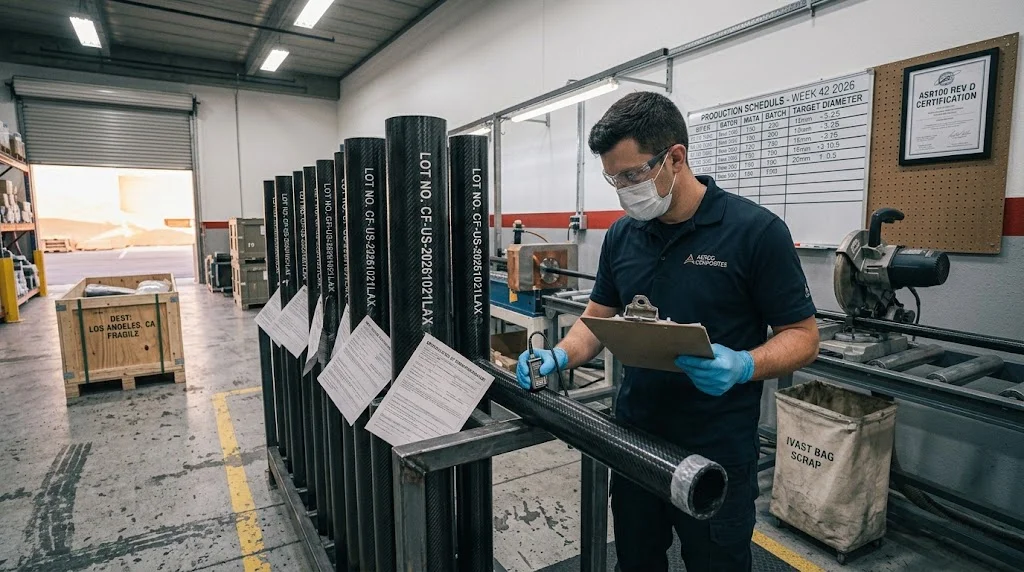
Introduction Sourcing carbon fiber tubes USA-based has become a priority for defense contractors, aerospace OEMs, robotics integrators, and industrial equipment builders who need reliable domestic supply, controlled documentation, and predictable lead times. The phrase "carbon fiber tubes usa" captu
Introduction
Sourcing carbon fiber tubes USA-based has become a priority for defense contractors, aerospace OEMs, robotics integrators, and industrial equipment builders who need reliable domestic supply, controlled documentation, and predictable lead times. The phrase "carbon fiber tubes usa" captures a buyer intent that goes beyond price shopping: these buyers are qualifying suppliers for production programs, where a missed delivery or an uncontrolled material substitution can halt an assembly line or fail an audit. This guide maps the landscape of domestic carbon fiber tube suppliers, explains realistic lead time expectations for stock and custom profiles, and gives procurement teams a concrete framework for evaluating manufacturers on the criteria that actually matter in production environments.
Whether you are an engineer selecting a tube supplier for a robotics arm project or a purchasing manager consolidating composite spending, understanding the domestic supply ecosystem — who manufactures where, what they stock, how fast they ship, and what documentation they provide — is the difference between a qualified source and a recurring headache.
Domestic vs Imported Carbon Fiber Tubes: The Real Trade-Offs
The USA carbon fiber tube market blends domestic manufacturers with imported stock from China, Taiwan, and Europe. Each sourcing route carries distinct advantages and risks that procurement teams must weigh against their program requirements:
- Domestic manufacturers: Offer tighter quality control systems (often AS9100 or ISO 9001 certified), full material traceability with lot-specific certificates of conformance, domestic engineering support for custom layup design, and IP protection for proprietary profiles. Lead times for custom pultruded or roll-wrapped tubes typically run 4-8 weeks. Unit costs run 20-60% higher than offshore alternatives at comparable specifications.
- Imported stock (China/Taiwan):** Competitive pricing for standard round and square profiles held in US warehouses by distributors. Faster to market for prototype quantities and non-critical applications. Reduced traceability — material certificates may reference mill lots without full process data. Custom profiles require 8-12 week ocean freight lead times. IP exposure for proprietary cross-sections.
- Hybrid approach: Many production programs qualify a domestic supplier for flight-critical or export-controlled assemblies while sourcing commodity sizes from importers for non-structural brackets, fixtures, and secondary structures. This balances cost and compliance without over-concentrating risk.
Export control classification matters: carbon fiber tubes with certain fiber types (certain high-modulus grades) or destined for defense applications may fall under ITAR or EAR jurisdiction, making domestic sourcing not just preferable but legally required. Confirm classification before qualifying any offshore source.
Typical Lead Times for Stock vs Custom Profiles
Lead time expectations vary dramatically between catalog items and engineered custom profiles. Procurement teams should build schedules around these realistic ranges rather than optimistic quotes:
| Tube Type | Domestic Lead Time | Imported Stock (US Warehouse) | Custom Import |
|---|---|---|---|
| Standard round pultruded (in-stock sizes) | 1-2 weeks | Ships same week | N/A |
| Standard round, non-stock diameter | 3-5 weeks | 2-3 weeks (from importer stock) | 8-12 weeks |
| Custom pultruded profile | 5-8 weeks | Rarely available | 10-14 weeks |
| Roll-wrapped / filament-wound custom | 6-10 weeks | Limited sizes only | 12-16 weeks |
| CNC-machined tube with close tolerances | 3-6 weeks | 4-6 weeks | Not economical |
Domestic lead times reflect mold/die fabrication schedules for custom pultrusion (if no existing tooling), prepreg kitting, cure cycle scheduling, and CNC finishing. Import lead times add ocean freight, customs clearance, and inland distribution. Expedite fees of 25-40% are common for compressed domestic schedules; true expedite on imports is usually limited to air freight at 3-5x normal cost.
Evaluating USA Carbon Fiber Tube Suppliers
A qualified carbon fiber tube supplier should clear these evaluation gates before receiving a production purchase order:
- Certification and quality system: ISO 9001 minimum; AS9100D for aerospace and defense. Request the current certificate and scope statement — not just a logo on a website.
- Material traceability: Lot-specific resin and fiber identification, cure cycle records, and dimensional inspection reports shipping with each order. For prepreg-based tubes, cold chain documentation.
- Tolerance capability: Diameter tolerance of ±0.05mm on precision roll-wrapped tubes, ±0.1mm on pultruded stock. Straightness specifications (typically ≤1mm per meter). Wall thickness consistency verified by ultrasonic or air-gauge measurement.
- Engineering engagement: Willingness to review layup schedules, discuss fiber orientation for your load case, and provide failure analysis support. Red flag: a supplier who cannot explain how their process produces the quoted mechanical properties.
- Capacity and continuity: Multiple cure ovens or pultrusion lines, safety stock of raw fiber for qualified programs, and documented business continuity planning. Single-line shops pose concentration risk for production programs.
Site audits remain the gold standard for production qualification. For remote qualification, request a virtual tour of the pultrusion line or cure facility, sample certificates from recent shipments, and reference calls with existing production customers.
Frequently Asked Questions
Why do domestic carbon fiber tubes cost more than imported alternatives?
Domestic pricing reflects higher labor costs, stricter quality management systems, full material traceability requirements, shorter supply chains with lower logistics risk, and compliance with US export control and IP protection standards. For production programs where material failure carries liability or requalification costs, the domestic premium typically pays for itself in avoided scrap, rework, and schedule risk.
Can I get carbon fiber tubes made in the USA with offshore-competitive pricing?
For standard pultruded profiles in common diameters, yes — high-volume domestic pultruders approach import pricing through automated lines and material purchasing leverage. For custom roll-wrapped or filament-wound tubes with aerospace-grade fiber, domestic pricing will remain 20-40% above offshore alternatives due to labor intensity and smaller production runs. Volume commitments and multi-year agreements can narrow this gap.
What documentation should accompany a domestic carbon fiber tube shipment?
Request: certificate of conformance referencing the purchase order and lot number; material certificates for resin and fiber (with manufacturer, grade, and lot data); cure or pultrusion process records; dimensional inspection report (diameter, wall thickness, straightness, length); and packing list with handling instructions for temperature-sensitive prepreg-based products. Aerospace programs should also receive first-article inspection reports per AS9102.
Conclusion
Sourcing carbon fiber tubes USA-based requires matching the supplier to the program's compliance, traceability, and lead time requirements rather than defaulting to the lowest unit price. Domestic manufacturers deliver quality systems, documentation, and engineering support that production environments demand, at a cost premium that typically justifies itself in risk reduction. Imported stock remains viable for prototypes, non-structural applications, and commodity sizes. A balanced supply chain — domestic for qualified production, importers for overflow and non-critical parts — gives procurement teams both cost control and program security.
For buyers evaluating carbon fiber tube suppliers with full technical documentation, lot traceability, and domestic engineering support, explore our carbon fiber tube product range or contact our sales engineering team to discuss custom profiles, tolerance requirements, and qualification samples for your program.
Part of topic
Related Articles
- Carbon Fiber Sheet 4x8: Large-Format Panels for Tooling and Construction
- Carbon Fiber Rod Supplier: Pultruded vs Roll-Wrapped Quality Comparison
- Carbon Fiber Suppliers in UAE: Sourcing for Aviation, Oil and Gas and Construction
- Carbon Fiber Tubes: Stock Range, Fiber Orientation and Joint Design
- Carbon Fiber Rod Price: Volume Discounts and Custom Diameter Economics
- Carbon Fiber Suppliers USA: Domestic Sourcing for Defense, Aerospace and Motorsport
Interested in Our Products?
Contact our team for competitive pricing and technical specifications.
Get a QuoteRelated Products

Round Carbon Fiber Tube — 3K Plain Weave T700
Standard round carbon fiber tube manufactured from Toray T700 grade fiber with 3K plain weave. Offers balanced strength and stiffness for general industrial applications including robotics, automation, sports equipment, and aerospace structures.

Square Carbon Fiber Tube — 3K Twill T700
Square cross-section carbon fiber tube manufactured with 3K twill weave for torsional strength. Preferred for structural frames, trusses, and support columns where rectangular geometry offers design flexibility.

Carbon Fiber Trekking Pole
Lightweight carbon fiber trekking pole manufactured from high-grade carbon fiber tube. Weighs only 160g per pole while providing superior shock absorption and durability for hiking, trail running, and backpacking.

Carbon Fiber Pickleball Paddle
High-performance pickleball paddle with Toray T700 carbon fiber face and polypropylene honeycomb core. Delivers excellent power-to-weight ratio, spin generation, and vibration dampening for competitive play.

Round Carbon Fiber Tube — 3K Twill
Lightweight and ultra-stiff round tubes ideal for drone frames, robotics, and structural applications.