
Choosing a carbon fiber rod supplier gets confusing the moment two quotes describe the same 8 mm rod and differ by a factor of three. One is priced like commodity stock, the other talks about mandrels, cure cycles and layup schedules, and neither invoice says which process actually made the rod. The
Introduction
Choosing a carbon fiber rod supplier gets confusing the moment two quotes describe the same 8 mm rod and differ by a factor of three. One is priced like commodity stock, the other talks about mandrels, cure cycles and layup schedules, and neither invoice says which process actually made the rod. The split behind those quotes is pultruded versus roll-wrapped, and that single distinction moves fiber alignment, tolerance, transverse strength, lead time and price further than any grade letter printed on the spec sheet.
This article compares both processes side by side, shows how to read a carbon fiber rod price quote line by line, and lists the shop-floor checks that separate a disciplined manufacturer from a catalog reseller. Whether you are buying straight pins for tooling or comparing carbon fiber rods for sale for a robot arm program, the same four inspections decide whether the material that arrives matches the drawing.
What the process decides: pultrusion versus roll-wrapping
Pultrusion is a continuous process. Roving is pulled through a resin bath and then through a heated die that shapes and cures the rod in one pass, at line speeds around 0.3 to 1.5 m per minute. Because every filament runs along the axis, a pultruded rod maximizes stiffness and strength per euro in the axial direction, and straightness is set by the die rather than by an operator. The trade-offs follow from the same geometry: no hoop or angle plies means weak transverse strength and splitty cut ends, and the tolerance is only as good as the die, which wears.
Roll-wrapping builds the rod on a mandrel. Prepreg or wet-wound plies, usually a 0-degree core with plus or minus angle layers on the surface, are cured under heat and pressure, then trimmed. The mandrel fixes the inner diameter and roundness, the angle plies add hoop integrity and damage tolerance, and the surface comes out smooth enough for bonding and painting. The cost is throughput: each batch needs its own cure cycle, so roll-wrapped rod is priced higher and scheduled in weeks rather than pulled off a shelf.
- Pultruded: continuous axial fiber, lowest cost per meter, excellent straightness, weak transverse direction, die-limited diameters.
- Roll-wrapped: tailored layup, higher transverse strength and surface quality, tighter roundness, higher price and longer lead time.
- Neither is better overall: the correct choice is the one whose weakness your application never touches.
How a carbon fiber rod supplier grades both processes
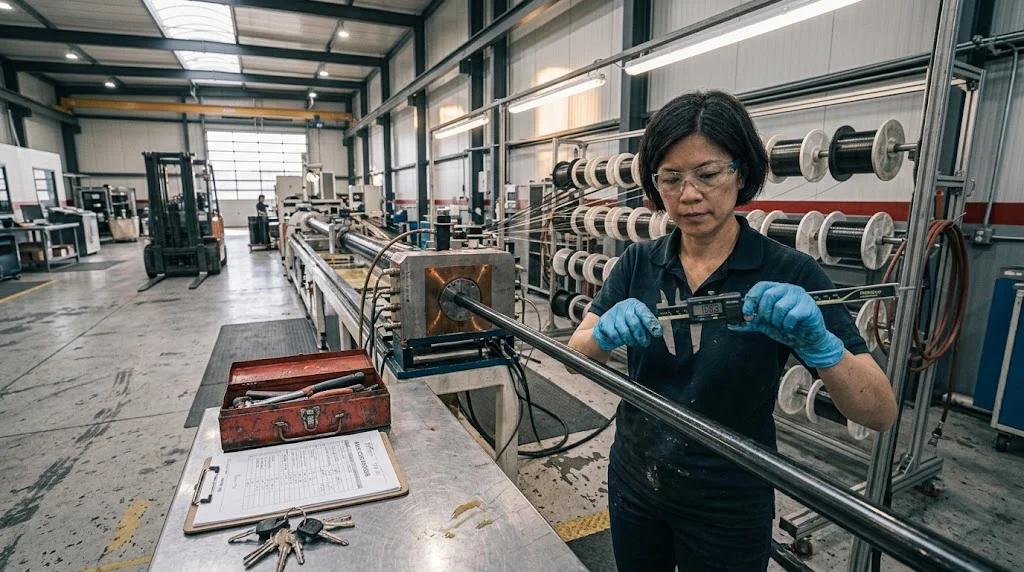
A supplier who runs or audits production can answer three questions from the last batch without sending an email. First, the cut end: fiber distribution should be concentric, voids should be absent at 10x magnification, and resin should neither starve nor puddle. Second, runout: roll the rod across a surface plate and measure deflection with a dial indicator over the full length, because a rod that bows 2 mm over a meter will not install the way the drawing promises. Third, cure: ask for the cure record or glass transition result tied to the lot number, not a generic datasheet that could belong to anyone's material.
Watch for the hybrid answer, where stock is pulled from a trading warehouse and certificates arrive separately from goods. Certificates that travel in the same box as the rod are worth more than certificates that arrive after payment, and a supplier willing to schedule a warehouse visit usually has something real to show.
Pultruded versus roll-wrapped rod: side-by-side data
The table below summarizes what typically separates the two forms in quotes from competent sources. Numbers are typical for standard-modulus tow in epoxy resin, so treat them as comparison bands rather than guaranteed specifications.
| Check | Pultruded rod | Roll-wrapped rod |
|---|---|---|
| Fiber architecture | Continuous 0-degree UD, no hoop | 0-degree core plus angle plies |
| Diameter tolerance | Typically plus or minus 0.1 mm | Typically plus or minus 0.05 mm |
| Straightness | Set by die, very high | Set by mandrel and cure, high |
| Transverse strength | Low, resin-dominated | Higher, plies bridge cracks |
| Axial tensile strength | 1,200 to 1,800 MPa | Layup-dependent, roughly 1,000 to 1,600 MPa |
| Surface | Matte, die-polished | Smooth, mandrel finish |
| 6 mm price band | 2.20 to 3.50 USD per meter | Usually two to four times higher |
| Lead time | Days from stock, 3-5 weeks custom | 3-6 weeks, cure-cycle bound |
| Common defect | Voids, fiber waviness in die | Porosity, wrinkling at ply drops |
How to read a carbon fiber rod price quote
Price spreads of three times on the same diameter are normal once you know where to look, and the cheapest line on a comparison sheet is rarely the cheapest delivered material. Read every quote against these points:
- Unit basis: per meter, per kilogram, or per cut length. A per-kilogram number hides the cutting and packaging cost that a per-meter number already includes.
- Tolerance class: plus or minus 0.1 mm and plus or minus 0.05 mm are different products with different scrap rates, and a quote silent on tolerance is quoting the loose one.
- Fiber grade and resin: stepping from standard to intermediate modulus can add 30 to 60 percent to material cost, and vinyl ester cures cheaper than structural epoxy in pultrusion.
- Minimum order and finishing: cutting to length, chamfering, sanding and packaging each add cost, and a low minimum order often carries a surcharge that erases the apparent saving.
- Delivery terms: specify the Incoterms rule, because freight, duty and insurance shift the comparison more than the per-meter difference between two competent suppliers.
Ask each source to quote the same tolerance, the same resin and the same cut length in writing. Once the quotes describe identical products, the spread usually collapses to the real difference in process control and inventory.
What a carbon fiber rod manufacturer controls on the line
Behind every stable quote sits a short list of process controls that a serious carbon fiber rod manufacturer treats as non-negotiable. On the pultrusion line it is die wear logs, bath ratio, pull tension and line speed, because a worn die silently opens the tolerance band over a production run. On the roll-wrapping side it is mandrel runout, ply drop positions, vacuum integrity and the cure profile, because most roll-wrapped defects are born in the layup and only discovered at trimming.
Over both processes sits traceability: a lot number that follows the rod from roving creel to shipping carton, a first-article inspection on any new die or mandrel, and the discipline to hold a batch when a measurement drifts rather than shipping it and arguing later. Those controls are exactly what you are buying when two offers differ by three times, and they are the reason the more expensive quote often costs less after scrap and rework are counted.
Frequently Asked Questions
Which process should a mostly axial structural part use?
If the load is axial bending or tension and the surface will not be bonded or painted, pultruded rod usually wins on cost and straightness because all of its fiber runs along the axis. When the part gets drilled, clamped, bonded to a skin, or hit, the angle plies and tighter tolerance of roll-wrapped construction earn their price. Send both options to your stress check with the actual layup properties instead of comparing them on grade letters alone.
Why do two quotes for the same diameter differ by three times?
Almost always one quote is pultruded stock at a loose tolerance in standard-modulus fiber, and the other is roll-wrapped or tight-tolerance pultruded material with a certificate attached. Line by line, check the process, the tolerance, the fiber grade, the resin, the cut length and the delivery terms; when those six fields match, the price gap usually shrinks to a few percent. A gap that survives matching all six fields is telling you something about inventory and process control rather than about margin.
How do you verify a new supplier before committing volume?
Order a qualification batch small enough to run through your own incoming inspection: measure diameter and runout on several rods, inspect cut ends, and pull a tensile coupon if the application warrants it. Confirm that the certificate in the box carries the same lot number as the carton label, then repeat the check for the second delivery, because consistency across two shipments is the actual proof of process control. Volume should follow the second passed batch, not the first polished sales call.
Conclusion
Pultruded and roll-wrapped rods are not competing answers to one question; they are different tools, and the process behind each one explains every number that shows up later in tolerance, strength and price. A supplier who can show die wear logs, mandrel records, lot traceability and certificates that travel with the goods is selling process control, and that is what survives contact with your assembly line.
Start by writing the tolerance, resin and delivery terms into the request, then send it to suppliers who will accept a warehouse visit. Browse our carbon fiber rod and tube range, or contact our engineering team with your drawing and annual volume, and we will quote the process that fits the part instead of the one that fits our inventory.
Part of topic
Related Articles
- Carbon Fiber Sheet 4x8: Large-Format Panels for Tooling and Construction
- Carbon Fiber Tubes USA: Domestic Suppliers and Lead Times
- Carbon Fiber Suppliers in UAE: Sourcing for Aviation, Oil and Gas and Construction
- Carbon Fiber Tubes: Stock Range, Fiber Orientation and Joint Design
- Carbon Fiber Rod Price: Volume Discounts and Custom Diameter Economics
- Carbon Fiber Suppliers USA: Domestic Sourcing for Defense, Aerospace and Motorsport
Interested in Our Products?
Contact our team for competitive pricing and technical specifications.
Get a QuoteRelated Products

Round Carbon Fiber Tube — 3K Plain Weave T700
Standard round carbon fiber tube manufactured from Toray T700 grade fiber with 3K plain weave. Offers balanced strength and stiffness for general industrial applications including robotics, automation, sports equipment, and aerospace structures.

Square Carbon Fiber Tube — 3K Twill T700
Square cross-section carbon fiber tube manufactured with 3K twill weave for torsional strength. Preferred for structural frames, trusses, and support columns where rectangular geometry offers design flexibility.

Carbon Fiber Trekking Pole
Lightweight carbon fiber trekking pole manufactured from high-grade carbon fiber tube. Weighs only 160g per pole while providing superior shock absorption and durability for hiking, trail running, and backpacking.

Carbon Fiber Pickleball Paddle
High-performance pickleball paddle with Toray T700 carbon fiber face and polypropylene honeycomb core. Delivers excellent power-to-weight ratio, spin generation, and vibration dampening for competitive play.

Carbon Fiber Plate — 3K Twill T700 3.0mm
Medium-thickness 3.0mm carbon fiber plate offering significantly higher load capacity while maintaining attractive 3K twill finish. Suitable for structural brackets, reinforcement plates, and load-bearing panels.