
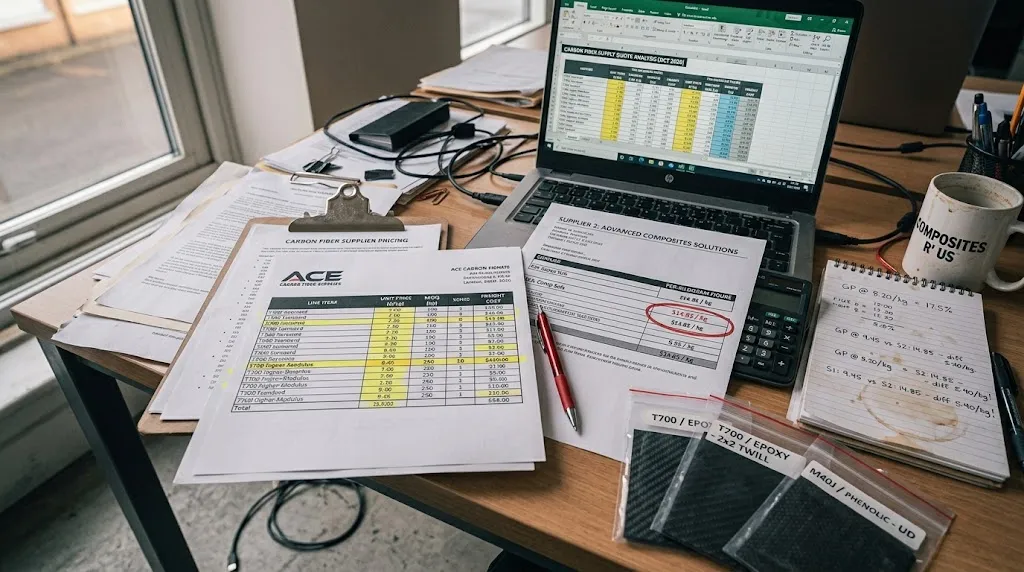
A carbon fiber supplier pricing sheet is the document that turns a technical specification into a commercial commitment — yet it is routinely misread by procurement teams who compare only the headline number. The same grade of carbon fiber can appear 40% cheaper on one sheet and more expensive than
Introduction
A carbon fiber supplier pricing sheet is the document that turns a technical specification into a commercial commitment — yet it is routinely misread by procurement teams who compare only the headline number. The same grade of carbon fiber can appear 40% cheaper on one sheet and more expensive than a competitor on another, purely because of unit bases, included services, currency assumptions, and order-size brackets that are buried in footnotes rather than stated in the price column. Understanding how a carbon fiber supplier pricing sheet is structured, what each line item actually covers, and which surcharges sit outside the quoted number is the difference between a competitive award and a budget overrun six months into production.
This guide walks through the anatomy of a typical pricing sheet for carbon fiber sheets, plates, tubes, and panels, explains the unit conventions suppliers use, and shows how to normalize quotes so the price of carbon fiber per kg — and per finished part — can be compared like for like. It closes with a negotiation checklist procurement teams can apply before any supply agreement is signed.
Anatomy of a Carbon Fiber Supplier Pricing Sheet
A well-structured pricing sheet separates material cost from process cost, but many supplier quotes collapse the two. The table below maps the line items you should expect and what each one actually controls:
| Line Item | What It Controls | Common Pitfall |
|---|---|---|
| Fiber grade (T300, T700, T800) | Raw material class and mechanical properties | Grade equivalence claims without test method citations |
| Areal weight (g/m²) | Fabric density and resin uptake per unit area | Quoted on dry fabric weight while pricing assumes prepreg weight |
| Unit price basis | Per kg, per meter, per sheet, or per square meter | Per-kg pricing that excludes tooling, cutting, and packaging |
| Minimum order quantity | Smallest shippable lot and its price break | Low unit price valid only above an unrealistic MOQ |
| Currency and validity | Exchange rate basis and quote expiration | Prices firm in USD while costs are incurred in a volatile local currency |
| Included services | Cutting, bagging, labeling, certification | Services listed as included but charged as extras on the invoice |
The single most important column is the unit price basis. A quote of $18 per kg for carbon fiber sheet means nothing until you know whether that price assumes bulk roll goods, cut-to-size sheets, or finished panels with peel ply applied. For cut-to-size work, the effective price of carbon fiber per kg rises sharply once scrap allowance and nesting efficiency are factored in.
Hidden Costs That Distort the Headline Price
Beyond the unit price, several cost layers sit outside the number procurement teams usually compare first:
- Freight and insurance: Carbon fiber sheets and tubes are bulky relative to their weight; air freight can add 15-25% to landed cost for urgent orders, while sea freight introduces lead-time risk that may justify higher safety stock.
- Packaging and moisture protection: Prepreg materials require cold-chain packaging with dry ice or gel packs; standard-grade sheets may only need moisture barrier bags, but the difference is rarely itemized.
- Certification and traceability: Lot-specific certificates of conformance, test reports to ASTM D3039, and full material traceability add administrative cost that some suppliers include and others charge separately.
- Currency hedging: If a supplier quotes in USD but sources fiber in another currency, exchange-rate movement between quote and shipment can shift landed cost 5-10% without any change in the agreed unit price.
- Tooling and setup: Custom plate geometries, tube mandrels, or mold tooling are frequently quoted as one-time charges outside the recurring unit price — a legitimate practice, but one that must be amortized explicitly across the program volume.
For carbon fiber round tubes, price comparison is especially sensitive to wall thickness tolerance and fiber alignment method — pultruded tubes and roll-wrapped tubes can share a nominal outer diameter yet differ 30% in material cost per meter.
Normalizing Quotes for Fair Comparison
Two buyers looking at the same carbon fiber supplier pricing sheet can reach different conclusions if they do not normalize for order volume, scrap rate, and included services. A reliable comparison framework uses three steps:
- Convert to a common unit basis: Reprice every quote to cost per kilogram of usable material — not per sheet, not per meter. Divide the total lot cost by the net weight that actually lands in your layup, excluding packaging and scrap.
- Apply your own scrap rate: If your nesting efficiency is 70%, a supplier quoting $20 per kg of raw sheet is effectively charging you $28.60 per kg of finished part. Apply the same scrap assumption to every quote before ranking them.
- Separate one-time from recurring costs: Tooling, first-article inspection, and qualification testing belong in a separate column from unit price. Amortize them across your expected program volume to see the true per-unit burden.
With this normalization in place, the price of carbon fiber sheets price quotes from different suppliers becomes comparable — and the lowest headline number is often no longer the lowest total cost. Suppliers offering tighter thickness tolerance, documented fiber volume fraction, or included cutting services may price 8-12% higher per kilogram yet deliver lower total cost once scrap and rework are counted.
Frequently Asked Questions
What is a realistic price range for carbon fiber per kg on a supplier pricing sheet?
For standard-modulus PAN-based carbon fiber (T300 class), bulk tow pricing typically falls in the $15-25 per kg range depending on order volume and grade. Intermediate-modulus grades (T700, T800 class) command $25-45 per kg, while high-modulus pitch-based grades exceed $80 per kg. Cut-to-size sheets and finished plates add processing cost that can double the effective per-kilogram price versus bulk material. Always confirm whether the quoted price is for dry fiber, prepreg, or cured laminate — these are three different price points that are frequently presented without qualification.
How do I compare a per-kg quote against a per-sheet quote?
Convert both to cost per kilogram of net usable material. Weigh a representative sheet, confirm whether the quoted weight is dry fabric weight or cured panel weight, then divide the sheet price by that weight. Apply your own scrap rate for cutting efficiency. A per-sheet quote that looks expensive may normalize favorably if the supplier includes precision cutting, peel ply, or bagging that you would otherwise pay for separately.
What payment terms are typical for carbon fiber supply agreements?
For established supply relationships, 30% deposit with balance against shipping documents is common for first orders, relaxing to net 30 or net 60 terms once volume history is established. New suppliers or custom tooling runs may require 50% deposit. Watch for clauses that tie price validity to raw material index movements — these can void a favorable unit price mid-program if fiber markets shift.
Conclusion
Reading a carbon fiber supplier pricing sheet correctly means looking past the headline number to the unit basis, MOQ, included services, and hidden surcharges that determine landed cost. Normalizing every quote to cost per kilogram of usable material — after applying your own scrap rate and amortizing tooling — is the only way to compare suppliers on equal footing. The lowest unit price is not always the lowest total cost, especially when certification, tolerance, and included cutting services vary between vendors.
YongXian supplies carbon fiber sheets, plates, tubes, and panels with transparent pricing, lot traceability, and application-specific technical support. Explore our carbon fiber product range or request a detailed quotation to compare line-item pricing for your next program.
Part of topic
Related Articles
- How to Choose a Carbon Fiber Drone Manufacturer
- Carbon Fiber Plate Custom: CNC Cutting, Nesting and Thickness Selection
- Carbon Fiber Tube Custom Orders: OD, Wall Thickness and Tolerance Buying Guide
- Carbon Fiber Sheet 4x8: Large-Format Panels for Tooling and Construction
- Carbon Fiber Tubes USA: Domestic Suppliers and Lead Times
- Carbon Fiber Rod Supplier: Pultruded vs Roll-Wrapped Quality Comparison
Interested in Our Products?
Contact our team for competitive pricing and technical specifications.
Get a QuoteRelated Products

Round Carbon Fiber Tube — 3K Plain Weave T700
Standard round carbon fiber tube manufactured from Toray T700 grade fiber with 3K plain weave. Offers balanced strength and stiffness for general industrial applications including robotics, automation, sports equipment, and aerospace structures.

Square Carbon Fiber Tube — 3K Twill T700
Square cross-section carbon fiber tube manufactured with 3K twill weave for torsional strength. Preferred for structural frames, trusses, and support columns where rectangular geometry offers design flexibility.

Carbon Fiber Pickleball Paddle
High-performance pickleball paddle with Toray T700 carbon fiber face and polypropylene honeycomb core. Delivers excellent power-to-weight ratio, spin generation, and vibration dampening for competitive play.

Carbon Fiber Trekking Pole
Lightweight carbon fiber trekking pole manufactured from high-grade carbon fiber tube. Weighs only 160g per pole while providing superior shock absorption and durability for hiking, trail running, and backpacking.

Carbon Fiber Plate — 3K Twill T700 3.0mm
Medium-thickness 3.0mm carbon fiber plate offering significantly higher load capacity while maintaining attractive 3K twill finish. Suitable for structural brackets, reinforcement plates, and load-bearing panels.