
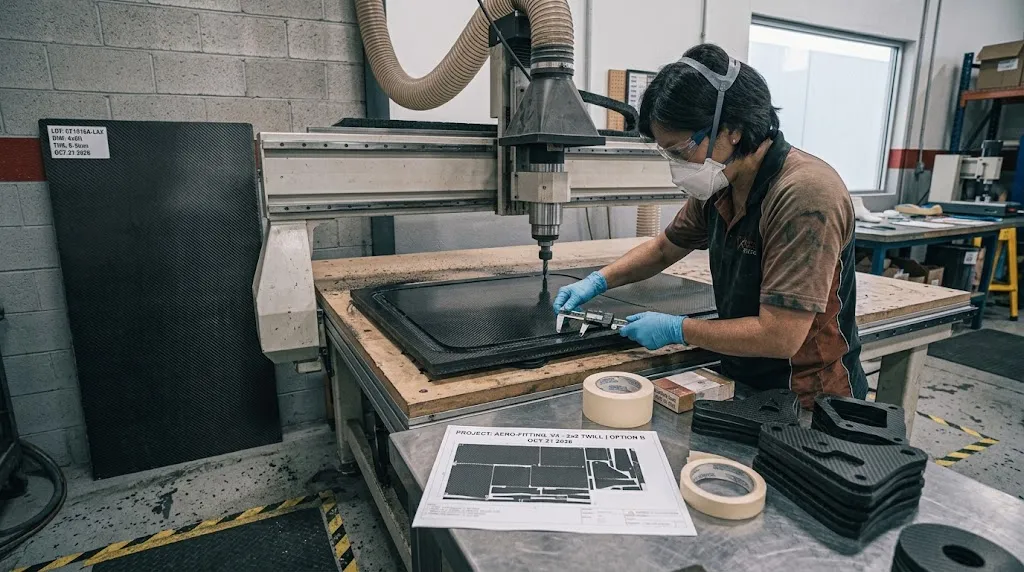
A carbon fiber plate custom program starts long before the spindle turns: it begins with a drawing review that fixes material grade, laminate stack, finished thickness and tolerance, then a nesting step that maps every part onto the available sheet. Whether you buy a carbon fiber sheet for sale from
Introduction
A carbon fiber plate custom program starts long before the spindle turns: it begins with a drawing review that fixes material grade, laminate stack, finished thickness and tolerance, then a nesting step that maps every part onto the available sheet. Whether you buy a carbon fiber sheet for sale from stock or order quasi-isotropic laminate cut to your outline, the economics and the risks live in the same three decisions — grade, thickness and how efficiently parts are nested. This guide walks through the full workflow: what to specify in a request for quote, how suppliers nest parts on 4x8-foot sheets, which cutting process suits which thickness, and how to select a finished thickness that meets your stiffness target without paying for plies you do not need.
What a Supplier Needs for a Carbon Fiber Plate Custom Quote
Most delays in custom plate programs come from an incomplete RFQ, not from machining. A quote that holds up under production needs five things specified up front:
- Material system: layup type (quasi-isotropic, UD-dominant, or woven face sheets), fiber grade (T300-class, T700-class) and resin system (epoxy for room-temperature structure, phenolic for flame-smoke-toxicity requirements).
- Finished thickness and tolerance: state the finished value plus allowable band — a common callout is 3.0 mm ±0.15 mm after cure, which constrains the number of plies before cutting ever starts.
- Flatness and edge requirements: warpage limit (typically 1 mm over 300 mm for machined plates), whether edges need sealing, and whether CNC-milled edges or waterjet-cut edges are acceptable.
- Quantity and part count per sheet: the same drawing at 20 pieces and 2,000 pieces should not be priced the same, because nesting efficiency and setup amortization dominate at low volume.
- Inspection expectations: ultrasonic c-scan for voids, dimensional report, or simple certificate of conformance — each adds a different amount to piece price.
Nesting Carbon Fiber Sheets: Why 4x8 Layouts Decide Cost
Raw carbon fiber plate is produced and sold in standard sheets — the workhorse format is 1220 × 2440 mm (4 × 8 feet), with 1000 × 1000 mm and 1220 × 1220 mm common as well. A carbon fiber sheets 4x8 layout is where a custom job becomes cheap or expensive: material is billed by the sheet consumed, not by the weight of your parts, so yield directly drives unit price. Suppliers nest parts with a CAM optimizer, rotating and interleaving outlines to hold sheet utilization above 70–80 percent; a sparse nest of large rectangular blanks can fall below 50 percent, and that loss is passed into the quote.
| Finished Thickness | Typical Layup | Approx. Areal Mass | Flat Stiffness Index | Best-Fit Application |
|---|---|---|---|---|
| 0.5–1.0 mm | 2–4 plies woven 200 gsm | 750–1500 g/m² | 1× | Skins, covers, decorative panels |
| 1.5–3.0 mm | 6–12 plies quasi-isotropic | 2200–4400 g/m² | 8–25× | Robot arms, jigs, fixture plates |
| 4.0–6.0 mm | 16–24 plies quasi-isotropic | 5900–8800 g/m² | 55–160× | Machine mounts, tooling boards |
| 8.0–10.0 mm | 30–45 plies quasi-isotropic | 11,700–14,600 g/m² | 200–600× | Structural base plates, molds |
For buyers comparing a carbon fibre sheet custom size against a stocked panel: a non-standard size (say 900 × 1400 mm) is cut from a standard sheet and often billed as a full sheet anyway, whereas standard sizes bought as a carbon fiber sheet for sale from inventory carry no nesting penalty. If your part fits inside a stock size, ask for the stock size first.
Thickness Selection for Carbon Fiber Plate Custom Programs
Thickness is the single biggest lever on both performance and price, and it should be derived from a stiffness requirement rather than copied from an existing part. Start from the load case: for a plate spanning two supports, bending stiffness scales with the cube of thickness, so doubling thickness multiplies stiffness roughly eightfold while only doubling material cost. That asymmetry is why over-thick plates are wasteful — you pay twice for eight times the stiffness you may not need — and why under-thick plates force a second, expensive revision.
- Define the metric: bending stiffness (N/mm), first natural frequency, or allowable deflection under a stated load. Specify the span; stiffness without a span is meaningless.
- Pick the layup before the millimeter: a 3 mm quasi-isotropic plate and a 3 mm UD-dominant plate differ by more than 2× in off-axis stiffness. Orient plies to the load path, then set thickness.
- Reserve machining stock: order plates 0.2–0.3 mm over target thickness if faces will be milled or faced, since cured laminates rarely hold thickness tolerance straight out of the press.
- Validate with a coupon: one three-point-bend coupon per lot converts a theoretical schedule into a verified modulus before the full nest is cut.
Cutting Processes, Tolerances and Edge Quality
CNC routing with diamond-coated tooling is the default for plates up to about 6 mm: fast, dry, and accurate to ±0.1 mm with proper dust extraction. Above 6–8 mm, or for intricate outlines with small radii, waterjet cutting avoids tool wear and heat but can introduce edge moisture that must be dried before bonding; the tradeoff shows up as slightly wider kerf (±0.15–0.25 mm) and a matte, micro-pitted edge. Routing produces a clean, sealed-looking edge that usually needs no secondary operation; waterjet edges on thick plates should be light-sanded and sealed. Whichever route is used, carbon fiber plate custom parts should ship with the nest layout and the residual sheet documented, so repeat orders re-use the same offcuts and lift yield further.
Frequently Asked Questions
What is the MOQ for a custom carbon fiber plate?
For stock-thickness plate cut to your outline, MOQ is often one piece, because the material itself is already produced. For plate pressed to a custom thickness or laminate schedule, expect a minimum of 5–10 sheets, since autoclave or press cycles are booked by batch and setup is the dominant cost. Mixed thicknesses in one order can usually share a cure cycle if the resin system matches.
How long does a custom plate order take?
Cut-from-stock plate: typically 5–10 working days including nesting, machining, inspection and packing. Pressed-to-thickness plate adds 7–14 days for layup scheduling and cure, plus cure and post-cure time. First orders with a new drawing add a few days for DFM feedback — most of that is recovered on repeat orders.
Can you cut carbon fiber plate to a DXF file?
Yes. DXF or STEP outlines are the normal input for nesting and toolpath generation. Include the finished thickness, tolerance and quantity in the same package; a 2D outline alone leaves the shop guessing on material, which is where quote revisions come from.
Do you supply carbon fiber sheets 4x8 uncut?
Yes — full 1220 × 2440 mm sheets in standard thicknesses ship uncut, and custom plate work is nested on the same formats. If you are machining parts in-house, buying full sheets usually gives the lowest cost per kilogram; if you need finished outlines, cut-to-size from the same sheet stock is more economical than shipping full sheets to your facility.
Conclusion
A carbon fiber plate custom order rewards discipline up front: specify the layup, finished thickness and tolerance, understand how nesting on 4x8 sheets sets your unit price, and derive thickness from a measured stiffness target rather than from an old part. Get those three right and the cutting process — router or waterjet — becomes a detail instead of a risk. The cheapest revision is the one you never have to make.
YongXian manufactures custom carbon fiber plates from quasi-isotropic and UD laminates, cut and CNC-finished to your drawing. Browse our carbon fiber plate range or contact our engineering team with your drawing, thickness and quantity for a nested quote.
Part of topic
Related Articles
- How to Choose a Carbon Fiber Drone Manufacturer
- How to Read a Carbon Fiber Supplier Pricing Sheet
- Carbon Fiber Tube Custom Orders: OD, Wall Thickness and Tolerance Buying Guide
- Carbon Fiber Sheet 4x8: Large-Format Panels for Tooling and Construction
- Carbon Fiber Tubes USA: Domestic Suppliers and Lead Times
- Carbon Fiber Rod Supplier: Pultruded vs Roll-Wrapped Quality Comparison
Interested in Our Products?
Contact our team for competitive pricing and technical specifications.
Get a QuoteRelated Products

Round Carbon Fiber Tube — 3K Plain Weave T700
Standard round carbon fiber tube manufactured from Toray T700 grade fiber with 3K plain weave. Offers balanced strength and stiffness for general industrial applications including robotics, automation, sports equipment, and aerospace structures.

Square Carbon Fiber Tube — 3K Twill T700
Square cross-section carbon fiber tube manufactured with 3K twill weave for torsional strength. Preferred for structural frames, trusses, and support columns where rectangular geometry offers design flexibility.

Carbon Fiber Pickleball Paddle
High-performance pickleball paddle with Toray T700 carbon fiber face and polypropylene honeycomb core. Delivers excellent power-to-weight ratio, spin generation, and vibration dampening for competitive play.
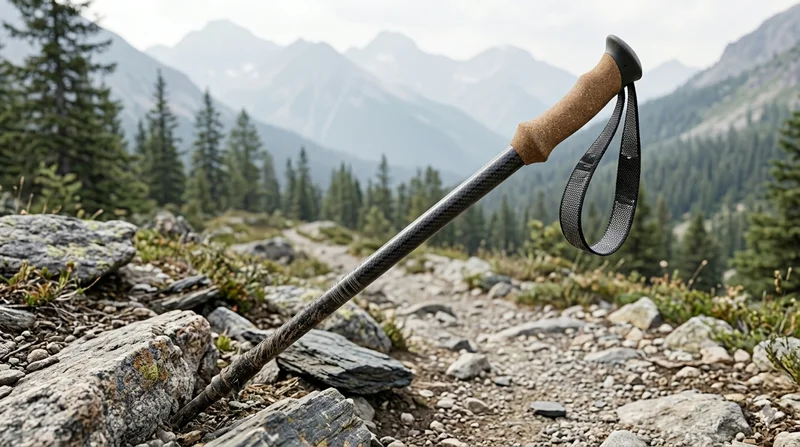
Carbon Fiber Trekking Pole
Lightweight carbon fiber trekking pole manufactured from high-grade carbon fiber tube. Weighs only 160g per pole while providing superior shock absorption and durability for hiking, trail running, and backpacking.

Round Carbon Fiber Tube — 3K Twill
Lightweight and ultra-stiff round tubes ideal for drone frames, robotics, and structural applications.