
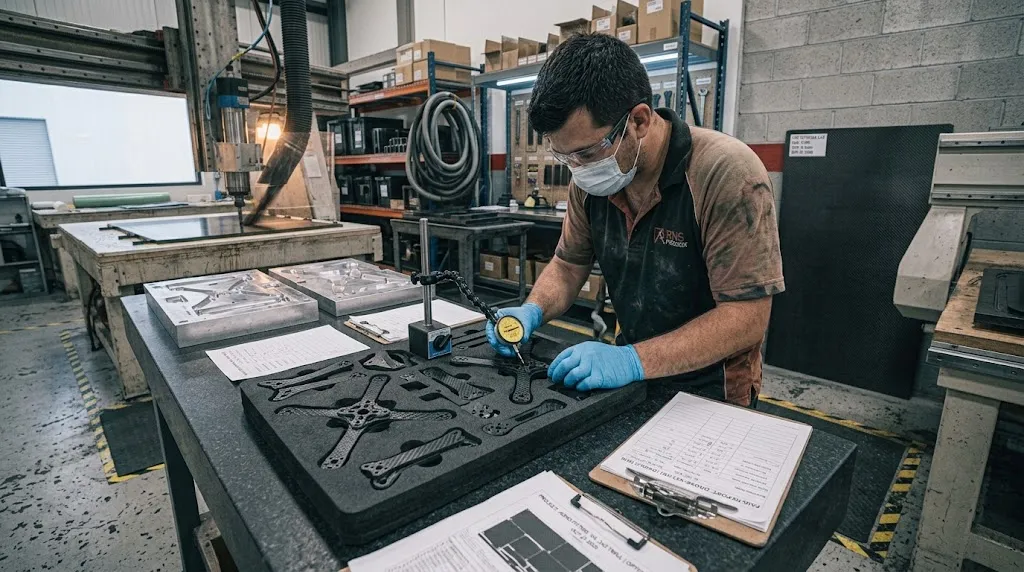
Choosing a carbon fiber drone manufacturer is a supply-chain decision with flight consequences: the frame parts you receive will carry every crash load, motor vibration and thermal cycle your platform sees. A supplier that looks capable on a homepage may be a trading desk, a job shop or a real facto
Introduction
Choosing a carbon fiber drone manufacturer is a supply-chain decision with flight consequences: the frame parts you receive will carry every crash load, motor vibration and thermal cycle your platform sees. A supplier that looks capable on a homepage may be a trading desk, a job shop or a real factory with in-house layup and curing — and the three behave very differently when your tolerance callout is tight or your recall is urgent. This guide gives buyers a concrete vetting path for carbon fiber drone frame and chassis work: what to ask before requesting a quote, which equipment and QC records actually matter, how mold quality shows up in the finished part, what price outliers are telling you, and a one-day sample audit that separates a manufacturer from a middleman. The same checklist scales whether you need ten prototype custom carbon fiber drone frame units or a monthly production run.
What a Carbon Fiber Drone Manufacturer Quote Should Include
A serious manufacturer answers an RFQ with engineering questions, not just a number. Before you compare prices, require these elements in writing:
- Material declaration: fiber grade (T300/T700-class or equivalent), resin system, prepreg supplier, and whether the layup is roll-wrapped, compression molded or autoclave-cured sheet machined to shape.
- Process route: cured-sheet CNC machining versus molded parts — molds imply tooling cost and lead time but deliver repeatability; machined parts carry no tooling but depend on nest and operator skill.
- Tolerance and inspection plan: which features are critical (motor bolt circles, arm-to-hub interfaces), the tolerance on each, and which measurement method backs it — calipers, CMM or optical scan.
- Pricing structure: tooling amortization, per-part price breaks, scrap allowance, and packaging. A quote that skips these will grow change orders later.
- Lead time logic: mold fabrication days, cure cycle scheduling, and the inspection gate — separated, not merged into a single optimistic number.
Vetting a Carbon Fiber Drone Manufacturer: Equipment Behind the Frames
Capacity claims are cheap; equipment lists and process control are not. Match the claimed output to the machines that produce it:
| Claimed Capability | Minimum Equipment to Verify | What It Signals |
|---|---|---|
| Molded frames and chassis | Matched metal molds, hot press or autoclave with cure logging | Repeatable geometry, viable at 500+ units/year |
| Cut-to-shape plates and arms | CNC router with diamond tooling, dust extraction, spoilboard fixtures | In-house nesting skill, dimensional control |
| Tight flatness / bondline control | Surface plate + CMM or optical scanner, documented calibration | QC is measured, not asserted |
| Frame-level assembly | Torque tools, jigs, vibration or drop test setup | They understand the part in service, not just in drawing |
Ask what runs on which machine and how many shifts. A single press running three products means your lead time shares a queue; two presses with scheduled cure logs mean your batch has a slot. For carbon fiber drone frames, also ask how they control warpage — springback after cure is the difference between frames that bolt up flat and frames that need shimming. Post-cure flat pressing on a temperature-controlled platen is the mark of a shop that has learned this the hard way.
QC Systems for Custom Carbon Fiber Drone Frame Parts
Quality for drone frame parts is mostly dimensional consistency and laminate integrity. Look for these controls, and ask for records rather than assurances:
- First-article inspection (FAI): a dimensional report on the first part of every tool, signed and retained. If they cannot produce the last FAI for a similar part, expect to fund the learning curve.
- Incoming material traceability: batch numbers for prepreg or pultrusion stock, storage temperature logs, and shelf-life checks — out-of-date prepreg is the invisible cause of frames that delaminate early.
- Laminate integrity checks: ultrasonic c-scan or A-scan spot checks on structural parts, plus destructive sectioning on a sample per lot if you are buying a carbon fiber drone chassis volume.
- Process stability: cure temperature logs per batch, torque records for critical fasteners if they assemble, and a nonconformance log they are willing to show you.
For production orders, add a sampling plan: define sampling by lot size (ISO 2859-1 style AQL for dimensional, zero-defect for safety-critical interfaces like motor mounts) and state who pays for a rejected lot — clarity here prevents the common dispute where both sides assume the other absorbs scrap.
Reading Price: What Outliers Tell You About a Drone Frame Supplier
Drone frame pricing clusters, and departures from the cluster are informative. A quote 40 percent below peers usually means one of four things: pultruded rather than roll-wrapped stock, heavier wall than your spec, omitted tooling amortization, or an unstated revision policy where changes bill hourly. A quote far above usually carries full FAI, real cure logging and spare capacity — worth it for production frames, unnecessary for one-off prototypes. Between them, the honest middle price comes with the engineering questions from the first section attached. Total cost also includes the failure cost: a chassis that cracks at 300 cycles costs more than the unit saving, so weigh price against the test evidence the manufacturer can actually show — drop tests, vibration logs, field return data — rather than against the catalog page. If they manufacture other composites too, ask how drone parts are scheduled; dedicated lines protect your cure windows from priority swaps.
Frequently Asked Questions
What MOQ should I expect from a carbon fiber drone manufacturer?
For CNC-machined frames from stock plate, MOQ can be one piece — you pay setup, not tooling. For molded frames and chassis, expect tooling charges plus a minimum run of 50–100 pieces; molds amortize quickly beyond that, and unit price drops steeply between the first 100 and the first 500. Prototype-friendly shops will cut one mold and run a short pilot before committing to volume tooling.
How do I know the factory actually manufactures instead of trading?
Ask for a live video walkthrough showing the specific machines for your part — press, router, CMM — and request process records tied to your quote (cure log template, FAI form). Offer to send a technical question only a maker would answer, such as how they compensate springback on a 4 mm arm plate. Trading houses answer with delays; factories answer with detail.
Molded or CNC-machined: which is better for drone frames?
Molded wins on repeatability and unit price at volume, adds tooling cost and 2–4 weeks of lead time, and lets you integrate features (ribs, bosses, inserts) that machining cannot. CNC wins for prototypes, low volumes and frequent design changes. Many teams start CNC, freeze the geometry after two revisions, then switch to tooling for production — sequence your orders that way.
How long does custom carbon fiber drone frame production take?
CNC parts: 2–3 weeks including FAI. Molded parts: 3–4 weeks for first shots if the mold does not exist (mold fabrication alone is 5–10 days), then 1–2 weeks per production batch. Add time for any drop or vibration test gate you require as acceptance — builders who skip this step discover issues in the field instead.
Conclusion
Choosing a carbon fiber drone manufacturer comes down to evidence: an RFQ answered with engineering questions, equipment that matches the claimed process, inspection records you can read, and pricing that explains itself. Run the sample audit, demand the FAI and cure logs, and let test data — not a homepage gallery — decide. Frames are the part of your aircraft that absorbs every hard landing; the supplier behind them deserves the same scrutiny you give the flight controller.
YongXian manufactures carbon fiber drone frames, arms and chassis — roll-wrapped tubes, CNC-machined plates and compression-molded parts with documented QC. Browse our carbon fiber products or contact our engineering team with your drawings for a capacity and quote review.
Related Articles
- Carbon Fiber Plate Custom: CNC Cutting, Nesting and Thickness Selection
- How to Read a Carbon Fiber Supplier Pricing Sheet
- Carbon Fiber Tube Custom Orders: OD, Wall Thickness and Tolerance Buying Guide
- Carbon Fiber Sheet 4x8: Large-Format Panels for Tooling and Construction
- Carbon Fiber Tubes USA: Domestic Suppliers and Lead Times
- Carbon Fiber Rod Supplier: Pultruded vs Roll-Wrapped Quality Comparison
Interested in Our Products?
Contact our team for competitive pricing and technical specifications.
Get a QuoteRelated Products

Round Carbon Fiber Tube — 3K Plain Weave T700
Standard round carbon fiber tube manufactured from Toray T700 grade fiber with 3K plain weave. Offers balanced strength and stiffness for general industrial applications including robotics, automation, sports equipment, and aerospace structures.

Square Carbon Fiber Tube — 3K Twill T700
Square cross-section carbon fiber tube manufactured with 3K twill weave for torsional strength. Preferred for structural frames, trusses, and support columns where rectangular geometry offers design flexibility.

Carbon Fiber Pickleball Paddle
High-performance pickleball paddle with Toray T700 carbon fiber face and polypropylene honeycomb core. Delivers excellent power-to-weight ratio, spin generation, and vibration dampening for competitive play.
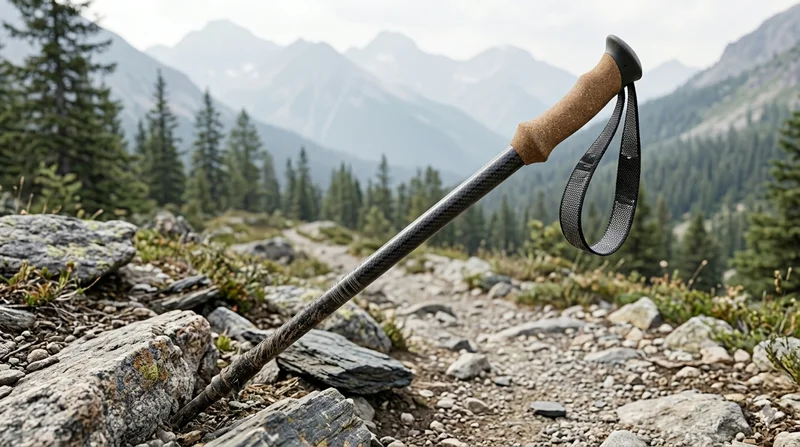
Carbon Fiber Trekking Pole
Lightweight carbon fiber trekking pole manufactured from high-grade carbon fiber tube. Weighs only 160g per pole while providing superior shock absorption and durability for hiking, trail running, and backpacking.

Round Carbon Fiber Tube — 3K Twill
Lightweight and ultra-stiff round tubes ideal for drone frames, robotics, and structural applications.