
Commission Implementing Regulation (EU) 2026/718, published in the Official Journal on 23 March 2026, marks the first time environmental sustainability requirements have become binding in public procurement of wind turbines. Adopted under Regulation (EU) 2024/1735 — the Net-Zero Industr
Introduction
Commission Implementing Regulation (EU) 2026/718, published in the Official Journal on 23 March 2026, marks the first time environmental sustainability requirements have become binding in public procurement of wind turbines. Adopted under Regulation (EU) 2024/1735 — the Net-Zero Industry Act — the implementing rule applies from 30 June 2026 to public procurement procedures launched on or after that date. Its core requirement is direct: the blades of onshore and offshore wind turbines must have a recyclability rate of at least 70%, calculated as the relative weight of recyclable material, and demonstrated at the latest upon completion of the contract.
The regulation targets the component that has always been the weakest link in turbine circularity. While 80 to 95% of a turbine's total mass — steel towers, iron castings, nacelle frames — is recyclable through conventional channels, blades represent about 15% of turbine mass and contain complex composite materials of reinforced fibers and polymer matrices that resist conventional recycling. With composite waste from decommissioned blades projected to reach approximately 400,000 tonnes by 2040, the rule converts an environmental aspiration into a contractual condition.
What the Regulation Actually Requires
The regulatory mechanism is precise and needs to be read carefully, because it differs from an absolute recycling mandate. The key obligations are:
- Scope: The requirement applies to public procurement procedures for wind turbines — onshore and offshore — launched on or after 30 June 2026, falling within Article 25(1) of Regulation (EU) 2024/1735.
- Metric: Blades must achieve a recyclability rate of at least 70%, defined as the relative weight of recyclable material.
- Demonstration point: The recyclability rate must be demonstrated at the latest upon completion of the execution of the contract, not necessarily at the award stage.
- Binding nature: Contracting authorities must incorporate the requirement into procurement documents as a contract performance condition or technical specification.
- Deferred application: The regulation entered into force on the twentieth day after publication and applies from 30 June 2026, giving authorities and suppliers time to adapt procedures.
Two details matter for suppliers. First, the demonstration is at contract completion, which gives blade manufacturers room to introduce recyclable designs and recycling partners during contract execution. Second, the metric is recyclability — the potential to be recycled — calculated by weight, not a measured recycling outcome, which shifts the design burden toward material systems that can be demonstrated as recyclable at the time the blade is produced.
Why Blades Are the Constraint
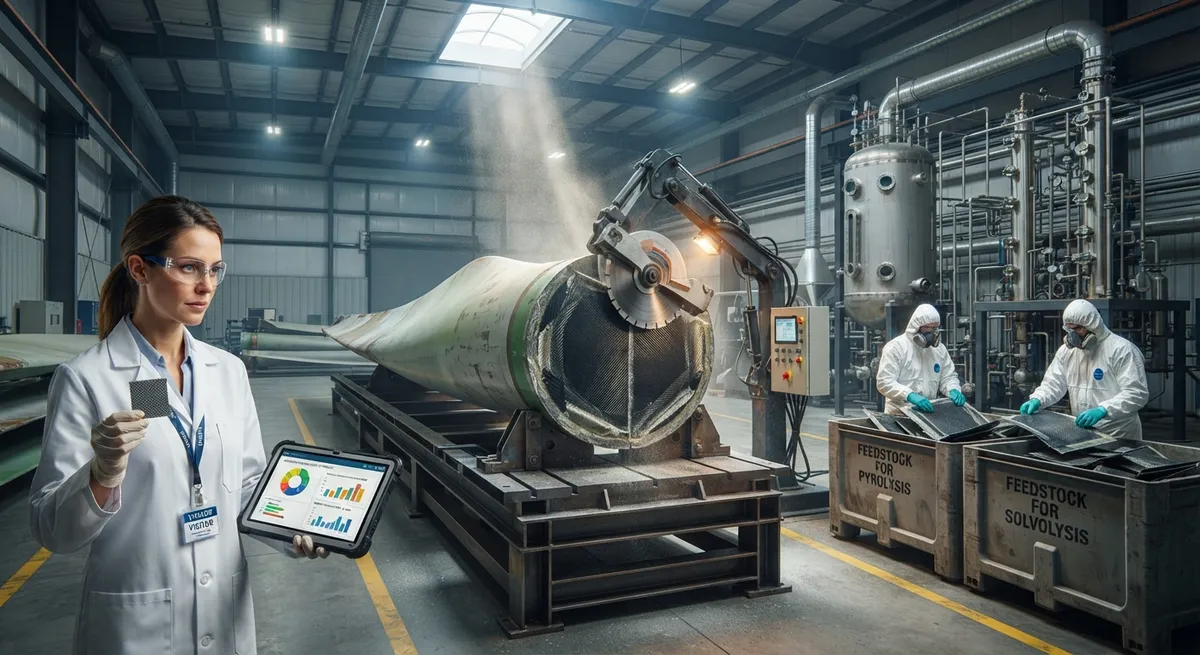
The regulation's focus on blades is a response to a specific technical bottleneck. A modern wind turbine is largely circular by default: towers are steel, nacelles are iron and aluminum castings, and foundations are concrete, and 80 to 95% of total mass can be recycled with established practices. The blade is the exception. A 60-meter class blade is a sandwich structure of glass and carbon fiber laminates bonded with thermoset epoxy resin — a cross-linked matrix that does not remelt and that conventional recyclers cannot rework at scale.
The scale of the problem is now quantified in regulatory terms. Composite waste from decommissioned wind blades is projected to reach about 400,000 tonnes by 2040, and the first wave of end-of-life blades is arriving this decade as early turbine generations reach retirement. Without a design-level requirement, this stream mostly lands in landfill or cement kilns — outcomes the industry itself has committed to phasing out. The 70% recyclability threshold was set as "ambitious yet realistic" by the Commission, reflecting the state of recycling technology while creating the demand signal that has been missing from the market.
The 70% Threshold in Context
How demanding the 70% requirement is depends on the blade's material architecture. The table below illustrates the recyclability outcome of different design strategies across a typical 60-meter blade's mass distribution:
| Blade design strategy | Recyclable fraction by mass | Compliance path | Design maturity |
|---|---|---|---|
| Conventional epoxy laminate + thermoset core | Roughly 30-50% | Falls short of 70% | Incumbent baseline |
| Epoxy laminate + recyclable resin (e.g. cleavable hardener) | 70-85% with recycling infrastructure | Meets 70% with certified recycling partner | Commercial deployment |
| Thermoplastic-compatible blade architecture | 80-90% potential | Exceeds 70% with remelting routes | Pilot to early commercial |
| Hybrid: recyclable resin + separable sandwich core | 85-95% potential | Comfortably exceeds 70% | Development and validation |
The pattern is clear: a conventional thermoset blade designed without recyclability in mind does not meet the threshold, while designs built around cleavable epoxy chemistries or thermoplastic-compatible architectures clear it with margin. The regulation therefore operates as a design filter — it does not specify the technology, but it excludes material systems that cannot demonstrate a 70% recyclable mass fraction.
Supply Chain Implications
Because the requirement applies to public procurement — and public authorities buy a large share of European wind capacity — the rule cascades through the supply chain:
- Blade OEMs: Must qualify recyclable resin systems and demonstrate the 70% recyclability rate at contract completion, making resin chemistry a procurement-relevant specification rather than a manufacturing detail.
- Material suppliers: Recyclable epoxy hardeners, thermoplastic resins, and separable core materials gain a documented demand pull, and suppliers that can evidence recyclability with the recycling partner earn a qualification advantage.
- Recyclers: The demonstration requirement creates a demand for certified recycling capacity, turning solvolysis, pyrolysis, and commingling routes into contractual inputs rather than end-of-life afterthoughts.
- Contracting authorities: Must embed the 70% condition into tenders launched from 30 June 2026, creating a standardized compliance language across Member States.
- Testing and certification bodies: Recyclability demonstration at contract completion requires documented calculation methods for "relative weight of recyclable material," establishing a new verification discipline.
Frequently Asked Questions
When does EU Regulation 2026/718 apply?
The regulation was published in the Official Journal of the EU on 23 March 2026, entered into force on the twentieth day after publication, and applies from 30 June 2026. It applies to public procurement procedures for wind turbines launched on or after that date under Article 25(1) of Regulation (EU) 2024/1735, the Net-Zero Industry Act. The deferred application date gives contracting authorities and suppliers time to adapt their procedures and designs.
Is the 70% requirement a recycling outcome or a design metric?
It is a recyclability rate — the relative weight of recyclable material in the blade — not a measured end-of-life recycling outcome. The rate must be demonstrated at the latest upon completion of the execution of the contract. This shifts the burden toward design: blade manufacturers must be able to show that the material system is recyclable by mass, typically through recyclable resin chemistries or thermoplastic-compatible architectures, and in practice with the backing of a certified recycling route.
Which turbine components are covered by the 70% recyclability requirement?
The requirement applies specifically to wind turbine blades of onshore and offshore wind technologies, because blades are the component with the biggest recyclability challenges — about 15% of turbine mass in complex composite materials. The rest of the turbine, at 80 to 95% of total mass in steel, iron, and concrete, is already recyclable through conventional channels. Suppliers purchasing or manufacturing blades for public wind tenders are the direct addressees of the new condition.
Conclusion
EU Regulation 2026/718 makes blade recyclability a contractual condition of public wind procurement for the first time. From 30 June 2026, onshore and offshore blades procured in public tenders must demonstrate a recyclability rate of at least 70% by mass at contract completion, shifting the design filter from voluntary aspiration to enforceable specification. Composite blade waste is projected at about 400,000 tonnes by 2040, and the regulation converts that problem into a demand signal: for recyclable resin systems, certified recycling capacity, and material architectures that clear the 70% threshold with margin.
For material suppliers, blade OEMs, and purchasers in the European wind chain, the practical response is to qualify recyclable material systems early and document the recyclable mass fraction with the recycling partner. Explore our range of carbon fiber fabrics and reinforcement formats for blade and composite applications, or contact our engineering team to discuss material specifications that support recyclable blade architectures.
Part of topic
Related Articles
- Carbon Fibre Sheet Supplier UK: Sourcing Options and Specification Checklist
- Carbon Fiber Sheets Near Me Suppliers: Local Stock vs Factory Direct
- Filament Wound Epoxy Tubes: Industry Standards and Compliance Requirements
- Carbon Fiber Dealers Near Me: What a Good Dealer Actually Adds
- Carbon Fiber Supplies Near Me: Local Sourcing Without Compromising Spec
- Carbon Fiber for Sale: Online Platforms and Direct Sales Channel Comparison
Interested in Custom Carbon Fiber Products?
Contact our team for competitive pricing and technical specifications.
Get a QuoteRelated Products

Custom Carbon Fiber Medical Device Components
Medical-grade carbon fiber components manufactured for imaging equipment, surgical instruments, and patient support systems. Carbon fiber's radiolucency (X-ray transparency) and high strength-to-weight ratio make it ideal for CT scanner beds, wheelchair frames, surgical robot arms, and MRI-compatible accessories. Biocompatible resin systems available.
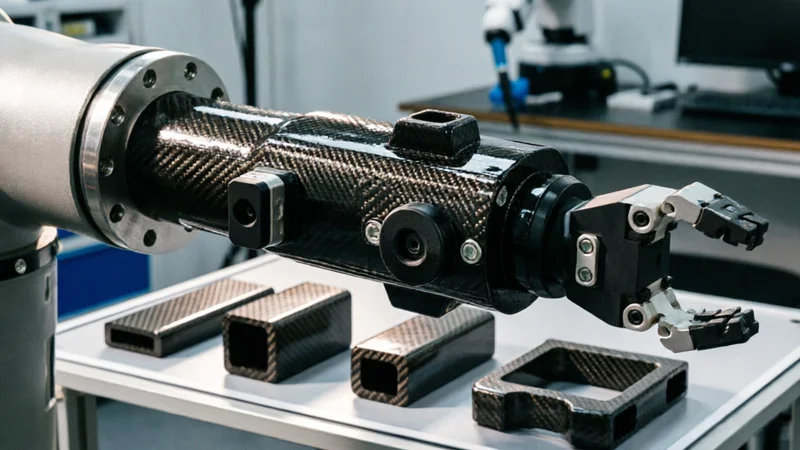
Carbon Fiber Robot End Effector Link — Custom Shape & Sensor Integration
Custom-shaped carbon fiber end effector links for robotic arms. Designed for automation integrators and research labs requiring lightweight, rigid connections between the robot wrist and gripper/tool. Can incorporate sensor mounting bosses, cable routing channels, and quick-change interfaces.

Custom Carbon Fiber Musical Instrument Parts
Carbon fiber components for musical instrument manufacturing offering superior dimensional stability, low weight, and consistent acoustic properties. We produce carbon fiber bows, guitar necks, violin chin rests, drum shells, and wind instrument bodies. Carbon fiber instruments are immune to humidity changes and temperature fluctuations that affect wooden instruments.
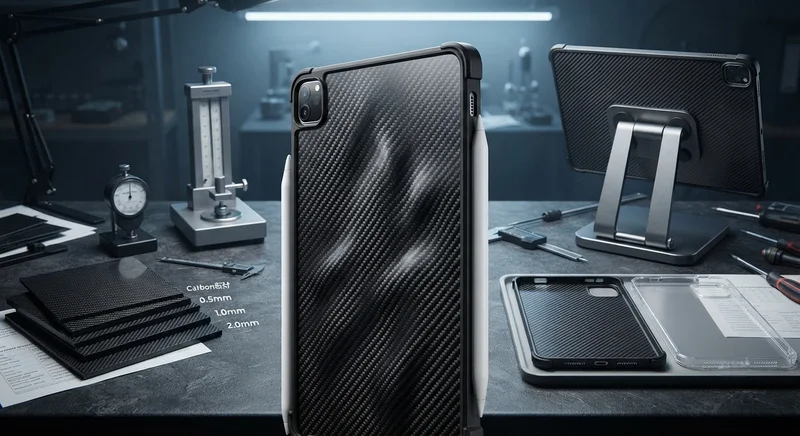
Carbon Fiber Tablet Case — Ultra-Light Protective Shell
Lightweight carbon fiber protective case for tablets and iPads. Molded from T700 3K prepreg with reinforced corner protection. Adds minimal weight while providing superior rigidity and drop protection compared to polycarbonate or silicone cases. Ideal for field workers, enterprise deployments, and professionals requiring durable tablet protection.
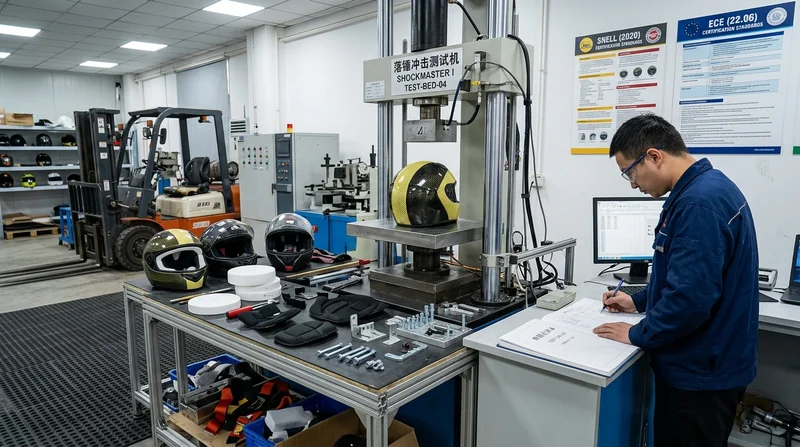
Custom Carbon Fiber Sports Protective Gear Components
High-impact carbon fiber components for protective sports gear. Our multi-layer carbon/Kevlar hybrid layups provide superior impact resistance while keeping weight minimal. Used in motorcycle helmet shells, knee brace frames, chest protectors, and shin guard inserts. EPS foam integration available for complete helmet shell manufacturing.