
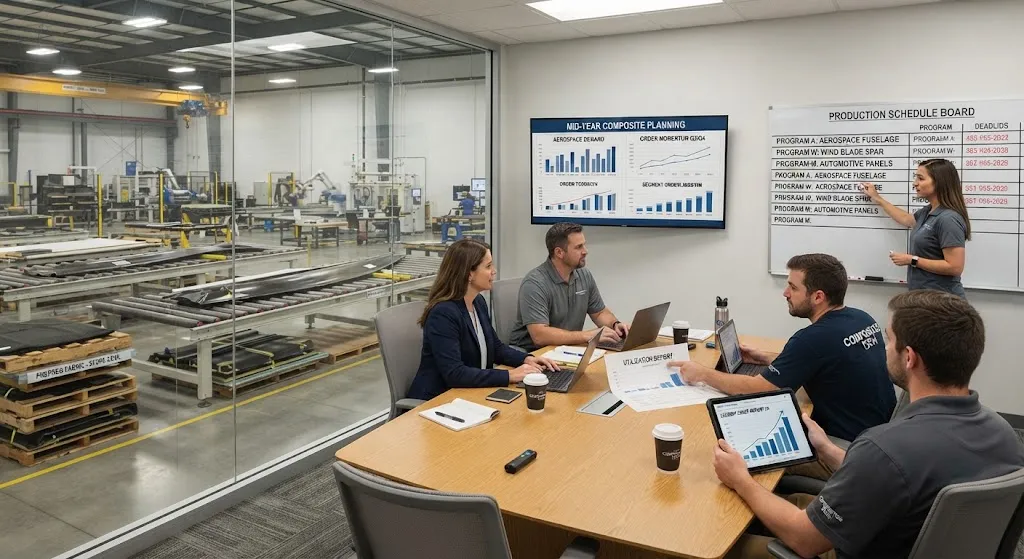
Every quarter, CompositesWorld's composites demand surveys track order momentum, capacity utilization, and inventory positions across the industry's main market segments. The July 2026 reading is the most instructive of the mid-cycle period: it captures a market that has cooled from its
Introduction
Every quarter, CompositesWorld's composites demand surveys track order momentum, capacity utilization, and inventory positions across the industry's main market segments. The July 2026 reading is the most instructive of the mid-cycle period: it captures a market that has cooled from its 2025 peak without reversing, and it distinguishes clearly between the segments still climbing and the ones plateauing. Understanding that spread — not just the headline direction — is what separates a useful demand read from a misleading one.
This article analyzes the July pulse in three parts: what the aggregate data show, how the utilization-ordering gap should be interpreted, and what the signals imply for procurement and capacity decisions in the second half of 2026.
What the July Data Show
The July 2026 survey readings cluster around a recognizable pattern: growth has slowed from 2025 levels, new-order momentum has softened for a second consecutive month, and capacity utilization has stayed surprisingly firm. The combination matters because the two signals usually move together — when orders soften, utilization follows with a lag. The fact that utilization remains supported while the order book thins is the defining feature of this reading.
| Segment | Order Momentum | Capacity Utilization | July Signal |
|---|---|---|---|
| Aerospace and defense | Firm, stable backlogs | High, near full | Steady; long-cycle orders buffer swings |
| Wind energy | Softening | Moderate and declining | Project timing shifts to late 2026, 2027 |
| Automotive | Moderate, mixed | Low to moderate | EV programs steady, legacy programs thin |
| Construction and infrastructure | Improving | Low base, rising | Early cycle gains continue |
| Marine | Stable | Moderate | Repair and refit demand underpins |
| Industrial and general | Cooling | Firm | Spot demand softer on inventory discipline |
The table condenses a survey with more nuance than the headline. Aerospace and defense remain the anchor, with order books extending years rather than months. Wind is the most visibly cooling segment, but its softness is a timing shift — project awards are slipping to late 2026 and 2027 rather than disappearing. Construction and infrastructure, off a low base, is the quiet improver. The market is not collapsing; it is rotating, and the rotation itself is the signal.
Why Order Momentum Matters More Than Headlines
Order momentum is the earliest reliable indicator in the composites survey family. Unlike utilization, which reflects past decisions, or shipment data, which lands with a lag, order momentum captures the decisions buyers are making right now. When it softens for two consecutive months, it typically precedes a broader slowdown by one to two quarters — which is why the July reading has more analytical weight than its modest headline change suggests.
The current softening also looks different from 2023, the last comparable period. In 2023 orders fell because end markets genuinely contracted. In mid-2026 the fall is shallower and narrower: it is concentrated in wind project timing, general industrial spot volume, and the inventory normalization that follows a strong year. Segments with structural drivers — aerospace backlogs, defense programs, EV structural parts, infrastructure repair — have not rolled over. A demand pulse that looks like a receding tide at the aggregate level is, read closely, a rotation between segments with very different trajectories.
Reading the Utilization-Ordering Gap
The gap between firm utilization and softening orders deserves careful interpretation. Three factors explain it, and each points a different direction for the coming quarters:
- Backlog depletion timing: utilization reflects orders placed six to twelve months ago, so today's firmer utilization is partly yesterday's order book. A sustained order softness would pull utilization down from the fourth quarter onward.
- Inventory discipline: buyers are drawing down inventories built during the 2025 surge, keeping factories busier than current order intake alone would justify. The drawdown is a one-time cushion, not a trend.
- Selective restocking: segments with structural demand — aerospace, defense, EV structural parts — are selectively restocking, which bolsters utilization even as general industrial buyers pause.
The practical reading is that utilization has a limited lease on life. If new-order momentum does not recover within two quarters, capacity utilization will converge downward toward the softer order signals. Suppliers planning capacity additions on the strength of today's utilization should stress-test their assumptions against the order data, because utilization is a lagging indicator and the leading indicator is pointing sideways.
Where the Cycle Actually Sits
Placing the July reading on the recovery timeline helps separate noise from signal. The composites industry exited 2024 in a shallow recovery, accelerated through 2025 as aerospace ramped and EV programs matured, and entered 2026 at a peak that the July data now show has already passed. That does not make 2026 a downturn year — it makes it a normalization year, the stage of the cycle where quarterly comps get harder and growth rates moderate even while absolute demand stays healthy.
Several markers support that classification. Energy and freight prices have stabilized after the swings of the past two years, removing one source of buyer hesitation. Interest-rate-sensitive end markets such as construction have started to move again, which is what the improving infrastructure orders reflect. And the aerospace backlog, the largest single pool of composite demand, is still scheduled years out — a structural floor under the cycle that did not exist in the 2023 downturn. The pattern is consistent with the mature phase of an expansion: growth decelerates, mix matters more than volume, and the segments that were last to recover — construction, infrastructure repair — pick up the slack from the early movers.
The risk case is also worth stating plainly. If order momentum stays soft through the third quarter and the inventory drawdown completes ahead of a restock, utilization would be expected to slide into the low-to-mid range by early 2027, and spot prices for standard-modulus materials would follow. That is a moderate, forecastable adjustment — not a demand shock — but suppliers who read today's utilization as permanent demand will be the ones surprised by it. The recovery trajectory is intact; its slope has simply flattened.
What the Second Half Implies for Buyers and Suppliers
For buyers, the mid-cycle signal argues for disciplined but not frozen procurement. The cooling is broad but shallow, and the segments that matter most to composite demand — aerospace, defense, infrastructure, EV structural — remain supported. Buying strategies that held cash during the 2025 surge now face a choice: the inventory drawdown provides near-term comfort, but restocking decisions will need to be made before the turn, not after it, because the longest lead times still belong to aerospace-grade and specialty materials.
For suppliers, the July reading argues two things. First, keep utilization-reliant planning honest by weighing order data, not just the full-enough schedule on the wall. Second, treat the segment rotation as the opportunity it is: capacity and sales effort that migrates toward aerospace, defense, construction, and EV structural applications is moving with the market, while capacity anchored to wind and general industrial spot volume is working against the grain.
Neither message argues for dramatic action. The market is not signaling a collapse that demands cash conservation, nor a ramp that demands aggressive capacity building. It is signaling a normalization — a market where growth is real but slower, where margins come from product mix rather than rising tide, and where the companies that read the segment data will be positioned to buy the right materials and hold the right capacity as the cycle matures.
Frequently Asked Questions
What exactly does "order momentum" mean in the composites demand survey?
Order momentum is the survey's measure of whether buyers are placing more orders, the same number, or fewer than in the prior period. It is a diffusion index: respondents report the direction of new orders, and the compiled number shows how widely improvement or decline is spread across the industry. It is the earliest reliable signal in the survey because it captures decisions being made now rather than activity already completed.
Is a cooling market in mid-2026 a sign of an upcoming downturn?
Not necessarily. The current cooling is concentrated in wind project timing, general industrial spot volume, and inventory normalization after a strong 2025 — not in the structural segments. Aerospace backlogs extend years out, defense demand is firm, and infrastructure is improving off a low base. The more accurate description is a maturing expansion: growth decelerating, mix mattering more, and no evidence of an end-market contraction on the scale of 2023.
Why does capacity utilization stay firm when orders soften?
Because utilization is a lagging indicator. It reflects the orders placed six to twelve months ago that are still running through factories, plus the temporary cushion of inventory drawdown. When new orders soften for several consecutive months, utilization eventually follows downward — that is why analysts watch order momentum as the leading indicator and treat firm utilization as delayed transmission rather than proof of durable demand.
Which composite segments should buyers watch most closely in the second half of 2026?
Aerospace and defense, because their backlogs anchor the market and their long lead times reward early decisions. Construction and infrastructure, as the improving late-cycle segment. And EV structural applications, which are steady even while legacy automotive programs thin out. Wind is worth watching mainly for project timing: awards have slipped to late 2026 and 2027, so schedules matter more than the headline demand figure.
Conclusion
The July 2026 composites demand pulse describes a maturing cycle, not a broken one. Growth has cooled from the 2025 peak, new orders have softened for two consecutive months, but capacity utilization remains firmer than the order flow alone would justify — a gap that is best understood as delayed transmission rather than durable strength. The market is rotating toward aerospace, defense, infrastructure, and EV structural demand, and away from wind's project-timing softness and general industrial spot volume. The recovery trajectory is intact; its slope has flattened, and the segments that move first in the coming quarters will be the ones with structural, backlog-backed demand.
For buyers and suppliers alike, the second half of 2026 rewards those who read the segment spread rather than the headline, and who time restocking and capacity decisions to the rotation. Review our carbon fiber and composite product range or contact our team to discuss how current demand conditions map to your material requirements.
Part of topic
Related Articles
- Recycled Carbon Fiber Market Forecast 2030: Technology Maturity and Commercialization Path
- South Korea Carbon Fiber Market 2026: Hydrogen Economy and Shipbuilding Innovation
- Wind Turbine Blade Leading Edge Protection 2026: Polyurethane, Tape, and Metallic Shield Solutions
- China Carbon Fiber Overcapacity 2026: Price War Impact and Industry Consolidation
- India Carbon Fiber Market 2026: Wind Energy, Aerospace, and Defense Expansion
- PAN Precursor Market 2026: Acrylonitrile Supply and Carbon Fiber Cost Structure
Interested in Our Products?
Contact our team for competitive pricing and technical specifications.
Get a QuoteRelated Products

Custom Carbon Fiber Medical Device Components
Medical-grade carbon fiber components manufactured for imaging equipment, surgical instruments, and patient support systems. Carbon fiber's radiolucency (X-ray transparency) and high strength-to-weight ratio make it ideal for CT scanner beds, wheelchair frames, surgical robot arms, and MRI-compatible accessories. Biocompatible resin systems available.
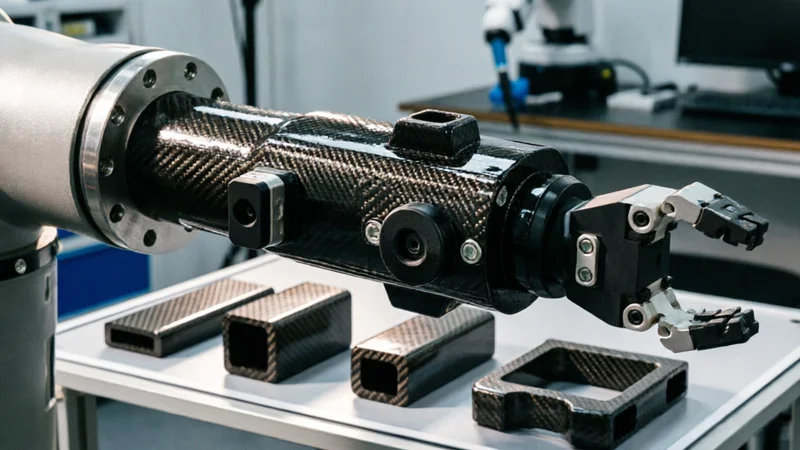
Carbon Fiber Robot End Effector Link — Custom Shape & Sensor Integration
Custom-shaped carbon fiber end effector links for robotic arms. Designed for automation integrators and research labs requiring lightweight, rigid connections between the robot wrist and gripper/tool. Can incorporate sensor mounting bosses, cable routing channels, and quick-change interfaces.

Custom Carbon Fiber Musical Instrument Parts
Carbon fiber components for musical instrument manufacturing offering superior dimensional stability, low weight, and consistent acoustic properties. We produce carbon fiber bows, guitar necks, violin chin rests, drum shells, and wind instrument bodies. Carbon fiber instruments are immune to humidity changes and temperature fluctuations that affect wooden instruments.

Carbon Fiber Tablet Case — Ultra-Light Protective Shell
Lightweight carbon fiber protective case for tablets and iPads. Molded from T700 3K prepreg with reinforced corner protection. Adds minimal weight while providing superior rigidity and drop protection compared to polycarbonate or silicone cases. Ideal for field workers, enterprise deployments, and professionals requiring durable tablet protection.

Carbon Fiber Plate — High-Gloss Decorative
High-gloss decorative carbon fiber plate with a mirror-like surface finish. The glossy coating enhances the visible 3K twill weave, creating a premium aesthetic for consumer-facing applications. Lightweight yet stiff, available in thin gauges for easy cutting and forming.