China's carbon fiber overcapacity crisis in 2026 represents the most significant structural challenge the global carbon fiber industry has faced in two decades. With installed production capacity reaching 162,000 tons against domestic demand of approximately 96,000 tons—a utilization ra
Introduction
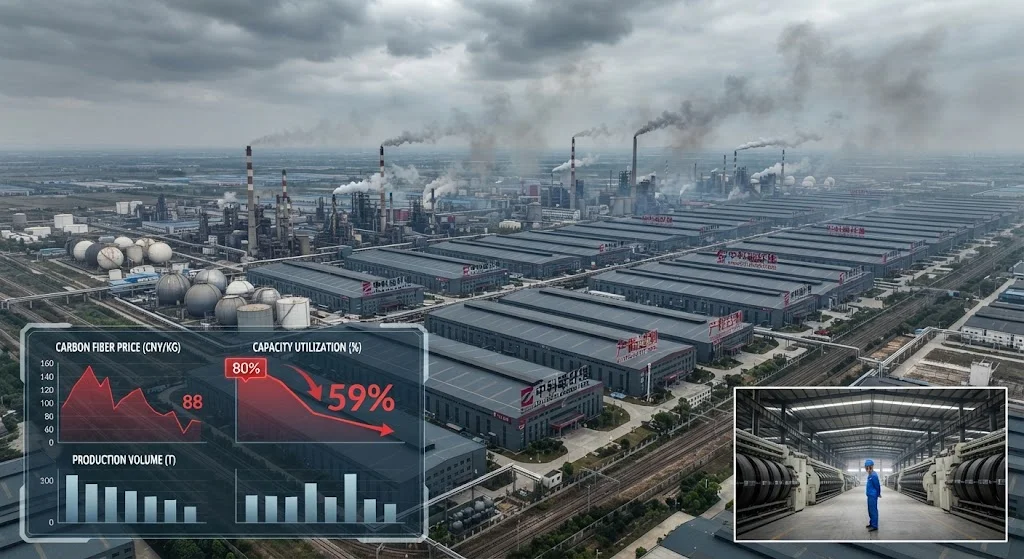
China's carbon fiber overcapacity crisis in 2026 represents the most significant structural challenge the global carbon fiber industry has faced in two decades. With installed production capacity reaching 162,000 tons against domestic demand of approximately 96,000 tons—a utilization rate of only 59%—the Chinese carbon fiber market has entered a period of intense price competition that is reshaping the competitive landscape for producers worldwide. The overcapacity is not a temporary cyclical phenomenon but the result of strategic capacity investments made during 2020-2024, driven by national policy objectives around self-sufficiency and export substitution.
For global carbon fiber buyers, this structural oversupply creates both opportunities and risks. The immediate benefit is significantly lower Chinese carbon fiber prices—standard modulus grades have fallen 35-45% from 2023 peaks. However, the long-term implications include potential quality variability as margin-pressured producers cut corners, supply chain disruption if unprofitable facilities close, and trade friction as exporting countries face competitive pressure. This article provides a comprehensive analysis of the overcapacity drivers, price dynamics, industry response, and strategic implications for stakeholders across the carbon fiber value chain.
Structural Causes of China's Carbon Fiber Overcapacity
The roots of China's carbon fiber overcapacity lie in the intersection of industrial policy, investment incentives, and market timing:
- National strategic policy: China's 14th Five-Year Plan (2021-2025) designated carbon fiber as a "strategic new material," establishing production capacity targets of 80,000 tons by 2025. Provincial governments, incentivized to meet these targets, offered land grants, tax breaks, and subsidized loans to carbon fiber projects, driving capacity investments far beyond market demand signals.
- Capital availability: Low interest rates and abundant venture capital during 2020-2023 fueled capacity expansion by both established chemical companies (Sinopec, CNKI) and specialized carbon fiber producers (Zhongfu Shenying, Weihang Composites). Total capital investment in Chinese carbon fiber capacity exceeded ¥50 billion ($7 billion) during this period.
- Technology transfer acceleration: Former Japanese and American carbon fiber engineers established Chinese operations, accelerating technology maturation and reducing the learning curve for new entrants. This enabled medium-quality production at significantly lower cost than incumbent producers.
- Demand projection errors: Capacity investments were based on forecasted demand growth rates of 15-20% annually, while actual growth averaged 8-12%—a 40-50% forecasting error that left the industry structurally overinvested.
The result is an industry with 30+ production facilities, compared to 5-6 globally significant producers in 2020, creating a fragmented market where pricing discipline has collapsed.
Price War Dynamics and Market Impact
The overcapacity-driven price war has fundamentally altered carbon fiber pricing structures in China and increasingly in export markets:
| Carbon Fiber Grade | 2023 Peak Price (¥/kg) | 2026 Market Price (¥/kg) | Price Decline | Global Impact |
|---|---|---|---|---|
| Standard Modulus (T300-level) | 180-220 | 100-130 | -40 to -45% | Export price pressure on Japanese producers |
| Intermediate Modulus (T700-level) | 350-400 | 220-280 | -30 to -35% | Competitive with Japanese domestic pricing |
| High Modulus (T800-level) | 600-700 | 400-500 | -25 to -30% | Limited global impact (niche applications) |
| Precursor (PAN tow) | 90-110 | 55-70 | -35 to -40% | Threatens global precursor suppliers |
The price war has several structural features that make it likely to persist. First, many producers have high fixed costs from recent capital investments and must maintain production volumes to service debt, creating a "produce or default" dynamic. Second, government subsidies and local employment concerns prevent facility closures even when unprofitable. Third, quality differentiation remains limited—most Chinese producers offer similar standard modulus grades, making price the primary competitive factor. The result is a market where prices have fallen below marginal production costs for 30-40% of Chinese producers, yet production continues to grow at 10-15% annually.
Impact on Producers and Downstream Users
The price war is creating distinct winners and losers across the carbon fiber value chain:
- Chinese producers (losers): Operating margins have compressed from 15-25% in 2022 to 0-8% in 2026, with 30-40% of producers operating below cash cost. Balance sheets are deteriorating as inventory levels rise and receivables extend. Several mid-tier producers have entered debt restructuring or government-guided mergers.
- Chinese downstream users (winners): Wind energy, automotive, and sporting goods manufacturers have achieved 30-40% material cost reductions, improving product competitiveness and enabling applications previously uneconomic. The lower price point is accelerating carbon fiber adoption in price-sensitive markets.
- Global producers (mixed): Japanese producers (Toray, Mitsubishi, Toho) face margin pressure but maintain premium positioning through quality differentiation and technical support. European producers (SGL, Hexcel) are losing market share in commoditized applications but defending specialty segments.
- Global buyers (short-term winners, long-term risk): Current low prices benefit procurement, but quality consistency concerns and potential supply disruption from facility closures create long-term supply chain risk.
Government Policy Response
Chinese government policy is attempting to manage the overcapacity while protecting strategic industry interests:
- Capacity rationalization guidance: The Ministry of Industry and Information Technology (MIIT) issued guidelines in 2025 calling for "orderly capacity expansion" and discouraging new greenfield projects, but enforcement remains limited due to local government resistance.
- Export control expansion: China's 2026 export control regulations include carbon fiber production equipment and certain high-performance fiber grades, aiming to protect domestic technology while managing international trade friction.
- Industry consolidation support: Government-backed mergers and acquisitions are encouraged, with state banks providing financing for consolidated entities. Several large-scale mergers are in progress, aiming to create 3-5 national champions with 30,000+ ton capacity.
- Quality standard enforcement: Tightening of national standards for carbon fiber quality is intended to force marginal producers out of the market, but implementation varies by province and is often weak in regions dependent on carbon fiber employment.
Industry Consolidation Trajectory
The overcapacity will drive significant industry consolidation through 2030, following patterns observed in other Chinese industrial overcapacity cycles:
- Phase 1 (2026-2027): Continued price competition forces 10-15 marginal producers into debt restructuring or closure. Capacity utilization improves to 65-70% as low-cost producers gain volume.
- Phase 2 (2028-2029): Government-guided mergers create 3-5 large groups with combined capacity of 40,000-60,000 tons each. These groups achieve cost advantages through vertical integration (precursor to finished fiber) and economies of scale.
- Phase 3 (2030+): Consolidated industry stabilizes at 120,000-140,000 tons capacity with 75-80% utilization. Pricing normalizes to sustainable levels with 12-18% margins for efficient producers. Industry structure resembles the global market before 2020, with 5-7 significant producers dominating.
The timeline assumes no major demand shock (positive or negative) and continued government support for consolidation. A demand surge from wind energy or hydrogen storage could accelerate the process; a global recession could extend the pain.
Implications for Global Carbon Fiber Buyers
Global buyers should develop strategies that capture current price benefits while managing emerging risks:
- Quality assurance protocols: Implement rigorous incoming inspection and supplier qualification programs, as margin pressure may incentivize quality shortcuts. Third-party certification and regular audits become essential.
- Supply chain diversification: Maintain qualified alternative sources from Japan, Europe, or emerging producers in India and Southeast Asia to reduce concentration risk as Chinese facilities consolidate.
- Contract flexibility: Structure supply agreements with volume flexibility and force majeure provisions that address potential facility closures. Long-term contracts with consolidation survivors may offer stability.
- Total cost analysis: Evaluate Chinese carbon fiber on total cost including quality variability, supply reliability, and logistics risk—not just unit price. The lowest price is not always the lowest total cost.
Frequently Asked Questions
Is China's carbon fiber overcapacity likely to be resolved through export growth?
Export growth can absorb some excess capacity but cannot solve the structural imbalance. China's carbon fiber exports reached approximately 20,000 tons in 2025, growing at 25% annually, but this represents only 20% of the surplus. More importantly, export growth faces trade friction—anti-dumping investigations in the EU and US, and resistance from established producers in Japan and South Korea. Export markets are also price-sensitive and will resist Chinese prices if quality standards are not consistently met. The overcapacity is primarily a domestic market problem requiring domestic demand growth and capacity rationalization.
How are Chinese carbon fiber producers surviving with negative margins?
Several mechanisms sustain unprofitable producers. Government subsidies and tax incentives cover 15-25% of operating costs for strategically designated facilities. State bank lending provides working capital even when cash flow is negative. Local governments intervene to prevent closures that would cause job losses in regions dependent on carbon fiber employment. Additionally, some producers are cross-subsidized by profitable divisions within larger chemical conglomerates. These mechanisms delay the natural market correction, extending the overcapacity period but not preventing eventual consolidation.
Should global buyers switch to Chinese carbon fiber to take advantage of lower prices?
The decision depends on application requirements and risk tolerance. For non-critical applications with established quality protocols—wind energy blades, sporting goods, industrial equipment—Chinese standard modulus carbon fiber offers compelling value. For aerospace, defense, and safety-critical applications, quality consistency, traceability, and long-term supply reliability may justify the premium for Japanese or European producers. A hybrid strategy—using Chinese fiber for commodity applications and maintaining premium sources for critical uses—often provides the best balance of cost and risk.
Conclusion
China's carbon fiber overcapacity in 2026 is a structural phenomenon driven by policy-induced investment that outpaced market demand, creating price competition that is reshaping the global industry. While the crisis creates short-term opportunities for buyers through lower prices, it also introduces quality and supply chain risks that require careful management. The industry will consolidate through 2030, emerging with fewer but larger, more efficient producers and pricing that reflects sustainable economics. For global stakeholders, the imperative is to capture current value while positioning for the post-consolidation market structure.
For procurement professionals and supply chain managers evaluating Chinese carbon fiber sources, a thorough assessment of supplier financial health, quality systems, and production sustainability is essential before committing to significant volume. Explore our range of carbon fiber materials from qualified global suppliers, or contact our team to discuss supply chain strategies that balance cost optimization with risk management.
Part of topic
Related Articles
- Recycled Carbon Fiber Market Forecast 2030: Technology Maturity and Commercialization Path
- South Korea Carbon Fiber Market 2026: Hydrogen Economy and Shipbuilding Innovation
- Wind Turbine Blade Leading Edge Protection 2026: Polyurethane, Tape, and Metallic Shield Solutions
- India Carbon Fiber Market 2026: Wind Energy, Aerospace, and Defense Expansion
- PAN Precursor Market 2026: Acrylonitrile Supply and Carbon Fiber Cost Structure
- Carbon Fiber Price War Bottom 2026: Toray Price Hike and Industry Consolidation Outlook
Interested in Our Products?
Contact our team for competitive pricing and technical specifications.
Get a QuoteRelated Products

Carbon Fiber Fishing Rod Blank
High-quality carbon fiber fishing rod blank manufactured from multiple grades of Toray carbon fiber cloth. Available in a wide range of lengths, powers, and actions for freshwater and saltwater applications. Suitable for OEM rod building.
Carbon Fiber Plate — 3K Twill T700 1.5mm
Thin 1.5mm carbon fiber plate with 3K twill weave surface. Lightweight and stiff, commonly used for covers, panels, drone bodies, and applications requiring a premium aesthetic appearance.
Carbon Fiber Plate — 3K Twill T700 3.0mm
Medium-thickness 3.0mm carbon fiber plate offering significantly higher load capacity while maintaining attractive 3K twill finish. Suitable for structural brackets, reinforcement plates, and load-bearing panels.

Carbon Fiber Trekking Pole
Lightweight carbon fiber trekking pole manufactured from high-grade carbon fiber tube. Weighs only 160g per pole while providing superior shock absorption and durability for hiking, trail running, and backpacking.

Square Carbon Fiber Tube — 3K Twill T700
Square cross-section carbon fiber tube manufactured with 3K twill weave for torsional strength. Preferred for structural frames, trusses, and support columns where rectangular geometry offers design flexibility.