
The carbon fiber industry generates an estimated 15,000-25,000 tons of manufacturing waste annually, with end-of-life composite components adding another 5,000-10,000 tons as aircraft, wind turbine blades, and automotive parts reach retirement. This combined waste stream — currently less than 5% rec
Introduction
The carbon fiber industry generates an estimated 15,000-25,000 tons of manufacturing waste annually, with end-of-life composite components adding another 5,000-10,000 tons as aircraft, wind turbine blades, and automotive parts reach retirement. This combined waste stream — currently less than 5% recycled — represents both an environmental challenge and a significant commercial opportunity. Recycled carbon fiber, when processed through appropriate technologies, can deliver 70-95% of virgin fiber mechanical properties at 30-60% lower material cost, making it economically attractive for applications where the full performance of virgin carbon fiber is not required.
The recycled carbon fiber market has evolved from a niche curiosity to a credible commercial segment over the past decade, driven by three converging factors. First, aerospace and automotive manufacturers face increasing pressure to meet sustainability targets and circular economy mandates, creating pull demand for recycled content. Second, recycling technologies have matured from laboratory demonstrations to pilot and commercial-scale operations, with throughput capacities approaching economically viable levels. Third, the growing volume of carbon fiber waste from manufacturing scrap and decommissioned structures provides the feedstock base that recycling operations need to achieve scale. This article provides a comprehensive analysis of recycling technologies, material properties, market dynamics, and the pathway to achieving $1.2 billion market size by 2030.
Recycling Technologies: Current State and Maturity
Three primary recycling technologies dominate the recycled carbon fiber landscape, each with distinct advantages, limitations, and optimal application scenarios. The maturity and scalability of each technology directly influences the properties and cost of the resulting recycled fiber.
| Technology | Mechanism | Temperature | Fiber Length | Property Retention | Commercial Scale |
|---|---|---|---|---|---|
| Mechanical grinding | Shredding and milling | Ambient | 0.1-5 mm (chopped) | 50-70% | 5,000+ tons/year |
| Pyrolysis | Thermal decomposition of resin | 500-700°C | 1-50 mm (varied) | 80-95% | 2,000+ tons/year |
| Chemical solvolysis | Acid/base/enzymatic dissolution | 150-300°C | Continuous tow available | 85-98% | 500+ tons/year |
| Supercritical water | Hydrothermal decomposition | 300-400°C | 10-100 mm | 85-95% | Pilot scale |
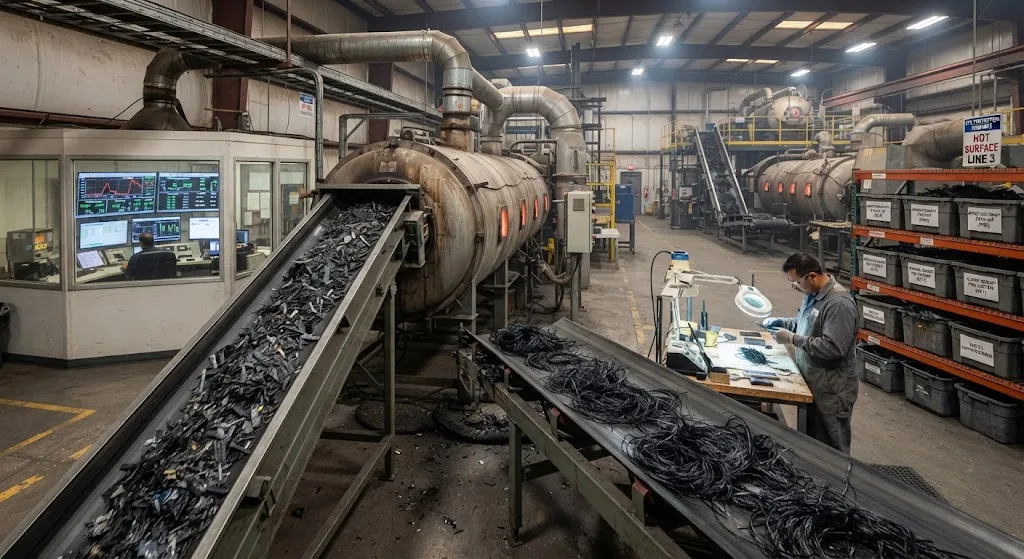
Mechanical recycling is the most mature technology, with established operations processing over 5,000 tons per year. The process involves shredding composite waste into small particles, then using impact milling to separate fibers from the resin matrix. The resulting material consists of short, chopped fibers (0.1-5 mm length) embedded in residual resin powder. While this technology achieves high throughput and low processing cost, the severe fiber length reduction limits mechanical property recovery to 50-70% of virgin values. The primary applications for mechanically recycled carbon fiber include injection molding compounds, sheet molding compound (SMC) fillers, and short-fiber reinforced thermoplastics where extreme length is not required.
Pyrolysis heating composite waste to 500-700 degrees Celsius in an oxygen-free atmosphere decomposes the resin matrix, leaving clean carbon fibers with minimal surface damage. The process preserves fiber lengths up to 50 mm and retains 80-95% of virgin fiber tensile strength, making pyrolysis-recycled fibers suitable for non-woven mats, chopped strand applications, and compression molding compounds. The challenge lies in energy consumption — pyrolysis requires approximately 3-5 kWh per kilogram of processed material — and the need for off-gas treatment systems to handle resin decomposition products. Commercial pyrolysis operations are scaling rapidly, with several European facilities achieving throughputs of 1,000-2,000 tons per year.
Mechanical Properties of Recycled Carbon Fibers
The critical question for recycled carbon fiber adoption is whether the material properties meet application requirements. The answer depends strongly on the recycling technology used and the intended end-use application. The following comparison illustrates the property spectrum across recycling methods:
| Property | Virgin Carbon Fiber | Pyrolysis Recycled | Chemical Recycled | Mechanical Recycled |
|---|---|---|---|---|
| Tensile strength | 3,500-5,000 MPa | 2,800-4,500 MPa | 3,000-4,800 MPa | 1,500-2,500 MPa |
| Tensile modulus | 230-240 GPa | 200-230 GPa | 210-240 GPa | 150-200 GPa |
| Fiber length (typical) | Continuous | 10-50 mm | Continuous available | 0.1-5 mm |
| Fiber surface quality | Pristine sizing | Minor degradation | Original surface | Significant damage |
| Cost (relative) | 1.0x | 0.3-0.5x | 0.4-0.6x | 0.2-0.3x |
Chemical solvolysis — using acids, bases, or organic solvents to dissolve the resin matrix — produces the highest-quality recycled fibers because it operates at lower temperatures and avoids thermal degradation of the fiber surface. The process can recover continuous tows with properties approaching virgin fiber specifications, making chemical recycling the preferred route for aerospace and high-performance applications. However, chemical recycling requires careful management of solvent streams and generates wastewater that demands treatment, adding to processing costs.
Market Dynamics and Growth Drivers
The recycled carbon fiber market growth to $1.2 billion by 2030 is supported by several reinforcing demand drivers across multiple end-use sectors. Understanding these dynamics is essential for assessing the commercialization pathway and identifying the highest-value market segments.
- Automotive lightweighting: Automotive manufacturers are the largest potential consumers of recycled carbon fiber, using it in semi-structural and interior components where the 30-50% cost savings over virgin fiber outweigh the 5-20% property reduction. The European automotive sector, driven by CO2 emission regulations requiring fleet averages below 95 g/km, is projected to consume 3,000-5,000 tons of recycled carbon fiber annually by 2028.
- Consumer electronics: Laptop housings, smartphone cases, and wearable device enclosures represent high-volume applications where recycled carbon fiber provides both structural performance and sustainability marketing value. Annual consumption is projected at 1,000-2,000 tons by 2030.
- Aerospace interior: Cabin interior components — seat backs, overhead bins, galley structures — use recycled carbon fiber in non-primary structural applications where fire-smoke-toxicity compliance can be achieved with recycled material at significant cost savings.
- Sports and recreation: Equipment manufacturers including bicycle frame builders, ski manufacturers, and sporting goods companies increasingly specify recycled carbon fiber for products where environmental credentials add marketing value alongside adequate mechanical performance.
Commercialization Barriers and Mitigation Strategies
Despite strong growth projections, the recycled carbon fiber industry faces several barriers that must be addressed to achieve full commercial potential. Feedstock quality variability remains the primary technical challenge — composite waste streams contain mixed resin systems, contaminants, and varying fiber types that complicate recycling process control and output consistency. Industry initiatives to address this include developing waste classification standards, implementing traceability systems from manufacturing through end-of-life, and establishing quality certification protocols for recycled fiber products.
The lack of standardized testing and specification frameworks creates buyer uncertainty that suppresses adoption. Unlike virgin carbon fiber, which has well-established material specifications from organizations such as CMH-17 and Airbus specifications, recycled carbon fiber lacks equivalent industry standards. Several industry consortia are developing specifications that define minimum property requirements, test methods, and quality levels for recycled carbon fiber products, with initial standards expected by 2027.
Scale-up economics present another barrier — recycling operations must achieve throughputs of 2,000-5,000 tons per year to reach cost competitiveness with virgin fiber on a delivered-cost basis. Current commercial operations are approaching this threshold, with European recycling facilities leading in capacity development. Government incentives including extended producer responsibility (EPR) schemes and recycled content mandates in automotive and construction applications are expected to accelerate capacity investment through 2030.
Frequently Asked Questions
Is recycled carbon fiber suitable for structural aerospace applications?
Currently, recycled carbon fiber is not approved for primary structural aerospace applications due to the variability in fiber properties and the conservative certification approach in aviation. However, it is increasingly used in secondary and tertiary aerospace structures — cabin interiors, non-load-bearing fairings, equipment brackets — where the combination of adequate mechanical properties, cost savings, and sustainability benefits creates a compelling value proposition. Aerospace-grade recycled fiber from chemical solvolysis, with properties within 5-10% of virgin material, is approaching qualification for more demanding secondary structures.
How does recycled carbon fiber pricing compare to virgin and glass fiber?
Recycled carbon fiber from pyrolysis typically costs $8-15 per kilogram, compared to $15-25 per kilogram for virgin standard modulus carbon fiber and $2-3 per kilogram for E-glass fiber. On a stiffness-to-cost basis, recycled carbon fiber at $10-12/kg delivers approximately 3-5 times the stiffness per dollar compared to E-glass, making it cost-competitive for weight-sensitive applications where the performance advantage justifies the material premium over glass fiber. The cost advantage becomes most significant in automotive and electronics applications where system-level cost savings from weight reduction offset the material price differential.
What is the environmental benefit of recycling carbon fiber versus landfilling?
Recycling carbon fiber avoids the environmental impact of both virgin fiber production and composite waste disposal. Virgin carbon fiber production generates approximately 20-30 kg of CO2 per kilogram of fiber, while recycling produces only 2-5 kg of CO2 per kilogram — an 85-90% reduction in carbon footprint. Additionally, landfilling composite waste creates long-term environmental liability as resin decomposition products can leach into groundwater, while recycling recovers the embedded energy and material value. Life cycle assessments consistently show that recycling is environmentally superior to landfilling for all recycling technologies, with chemical solvolysis providing the highest net environmental benefit due to lower energy requirements and higher property retention.
Conclusion
The recycled carbon fiber market is transitioning from an emerging technology segment to a mainstream commercial industry, with projections of $1.2 billion market size by 2030 reflecting genuine demand pull from automotive, electronics, and industrial applications. The convergence of maturing recycling technologies, growing waste stream availability, and increasing sustainability mandates creates a favorable environment for rapid market development. While challenges remain in feedstock standardization, quality certification, and scale-up economics, the trajectory is clear — recycled carbon fiber will become an essential part of the carbon fiber materials ecosystem, complementing virgin fiber for applications where moderate performance at lower cost provides the optimal solution.
For manufacturers evaluating recycled carbon fiber materials, explore our recycled carbon fiber product range, or contact our technical team to discuss how recycled carbon fiber can meet your specific performance and cost requirements.
Part of topic
Related Articles
- South Korea Carbon Fiber Market 2026: Hydrogen Economy and Shipbuilding Innovation
- Wind Turbine Blade Leading Edge Protection 2026: Polyurethane, Tape, and Metallic Shield Solutions
- China Carbon Fiber Overcapacity 2026: Price War Impact and Industry Consolidation
- India Carbon Fiber Market 2026: Wind Energy, Aerospace, and Defense Expansion
- PAN Precursor Market 2026: Acrylonitrile Supply and Carbon Fiber Cost Structure
- Carbon Fiber Price War Bottom 2026: Toray Price Hike and Industry Consolidation Outlook
Interested in Our Products?
Contact our team for competitive pricing and technical specifications.
Get a QuoteRelated Products

Carbon Fiber Fishing Rod Blank
High-quality carbon fiber fishing rod blank manufactured from multiple grades of Toray carbon fiber cloth. Available in a wide range of lengths, powers, and actions for freshwater and saltwater applications. Suitable for OEM rod building.

Carbon Fiber Plate — 3K Twill T700 1.5mm
Thin 1.5mm carbon fiber plate with 3K twill weave surface. Lightweight and stiff, commonly used for covers, panels, drone bodies, and applications requiring a premium aesthetic appearance.

Carbon Fiber Plate — 3K Twill T700 3.0mm
Medium-thickness 3.0mm carbon fiber plate offering significantly higher load capacity while maintaining attractive 3K twill finish. Suitable for structural brackets, reinforcement plates, and load-bearing panels.

Carbon Fiber Trekking Pole
Lightweight carbon fiber trekking pole manufactured from high-grade carbon fiber tube. Weighs only 160g per pole while providing superior shock absorption and durability for hiking, trail running, and backpacking.

Square Carbon Fiber Tube — 3K Twill T700
Square cross-section carbon fiber tube manufactured with 3K twill weave for torsional strength. Preferred for structural frames, trusses, and support columns where rectangular geometry offers design flexibility.