
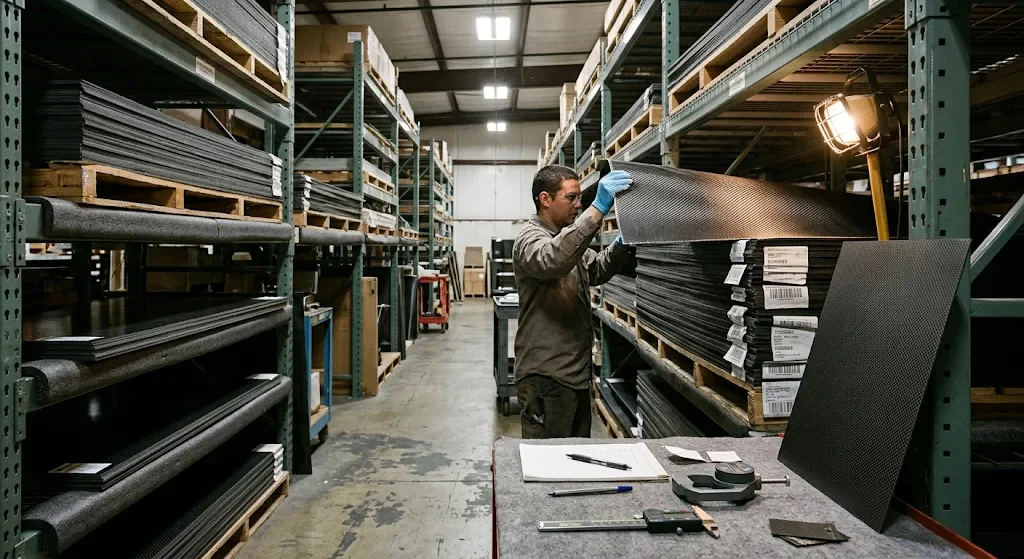
The best carbon fiber sheet for a build is the one whose weave, grade, and thickness line up with the load case — not the thickest or the most expensive option on the price list. Buyers arriving at this topic usually already know they need a carbon fiber sheet; the open questions are whether plain o
Introduction
The best carbon fiber sheet for a build is the one whose weave, grade, and thickness line up with the load case — not the thickest or the most expensive option on the price list. Buyers arriving at this topic usually already know they need a carbon fiber sheet; the open questions are whether plain or twill weave suits the finish, whether T300-class fiber covers the strength budget, and what thickness actually fits the design instead of a catalog default.
This guide maps the three decision axes — weave, grade, and thickness — then walks through the checks that separate a usable sheet of carbon fiber from a generic laminate blank, and closes with the questions worth asking a supplier before payment.
Best Carbon Fiber Sheet Grades: T300 versus T700
Fiber grade sets the strength ceiling of the laminate. T300-class carbon is the workhorse for general structures, tooling fixtures, and cosmetic panels: tensile strength around 3,530 MPa, modulus around 230 GPa, and the lowest cost per square metre. T700-class raises tensile strength to roughly 4,900 MPa at a similar modulus, which buys either thinner sections at the same safety factor or higher margins at the same thickness — at a unit price typically 15 to 30 percent above T300. Above T700, T800 and higher-modulus grades are specialty territory with long lead times and no meaningful benefit for most sheet parts.
- T300-class: best cost-to-performance for panels, jigs, and brackets; wide availability; pair with standard epoxy for room-temperature cure.
- T700-class: best when weight is the constraint — drone chassis plates, robot end-effector plates, and structural floor panels all benefit from the higher strength-to-weight.
- Hybrid stacks: a T700 face over a T300 core is a common cost optimizer; specify the stack-up explicitly so the supplier does not substitute.
| Grade | Tensile strength | Tensile modulus | Typical use | Relative price |
|---|---|---|---|---|
| T300-class | ~3,530 MPa | ~230 GPa | Panels, jigs, brackets | Baseline |
| T700-class | ~4,900 MPa | ~230 GPa | Drone plates, structural floors | +15-30% |
| T800-class | ~5,490 MPa | ~294 GPa | Specialty aerospace brackets | +50% or more |
Grade alone does not decide the part: resin system, fibre volume fraction, and cure cycle move the final properties as much as the fibre does. A well-made T300 sheet with 60 percent fibre volume will outperform a poorly infused T700 sheet with voids.
How to Pick the Best Carbon Fiber Sheet Thickness
Thickness is where most designs go wrong, because stiffness scales with the cube of thickness for bending. Doubling sheet thickness multiplies bending stiffness roughly eightfold — which means a 2 mm plate is not "twice as stiff" as a 1 mm plate, it is a different structural class. Practical thickness bands map to common uses: 0.5 to 1 mm for cosmetic covers and light fairings, 2 to 3 mm for drone chassis and machine covers, 4 to 6 mm for structural brackets and fixtures, and 8 mm and above for jigs that must resist clamp loads without creep.
For shear- or tension-dominated parts, thickness can stay modest and width carries the load; for bending-dominated parts, spend the thickness budget there first. Also check flatness: press-moulded sheets hold ±0.1 mm flatness over 300 mm, while infusions can wander to ±0.3 mm or worse, which matters when the sheet is a machine reference surface.
Carbon Fiber Sheet Weave Options: Plain, Twill, and UD
Weave choice is half structural, half cosmetic. Plain weave (1/1) is the stiffest and most stable of the common weaves, resists distortion during lay-up, and is the default for structural plates where appearance is secondary. Twill (2/2) drapes better over curves, shows the classic diagonal pattern buyers associate with carbon, and is the usual choice for visible parts and wrapped surfaces. Unidirectional (UD) sheets carry all fibre in one axis: highest specific stiffness along that axis, weakest across it, and the right answer for beams, spars, and reinforcement strips rather than general panels.
For a best carbon fiber sheet that will be seen, 2x2 twill over a quasi-isotropic or cross-ply core balances drape and stability; for a sheet buried in a structure, plain weave or cross-ply UD is cheaper and stiffer for the same mass. Surface finish — glossy, matte, or peel-ply — should be specified with the weave, because it changes secondary bonding and painting more than most buyers expect.
Sheet of Carbon Fiber: Buying Checks Before Payment
Before releasing payment on a sheet of carbon fiber, confirm four items in writing. First, the stack-up: number of plies, weave per ply, and fibre grade per ply — not just "carbon fiber sheet, 2 mm". Second, fibre volume fraction and resin system: 55 to 60 percent Vf with standard epoxy is the industry norm; below 50 percent is a strength discount. Third, flatness and thickness tolerance: ±0.1 mm thickness and ±0.15 mm flatness over a 500 mm sheet are reasonable asks for moulded stock. Fourth, edge condition: trimmed and deburred edges save a machining step and prevent fibre breakout during handling. Ask for a cut sample of the exact stack before the full order — the sample is your reference for incoming inspection and for bonding trials.
Frequently Asked Questions
Is a thicker carbon fiber sheet always stronger?
Not proportionally. Bending stiffness rises with the cube of thickness, but shear strength and through-thickness properties do not scale the same way, and a thick sheet with voids can be weaker than a thin sheet with good consolidation. Size for the load case, then verify consolidation with the supplier.
Which weave is best for a visible carbon fiber sheet part?
2x2 twill is the standard for visible parts because it drapes cleanly and shows the diagonal pattern buyers expect. Plain weave is stiffer and flatter but reads as a checkerboard; choose it when the part is structural first and visible second.
How do I check a carbon fiber sheet supplier before ordering?
Request the lay-up schedule (plies, weave, grade), a fibre volume fraction statement, thickness and flatness tolerances, and a sample cut from the same production batch. Verify flatness on a surface plate and confirm the weave pattern matches the specification before releasing the full order.
Conclusion
The best carbon fiber sheet is specified on three axes — weave for drape and stability, grade for strength budget, and thickness for stiffness class — then verified with stack-up, tolerance, and sample in writing. YongXian supplies moulded carbon fiber sheets in plain, twill, and UD stacks: browse carbon fiber sheets or send your stack-up and flatness requirements for a quote.
Part of topic
Related Articles
- Carbon Fiber Sheets in South Africa: Import and Stock Guide
- How Much Is Carbon Fiber Fabric: Price per Square Meter
- Carbon Fibre Sheet Australia: Sourcing, Specs, and Landed Cost
- Carbon Fiber Manufacturing Companies in India: Landscape 2026
- Where Is Carbon Fiber Made: From Precursor Plants to Carbonization Hubs
- Carbon Fiber Sheet Price in Bangladesh: Landed Cost and Sourcing Guide
Interested in Our Products?
Contact our team for competitive pricing and technical specifications.
Get a QuoteRelated Products

Round Carbon Fiber Tube — 3K Plain Weave T700
Standard round carbon fiber tube manufactured from Toray T700 grade fiber with 3K plain weave. Offers balanced strength and stiffness for general industrial applications including robotics, automation, sports equipment, and aerospace structures.
Carbon Fiber Trekking Pole
Lightweight carbon fiber trekking pole manufactured from high-grade carbon fiber tube. Weighs only 160g per pole while providing superior shock absorption and durability for hiking, trail running, and backpacking.

Carbon Fiber Pickleball Paddle
High-performance pickleball paddle with Toray T700 carbon fiber face and polypropylene honeycomb core. Delivers excellent power-to-weight ratio, spin generation, and vibration dampening for competitive play.

Square Carbon Fiber Tube — 3K Twill T700
Square cross-section carbon fiber tube manufactured with 3K twill weave for torsional strength. Preferred for structural frames, trusses, and support columns where rectangular geometry offers design flexibility.

Round Carbon Fiber Tube — 3K Twill
Lightweight and ultra-stiff round tubes ideal for drone frames, robotics, and structural applications.