
Light-sport aircraft (LSA) and kit-built ultralights have become one of the fastest-growing segments of general aviation. The category appeals to private pilots, flying schools, and a new wave of low-altitude economy operators because the aircraft are simpler, cheaper, and more accessib
Introduction
Light-sport aircraft (LSA) and kit-built ultralights have become one of the fastest-growing segments of general aviation. The category appeals to private pilots, flying schools, and a new wave of low-altitude economy operators because the aircraft are simpler, cheaper, and more accessible than certified GA types. Within this segment, the airframe material choice is decisive: at the weight limits that define the category, every kilogram counts directly against payload and range.
Carbon fiber composite airframes are the strongest answer to that constraint. This article explains the certification envelopes for LSA and ultralight categories, why carbon fiber suits them, the manufacturing routes available to builders, and the documentation a buyer needs when sourcing composite materials for an airframe program.
The Weight Envelope of LSA and Ultralight Categories
The entire LSA concept is built around weight limits. Under the United States definition, an LSA may not exceed 1,320 lb (599 kg) maximum takeoff weight, must have a maximum stall speed of 45 knots, and is limited to two seats and a single engine. Europe's CS-LSA sets the same package at 600 kg. Two-seat ultralight categories in Europe commonly sit near 450 kg, while kit and experimental homebuilt aircraft are flown under national experimental rules.
Because a training aircraft must carry two people, and because empty weight is a direct subtraction from the takeoff-weight limit, the ratio of empty weight to useful load is the whole game. A lighter airframe means more fuel, more baggage, or a larger safety margin before the takeoff-weight limit is reached.
| Category | Max Takeoff Weight | Seats | Max Stall Speed | Certification Basis |
|---|---|---|---|---|
| US Light-Sport (land) | 1,320 lb (599 kg) | 2 | 45 kt CAS | ASTM F2245 |
| EU CS-LSA | 600 kg | 2 | 45 kt CAS | CS-LSA |
| EU two-seat ultralight | Around 450 kg (per country) | 2 | Set by national rules | National UL rules |
| Kit / experimental homebuilt | Varies by design | Varies | Set by design | National experimental rules |
Why Carbon Fiber Airframes Fit the Category
Designing an airframe inside a 600 kg limit rewards materials with high strength and stiffness per unit weight. Carbon fiber composites deliver that better than any structural material available to small manufacturers:
| Property | Carbon Fiber Laminate | 2024-T3 Aluminum | Steel-Tube and Fabric |
|---|---|---|---|
| Density | About 1.6 g/cm³ | 2.78 g/cm³ | 7.85 g/cm³ (steel) |
| Specific strength | Highest, directionally tunable | Good | Moderate |
| Fatigue behavior | Excellent, no fatigue limit concern | Requires inspection schedules | Joints need monitoring |
| Corrosion | None | Needs protection | Needs paint and care |
| Tooling investment | Molds required, higher setup | Moderate | Low |
| Part-count efficiency | Few, large integrated parts | Many riveted parts | Many welded and fabric parts |
A well-executed composite airframe is typically 20-30% lighter than an equivalent metal structure. The arithmetic is simple and motivating: saving 30 kg of empty weight transfers roughly 30 kg to payload or fuel — meaningful in a category where two adults, baggage, and full tanks approach the limit.
Design and Manufacturing Routes
Carbon fiber airframes are produced through three principal routes, each with different cost and control characteristics:
- Prepreg and autoclave: the professional standard at low-volume aircraft production. Higher material cost buys the best mechanical properties and part quality.
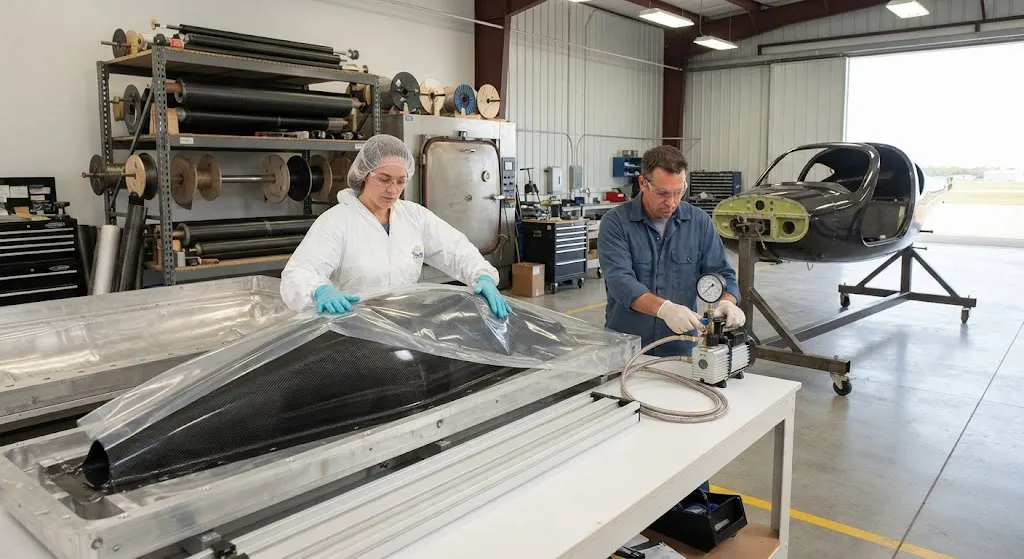
- Vacuum-bag wet layup: the classic kit-builder route. Lower cost, higher sensitivity to builder skill, and higher variability in fiber volume.
- Resin infusion: a bridge between the two — dry fabric is shaped and resin is drawn through under vacuum, giving good fiber volume without an autoclave, favored for skins and large parts.
Whichever route is used, the structural design must satisfy the limit load factors of the category — around plus 4 g and minus 2 g for LSA designs per ASTM F2245 — with composite-specific design rules: knockdown factors in compression, proven joint design, and attention to damage tolerance in thin skins.
Payload and Range Arithmetic
The weight saved by a composite structure converts directly into operational value. Consider a two-seat LSA at a 600 kg takeoff limit with a 250 kg empty weight: useful load is 350 kg. Shave the empty weight to 220 kg, and useful load rises to 380 kg — around 15% more payload, which can be flown as extra baggage, a heavier pilot-and-passenger combination, or more fuel. In training operations the same math becomes schedule value: more endurance, fewer refuel stops, more hours flown per day.
Low-altitude economy operators such as aerial survey, agriculture, and regional air-taxi flights value the same property. The aircraft that flies with a heavier sensor or a longer mission profile is the one that wins the job.
Certification and What Buyers Must Document
Composites carry a documentation burden that metals do not: properties depend on the process, so traceability is essential. For producers and kit suppliers the must-haves are:
- Material data: lamina and laminate test data from standard test methods, traceable to the batch that went into the parts.
- Process control: documented cure cycles, vacuum integrity checks, and fiber-volume verification.
- Batch traceability: resin, fiber, and prepreg batch records linking every part to its raw material.
- Qualification records: test coupons from each production run demonstrating that properties have not drifted.
Regulators accept composite airframes when this evidence exists. An aircraft built from documented material and a proven process passes load testing and flies with type-level confidence even in experimental categories.
Structural Testing Before First Flight
Whatever route produces the airframe, the composite structure has to prove itself before the aircraft flies. A typical development program starts with static load testing: the airframe is loaded to proof and then to ultimate load, verifying that it meets the design limit and ultimate factors without failure or permanent deformation beyond the tolerances allowed. The incrementally loaded structure is monitored with strain gauges, and the measured strain distribution is compared to the design analysis, uncovering any modeling error before it reaches a pilot.
Beyond static strength, the program checks natural frequencies for flutter clearance and control-surface balance weights, runs control-system functional checks, and performs ground vibration testing. For a composite airframe these steps matter more than for metal, because composites have no yield plateau to warn the inspector: the margin between healthy and failed can be invisible until it is too late. That is why discipline in testing and documentation is built into the certification story of composite kit aircraft, and why buyers who supply materials into this market must provide batch data rather than generic values.
The growth of the low-altitude economy is accelerating this market in practical ways. Local governments and operators are placing orders for medical transport, survey, and logistics aircraft in the ultralight and LSA classes, and these buyers apply the same procurement discipline as airlines: they want documented materials, reproducible builds, and parts that can be serviced in the field. A composite airframe that comes with batch traceability is markedly easier to finance, insure, and certify into commercial service than one that does not.
Frequently Asked Questions
Is a carbon fiber airframe safe when built by an individual or a small shop?
Yes, when the process is controlled. Carbon fiber itself is extremely reliable; the risks come from uncontrolled process variables such as cure temperature, vacuum integrity, and fiber volume. Builders who follow a validated process, run test coupons, and inspect at defined stages produce structurally sound airframes. Factory-built carbon aircraft in the LSA and certified categories prove the material at fleet scale with millions of flight hours.
Can a composite airframe be repaired after hangar rash or a hard landing?
Yes. Composite repairs follow standard techniques: the damaged region is cleaned, scarf ground, and rebuilt with matched prepreg or wet layup, then cured and inspected. Damage detection typically uses visual inspection plus tap testing or ultrasonic scanning to find delamination that is not visible on the surface. Because carbon fiber does not corrode, the repair stays stable for the life of the part, unlike repaired metal that can corrode at repair boundaries.
What documentation must a composite materials buyer keep for certification?
Keep four categories of evidence: batch traceability records from the material supplier, process records such as cure cycles and vacuum checks, test data from standard coupons, and final inspection records including weight and balance. These records are what an authority or a buyer's engineering review will ask for, and they are exactly what a material supplier should be able to provide with every shipment.
Conclusion
Carbon fiber is the material best matched to the physics of light-sport and ultralight aircraft: it makes the airframe lighter, and lighter directly means more payload, more range, and more operational value inside a fixed takeoff-weight limit. The dominant manufacturing routes — prepreg-autoclave and resin infusion — are proven at small-aircraft scale, and the documentation discipline that composites require is well understood.
Airframe manufacturers and kit suppliers considering carbon fiber can explore our carbon fiber materials or contact our technical team for prepreg, fabrics, and the batch documentation that certification or buyer review will demand.
Part of topic
Related Articles
- Carbon Fiber Mooring for Floating Offshore Wind: Fatigue and Corrosion in Deep Water
- Carbon Fiber Bicycle Frame Optimization: Layup Design and Manufacturing for Competitive Racing
- Carbon Fiber CFRP Retrofit for Infrastructure: Bridge and Building Seismic Strengthening
- Carbon Fiber Medical Imaging Equipment: Lightweight Gantry and Couch Structures for MRI/CT
- Carbon Fiber EV Battery Enclosures: Crash Safety and Electromagnetic Shielding Design
- Carbon Fiber Structures for Low-Altitude Economy: UAV Airframes and eVTOL Components
Interested in Our Products?
Contact our team for competitive pricing and technical specifications.
Get a QuoteRelated Products

Carbon Fiber Plate — 3K Twill T700 3.0mm
Medium-thickness 3.0mm carbon fiber plate offering significantly higher load capacity while maintaining attractive 3K twill finish. Suitable for structural brackets, reinforcement plates, and load-bearing panels.

Carbon Fiber Plate — 3K Twill T700 1.5mm
Thin 1.5mm carbon fiber plate with 3K twill weave surface. Lightweight and stiff, commonly used for covers, panels, drone bodies, and applications requiring a premium aesthetic appearance.

Square Carbon Fiber Tube — 3K Twill T700
Square cross-section carbon fiber tube manufactured with 3K twill weave for torsional strength. Preferred for structural frames, trusses, and support columns where rectangular geometry offers design flexibility.
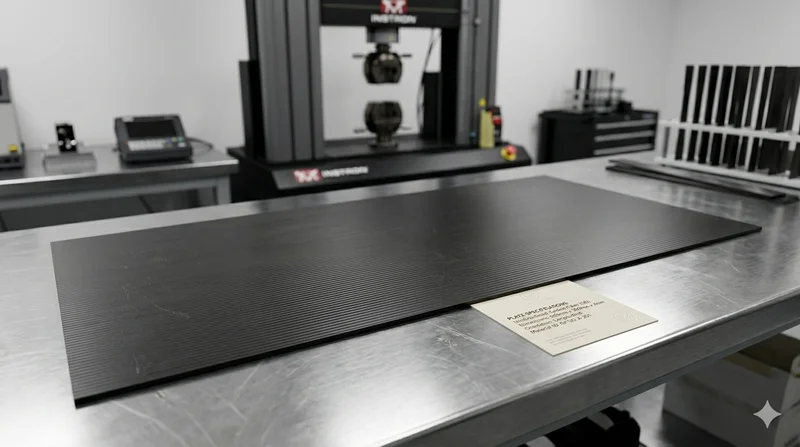
Carbon Fiber Plate — UD Unidirectional T700
Unidirectional carbon fiber plate with all fibers oriented in a single direction for maximum strength along the fiber axis. Essential for structural reinforcements, splints, and applications where load direction is predictable.
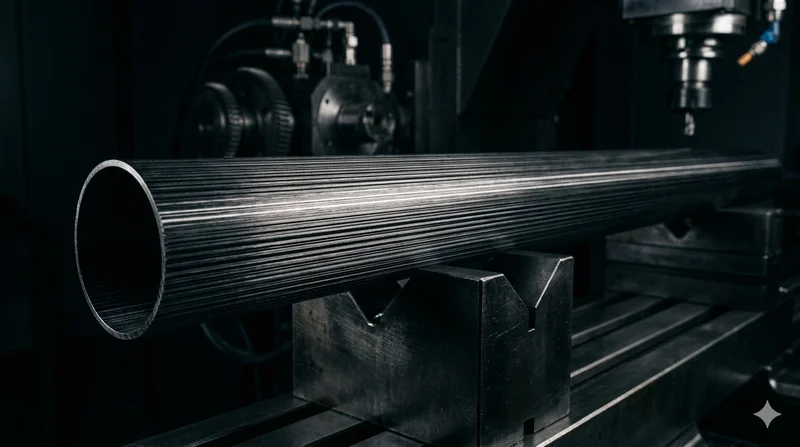
Round Carbon Fiber Tube — UD Unidirectional T700
Unidirectional (UD) round tube with all fibers aligned axially for maximum longitudinal stiffness. Ideal for applications requiring high bending rigidity with minimal weight, such as shafts, struts, and structural reinforcements.