
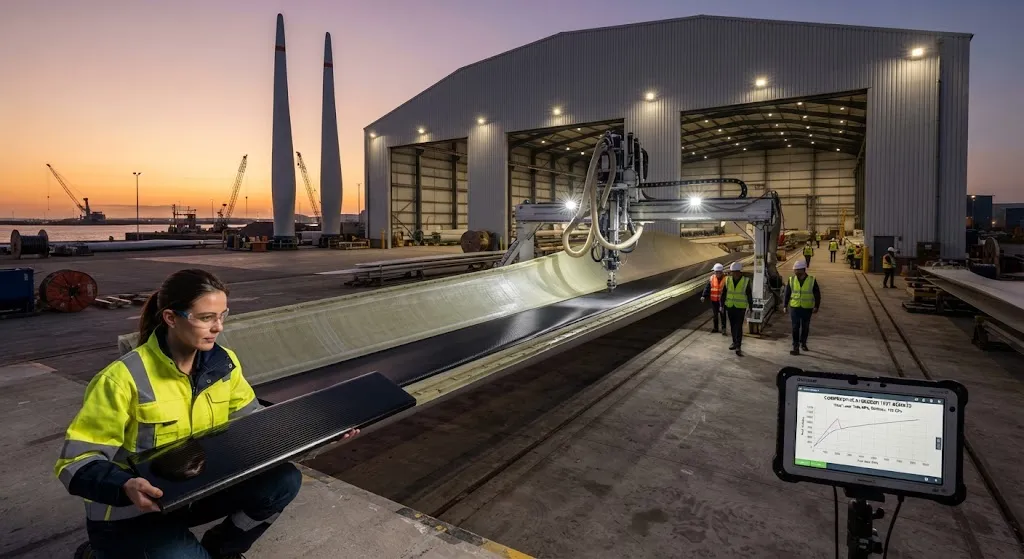
Offshore wind turbines keep growing because longer blades sweep more area and capture more energy without adding proportional tower and drivetrain cost. That growth has reached the point where the spar cap of a blade must carry compressive loads that glass fiber alone can no longer supp
Introduction
Offshore wind turbines keep growing because longer blades sweep more area and capture more energy without adding proportional tower and drivetrain cost. That growth has reached the point where the spar cap of a blade must carry compressive loads that glass fiber alone can no longer support efficiently. On Mingyang's 18 MW offshore platform, the 143-meter blade uses an estimated 15-18 tons of carbon fiber per blade, a figure that reflects both the enormous structure and the material now required to make it work.
This article explains why 143-meter blades need carbon, how much carbon fiber such a blade actually consumes, and what the demand means for carbon fiber suppliers and offshore wind project economics. For blade makers and buyers, understanding the carbon-for-glass substitution is essential to planning supply and cost.
Why Blades Grow and Why Glass Plateaus
A wind blade's power capture grows roughly with the square of its rotor radius, so a 18 MW machine with a 143-meter blade on a large rotor sweeps dramatically more area than smaller platforms. But the loads on the blade structure grow at a different rate. The bending moment at the blade root scales with blade length raised to a high power, so the spar cap, the main structural member that resists flapwise bending, must carry compressive stress that climbs steeply as blades lengthen:
| Factor | Glass Fiber Blade | Carbon-Glass Hybrid Blade | Impact of Carbon |
|---|---|---|---|
| Spar cap modulus | ~40-80 GPa | Mixed, carbon 120-150 GPa region | Much stiffer cap for same mass |
| Compressive strength | Moderate | Higher in carbon regions | Withstands higher root bending |
| Blade mass | Very heavy at 143 m | Lighter than all-glass | Reduced gravity and edge loads |
| Fatigue life | Good at moderate loads | Good at extreme loads | Sustains long offshore fatigue life |
At roughly 90-110 meters a design reaches the point where an all-glass spar cap becomes too heavy and too flexible. The blade diameter, the required stiffness, and the compressive strength requirement combine so that a heavier all-glass cap adds so much mass that gravity loads and edgewise fatigue drive the design into diminishing returns. Carbon's higher modulus lets the cap carry the same bending load with far less material and mass, which is why every ultra-long offshore blade now uses carbon in its spar cap.
How Much Carbon Does a 143-Meter Blade Use?
A 143-meter blade is a large structure. Mingyang's platform consumes an estimated 15-18 tons of carbon fiber per blade for the spar cap, predominantly in a unidirectional carbon-glass hybrid layup. To make the scale concrete, consider the following:
- Per-blade carbon: Roughly 15-18 tons of carbon fiber per blade, used in the pultruded or infused spar cap over most of the blade's length.
- Per-turbine demand: A three-blade 18 MW rotor carries roughly 45-54 tons of carbon fiber just for the spar caps.
- Annual offshore appetite: Analysts estimate this class of wind blade alone drives roughly 50,000 tons of all offshore blade carbon fiber demand per year as the 11-22 MW platforms scale up.
- Compressive strength driver: The spar cap on 11-22 MW class blades must meet compressive requirements exceeding roughly 4,800 MPa in some qualification targets, a level glass cannot reach.
These numbers show why wind became the single largest consumer of industrial carbon fiber. A single offshore rotor uses more carbon fiber than many entire aerospace programs, and the volume, while lower-margin, brings scale that pulls down the price of the raw material for every other application that buys the same tow.
Material Options: Pultruded Spar Caps and Hybrid Laminates
Blade makers choose how to deploy the carbon, and the choice affects cost, quality, and where the carbon actually contributes. Two approaches dominate:
| Approach | How It Works | Advantage | Trade-off |
|---|---|---|---|
| Pultruded carbon cap | Continuous carbon pultruded into wide, thin plate then bonded to shell | Fast, consistent, high fiber volume | Bonded joint adds adhesive inspection need |
| Infused hybrid laminate | Carbon and glass infused together in the cap layup | Monolithic, no bonded cap joint | Slow infusion, higher fiber handling |
The pultruded spar cap has become the mainstream because it decouples fast fiber placement from the slow shell infusion. Carbon and glass plates are pultruded at high quality and constant thickness, then bonded or co-infused into the shell. This approach controls fiber waviness, the main enemy of compressive strength, and lets manufacturers scale output with simpler tooling. The trade-off is the bonded joint, which requires rigorous adhesive process control and non-destructive inspection to guarantee the structural link between cap and shell.
Compressive Strength and the 4,800 MPa Question
The single property that makes carbon indispensable in these blades is compressive strength. A spar cap under bending sees its upper surface in compression, and that compression is what limits practical blade length with glass. Qualifying an 11-22 MW class spar cap involves demonstrating compressive strength in the region of, and in some targets above, roughly 4,800 MPa, a level achievable only with high-modulus, low-waviness carbon laminates:
- Fiber straightness: Fiber waviness directly reduces composite compressive strength, so pultrusion and tight process control are essential.
- High fiber volume: Reaching high compressive values requires fiber volume fractions in the mid-60s percent and a stiff, well-cured matrix.
- Low void content: Voids act as stress concentrators that trigger microbuckling and premature compressive failure.
- Grading: Many designs grade carbon and glass along the span, using full carbon where loads peak and hybrid or glass where loads drop toward the tip.
Meeting compressive requirements reliably is a manufacturing quality challenge as much as a materials one. Suppliers that hold fiber straightness, manage infusion, and verify void content give blade makers the confidence to certify a 143-meter blade, while inconsistent quality forces de-rating or heavier designs that erase the carbon advantage.
Frequently Asked Questions
Why does a 143-meter blade need carbon fiber?
Blades longer than roughly 90-110 meters reach the point where an all-glass spar cap becomes too heavy and too flexible to carry the root bending moment efficiently. Carbon fiber's higher modulus lets the spar cap carry the same bending load with much less material and mass, reducing gravity and edgewise fatigue loads that would otherwise force the design into diminishing returns. Carbon also provides the high compressive strength needed where the cap is in compression under bending. On Mingyang's 18 MW platform this makes the 143-meter blade practical with lower mass than an equivalent all-glass design could achieve.
How much carbon fiber is in a 143-meter blade?
A 143-meter blade uses an estimated 15-18 tons of carbon fiber in its spar cap, so a three-blade 18 MW rotor carries roughly 45-54 tons. Analysts estimate this class of ultra-long offshore blade drives about 50,000 tons of carbon fiber demand per year across the global offshore fleet as 11-22 MW platforms scale up. Because the carbon is concentrated in the spar cap rather than the whole blade, the 15-18 ton figure reflects a hybrid layup in which most of the blade remains glass while the heavily loaded cap is carbon.
What compressive strength does a modern ultra-long blade spar cap need?
An 11-22 MW class blade spar cap must meet compressive strength requirements in the region of, and in some qualification targets above, roughly 4,800 MPa. That value is achievable only with high-modulus carbon laminates at high fiber volume, low void content, and very low fiber waviness. Pultruded spar caps are the preferred route because pultrusion controls fiber straightness and consistency far better than hand or automated infusion alone. The compressive requirement is the core reason glass, which cannot reach these values, is replaced by carbon in the cap of the longest blades.
What role does carbon fiber play in offshore wind economics?
Carbon fiber in the spar cap is what makes an 18 MW, 143-meter platform technically feasible and economically attractive, because it keeps blade mass and gravity loads low enough that the larger rotor is worth building. The trade-off is cost: offshore-grade carbon and the pultrusion or infusion needed to use it add cost per blade, offset by the larger swept area and higher energy capture per machine. As carbon fiber volume from wind grows, it also lowers the material price baseline for other applications, improving the economics of the entire supply chain. Buyers weigh blade-level carbon cost against per-megawatt energy yield and tower and foundation savings.
Conclusion
Ultra-long blades are the engine of offshore wind's continuing cost decline, and carbon fiber is the material that makes them possible. On Mingyang's 18 MW platform, the 143-meter blade's 15-18 tons of carbon per blade reflect a spar cap that must carry compressive loads beyond glass and keep blade mass low enough to be worth building. The compressive strength requirement, at times above 4,800 MPa, is met through high-volume, low-waviness carbon laminates increasingly delivered by pultrusion.
The result is a wind industry that consumes roughly 50,000 tons of carbon fiber a year in offshore blades, making it the largest industrial market for the material and a powerful force for lowering fiber prices across every application. Explore our carbon fiber materials for wind, aerospace, and industrial structures, or contact our technical team to discuss high-modulus tows and spar cap sourcing for your next program.
Part of topic
Related Articles
- Carbon Fiber Mooring for Floating Offshore Wind: Fatigue and Corrosion in Deep Water
- Carbon Fiber Bicycle Frame Optimization: Layup Design and Manufacturing for Competitive Racing
- Carbon Fiber CFRP Retrofit for Infrastructure: Bridge and Building Seismic Strengthening
- Carbon Fiber Medical Imaging Equipment: Lightweight Gantry and Couch Structures for MRI/CT
- Carbon Fiber EV Battery Enclosures: Crash Safety and Electromagnetic Shielding Design
- Carbon Fiber Structures for Low-Altitude Economy: UAV Airframes and eVTOL Components
Interested in Our Products?
Contact our team for competitive pricing and technical specifications.
Get a QuoteRelated Products
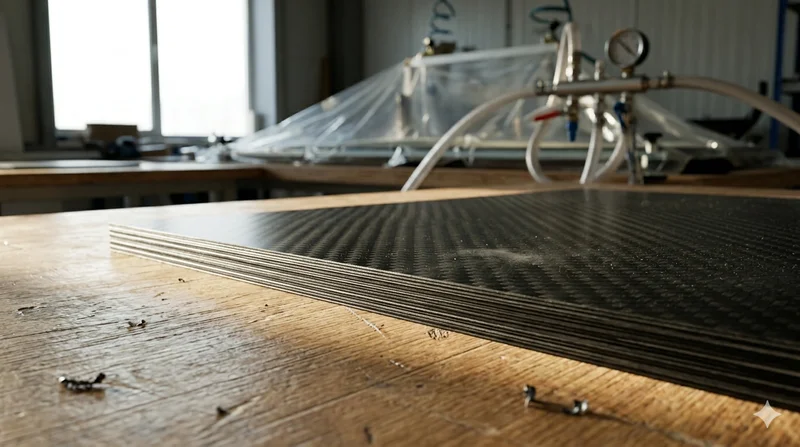
Carbon Fiber Plate — 3K Twill T700 3.0mm
Medium-thickness 3.0mm carbon fiber plate offering significantly higher load capacity while maintaining attractive 3K twill finish. Suitable for structural brackets, reinforcement plates, and load-bearing panels.
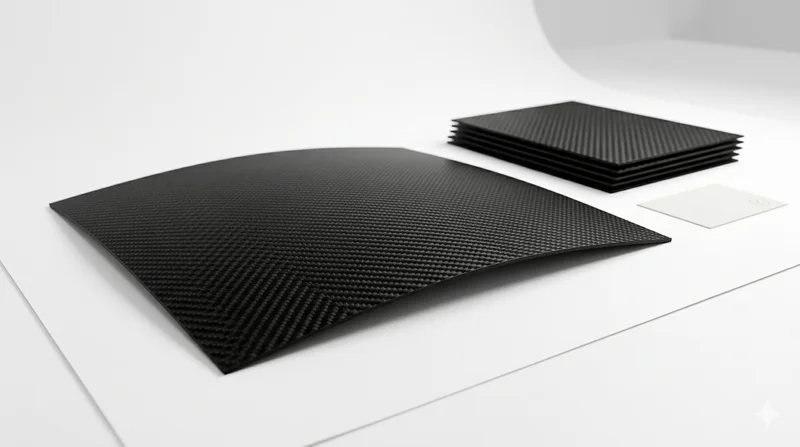
Carbon Fiber Plate — 3K Twill T700 1.5mm
Thin 1.5mm carbon fiber plate with 3K twill weave surface. Lightweight and stiff, commonly used for covers, panels, drone bodies, and applications requiring a premium aesthetic appearance.
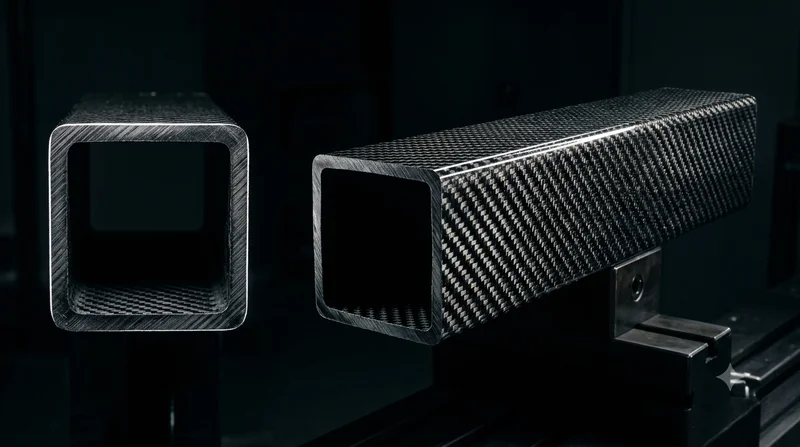
Square Carbon Fiber Tube — 3K Twill T700
Square cross-section carbon fiber tube manufactured with 3K twill weave for torsional strength. Preferred for structural frames, trusses, and support columns where rectangular geometry offers design flexibility.
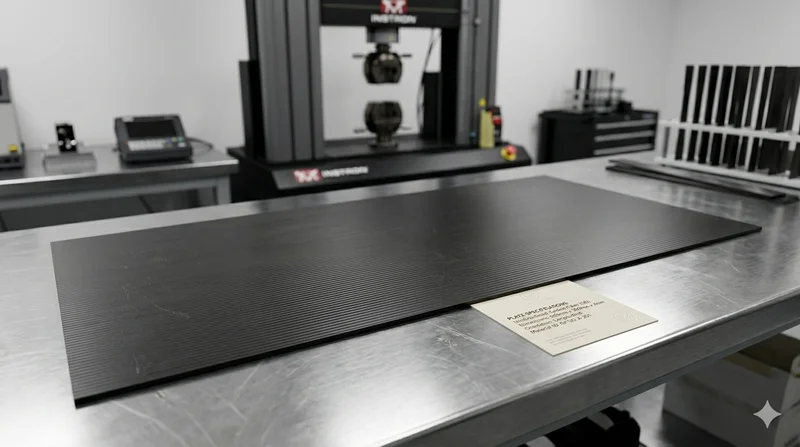
Carbon Fiber Plate — UD Unidirectional T700
Unidirectional carbon fiber plate with all fibers oriented in a single direction for maximum strength along the fiber axis. Essential for structural reinforcements, splints, and applications where load direction is predictable.
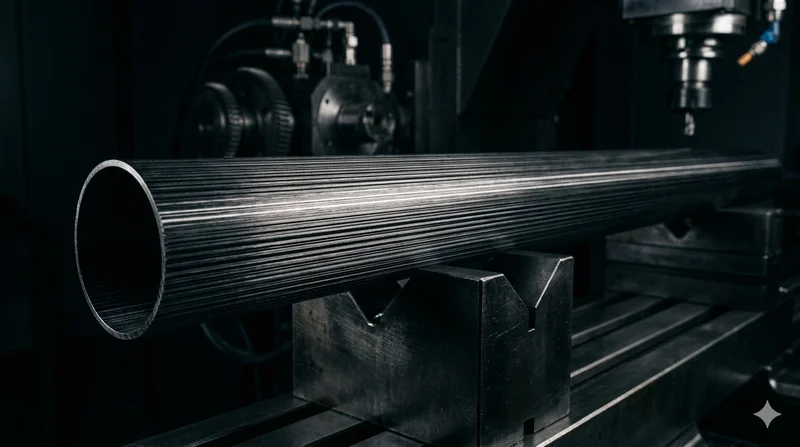
Round Carbon Fiber Tube — UD Unidirectional T700
Unidirectional (UD) round tube with all fibers aligned axially for maximum longitudinal stiffness. Ideal for applications requiring high bending rigidity with minimal weight, such as shafts, struts, and structural reinforcements.