
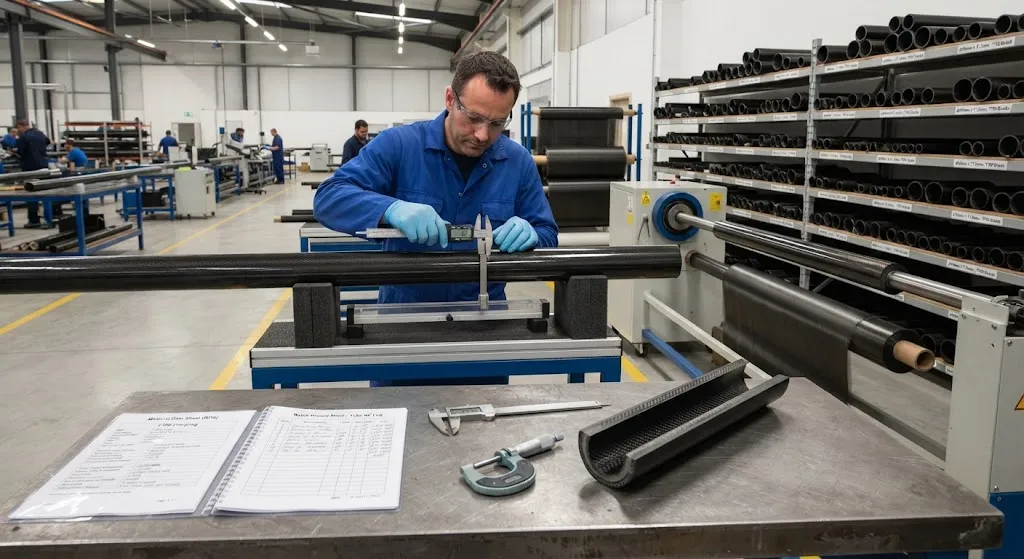
A carbon fiber tube for sale is one of the most searched composite products online, and one of the easiest to buy badly. The same nominal size — say, a 20 mm outer diameter tube with a 2 mm wall — can be pultruded, roll-wrapped, or filament wound, made from T300 or T700 fiber, in epoxy or vinyl este
Introduction
A carbon fiber tube for sale is one of the most searched composite products online, and one of the easiest to buy badly. The same nominal size — say, a 20 mm outer diameter tube with a 2 mm wall — can be pultruded, roll-wrapped, or filament wound, made from T300 or T700 fiber, in epoxy or vinyl ester resin, and priced anywhere from $8 to $60 per meter depending on which of those choices the seller made. A carbon fiber tube for sale listing that omits the manufacturing method and the fiber grade is asking you to gamble on the two details that most determine whether the tube will perform in your application.
This article shows you how to read carbon fiber tubes for sale listings, what the manufacturing method and material choices mean for performance and price, and the specific red flags that indicate a listing is not worth your money.
Carbon Fiber Tube for Sale: What the Listing Must Tell You
Before comparing prices, compare specifications. A usable carbon fiber tube for sale listing names at least these six fields, and any listing missing most of them should be treated as incomplete:
| Listing Field | Why It Matters | What a Good Listing States |
|---|---|---|
| Manufacturing method | Sets fiber orientation and strength | Pultruded, roll-wrapped, or filament wound |
| Fiber grade | Sets strength and modulus | T300, T700, or T800 class |
| Resin system | Sets temperature and weather resistance | Epoxy, vinyl ester, or polyester |
| Dimensions | Defines fit and stiffness | OD, ID, wall, and length with tolerance |
| Straightness and roundness | Affects alignment and bearing fit | Stated runout or straightness per meter |
| Data sheet | Backs up every claim | Material data sheet or test report |
These six fields are not bureaucratic extras — they are the difference between a tube that carries your load and one that fails at a fraction of it. A pultruded tube, for example, has its fibers running along the length, which makes it stiff and strong in bending but weak across the wall; a roll-wrapped tube has fibers at an angle that make it stronger in torsion and compression but with different bending behavior. Neither is "better" — they are different products sold under the same name, and the listing must say which one you are buying.
Carbon Fiber Tubes for Sale: Manufacturing Methods Behind the Price
Most of the price spread between carbon fiber tubes for sale comes from the manufacturing method and the material quality, not from seller greed. The table below summarizes the three common methods and what each one buys you:
| Method | Fiber Orientation | Typical Strength Profile | Typical Price Range (20 mm OD, 2 mm wall) |
|---|---|---|---|
| Pultrusion | Mostly 0° (along length) | High bending stiffness, low transverse strength | $8-20 per meter |
| Roll wrapping | Angled plies (typically ±45° and 0°) | Balanced axial and torsional strength | $20-45 per meter |
| Filament winding | Helical and hoop windings | Excellent hoop and internal pressure strength | $15-40 per meter |
Fiber grade explains the rest of the spread. T300-class fiber is the standard workhorse with a tensile strength around 3500 MPa; T700-class fiber runs around 4900 MPa and commands a premium in the same geometry. If a listing quotes a price far below the range for its method, the likely explanations are a lower fiber grade, a thinner wall than stated, or a polyester resin that degrades under UV — all of which are invisible in a photo. The data sheet is the only way to tell.
Carbon Fiber Tube Price: Reading Between the Numbers
Carbon fiber tube price is the fastest way to sort listings, provided you read it as a signal of specification rather than a negotiation target. Three price patterns repeat across marketplaces:
- Suspiciously cheap: A pultruded T300 tube priced at $5-8 per meter with no data sheet is likely polyester resin, thin wall, or seconds-grade material. For non-structural uses — display frames, antenna masts, craft projects — it can still be a bargain; for anything load-bearing, treat it as unfit.
- Mid-range with a full description: The $15-40 per meter band with named fiber, resin, and method is where most legitimate stockists sell, and it is the right band for structural hobby and light industrial use.
- Premium with engineering data: Aerospace-grade roll-wrapped or wound tubes with test reports and traceability run $40-100 per meter and are the only reasonable choice when the tube carries safety-critical loads.
One more arithmetic point: the cheapest listing is rarely the cheapest purchase. Freight for a long tube is dimensional and often exceeds the tube's own price, and a failed tube mid-project costs more in rework than any per-meter saving. Compare total delivered cost and the cost of failure, not the sticker price.
How to Buy Carbon Fiber Tube Without Getting Burned
Applying the checklist turns a carbon fiber tube for sale search into a shortlist of two or three credible candidates. The process is simple:
- Shortlist by method: Decide which manufacturing method your load case needs, then filter listings to that method only — comparing across methods is comparing apples and oranges.
- Demand the data sheet: Ask the seller for the material data sheet before ordering. A seller who cannot produce one for a structural product is a seller to avoid.
- Verify dimensions on arrival: Measure OD, wall thickness, and straightness when the tube arrives. Wall thickness of cheap tubes is frequently understated by 0.2-0.5 mm, which silently cuts bending strength by 15-30%.
- Check the ends: Frayed or delaminated ends indicate rough handling or a dry layup, and a dry layup means the tube was made without enough resin — a defect that runs the full length.
These four steps take ten minutes and catch the majority of bad buys. The listings that survive them are the ones that respect the specification — and those are the listings worth your budget.
Frequently Asked Questions
What is the difference between pultruded and roll-wrapped carbon fiber tubes?
Pultruded tubes are drawn continuously through a heated die with the fibers running along the length, which gives high bending stiffness and the lowest cost, but low strength across the wall and through the thickness. Roll-wrapped tubes are built from sheets of fabric wrapped around a mandrel, with fibers at angles such as 0° and ±45°, which gives balanced axial and torsional strength and a higher price. For a strut or a spar loaded in bending, pultrusion is often sufficient; for torsion, impact, or compression loads, roll wrapping is the safer choice.
How much should I pay for a carbon fiber tube?
For a standard 20 mm outer diameter, 2 mm wall tube, expect $8-20 per meter for pultruded T300, $20-45 per meter for roll-wrapped, and $15-40 per meter for filament wound, with T700 fiber adding a premium. Aerospace-grade tubes with test data run $40-100 per meter. The exact number depends on fiber grade, resin, tolerance, and quantity, but a tube priced far below its method's band is almost always missing one of those — usually fiber grade, wall thickness, or resin quality.
How can I tell if a carbon fiber tube listing is a scam or low quality?
Look for four signals. First, no manufacturing method stated — you cannot evaluate what you cannot identify. Second, no fiber grade and no data sheet — the two documents that prove material quality. Third, wall thickness that is not stated at all, which allows the seller to ship a thinner, weaker tube. Fourth, a price far below the market band for the method — polyester resin and seconds material hide there. A credible listing states method, fiber, resin, dimensions with tolerance, and offers a data sheet on request.
Can I cut and drill a bought carbon fiber tube without damaging it?
Yes, with the right technique. Cut with a fine-toothed carbide blade or a diamond wheel, not a standard hacksaw, which frays the fibers. Drill with carbide bits and back the hole with a wooden block to prevent delamination at the exit. Always wear a dust mask and eye protection, since carbon fiber dust is abrasive and irritates the skin and lungs. Sealing the cut ends with a thin epoxy or cyanoacrylate coat prevents moisture wicking into the laminate, which is the main cause of long-term strength loss in exposed tubes.
Conclusion
Buying a carbon fiber tube for sale comes down to reading the specification behind the price. The manufacturing method sets the strength profile, the fiber grade sets the ceiling, the resin sets the durability, and the dimensions with tolerance set whether the part fits. Carbon fiber tube price is a signal, not a target — the cheapest listing is usually the cheapest in specification too, and the premium band is where the data sheets live. Apply the six-field checklist, measure on arrival, and a marketplace search becomes a reliable sourcing channel instead of a gamble.
When your project needs a tube you can trust, with a stated method, fiber grade, and data sheet, YongXian supplies pultruded, roll-wrapped, and filament-wound carbon fiber tubes in standard and custom sizes. Browse our carbon fiber tube range or contact our team with your dimensions and load case for a specification-backed quote.
Part of topic
Related Articles
- Carbon Fiber Engine Parts: High-Temperature Performance for Racing and Performance Vehicles
- Carbon Fiber Body Parts: Automotive Exterior Panels and Structural Components
- Carbon Fiber Drone Body Manufacturing: Monocoque Design and Production Methods
- Carbon Fiber Drone Parts Supplier: FPV Frames, Arms and Structural Components
- Filament Wound Epoxy Tubes: Industrial Applications from Oil and Gas to Aerospace
- Carbon Fiber Rod Near Me: Stock Sizes, Tolerances and Local Availability
Interested in Our Products?
Contact our team for competitive pricing and technical specifications.
Get a QuoteRelated Products

Carbon Fiber Plate — 3K Twill T700 3.0mm
Medium-thickness 3.0mm carbon fiber plate offering significantly higher load capacity while maintaining attractive 3K twill finish. Suitable for structural brackets, reinforcement plates, and load-bearing panels.

Carbon Fiber Plate — 3K Twill T700 1.5mm
Thin 1.5mm carbon fiber plate with 3K twill weave surface. Lightweight and stiff, commonly used for covers, panels, drone bodies, and applications requiring a premium aesthetic appearance.

Square Carbon Fiber Tube — 3K Twill T700
Square cross-section carbon fiber tube manufactured with 3K twill weave for torsional strength. Preferred for structural frames, trusses, and support columns where rectangular geometry offers design flexibility.
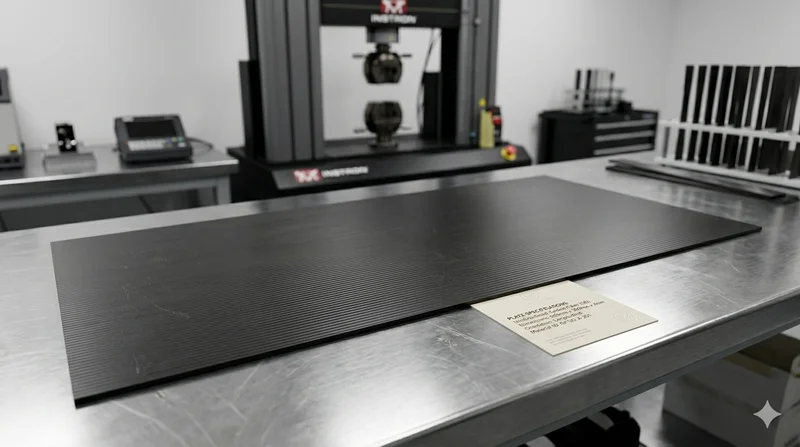
Carbon Fiber Plate — UD Unidirectional T700
Unidirectional carbon fiber plate with all fibers oriented in a single direction for maximum strength along the fiber axis. Essential for structural reinforcements, splints, and applications where load direction is predictable.
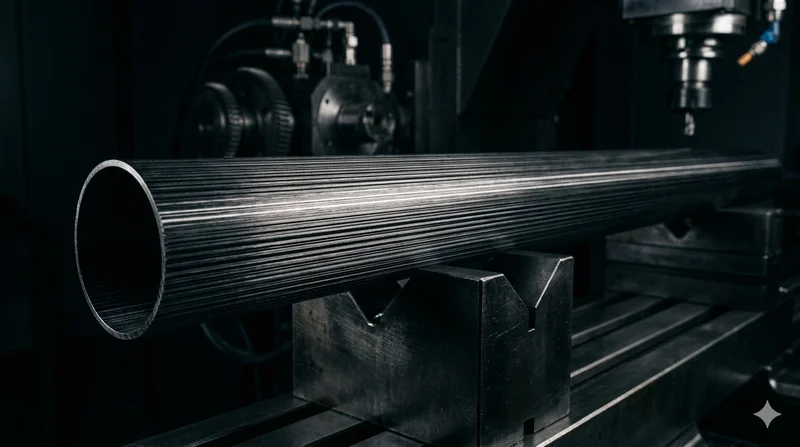
Round Carbon Fiber Tube — UD Unidirectional T700
Unidirectional (UD) round tube with all fibers aligned axially for maximum longitudinal stiffness. Ideal for applications requiring high bending rigidity with minimal weight, such as shafts, struts, and structural reinforcements.