
Concrete structures carry the world's bridges, buildings, and industrial infrastructure, but a large share of them now operate beyond their original design intent. Traffic volumes have grown, load codes have tightened, and decades of environmental exposure have taken their toll. Where a
Introduction
Concrete structures carry the world's bridges, buildings, and industrial infrastructure, but a large share of them now operate beyond their original design intent. Traffic volumes have grown, load codes have tightened, and decades of environmental exposure have taken their toll. Where a structure once had reserve capacity, engineers now routinely confront elements that must carry higher loads, survive seismic demands, or resist corrosion damage. Carbon fiber reinforced polymer strengthening has become the default answer to these problems because it delivers the required capacity increase with almost no added dead weight and without shutting down the structure for weeks of construction.
This article covers the two externally bonded CFRP systems — cured plates and wet-applied wraps — the mechanisms by which they strengthen flexure, shear, and confinement, and the design and site practices that determine whether a retrofit is reliable and durable.
Two Application Forms: Plates and Wraps
Externally bonded CFRP strengthening comes in two principal forms, each suited to different site conditions and load cases:
- Pultruded or cured plates: factory-made carbon fiber plates, typically 1.2-1.4 mm thick and 50-200 mm wide, bonded with a structural epoxy adhesive to prepared concrete surfaces. Plates provide high stiffness gain in one direction and are ideal for flexural strengthening of beams and slabs where access allows unobstructed bonding along the tension face.
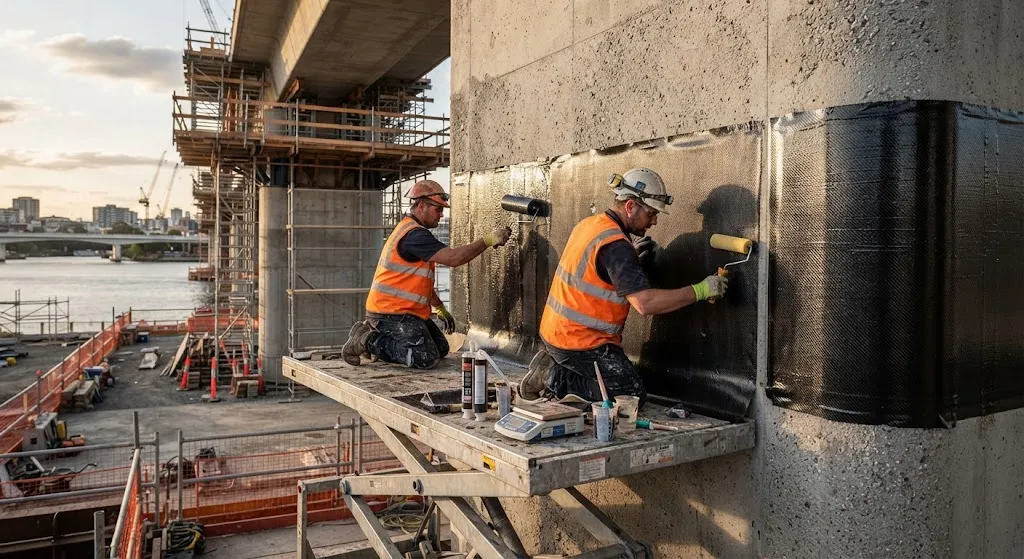
- Wet-applied wraps and fabrics: unidirectional carbon fiber sheets saturated with epoxy on site and wrapped around members, following the surface profile of columns and beams. Fabrics conform to curved geometry and are applied in multiple layers to build thickness; they are the standard choice for shear strengthening and column confinement.
| Characteristic | CFRP Plates | CFRP Wraps | Steel Plate Bonding |
|---|---|---|---|
| Typical strengthened capacity gain | 20-40% | 30-60% | 20-40% |
| Added dead weight | 0.5-2 kg/m² | 0.5-1.5 kg/m² | 40-100 kg/m² |
| Corrosion behavior | Non-corrosive | Non-corrosive | Requires protection |
| Surface geometry tolerance | Needs flat bonding area | Conforms to curves | Needs flat bonding area |
| Typical site installation | 1-2 days per element | 1-2 days per element | 3-7 days per element |
The comparison makes the structural case straightforward: a CFRP wrap adds less than 2 kg/m² while a steel plate of equivalent capacity may add 40-100 kg/m² — on a large bridge slab, the difference is tens of tonnes of new dead load that the structure must carry permanently.
Strengthening Mechanisms
Externally bonded CFRP increases capacity through three distinct mechanisms, applied individually or in combination depending on the deficiency:
- Flexural strengthening: plates or fabric bonded to the tension face act as external reinforcement, adding tensile capacity in regions where the steel reinforcement is undersized or where live loads have increased. The CFRP carries a share of the tension force, reducing stress in the existing steel and increasing the section's moment capacity.
- Shear strengthening: wraps applied around the web of beams or girders, or U-wraps around three sides, act as external stirrups. Because the fabric is oriented with fibers perpendicular to the member axis, it resists diagonal tension cracking, converting a brittle shear failure mode into a more ductile response.
- Confinement strengthening: wraps fully surrounding columns provide lateral confinement that raises the concrete's effective compressive strength and ductility. This is the dominant technique for seismic retrofitting of columns, where increased deformation capacity matters as much as increased strength.
The three mechanisms often coexist in a single retrofit: a column may receive full-wrap confinement for seismic demands, beams may receive flexural plates and shear wraps, and the connection regions may be reinforced with additional fabric layers. Design standards such as ACI 440.2R and fib Bulletin 14 provide the analysis framework, with strain limits on the CFRP and verification that the strengthened member remains crack-controlled and serviceable.
Where the Technique Is Applied
Bridges, columns, and beams account for the majority of externally bonded CFRP projects, each with characteristic scenarios:
| Structure Type | Typical Deficiency | Preferred CFRP Scheme |
|---|---|---|
| Highway and railway bridges | Increased live loads, undersized flexural steel | Tension-face plates on slab and girder soffits |
| Columns and piers | Seismic deficiency, corrosion of longitudinal steel | Full-circumferential confinement wraps |
| Beams and girders | Shear cracking, increased dead and live load | U-wraps or full wraps on the web |
| Parking decks and slabs | Corrosion damage, punching shear concerns | Top-face plates and column-cap wraps |
| Industrial slabs and transfer structures | New equipment loads or changed use | Flexural plates with shear detail at supports |
Across these categories, the same properties drive adoption: speed, minimal disruption, and the absence of corrosion — the very problem that often necessitated the strengthening in the first place.
The Site Workflow
A typical externally bonded CFRP retrofit follows a disciplined sequence that keeps downtime to days rather than weeks:
- Surface preparation: the concrete surface is grit-blasted or scarified to remove laitance and expose aggregate, then repaired locally if spalled or delaminated; flatness is verified against the bonding requirement.
- Condition assessment: moisture content and concrete tensile strength are measured, because epoxy bonding fails if the substrate is damp or weak — pull-off tests confirm the surface is ready.
- Primer and adhesive application: a primer seals the surface and improves adhesion; for plates, a thixotropic structural epoxy is applied to the plate and pressed into place with roller pressure.
- Fabric saturation and wrap application: for wraps, the dry fabric is saturated with epoxy and applied wet, with rollers removing air and ensuring full fiber wet-out; multiple layers build the required thickness.
- Cure and quality control: the system cures at ambient temperature over several days; bond integrity is verified by tap testing and pull-off testing, and any void areas are repaired and retested.
The entire operation is performed without heavy equipment — scaffolding, hand rollers, and small pumps suffice. Bridges can often remain in service with partial lane closures, which is why owners with high-traffic structures consistently prefer CFRP over steel plate bonding or concrete jacketing.
Durability and Long-Term Performance
The durability case for externally bonded CFRP rests on the inertness of the carbon fiber and the protective role of the epoxy. Carbon fiber does not corrode, so the strengthening system does not introduce the rusting risk that steel plate bonding carries. The epoxy both transfers load and shields the fiber from moisture and chemical attack; UV exposure is managed with paint or a specialized protective coating on exterior applications. Fire performance is addressed by design: standards require assessment of adhesive and fiber behavior at elevated temperature, with fire protection applied where the strengthened member must maintain capacity during a fire event. Long-term monitoring programs on bridge retrofits from the late 1990s onward confirm stable bond behavior and unchanged strengthening effectiveness over operating lives approaching three decades.
Frequently Asked Questions
How much strengthening capacity does CFRP actually add?
Typical externally bonded CFRP strengthening increases member capacity by 20-60 percent depending on the configuration: flexural plates add 20-40 percent to moment capacity, shear wraps add 30-60 percent to shear strength, and confinement wraps can raise column axial capacity and ductility substantially. The realistic gain is bounded by the strain limits permitted by design standards like ACI 440.2R, which protect against debonding and keep the strengthened member serviceable.
Is CFRP strengthening suitable for bridges that must stay in service?
Yes — minimal disruption is one of its defining advantages. Site installation per element typically runs 1-2 days with scaffolding and hand tools, and lanes can often remain open with controlled closures. Compared to steel plate bonding (3-7 days per element, with heavy lifting) or concrete jacketing (weeks of formwork and cure), CFRP minimizes traffic interruption and associated user costs.
How long does externally bonded CFRP strengthening last?
Strengthening systems installed from the late 1990s onward have shown stable performance over operating lives approaching 30 years, with no observed loss of strengthening effectiveness in monitoring programs. The carbon fiber is non-corrosive and the epoxy matrix protects it from moisture when properly applied; UV-exposed exterior applications use protective coatings. Design standards require elevated-temperature assessment for fire scenarios.
Conclusion
Externally bonded CFRP plates and wraps have become the default strengthening technology for concrete bridges, columns, and beams because they combine meaningful capacity gains — 20-60 percent depending on the scheme — with negligible added dead weight, no corrosion risk, and site installation measured in days rather than weeks. The mechanisms are well understood, the design basis is codified in ACI 440.2R and fib Bulletin 14, and three decades of monitoring confirm the durability of properly installed systems.
For asset owners and structural engineers planning a retrofit, the practical path is a condition assessment, a design to the governing standard, and a qualified applicator with documented surface preparation and bond verification. Review our carbon fiber products for structural strengthening, including unidirectional plates and fabrics for external bonding, or contact our engineering team to discuss material specification and project support.
Part of topic
Related Articles
- Carbon Fiber Mooring for Floating Offshore Wind: Fatigue and Corrosion in Deep Water
- Carbon Fiber Bicycle Frame Optimization: Layup Design and Manufacturing for Competitive Racing
- Carbon Fiber CFRP Retrofit for Infrastructure: Bridge and Building Seismic Strengthening
- Carbon Fiber Medical Imaging Equipment: Lightweight Gantry and Couch Structures for MRI/CT
- Carbon Fiber EV Battery Enclosures: Crash Safety and Electromagnetic Shielding Design
- Carbon Fiber Structures for Low-Altitude Economy: UAV Airframes and eVTOL Components
Interested in Our Products?
Contact our team for competitive pricing and technical specifications.
Get a QuoteRelated Products

Carbon Fiber Plate — 3K Twill T700 3.0mm
Medium-thickness 3.0mm carbon fiber plate offering significantly higher load capacity while maintaining attractive 3K twill finish. Suitable for structural brackets, reinforcement plates, and load-bearing panels.

Carbon Fiber Plate — 3K Twill T700 1.5mm
Thin 1.5mm carbon fiber plate with 3K twill weave surface. Lightweight and stiff, commonly used for covers, panels, drone bodies, and applications requiring a premium aesthetic appearance.

Square Carbon Fiber Tube — 3K Twill T700
Square cross-section carbon fiber tube manufactured with 3K twill weave for torsional strength. Preferred for structural frames, trusses, and support columns where rectangular geometry offers design flexibility.
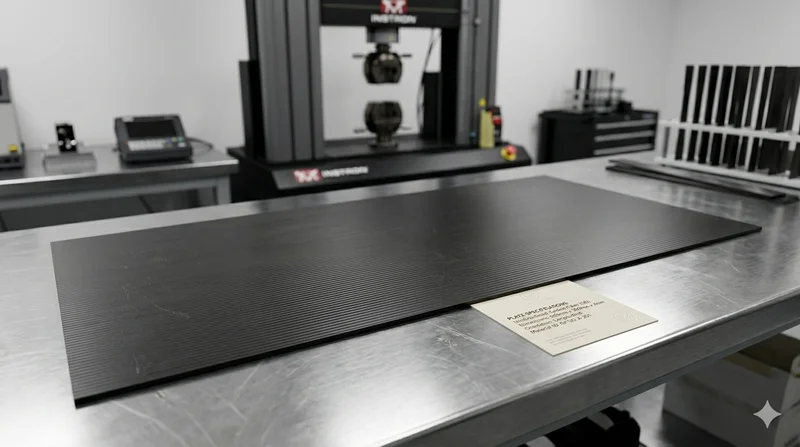
Carbon Fiber Plate — UD Unidirectional T700
Unidirectional carbon fiber plate with all fibers oriented in a single direction for maximum strength along the fiber axis. Essential for structural reinforcements, splints, and applications where load direction is predictable.
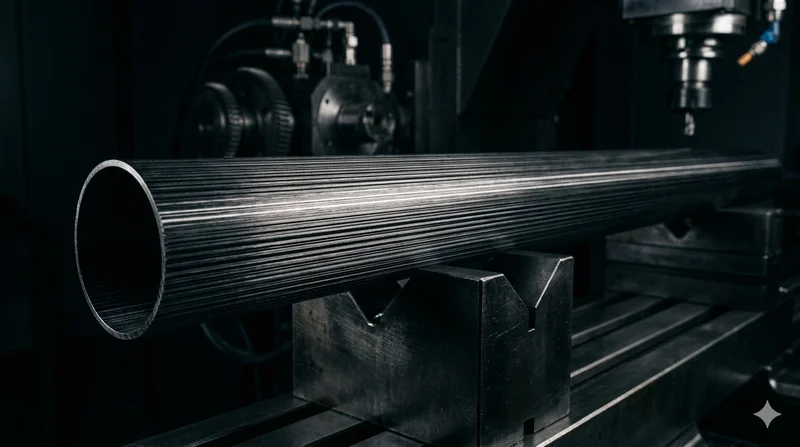
Round Carbon Fiber Tube — UD Unidirectional T700
Unidirectional (UD) round tube with all fibers aligned axially for maximum longitudinal stiffness. Ideal for applications requiring high bending rigidity with minimal weight, such as shafts, struts, and structural reinforcements.