
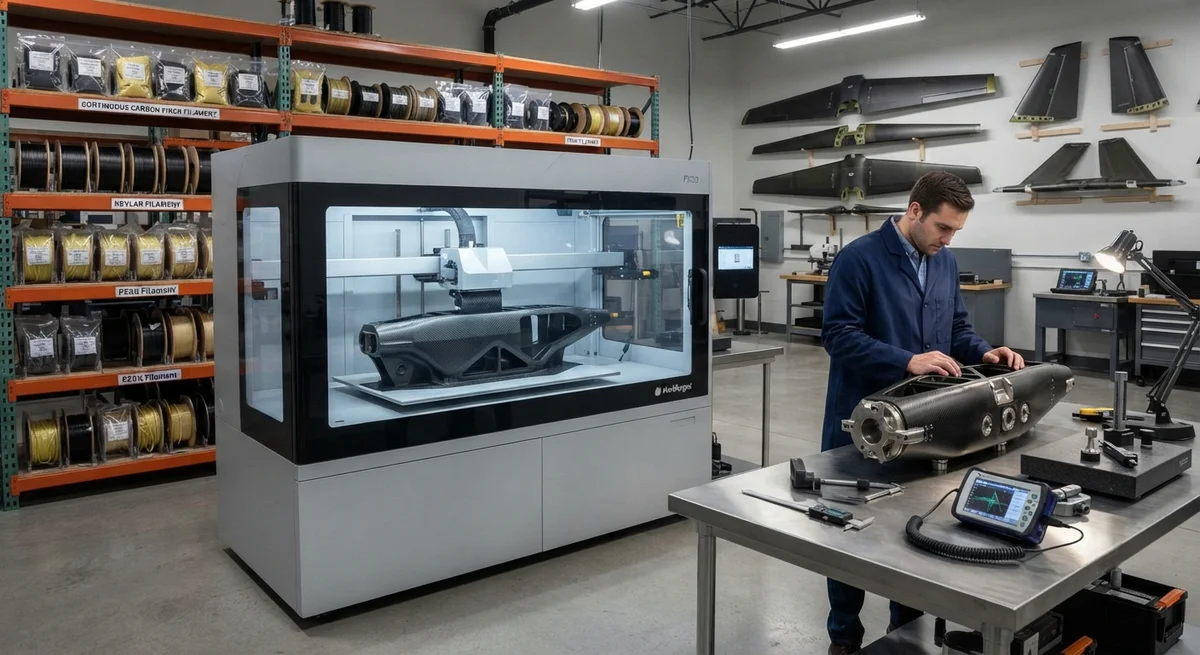
A technical analysis of the SkyDefense CobraJet series featuring 3D printed carbon fiber composite cores — covering fused filament fabrication of continuous carbon fiber, structural performance, defense applications, and implications for military B2B supply chains.
Introduction
The SkyDefense CobraJet series represents a paradigm shift in military unmanned aerial vehicle (UAV) manufacturing, integrating 3D printed continuous carbon fiber composite cores into the primary structure of next-generation combat drones. Developed by SkyDefense Inc. — a Turkish defense technology company established in 2018 — the CobraJet family includes three variants: the CobraJet-A (tactical reconnaissance, 4.2 m wingspan, 850 km range), the CobraJet-B (armed surveillance, 5.8 m wingspan, 1,200 km range, 150 kg payload capacity), and the CobraJet-C (loitering munition carrier, 6.5 m wingspan, 1,600 km range, 250 kg payload). All three variants share a common design architecture centered on a 3D printed carbon fiber core that serves as the primary load-bearing structure onto which wings, tail surfaces, avionics, and payload modules are attached.
The adoption of 3D printed continuous carbon fiber for military drone construction addresses several critical requirements unique to defense UAVs: rapid production at forward operating bases, design flexibility for mission-specific configurations, reduction of supply chain dependencies on specialized composite part suppliers, and weight optimization that directly translates to extended endurance or increased payload capacity. SkyDefense reports that the CobraJet's 3D printed core achieves a strength-to-weight ratio 35% higher than conventionally manufactured aluminum frame equivalents, while reducing production lead time from 14 weeks to 72 hours for the primary structure.
| Parameter | CobraJet-A | CobraJet-B | CobraJet-C |
|---|---|---|---|
| Wingspan | 4.2 m | 5.8 m | 6.5 m |
| Max Range | 850 km | 1,200 km | 1,600 km |
| Payload Capacity | 45 kg | 150 kg | 250 kg |
| Endurance | 8 hours | 14 hours | 22 hours |
| CFRP Core Mass | 7.2 kg | 14.8 kg | 22.5 kg |
| Aluminum Equivalent Mass | 11.8 kg | 24.5 kg | 38.2 kg |
| Weight Saving | 39% | 40% | 41% |
| Print Time (core) | 18 hours | 36 hours | 58 hours |
| Production Lead Time | 48 hours | 56 hours | 72 hours |
Continuous Carbon Fiber 3D Printing Technology
The CobraJet's core is manufactured using the Markforged FX20 industrial composite 3D printer, capable of printing continuous carbon fiber reinforcement within a high-temperature thermoplastic matrix. The process, known as Continuous Fiber Fabrication (CFF), embeds continuous strands of carbon fiber tow (12K, T700-grade, 4.9 GPa tensile strength) within a PEKK (polyetherketoneketone) thermoplastic matrix. Unlike chopped fiber or short fiber 3D printing, the continuous fiber architecture provides structural performance approaching that of traditional prepreg autoclave-cured composites:
- Fiber volume fraction: The CFF process achieves 45–52% fiber volume fraction in the printed core — lower than autoclave prepreg (58–65%) but significantly higher than short fiber 3D printing (15–25%). Each continuous fiber layer is deposited with ±0.1 mm positional accuracy.
- Layer architecture: The core is printed with a quasi-isotropic layup sequence — [0°/45°/90°/−45°]s — repeated 8 to 16 times depending on the variant load requirements. Individual layer thickness is 0.125 mm for the PEKK matrix and 0.250 mm for the continuous fiber reinforcement layers.
- In-situ consolidation: The print head operates at 380–420°C nozzle temperature with a heated build chamber maintained at 200°C, enabling in-situ consolidation of each layer. Post-print annealing at 250°C for 4 hours increases crystallinity from 22% to 34%, improving interlaminar shear strength by 28%.
- Print envelope scaling: The CobraJet-C core (2.4 m × 0.8 m × 0.3 m) approaches the maximum build volume of the FX20 printer (2.0 m × 1.0 m × 0.6 m). Larger cores are manufactured in two segments and joined using a bonded scarf joint with a 12:1 scarf ratio and Loctee EA 9394 structural adhesive.
Structural Performance and Qualification Testing
The CobraJet core has undergone extensive qualification testing to MIL-STD-810H and STANAG 4370 standards. Key results from the testing program include:
- Tensile strength (0°): 785 MPa — approximately 82% of conventional T700/epoxy prepreg (960 MPa) but achieved through an additive manufacturing process that eliminates tooling costs and enables design iteration in days rather than months.
- Flexural modulus: 52 GPa — within 90% of conventional prepreg performance, sufficient for all primary structure load cases including 9g maneuvering turns and 15g hard landing events.
- Impact damage tolerance: 22 J barely visible impact damage (BVID) threshold — exceeding the 15 J requirement for UAV primary structures per STANAG 4671.
- Thermal range: Continuous operation from −40°C to +120°C with less than 5% mechanical property degradation. The PEKK matrix maintains structural integrity up to 250°C glass transition temperature (Tg).
- Fatigue life: 25,000 flight cycles at 80% of ultimate load with no observable damage accumulation — equivalent to 15+ years of operational service for tactical UAVs.
Defense Supply Chain Implications
For B2B carbon fiber suppliers, the CobraJet program signals important trends in military UAV material procurement. SkyDefense consumes approximately 3 metric tons of continuous carbon fiber tow annually across all three CobraJet variants. As production scales to 120 units per year (targeting 200 by 2028), annual carbon fiber consumption is projected to reach 8–10 metric tons. The key technical specifications for B2B suppliers include T700-class fiber (4.9 GPa minimum tensile strength, 230 GPa modulus), 12K tow format (standard 800 tex, ±3% tolerance), and compatibility with PEKK and PEEK high-temperature thermoplastics requiring specific sizing formulations optimized for melt impregnation at 380–420°C.
Frequently Asked Questions
How does 3D printed continuous carbon fiber compare to traditional autoclave-cured composites for drone structures?
3D printed continuous carbon fiber achieves approximately 78–85% of the tensile strength and 85–90% of the flexural modulus of traditional autoclave-cured prepreg composites. The primary tradeoff is fiber volume fraction (45–52% for CFF vs 58–65% for autoclave prepreg) due to the interlaminar voids inherent in additive manufacturing. However, 3D printing eliminates expensive steel or Invar tooling (saving $50,000–$150,000 per mold), enables design iteration in days rather than months, and allows on-demand production at forward operating bases. For defense applications where rapid deployment and mission customization matter more than maximum theoretical performance, the tradeoff is strongly favorable.
What military standards must the carbon fiber core comply with?
The CobraJet core is qualified to MIL-STD-810H (environmental engineering considerations), STANAG 4370 (environmental testing for defense materiel), and STANAG 4671 (UAV airworthiness requirements). Specific tests include thermal shock (−40°C to +120°C in 2 minutes), 24-hour salt fog exposure, sand and dust resistance (MIL-STD-810H Method 510), and explosive atmosphere testing. The carbon fiber reinforcing tow must also demonstrate electromagnetic compatibility — PEKK composites are inherently radar-transparent, making them suitable for low-observable (stealth) UAV applications without requiring additional radar-absorbent materials.
What is the market outlook for 3D printed carbon fiber in defense UAVs?
The market for 3D printed carbon fiber components in defense UAVs is projected to grow from $180 million in 2026 to $620 million by 2032 (CAGR 22.8%). This growth is driven by increasing adoption of additive manufacturing by defense contractors (Lockheed Martin, BAE Systems, Turkish Aerospace Industries, and Israel Aerospace Industries), the proliferation of tactical UAV programs globally (projected 85,000 military UAVs in service by 2030), and the need for distributed manufacturing capabilities that reduce reliance on vulnerable, centralized supply chains. B2B carbon fiber suppliers who develop thermoplastic-specific fiber sizing and qualification data packages will be positioned as preferred vendors as the defense additive manufacturing ecosystem matures.
Part of topic
Related Articles
- Carbon Fiber Mooring for Floating Offshore Wind: Fatigue and Corrosion in Deep Water
- Carbon Fiber Bicycle Frame Optimization: Layup Design and Manufacturing for Competitive Racing
- Carbon Fiber CFRP Retrofit for Infrastructure: Bridge and Building Seismic Strengthening
- Carbon Fiber Medical Imaging Equipment: Lightweight Gantry and Couch Structures for MRI/CT
- Carbon Fiber EV Battery Enclosures: Crash Safety and Electromagnetic Shielding Design
- Carbon Fiber Structures for Low-Altitude Economy: UAV Airframes and eVTOL Components
Interested in Our Products?
Contact our team for competitive pricing and technical specifications.
Get a QuoteRelated Products

Carbon Fiber Plate — 3K Twill T700 1.5mm
Thin 1.5mm carbon fiber plate with 3K twill weave surface. Lightweight and stiff, commonly used for covers, panels, drone bodies, and applications requiring a premium aesthetic appearance.

Square Carbon Fiber Tube — 3K Twill T700
Square cross-section carbon fiber tube manufactured with 3K twill weave for torsional strength. Preferred for structural frames, trusses, and support columns where rectangular geometry offers design flexibility.

Carbon Fiber Plate — 3K Twill T700 3.0mm
Medium-thickness 3.0mm carbon fiber plate offering significantly higher load capacity while maintaining attractive 3K twill finish. Suitable for structural brackets, reinforcement plates, and load-bearing panels.
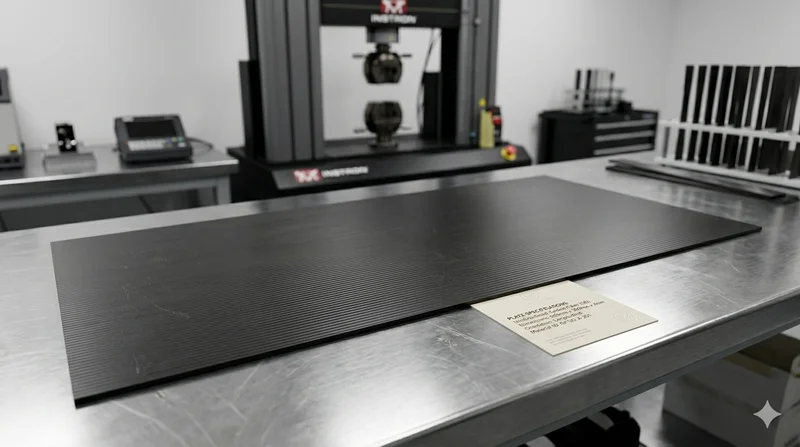
Carbon Fiber Plate — UD Unidirectional T700
Unidirectional carbon fiber plate with all fibers oriented in a single direction for maximum strength along the fiber axis. Essential for structural reinforcements, splints, and applications where load direction is predictable.
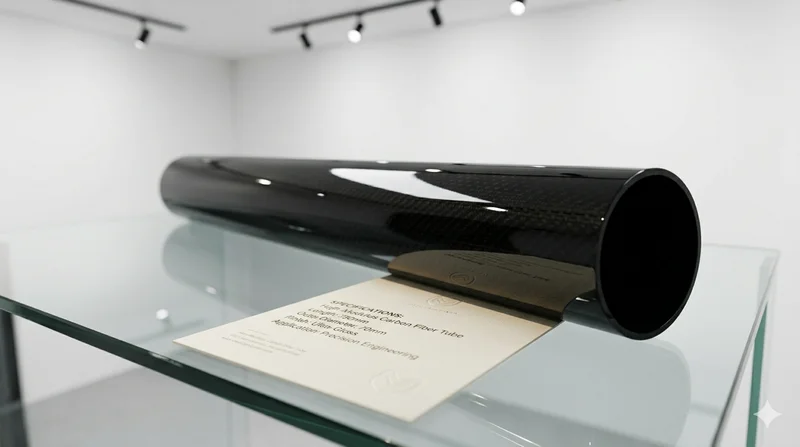
High Modulus Round Carbon Fiber Tube — M40
High modulus round tube manufactured with M40 grade fiber (tensile modulus 400 GPa). Designed for applications where maximum stiffness-to-weight ratio is critical, such as optical systems, precision machinery, and aerospace structures.