
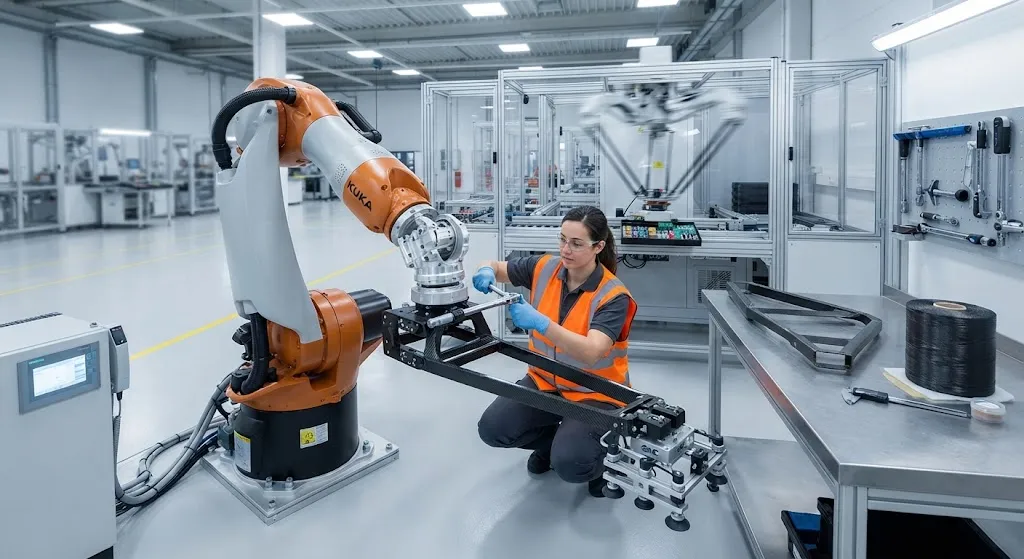
A production line that moves an object in a tenth of a second is a chain of compromises, and the weakest link is usually at the end of the arm. The end effector — the gripper or tool held at the wrist — must hold the part firmly, position it precisely, and accelerate and decelerate with
Introduction
A production line that moves an object in a tenth of a second is a chain of compromises, and the weakest link is usually at the end of the arm. The end effector — the gripper or tool held at the wrist — must hold the part firmly, position it precisely, and accelerate and decelerate with every cycle. Because it sits at the farthest point from the axis of rotation, its mass contributes disproportionately to the inertial load, torque and settling time of the whole arm. Replacing a heavy metal end-effector frame with carbon fiber can cut that contribution substantially, enabling faster cycles and smaller, cheaper robots.
This article explains why stiffness-to-weight ratio is the governing metric for end-effector design. It quantifies the inertial benefits of carbon fiber over aluminum and steel, covers the practical design considerations for composite end effector frames, and reviews the applications where the switch delivers the clearest return.
Why End-Effector Mass Matters
The end effector is the most levered part of the assembly. Its distance from the arm's axes means that a reduction in its mass produces a disproportionately large reduction in the torque the motors must produce and the inertia the controllers must overcome. The relationship is more subtle than simple gravity: an end effector that is 60% lighter reduces the effective inertia seen at the joints by a larger margin because inertia scales with mass and with the square of the distance from the axis.
The practical consequences for a pick-and-place cell are reflected in three numbers:
- Cycle time: Lower arm inertia allows shorter acceleration and deceleration phases, cutting overall cycle time by 5-15% in typical cells.
- Payload margin: A lighter end effector leaves more of the robot's rated payload available for the part being handled, enabling the same robot to move heavier parts.
- Robot selection: With a lighter end effector, a smaller, cheaper robot can often meet the same throughput, reducing capital and energy cost.
Material Comparison: Stiffness-to-Weight
The table below compares the material properties that matter most for end-effector frames — density, stiffness, and the ratio of stiffness to weight that governs deflection under load:
| Property | Carbon fiber composite | Aluminum 6061 | Steel |
|---|---|---|---|
| Density (g/cm³) | 1.55-1.60 | 2.70 | 7.85 |
| Young's modulus, quasi-isotropic (GPa) | 50-70 | 69 | 200 |
| Specific stiffness (GPa per g/cm³) | 32-45 | 25.6 | 25.5 |
| Typical frame weight saving vs steel | 60-75% | 60-65% | baseline |
| Damping of vibration | excellent | moderate | low |
Carbon fiber composites have a specific stiffness roughly 40-80% higher than aluminum, and their internal damping — the ability to absorb vibration rather than transmit it — is far better than both metals, which shortens settling time after each move. The weight saving against steel is the largest, typically 60-75%, and even against aluminum a well-oriented carbon fiber frame saves 15-30% while adding stiffness and damping.
Design Considerations for Composite End Effectors
Building an end effector from composite rather than metal changes the design process more than simply swapping materials. The orthotropic nature of carbon fiber means the layup must be oriented to carry the load paths of the specific application.
- Fiber orientation: For a gripper frame carrying bending and torsional loads, a quasi-isotropic layup in the flanges and a stiffer unidirectional layup along the principal bending axis balances stiffness and robustness.
- Metal inserts for wear points: The gripping surfaces, sensor mounts and interface flanges see concentrated loads and repetitive wear; local metal inserts or bonded metal plates protect these regions while the composite frame carries the gross load.
- Cost and volume trade-off: Composite end-effector frames are hand-laid or increasingly 3D-printed with continuous fiber, which suits the low-to-moderate volumes typical of specialized end tooling. Tooling amortizes well when a family of similar frames is produced.
- Temperature and stiffness stability: Carbon fiber composites have near-zero coefficient of thermal expansion, so frames hold their geometry across production-floor temperature swings better than aluminum — important when parts are handed off over tight tolerances.
Where Carbon Fiber End Effectors Deliver ROI
Not every end effector justifies carbon fiber — a light gripper carrying a small part may not benefit enough from a frame change. The payback concentrates in applications with three characteristics: high speed, high cycle count, and long or heavy end effectors.
- High-speed electronics assembly: Fast pick-and-place of circuit boards and components rewards every millisecond of cycle improvement, and the lightweight frames reduce vibration-induced misalignment.
- Robotic palletizing and packaging: Multi-head end effectors can be long and heavy; carbon fiber trusses cut mass and improve throughput.
- Automotive and appliance handling: Heavier parts push payload limits, so a lighter frame allows the same robot to handle larger components.
- Laboratory automation and inspection: Precise, low-settling-time robots benefit from the dimensional stability and damping of composite frames.
Frequently Asked Questions
How much lighter is a carbon fiber end effector than an aluminum one?
A carbon fiber end-effector frame is typically 15-30% lighter than an equivalent aluminum frame at the same stiffness, and 60-75% lighter than steel. The exact figure depends on the layup and the load case: a frame optimized for a single dominant bending load can be lighter than a quasi-isotropic design that must resist loads from several directions. Because the end effector sits far from the arm's axes, even this 15-30% frame saving produces a larger reduction in inertial load at the joints.
Does carbon fiber end-effector stiffness change robot accuracy?
Yes, in a beneficial direction. Carbon fiber's high specific stiffness keeps the tip deflection lower than an aluminum frame of equal mass, and its damping absorbs the vibration that otherwise causes the end effector to keep oscillating after a move — which lengthens settling time and limits how fast positioning can stabilize. For pick-and-place where parts are placed to a tight tolerance, the reduced settling time and stable geometry directly improve effective accuracy at speed.
Are carbon fiber end effectors cost-effective or a niche luxury?
For high-speed, high-cycle applications they are cost-effective — the faster cycle and smaller robot amortize the higher frame cost quickly. For a low-speed cell running a few cycles per minute, the payback can be slow, and metal may be the rational choice. Cost-effectiveness also depends on volume: tooling and layup are economical at the low-to-moderate volumes typical of end tooling, and continuous-fiber 3D printing is making composite frames increasingly accessible without dedicated molds.
Conclusion
End-effector frames are one of the clearest applications of carbon fiber in industrial automation because their position at the tip of the arm turns a modest weight saving into a large inertial benefit. With specific stiffness 40-80% above aluminum, 60-75% weight saving against steel, and superior damping that shortens settling time, carbon fiber end effectors deliver measurable cycle-time, payload and cost advantages in high-speed pick-and-place. The engineering task is to orient the layup to the load path, protect wear points with metal inserts, and confirm the cost trade-off for the specific cell.
For integrators and builders designing high-speed robotic cells, pairing a lightweight carbon fiber end effector with the right servo and control tuning closes the loop on throughput. Browse our carbon fiber tubes, plates and reinforcements suited to end-effector frames, or contact our engineering team to discuss material selection and custom composite fabrication for your robot tooling.
Related Articles
- Carbon Fiber Mooring for Floating Offshore Wind: Fatigue and Corrosion in Deep Water
- Carbon Fiber Bicycle Frame Optimization: Layup Design and Manufacturing for Competitive Racing
- Carbon Fiber CFRP Retrofit for Infrastructure: Bridge and Building Seismic Strengthening
- Carbon Fiber Medical Imaging Equipment: Lightweight Gantry and Couch Structures for MRI/CT
- Carbon Fiber EV Battery Enclosures: Crash Safety and Electromagnetic Shielding Design
- Carbon Fiber Structures for Low-Altitude Economy: UAV Airframes and eVTOL Components
Interested in Our Products?
Contact our team for competitive pricing and technical specifications.
Get a QuoteRelated Products
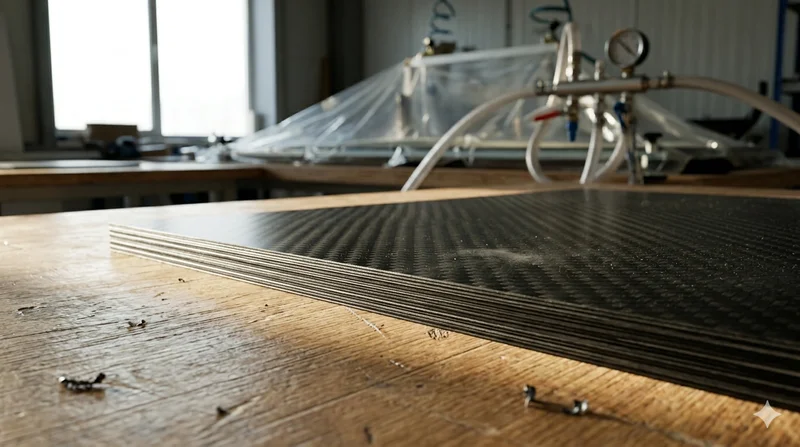
Carbon Fiber Plate — 3K Twill T700 3.0mm
Medium-thickness 3.0mm carbon fiber plate offering significantly higher load capacity while maintaining attractive 3K twill finish. Suitable for structural brackets, reinforcement plates, and load-bearing panels.

Carbon Fiber Plate — 3K Twill T700 1.5mm
Thin 1.5mm carbon fiber plate with 3K twill weave surface. Lightweight and stiff, commonly used for covers, panels, drone bodies, and applications requiring a premium aesthetic appearance.

Square Carbon Fiber Tube — 3K Twill T700
Square cross-section carbon fiber tube manufactured with 3K twill weave for torsional strength. Preferred for structural frames, trusses, and support columns where rectangular geometry offers design flexibility.
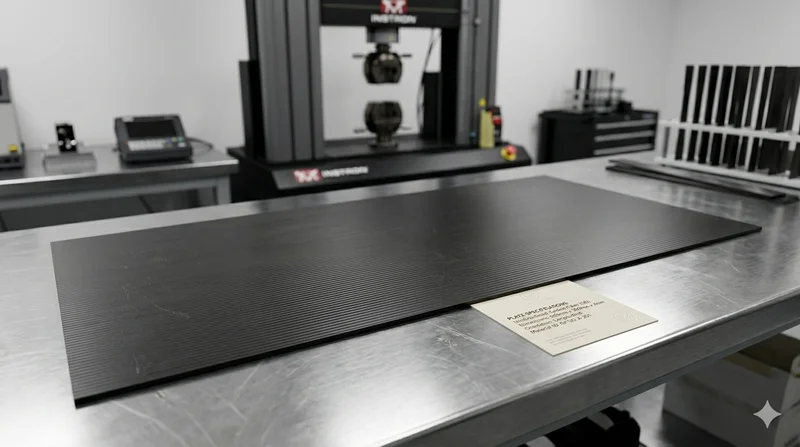
Carbon Fiber Plate — UD Unidirectional T700
Unidirectional carbon fiber plate with all fibers oriented in a single direction for maximum strength along the fiber axis. Essential for structural reinforcements, splints, and applications where load direction is predictable.
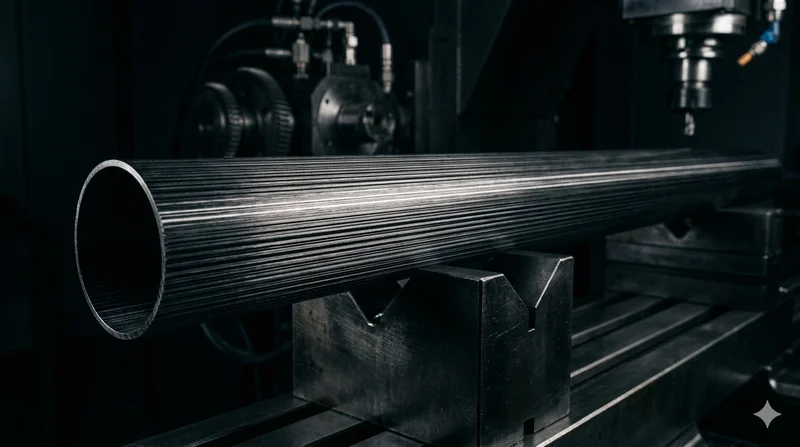
Round Carbon Fiber Tube — UD Unidirectional T700
Unidirectional (UD) round tube with all fibers aligned axially for maximum longitudinal stiffness. Ideal for applications requiring high bending rigidity with minimal weight, such as shafts, struts, and structural reinforcements.