
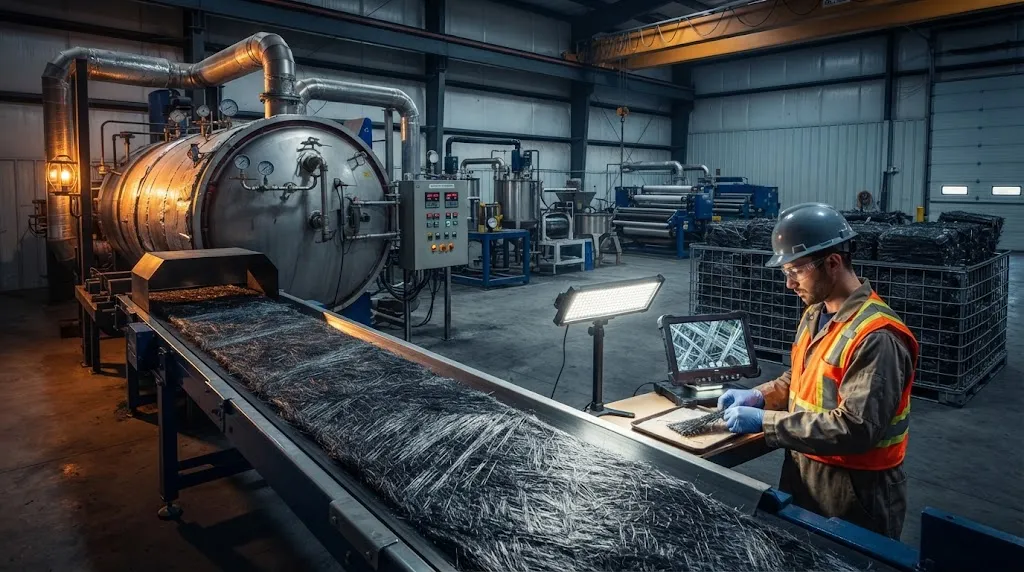
The carbon fiber recycling industry stands at a pivotal inflection point. Global CFRP waste generation is projected to reach 420,000-520,000 tons per year by 2030, up from approximately 65,000 tons in 2020, driven by end-of-life aerospace structures, automotive lightweighting programs,
Introduction
The carbon fiber recycling industry stands at a pivotal inflection point. Global CFRP waste generation is projected to reach 420,000-520,000 tons per year by 2030, up from approximately 65,000 tons in 2020, driven by end-of-life aerospace structures, automotive lightweighting programs, and decommissioned wind turbine blades. Yet fewer than 20 commercial-scale CFRP recycling facilities operate worldwide, with combined capacity of roughly 180,000 tons per year — less than half the projected waste stream. The bottleneck is not technology but economics: most recycling processes require throughput of 40,000-50,000 tons per year to achieve breakeven, a threshold that fewer than a dozen facilities currently meet or are planning to reach.
For carbon fiber manufacturers, recyclers, and downstream users, understanding this economic threshold is essential for strategic planning. This article quantifies the cost structures of the three primary recycling pathways — pyrolysis, solvolysis, and mechanical processing — analyzes the throughput-dependent cost curves that determine commercial viability, and evaluates the policy and market forces shaping the CFRP recycling landscape through 2030.
Recycling Pathways: Technology Overview
Three primary technologies dominate CFRP recycling, each with distinct cost profiles, recovered fiber quality, and scalability characteristics:
| Parameter | Pyrolysis | Solvolysis | Mechanical Grinding |
|---|---|---|---|
| Process Temperature | 400-700°C in inert atmosphere | 150-250°C under pressure | Ambient temperature |
| Fiber Strength Retention | 70-85% | 85-95% | 40-60% |
| Resin Recovery | None (thermal decomposition) | 60-80% (monomer recovery) | None |
| Capital Cost (per 10k ton/yr) | $8-15M | $12-22M | $3-6M |
| Operating Cost per kg | $4.50-7.00 | $6.00-10.00 | $2.00-3.50 |
| Min. Throughput for Breakeven | 35,000-45,000 t/yr | 45,000-60,000 t/yr | 20,000-30,000 t/yr |
| Recovered Fiber Value (per kg) | $8-15 | $12-22 | $3-6 |
Pyrolysis: The Dominant Commercial Pathway
Pyrolysis is the most mature and widely deployed CFRP recycling technology, accounting for approximately 65% of global commercial recycling capacity. The process heats CFRP waste to 400-700°C in an oxygen-free environment, decomposing the polymer matrix into pyrolysis oil and gas while recovering carbon fibers with 70-85% of their original tensile strength.
Economic modeling reveals a sharp cost reduction as throughput increases. At 10,000 tons per year, pyrolysis operating costs average $6.80 per kg of recovered fiber. At 30,000 tons, costs drop to $5.20 per kg. The breakeven point — where recycled fiber becomes cost-competitive with mid-grade virgin fiber — occurs at approximately 40,000 tons per year, where operating costs fall to $4.50-5.00 per kg and capital amortization contributes $1.20-1.50 per kg. ELG Carbon Fibre (UK) operates one of the world's largest pyrolysis facilities at 10,000 tons per year, with planned expansion to 20,000 tons. SGL Carbon's partnership with BMW processes approximately 8,000 tons annually of production scrap.
The critical economic insight is that pyrolysis facilities exhibit 35-40% economies of scale between 10,000 and 50,000 tons per year, driven by shared energy systems, automated material handling, and bulk purchasing of inert gas. Below 30,000 tons per year, most pyrolysis operations require subsidy or integration with a virgin fiber production facility to achieve positive margins.
Solvolysis: Higher Quality, Higher Cost
Solvolysis uses chemical agents — typically water (hydrothermal), glycols, or organic solvents — to dissolve or depolymerize the resin matrix at 150-250°C under pressure. The primary advantage is higher fiber strength retention (85-95%) and potential resin monomer recovery, which can offset 15-25% of operating costs when monomer markets exist.
However, solvolysis requires significantly higher capital investment ($12-22M per 10,000 tons per year versus $8-15M for pyrolysis) and faces higher operating costs due to solvent consumption, water treatment, and pressure vessel maintenance. The breakeven threshold is correspondingly higher: 45,000-60,000 tons per year for standalone operations. Vartega (USA) has demonstrated solvolysis at pilot scale with promising economics, while Toyota's supercritical water process achieves 90%+ fiber recovery at research scale.
Solvolysis becomes economically attractive when three conditions align: (1) high-quality recovered fiber commands premium pricing ($18-22 per kg vs $8-12 for pyrolysis fiber), (2) resin monomer recovery generates additional revenue, and (3) throughput exceeds 50,000 tons per year. For facilities lacking these conditions, pyrolysis offers a more forgiving economic profile.
Mechanical Grinding: Low Cost, Low Value
Mechanical recycling shreds and grinds CFRP waste into particulate or milled fiber for use as filler material in injection molding, concrete reinforcement, or thermoplastic compounding. The capital cost is lowest ($3-6M per 10,000 tons per year) and the process operates at ambient temperature with minimal energy input.
The limitation is fiber value retention: mechanical grinding reduces fiber length to 0.1-5 mm, limiting tensile strength retention to 40-60% and restricting applications to non-structural uses. Recovered fiber sells for $3-6 per kg, compared to $8-22 per kg for pyrolysis or solvolysis fibers. Carbon Conversions (USA) and Gen 2 Carbon (UK) operate mechanical recycling lines processing 5,000-15,000 tons per year, primarily serving automotive filler markets.
Mechanical recycling achieves breakeven at lower throughput (20,000-30,000 tons per year) but generates lower revenue per kg, making total profitability dependent on high-volume, low-margin filler markets rather than premium structural fiber applications.
The 40-50k Tons/Year Threshold
Across all three recycling pathways, a consistent economic pattern emerges: commercial viability requires processing 40,000-50,000 tons of CFRP waste per year. This threshold arises from the intersection of three cost drivers:
Capital amortization: Recycling facilities require $30-90M in total investment depending on technology. At 40,000 tons per year, 10-year amortization contributes $0.75-2.25 per kg — a manageable fraction of total cost. Below 20,000 tons per year, amortization alone exceeds $3.00 per kg, erasing margin.
Energy systems: Pyrolysis and solvolysis both benefit from thermal integration — waste heat from exothermic resin decomposition preheats incoming material. This integration becomes economically justified at 30,000+ tons per year, reducing energy costs by 25-35%.
Logistics: CFRP waste is bulky and low-density (typical loose density 50-100 kg/m3). Collection, sorting, and transport costs decrease 30-40% at scale as facilities establish regional collection networks with optimized routing.
Market Dynamics and Policy Drivers
The EU End-of-Life Vehicle Directive (2000/53/EC, revised 2024) mandates 95% vehicle weight recovery by 2031, with specific provisions for composite materials. This regulation creates regulatory demand for CFRP recycling capacity in Europe estimated at 120,000-180,000 tons per year by 2030. Similar regulations are under development in Japan (JAMA voluntary targets) and China (MIIT recycling mandates).
On the demand side, aerospace OEMs including Airbus, Boeing, and Embraer have committed to 30-50% recycled content in non-structural components by 2030. The automotive sector, led by BMW and Mercedes-Benz, uses 15-25% recycled CFRP in semi-structural applications. These commitments create offtake agreements that underpin recycling facility financing.
Current recycled carbon fiber pricing ranges from $8-15 per kg for standard pyrolysis fiber to $18-22 per kg for high-retention solvolysis fiber, compared to $15-30 per kg for standard-grade virgin carbon fiber. The cost advantage drives adoption, but only at scale: below 40,000 tons per year, the per-kg cost of recycled fiber often exceeds virgin fiber, eliminating the economic incentive.
Strategic Implications for Stakeholders
For carbon fiber manufacturers, the 40-50k ton threshold suggests two viable strategies: (1) establish captive recycling operations integrated with production facilities, where production scrap (typically 15-30% of output) provides baseline throughput, or (2) participate in industry consortiums that aggregate waste streams from multiple sources to reach threshold volume.
For recyclers, the analysis favors pyrolysis as the default technology for new facilities, with solvolysis reserved for sites where high-quality fiber recovery and resin monomer recovery can command premium pricing. Mechanical grinding serves as a complementary technology for processing residues and low-value waste streams.
For CFRP users, the maturing recycling ecosystem creates new procurement options. Recycled carbon fiber at $8-15 per kg with 70-85% strength retention offers compelling value for non-structural and semi-structural applications, potentially reducing material costs 20-40% while meeting sustainability targets.
What fiber strength retention can I expect from commercial pyrolysis recycling?
Commercial pyrolysis facilities typically achieve 70-85% tensile strength retention compared to virgin fiber, depending on process temperature, residence time, and CFRP feedstock composition. Lower pyrolysis temperatures (400-500°C) preserve more fiber properties but leave residual char on the fiber surface, requiring post-processing. Higher temperatures (600-700°C) produce cleaner fibers but with 5-10% additional strength loss. The recovered fiber is suitable for semi-structural applications including automotive panels, sporting goods, and industrial components, but typically does not meet aerospace structural allowables without additional surface treatment.
How does the EU ELV Directive affect CFRP recycling economics?
The revised EU ELV Directive (2024) mandates 95% vehicle weight recovery by 2031, with specific composite material provisions that require either recycling or energy recovery for CFRP components. This creates regulatory demand for approximately 120,000-180,000 tons per year of CFRP recycling capacity in Europe by 2030. For recyclers, this regulation provides demand certainty that supports facility financing. For automakers, it increases the total cost of CFRP adoption by an estimated EUR 1.50-3.00 per kg when end-of-life recycling obligations are included in lifecycle cost calculations.
Can recycled carbon fiber meet aerospace qualification requirements?
Recycled carbon fiber currently meets aerospace requirements only for non-structural and secondary structural applications. The 70-85% strength retention from pyrolysis does not satisfy the statistically-derived design allowables required for primary structures. However, several aerospace programs use recycled fiber in interior components, brackets, and non-load-bearing panels, where the 70-85% retention provides adequate margin. Solvolysis-recycled fiber at 85-95% retention is under evaluation for semi-structural aerospace applications, with qualification programs expected to complete by 2028-2029.
Conclusion
The CFRP recycling industry faces a clear economic reality: commercial viability requires throughput of 40,000-50,000 tons per year, a threshold driven by capital amortization, energy integration, and logistics optimization. Pyrolysis offers the most accessible path to scale, with breakeven at 35,000-45,000 tons per year, while solvolysis provides higher fiber quality at higher throughput requirements. Policy drivers, particularly the EU ELV Directive, are creating regulatory demand that will push the industry toward this threshold through 2030.
For carbon fiber manufacturers and users seeking to navigate the recycling landscape, understanding these economics is essential for strategic planning. Explore our carbon fiber fabric and reinforcement portfolio to discuss recycled fiber integration opportunities, or contact our engineering team for material specifications and supply chain guidance.
Part of topic
Related Articles
- Bio-Based Carbon Fiber Precursors: Lignin and Polyethylene for Low-Cost Production
- Large-Tow Carbon Fiber Cost Analysis: 48K vs 60K Price-Performance Comparison
- Carbon Fiber-Resin Interface Bonding: Surface Treatment and Coupling Agent Optimization
- Digital Twin for Carbon Fiber Manufacturing: Real-Time Process Monitoring and Defect Prevention
- Thermoplastic Carbon Fiber Welding for Automotive: Ultrasonic and Induction Welding Process Windows
- Large-Tow Carbon Fiber Wet Spinning: Process Optimization for 48K/60K Production Efficiency
Interested in Custom Carbon Fiber Products?
Contact our team for competitive pricing and technical specifications.
Get a QuoteRelated Products
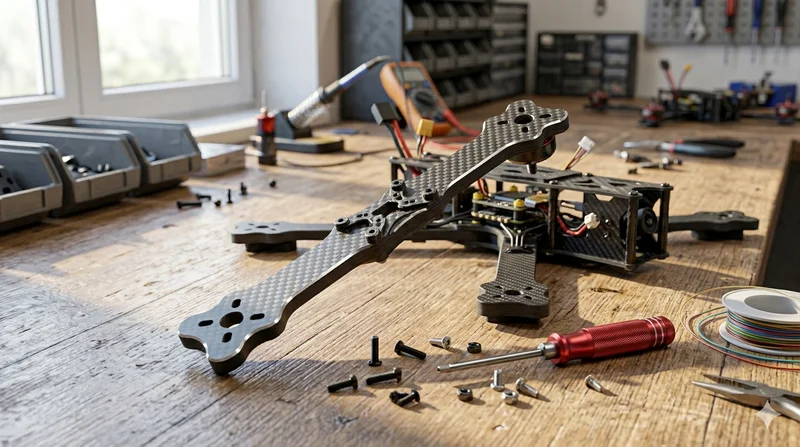
Carbon Fiber Drone Arm
Precision-molded carbon fiber drone arm combining unidirectional fiber for stiffness and woven layers for torsional strength. Designed for FPV, photography, and industrial drone platforms. Each arm is CNC-machined to exact specifications.

Custom Carbon Fiber Drone Arm — Lightweight & Vibration-Damping
High-modulus carbon fiber drone arms designed for industrial, agricultural, and surveying UAVs. Replace heavy aluminum arms with our custom-molded CFRP arms — 40-60% lighter with superior vibration damping for stable flight and sharper imaging.