
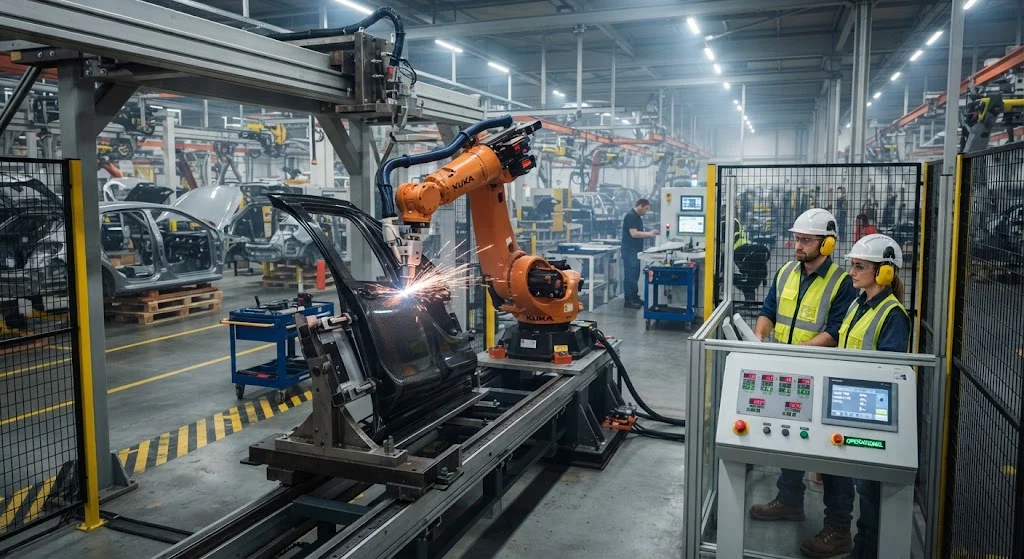
Thermoplastic carbon fiber welding has emerged as a critical enabling technology for automotive manufacturers seeking to reduce cycle times, eliminate fastener-related stress concentrations, and meet increasingly stringent weight reduction targets. Unlike thermoset composites, which req
Introduction
Thermoplastic carbon fiber welding has emerged as a critical enabling technology for automotive manufacturers seeking to reduce cycle times, eliminate fastener-related stress concentrations, and meet increasingly stringent weight reduction targets. Unlike thermoset composites, which require adhesive bonding or mechanical fastening, thermoplastic matrix composites can be joined through direct welding processes that melt and re-solidify the matrix at the joint interface. This capability transforms the economics of carbon fiber automotive production by enabling cycle times measured in seconds rather than hours.
For B2B buyers evaluating thermoplastic carbon fiber welding solutions, understanding the process windows, joint strength characteristics, and production trade-offs between ultrasonic and induction welding is essential. Both technologies are proven in laboratory and pilot-scale environments, but their suitability for high-volume automotive production differs significantly. This article provides a data-driven comparison to help manufacturing engineers and procurement teams make informed joining technology decisions.
Why Thermoplastic Carbon Fiber Welding Matters for Automotive
The automotive industry's shift toward carbon fiber reinforced thermoplastics (CFRTP) is driven by three requirements: fast cycle times compatible with high-volume production, recyclability mandated by end-of-life regulations, and the ability to form complex geometries through stamp forming or injection molding. Thermoplastic carbon fiber welding directly addresses the joining challenge that historically limited CFRTP adoption in body-in-white applications.
- Cycle time advantage: Ultrasonic welding joins thermoplastic carbon fiber components in 0.5-3 seconds, compared to 30-60 minutes for thermoset adhesive cure. Induction welding achieves 5-15 second cycle times with broader applicability to larger joint areas.
- No surface preparation: Both welding methods eliminate the cleaning, priming, and surface activation steps required for adhesive bonding, reducing process complexity and variable costs.
- Reversible joints: Thermoplastic carbon fiber welding produces joints that can be reheated for disassembly, supporting recycling and repair workflows that are increasingly important for circular economy compliance.
- Structural integrity: Welded joints in thermoplastic composites can achieve 70-95% of the parent material's interlaminar shear strength, depending on process parameters and joint design.
These advantages make thermoplastic carbon fiber welding particularly attractive for high-volume automotive applications including B-pillar reinforcements, seat structures, battery tray enclosures, and front-end module carriers where joining speed and cost per joint are decisive factors.
Ultrasonic Welding Process Windows for Thermoplastic Carbon Fiber
Ultrasonic welding uses high-frequency mechanical vibrations (typically 20-40 kHz) to generate frictional heat at the interface between two thermoplastic carbon fiber parts. The process is well-suited for spot-welding applications and small-to-medium joint areas. The key process parameters and their optimal ranges for automotive-grade CFRTP are summarized below:
| Parameter | Optimal Range | Effect on Joint Quality | Automotive Tolerance |
|---|---|---|---|
| Frequency | 20 kHz (standard) / 35 kHz (precision) | Higher frequency = finer energy control, smaller weld zones | ±0.5 kHz |
| Amplitude | 30-80 μm | Higher amplitude = faster melting, risk of fiber damage above 90 μm | ±5 μm |
| Weld pressure | 0.3-1.2 MPa | Insufficient pressure = porosity; excess = resin squeeze-out | ±0.05 MPa |
| Weld time | 0.5-3.0 seconds | Shorter time = incomplete fusion; longer = thermal degradation | ±0.1 s |
| Hold time | 0.5-2.0 seconds | Ensures solidification under pressure for consistent joint strength | ±0.2 s |
| Joint area limit | ≤ 40 cm² per spot | Larger areas require multiple spots or track welding | Design-dependent |
The critical constraint for ultrasonic thermoplastic carbon fiber welding is the joint area limit. Automotive structures such as B-pillars and floor panels require continuous seam welds or large-area bonds that exceed single-spot ultrasonic capability. Track welding (continuous ultrasonic along a path) extends the technology but introduces tooling complexity and reduces production throughput compared to single-cycle induction welding.
Induction Welding Process Windows for Thermoplastic Carbon Fiber
Induction welding uses electromagnetic energy to heat electrically conductive elements embedded in or placed on the thermoplastic carbon fiber joint. The most common approaches for automotive CFRTP include susceptor-embedded joints (metallic mesh or coated fibers at the interface) and direct induction of carbon fiber conductivity. Induction welding offers larger joint areas and more uniform heat distribution than ultrasonic methods.
| Parameter | Optimal Range | Effect on Joint Quality | Production Consideration |
|---|---|---|---|
| Frequency | 100-400 kHz | Higher frequency = shallower penetration, better for thin laminates | Equipment cost increases with frequency |
| Power density | 5-25 W/cm² | Higher power = faster heating, risk of thermal runaway in thick sections | Power supply sizing affects capital cost |
| Heating time | 3-15 seconds | Must match melt front progression through joint thickness | Cycle time constraint for takt time |
| Cooling time | 5-15 seconds | Controlled cooling under pressure prevents crystallization defects | Cooling dominates total cycle time |
| Susceptor design | Steel mesh, nickel-coated fabric, or chopped fiber mat | Susceptor placement controls heat uniformity and joint strength | Material cost adder per joint |
| Joint area | Up to 500 cm² per cycle | Uniform heating across large areas without sequential tooling | Tooling investment for coil design |
Induction welding's primary advantage for thermoplastic carbon fiber automotive production is the ability to join large structural areas in a single cycle. A B-pillar reinforcement or battery tray enclosure can be welded in one operation, compared to 8-15 ultrasonic spot welds with associated repositioning time. The trade-off is higher capital equipment cost and the need for susceptor materials at the joint interface.
Joint Strength Comparison: Ultrasonic vs Induction
The structural performance of thermoplastic carbon fiber welded joints depends on process parameters, joint design, and parent material properties. Laboratory testing on automotive-grade carbon fiber/polypropylene and carbon fiber/PA6 laminates reveals the following comparative data:
| Metric | Ultrasonic Welding | Induction Welding | Adhesive Bonding (Reference) |
|---|---|---|---|
| Interlaminar shear strength | 28-35 MPa (70-85% of parent) | 32-40 MPa (80-95% of parent) | 35-45 MPa (85-100% of parent) |
| Lap shear strength | 18-24 MPa | 22-30 MPa | 25-35 MPa |
| Peel strength | 8-15 N/mm | 12-22 N/mm | 15-25 N/mm |
| Crash energy absorption | Moderate (localized failure) | Good (distributed failure) | Good (adhesive yielding) |
| Environmental durability | Good (no adhesive aging) | Good (matrix re-fusion) | Moderate (moisture sensitivity) |
Induction welding generally produces higher joint strengths due to more uniform heating across the joint area, while ultrasonic welding's localized energy input can create stress concentrations near the weld spot. However, ultrasonic welding's faster cycle time and lower equipment cost make it competitive for applications where joints are not primary load paths.
Production Readiness and Automotive OEM Adoption
Both thermoplastic carbon fiber welding technologies are transitioning from development to production status, but at different rates across automotive OEMs:
- Ultrasonic welding in production: Already deployed for non-structural and semi-structural joining in instrument panel carriers, door module frames, and underbody shields at European OEMs. Cycle times below 2 seconds are proven at volumes exceeding 200,000 parts per year.
- Induction welding in pilot production: BMW and Audi have demonstrated induction welding for B-pillar reinforcements and center console structures in pilot programs. Production volumes are expected to ramp from 2027 as coil tooling costs decrease and susceptor supply chains mature.
- Hybrid approaches: Several OEMs are evaluating combinations of ultrasonic spot welds for positioning and induction seam welds for structural integrity, optimizing both cycle time and joint performance.
The decision between ultrasonic and induction thermoplastic carbon fiber welding for automotive production ultimately depends on joint size, structural requirements, and production volume. For high-volume, small-joint applications, ultrasonic welding offers the best cost-per-joint economics. For structural applications requiring large-area bonds, induction welding provides superior joint quality and production efficiency despite higher initial investment.
Frequently Asked Questions
What thermoplastic resins are compatible with carbon fiber welding in automotive?
The most common thermoplastic matrices for welded automotive carbon fiber components are polypropylene (PP), polyamide 6 (PA6), polyamide 66 (PA66), and polyphenylene sulfide (PPS). PP offers the lowest cost and best chemical resistance but requires higher welding pressures due to lower melt viscosity. PA6 and PA66 provide higher mechanical properties and are preferred for structural applications. PPS is used for high-temperature underhood applications but requires specialized welding parameters due to its narrow processing window. The choice of resin system directly affects the ultrasonic and induction welding process windows and must be validated for each specific joint design.
Can thermoplastic carbon fiber welded joints meet automotive crash requirements?
Yes, properly designed thermoplastic carbon fiber welded joints can meet automotive crash requirements. The key is joint design that ensures energy absorption through controlled failure modes rather than brittle fracture. Induction welded joints generally perform better in crash scenarios because the larger, more uniform weld zone distributes loads more effectively. European OEMs have validated induction-welded CFRTP B-pillars that meet ECE R21 head impact and FMVSS 214 side impact requirements. The weld zone must be designed so that the heat-affected zone does not become the weakest link in the structural chain, which requires careful thermal management during welding.
How does thermoplastic carbon fiber welding compare to adhesive bonding cost-per-joint?
Thermoplastic carbon fiber welding typically achieves 40-60% lower cost per joint compared to adhesive bonding when accounting for total process cost. Adhesive bonding requires surface preparation ($0.05-0.15/joint), adhesive material ($0.10-0.30/joint), application equipment ($50K-200K), and cure time (30-60 minutes requiring fixture investment). Ultrasonic welding eliminates surface preparation and adhesive costs, with equipment amortized over millions of cycles. Induction welding has higher equipment costs ($100K-500K) but eliminates adhesive and fixture costs. For production volumes above 50,000 units per year, welding consistently outperforms adhesive bonding on a cost-per-joint basis.
Conclusion
Thermoplastic carbon fiber welding represents a fundamental shift in how automotive manufacturers approach composite joining, with ultrasonic and induction methods offering distinct advantages for different production scenarios. Ultrasonic welding excels in high-volume, small-joint applications with cycle times under 3 seconds and proven production readiness. Induction welding delivers superior joint strength and large-area capability for structural applications, with production ramp expected through 2027-2028. Both technologies are mature enough for production deployment, and the choice depends on specific automotive OEM requirements for joint size, structural performance, and capital investment appetite.
For manufacturers evaluating thermoplastic carbon fiber welding for automotive production, understanding the process window trade-offs is essential for making cost-effective joining technology decisions. Explore our carbon fiber thermoplastic composite portfolio or contact our technical team to discuss welding-compatible material solutions for your automotive program.
Part of topic
Related Articles
- Bio-Based Carbon Fiber Precursors: Lignin and Polyethylene for Low-Cost Production
- Large-Tow Carbon Fiber Cost Analysis: 48K vs 60K Price-Performance Comparison
- Carbon Fiber-Resin Interface Bonding: Surface Treatment and Coupling Agent Optimization
- Digital Twin for Carbon Fiber Manufacturing: Real-Time Process Monitoring and Defect Prevention
- Large-Tow Carbon Fiber Wet Spinning: Process Optimization for 48K/60K Production Efficiency
- 3D Printing with Continuous Carbon Fiber: FDM/FFF Process Parameters and Mechanical Properties
Interested in Our Products?
Contact our team for competitive pricing and technical specifications.
Get a QuoteRelated Products

Carbon Fiber Fishing Rod Blank
High-quality carbon fiber fishing rod blank manufactured from multiple grades of Toray carbon fiber cloth. Available in a wide range of lengths, powers, and actions for freshwater and saltwater applications. Suitable for OEM rod building.

Carbon Fiber Plate — 3K Twill T700 1.5mm
Thin 1.5mm carbon fiber plate with 3K twill weave surface. Lightweight and stiff, commonly used for covers, panels, drone bodies, and applications requiring a premium aesthetic appearance.

Carbon Fiber Plate — 3K Twill T700 3.0mm
Medium-thickness 3.0mm carbon fiber plate offering significantly higher load capacity while maintaining attractive 3K twill finish. Suitable for structural brackets, reinforcement plates, and load-bearing panels.

Carbon Fiber Trekking Pole
Lightweight carbon fiber trekking pole manufactured from high-grade carbon fiber tube. Weighs only 160g per pole while providing superior shock absorption and durability for hiking, trail running, and backpacking.

Square Carbon Fiber Tube — 3K Twill T700
Square cross-section carbon fiber tube manufactured with 3K twill weave for torsional strength. Preferred for structural frames, trusses, and support columns where rectangular geometry offers design flexibility.