
The reinforcement defines how a sheet of carbon fiber responds to force. Plain weave cloth gives stable handling and a balanced appearance. Twill weave offers better drape and the classic carbon look that many visible parts require. Unidirectional layers concentrate stiffness in one direction and ar
Cloth architecture inside a sheet of carbon fiber
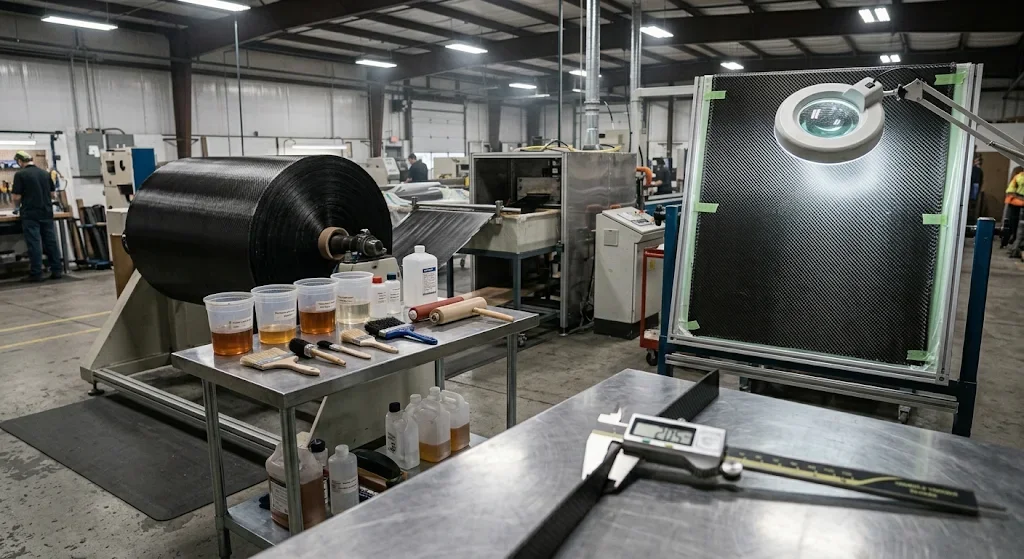
The reinforcement defines how a sheet of carbon fiber responds to force. Plain weave cloth gives stable handling and a balanced appearance. Twill weave offers better drape and the classic carbon look that many visible parts require. Unidirectional layers concentrate stiffness in one direction and are useful when the load path is clear. Some projects use hybrid stacks that combine woven faces with directional cores. Because the phrase sheet of carbon fiber does not reveal the layup, an RFQ should explain whether the panel is cosmetic, structural, or intended for CNC machining.
Fiber grade, tow size, and areal weight also matter. Standard modulus fibers are common for industrial laminates, while higher modulus fibers may reduce deflection in stiffness-driven designs. A thicker laminate is not automatically better; the best {kw} is the one whose ply schedule matches the part function. For drilled or slotted parts, ask how edge quality and delamination risk are controlled after cutting.
Resin matrix and cure quality
Resin in a sheet of carbon fiber transfers stress between filaments and protects them from abrasion, moisture, and handling damage. Epoxy systems are widely used because they balance strength, adhesion, and process stability. In specialized environments, vinyl ester or high-temperature systems may be considered. Cure control is equally important. Vacuum bag consolidation, press molding, and autoclave processing can all produce good panels when process parameters are controlled. The key question is not only the method, but whether the supplier manages temperature ramps, pressure, dwell time, and inspection records.
| Specification | Typical range or option | Why it matters |
|---|---|---|
| sheet of carbon fiber thickness | 0.5 mm to 12 mm | Controls bending stiffness, weight, and machining allowance |
| Reinforcement | Plain weave, twill, satin, UD, hybrid | Sets directional behavior and surface appearance |
| Resin system | Epoxy, vinyl ester, high-Tg epoxy | Matches temperature, moisture, and chemical exposure |
| Fiber areal weight | 200 to 400 g/m² per ply | Influences laminate build and surface texture |
| Finish | Gloss, matte, peel ply, protective film | Affects bonding, coating, and cosmetic acceptance |
| Tolerances | Thickness, cut size, flatness | Prevents fit issues during assembly or machining |
How to source a sheet of carbon fiber for production use
When sourcing a sheet of carbon fiber, describe the real application before discussing appearance. A robot fixture plate needs stiffness and hole accuracy. A cover panel needs surface quality and consistent weave direction. A bonded structural insert needs the right surface preparation. Provide drawings or at least length, width, thickness, quantity, tolerance, and post-processing steps. If you need cut blanks, state whether edges should be deburred, sealed, or left as-cut. Clear requirements help the supplier quote a sheet of carbon fiber that fits the job instead of a generic stock sheet.
- Specify the exact dimensions and quantity for the sheet of carbon fiber.
- State the main load direction and whether the laminate should be balanced.
- Confirm service temperature, humidity, UV, and chemical exposure.
- Ask for sample approval if weave direction or gloss level is critical.
- Request inspection data or traceability for repeat orders.
Common mistakes when buying carbon panels
A frequent mistake is choosing a sheet of carbon fiber by surface pattern alone. Visual weave does not prove the correct fiber orientation or resin control. Another mistake is treating all carbon laminates as isotropic; many panels are intentionally directional. Buyers also compare unit price without considering flatness, packaging, cutting accuracy, and batch consistency. For CNC parts, the cheapest sheet of carbon fiber can become expensive if it chips at holes, arrives warped, or varies from batch to batch.
For teams moving from prototype to production, it helps to lock a material specification after sample approval. Record the reinforcement style, resin type, nominal thickness, finish, and inspection method. That makes repeat purchasing easier and reduces variation in downstream machining and assembly.
Frequently asked questions
Can a sheet of carbon fiber be used for CNC machining?
Yes. A sheet of carbon fiber can be CNC cut, drilled, and milled with proper tooling and dust control. Carbon fiber is abrasive, so tool choice, feeds, and edge finishing should be planned in advance.
Is every sheet of carbon fiber the same strength in all directions?
No. The strength and stiffness of a sheet of carbon fiber depend on fiber orientation and ply schedule. Woven laminates can be balanced, while unidirectional or hybrid laminates may be highly directional.
What should I include in a quote request?
Include size, thickness, quantity, finish, tolerances, application, and any machining or bonding steps. If the sheet of carbon fiber is for a critical part, request a sample or test coupon before volume production.
For help specifying a sheet of carbon fiber, cut-to-size blanks, or composite machining support, contact Yongxian.
Part of topic
Related Articles
- Prusament PETG Carbon Fiber: Print Settings and Mechanical Behavior
- Small Carbon Fiber Rods: Diameters, Stock Lengths, and Uses
- How to Create Carbon Fiber Parts: Tooling Choices Compared
- Full Carbon Fiber Plates: 100% Laminate vs Hybrid Layups
- How to Make Carbon Fiber Parts: Wet Layup to Autoclave
- How to Make Carbon Fiber Rods: Mandrel Wrapping Workflow
Interested in Our Products?
Contact our team for competitive pricing and technical specifications.
Get a QuoteRelated Products

Custom Carbon Fiber Bicycle Frame
Full-custom carbon fiber bicycle frame manufactured to your geometry specifications. We produce road, gravel, mountain, and track frames using high-modulus carbon fiber layups optimized for each riding discipline. Monocoque construction with internal cable routing, available with disc or rim brake mounts.

Round Carbon Fiber Tube — 3K Plain Weave T700
Standard round carbon fiber tube manufactured from Toray T700 grade fiber with 3K plain weave. Offers balanced strength and stiffness for general industrial applications including robotics, automation, sports equipment, and aerospace structures.

Square Carbon Fiber Tube — 3K Twill T700
Square cross-section carbon fiber tube manufactured with 3K twill weave for torsional strength. Preferred for structural frames, trusses, and support columns where rectangular geometry offers design flexibility.

Carbon Fiber Pickleball Paddle
High-performance pickleball paddle with Toray T700 carbon fiber face and polypropylene honeycomb core. Delivers excellent power-to-weight ratio, spin generation, and vibration dampening for competitive play.

Round Carbon Fiber Tube — 3K Twill
Lightweight and ultra-stiff round tubes ideal for drone frames, robotics, and structural applications.