
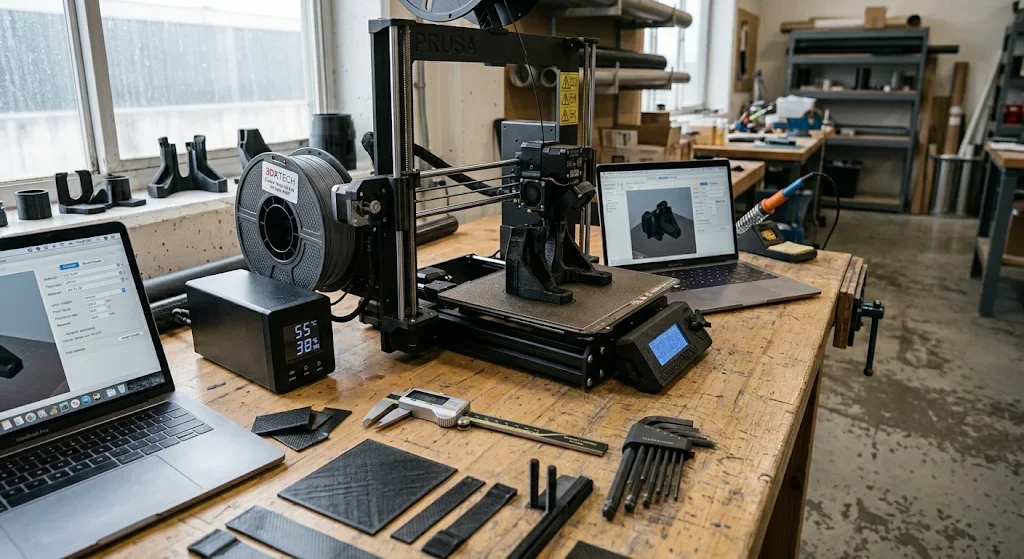
Prusament PETG carbon fiber is a short-fiber reinforced filament that blends PETG toughness with chopped carbon fibers to improve stiffness, dimensional stability, and surface appearance. For engineers and advanced makers, choosing Prusament PETG carbon fiber is less about chasing the highest possib
Introduction
Prusament PETG carbon fiber is a short-fiber reinforced filament that blends PETG toughness with chopped carbon fibers to improve stiffness, dimensional stability, and surface appearance. For engineers and advanced makers, choosing Prusament PETG carbon fiber is less about chasing the highest possible strength and more about getting predictable mechanical behavior on a standard FDM printer. This guide explains how print settings influence part performance, how the material compares with Prusament PC carbon fiber and Prusament PP carbon fiber, and what to expect when you move from prototypes to functional components.
Because carbon-filled PETG behaves differently from plain PETG, small changes in nozzle temperature, drying, and layer orientation can shift stiffness, impact response, and creep. Understanding those relationships helps you design parts that use the material where it is strongest instead of where it is merely convenient.
Prusament PETG Carbon Fiber Mechanical Behavior
The chopped fibers in Prusament PETG carbon fiber act as a reinforcement network inside the PETG matrix. The result is higher modulus and lower thermal expansion than unfilled PETG, but the improvement is anisotropic: strength follows the printed bead direction. In practical terms, parts are stiffest in the XY plane when infill and walls align with the load path, while Z-direction strength still depends heavily on layer bonding.
Compared with plain PETG, users typically notice reduced stringing after tuning, a matte finish that hides layer lines, and less warping on medium-sized parts. Compared with more aggressive composites, PETG-CF remains forgiving: it prints without an enclosure in many workshops, and it tolerates moderate cooling better than nylon-based composites.
| Property (typical, tuned print) | Prusament PETG | Prusament PETG Carbon Fiber | Prusament PC Carbon Fiber | Prusament PP Carbon Fiber |
|---|---|---|---|---|
| Relative stiffness | Baseline | Higher (noticeably more rigid) | Highest among these options | Moderate, more flexible feel |
| Impact toughness | High | Moderate to high | Moderate | High with ductile response |
| Heat resistance (service feel) | Moderate | Moderate, slightly improved stability | High | Low to moderate |
| Warping tendency | Low | Very low to low | Medium (enclosure helpful) | Low, but bed adhesion can be tricky |
| Moisture sensitivity | Medium | Medium | High (dry carefully) | Low |
| Best fit | General parts | Stiff functional brackets, jigs, housings | Hot, rigid structural parts | Chemical-resistant, lightweight ductile parts |
Values vary by printer, geometry, and test method, so treat the table as a selection guide rather than a datasheet substitute. For critical parts, print coupons in the same orientation as the final component.
Prusament PETG Carbon Fiber Print Settings
Reliable Prusament PETG carbon fiber print settings start with dry filament and an abrasion-resistant nozzle. Chopped carbon fibers are abrasive; a hardened steel, ruby-tipped, or other wear-resistant nozzle keeps diameter consistent over long prints. Brass nozzles can work for short jobs but wear quickly.
- Nozzle and diameter: Use a 0.4 mm hardened nozzle for detail or 0.6 mm for stronger, faster prints. Larger nozzles reduce clog risk and improve throughput.
- Temperature: Start around 250 °C for the nozzle and 80-85 °C for the bed, then tune in 5 °C steps. If layers look dull or brittle, raise temperature slightly; if stringing appears, lower temperature or adjust retraction.
- Speed and cooling: Moderate speeds (35-60 mm/s for perimeters, depending on printer) usually give better bonding than very fast profiles. Use moderate part cooling; too much cooling can weaken layer adhesion.
- Drying: Dry before important prints. PETG absorbs moisture, and wet filament causes popping, rough surfaces, and reduced strength.
- Perimeters and infill: For stiffness, add perimeters before adding extreme infill. A 4-wall shell with 25-40% grid or gyroid often outperforms a thin shell with dense infill for brackets and covers.
- Orientation: Place bending loads across beads, not across layer lines. Mechanical behavior is controlled as much by design orientation as by material choice.
When comparing Prusament PC carbon fiber, expect to need higher temperatures and usually an enclosure; PC-CF rewards the extra effort with heat resistance and rigidity. Prusament PP carbon fiber sits at the other end: it is lighter and more chemically resistant, but it demands careful first-layer strategy and is chosen for flexibility rather than maximum stiffness.
Design and Application Guidance
Use Prusament PETG carbon fiber for functional jigs, drone accessories, camera mounts, machine guards, and enclosures where a matte, rigid feel is valuable. Avoid assuming it replaces continuous-fiber laminates or machined metal in safety-critical structures. The material excels when you need a fast iteration cycle: print, test, adjust wall thickness or ribbing, and reprint without changing your whole manufacturing process.
For procurement teams, document nozzle type, drying routine, and orientation in the print traveler. That process control often matters more than a small difference in nominal material properties, especially when comparing PETG-CF against Prusament PC carbon fiber for hot zones or Prusament PP carbon fiber for chemical exposure.
Frequently Asked Questions
Is Prusament PETG carbon fiber stronger than regular PETG?
It is usually stiffer and more dimensionally stable than regular PETG, but “stronger” depends on the load. It performs well in rigid brackets and panels, while Z-layer adhesion and impact behavior still depend on print settings and part orientation.
Do I need a hardened nozzle for Prusament PETG carbon fiber?
Yes, for repeated printing. Carbon-filled filaments abrade soft brass nozzles and can gradually change extrusion width, which affects accuracy and mechanical consistency.
When should I choose Prusament PC carbon fiber or Prusament PP carbon fiber instead?
Choose Prusament PC carbon fiber when heat resistance and maximum rigidity are the priority. Choose Prusament PP carbon fiber when low weight, chemical resistance, and a more ductile response matter more than stiffness.
Conclusion
Prusament PETG carbon fiber offers a practical balance of stiffness, printability, and surface quality for functional FDM parts. By dialing in temperature, drying, cooling, and orientation, you can make its mechanical behavior consistent enough for jigs, housings, and iterative engineering work. If you need help selecting composite materials or moving from printed prototypes to production processes, explore YongXian composite products or contact our team for a manufacturing quote.
Related Articles
- Small Carbon Fiber Rods: Diameters, Stock Lengths, and Uses
- How to Create Carbon Fiber Parts: Tooling Choices Compared
- A sheet of carbon fiber: Anatomy of Cloth, Resin, and Cure
- Full Carbon Fiber Plates: 100% Laminate vs Hybrid Layups
- How to Make Carbon Fiber Parts: Wet Layup to Autoclave
- How to Make Carbon Fiber Rods: Mandrel Wrapping Workflow
Interested in Our Products?
Contact our team for competitive pricing and technical specifications.
Get a QuoteRelated Products

Custom Carbon Fiber Bicycle Frame
Full-custom carbon fiber bicycle frame manufactured to your geometry specifications. We produce road, gravel, mountain, and track frames using high-modulus carbon fiber layups optimized for each riding discipline. Monocoque construction with internal cable routing, available with disc or rim brake mounts.

Round Carbon Fiber Tube — 3K Plain Weave T700
Standard round carbon fiber tube manufactured from Toray T700 grade fiber with 3K plain weave. Offers balanced strength and stiffness for general industrial applications including robotics, automation, sports equipment, and aerospace structures.

Square Carbon Fiber Tube — 3K Twill T700
Square cross-section carbon fiber tube manufactured with 3K twill weave for torsional strength. Preferred for structural frames, trusses, and support columns where rectangular geometry offers design flexibility.

Carbon Fiber Pickleball Paddle
High-performance pickleball paddle with Toray T700 carbon fiber face and polypropylene honeycomb core. Delivers excellent power-to-weight ratio, spin generation, and vibration dampening for competitive play.

Round Carbon Fiber Tube — 3K Twill
Lightweight and ultra-stiff round tubes ideal for drone frames, robotics, and structural applications.