
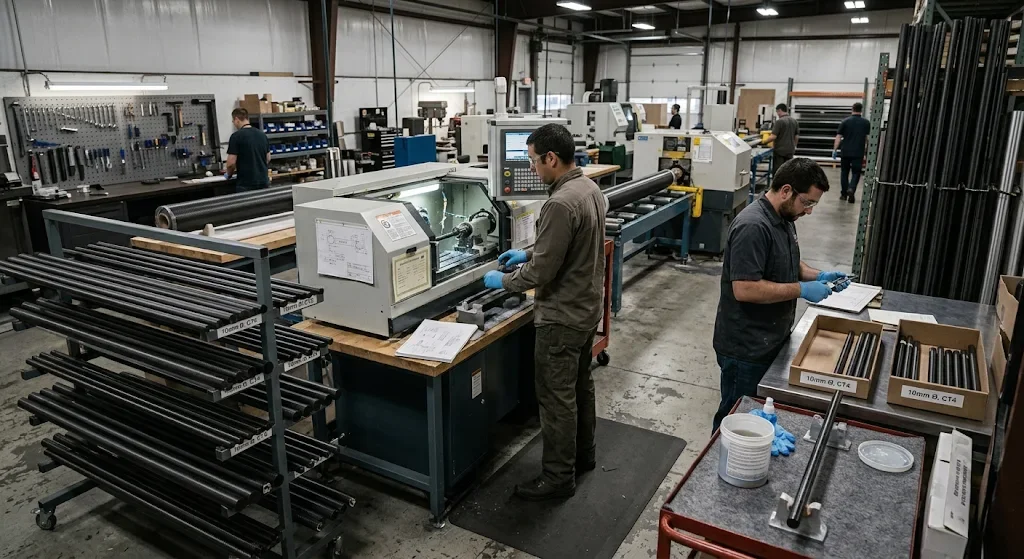
In most catalogs, small carbon fiber rods refer to solid round rods from about 0.5 mm to 12 mm in diameter. Below 0.5 mm, the product behaves more like a filament or pin and becomes difficult to handle without specialized tooling. Above 12 mm, rods move into medium-diameter structural territory wher
What Counts as Small Carbon Fiber Rods?
In most catalogs, small carbon fiber rods refer to solid round rods from about 0.5 mm to 12 mm in diameter. Below 0.5 mm, the product behaves more like a filament or pin and becomes difficult to handle without specialized tooling. Above 12 mm, rods move into medium-diameter structural territory where weight, cost, and machining strategy change significantly. For many precision assemblies, the sweet spot for small carbon fiber rods is 1 mm to 8 mm because this range balances stiffness, availability, and ease of integration.
Most commercial small carbon fiber rods are pultruded. Pultrusion aligns continuous carbon fibers along the rod axis and impregnates them with epoxy, vinyl ester, or another resin system. The result is excellent axial stiffness and tensile performance, which is exactly what you want in push rods, linkage members, antenna supports, and lightweight frames. However, because the fibers are primarily unidirectional, transverse impact strength and thread-holding capability are lower than those of isotropic metals. Understanding this anisotropy is the first step to using small carbon fiber rods successfully.
Common Diameters and Stock Lengths
Stock programs vary by supplier, but buyers will usually find a predictable set of diameters and cut lengths. The table below summarizes typical options for small carbon fiber rods used in prototyping and production.
| Diameter Range | Typical Increments | Common Stock Lengths | Typical Uses |
|---|---|---|---|
| 0.5 mm - 1.5 mm | 0.1 mm or 0.25 mm | 200 mm, 500 mm, 1000 mm | Model aircraft control links, indicators, micro mechanisms |
| 2.0 mm - 4.0 mm | 0.5 mm | 500 mm, 1000 mm | Drone arms, RC linkages, sensor probes, kite spars |
| 5.0 mm - 8.0 mm | 0.5 mm or 1.0 mm | 1000 mm, 1200 mm, 1500 mm | Automation guides, camera rigs, lightweight shafts, fixtures |
| 10.0 mm - 12.0 mm | 1.0 mm | 1000 mm, 1500 mm, 2000 mm | Structural braces, handles, support rods, machine guards |
When ordering small carbon fiber rods, always confirm whether the listed length is nominal or finished. Some suppliers allow a cutting tolerance of several millimeters per piece. For assemblies that depend on precise alignment, it is often better to buy longer stock and cut to final length in-house with proper dust control and fixturing.
Material Grades, Resin Systems, and Surface Finish
Not all small carbon fiber rods are built the same way. Fiber grade, resin choice, and surface treatment have a direct effect on stiffness, durability, and price.
- Standard modulus (e.g., T300 class): A balanced option for most commercial uses. It offers strong tensile performance and predictable cost for general-purpose small carbon fiber rods.
- Intermediate or high modulus: Useful when deflection must be minimized in slender designs. These grades can improve rigidity but may raise cost and reduce impact tolerance.
- Epoxy matrix: Common in precision rods because it provides good bonding, dimensional stability, and surface quality.
- Vinyl ester matrix: Sometimes selected for better chemical resistance in harsh environments.
- Ground or sanded finish: Improves diameter consistency and bonding for adhesive joints or press-fit interfaces.
- Matte pultruded finish: Economical for hidden structural members where cosmetic appearance is less important.
If your design involves adhesive bonding, specify a finish that can be lightly abraded and cleaned. Smooth, glossy rods may require extra surface preparation to achieve reliable joint strength. For sliding fits, confirm the actual outer diameter and roundness rather than relying only on the nominal size.
How to Select the Right Small Carbon Fiber Rods
Choosing small carbon fiber rods is easier when you start from the mechanical job the rod must perform. A diameter that looks adequate on paper can still fail if buckling, end conditions, or impact loads are ignored.
| Selection Factor | What to Check | Practical Recommendation |
|---|---|---|
| Stiffness | Allowable deflection under working load | Increase diameter or shorten unsupported length to control bending |
| Buckling risk | Compression load and end support conditions | Use a larger diameter for slender push rods and add guides if needed |
| Weight target | Mass budget per assembly | Compare carbon fiber against aluminum or steel before finalizing |
| Joining method | Adhesive bonding, clamping, or pinning | Avoid aggressive threading; prefer bonded sleeves or mechanical collars |
| Environment | UV, moisture, chemicals, temperature | Confirm resin compatibility and consider protective coatings |
For many teams, the fastest path is to prototype with two adjacent diameters. Testing both options in the real assembly often reveals whether the limiting factor is stiffness, vibration, or joint design. This approach is especially useful when sourcing small carbon fiber rods for new products where field loads are still being validated.
Typical Applications and Design Notes
Small carbon fiber rods appear in a wide range of industries because they deliver a strong stiffness-to-weight ratio in compact packages. Common applications include:
- Robotics and automation: Lightweight linkages, end-effector supports, and sensor booms benefit from reduced inertia.
- UAV and RC systems: Frames, braces, and control rods use small carbon fiber rods to maintain rigidity without adding unnecessary mass.
- Medical and laboratory devices: Non-magnetic, corrosion-resistant rods can be useful in fixtures, positioning aids, and instrument components.
- Sporting goods: Tent poles, archery components, and repair splints often rely on slender composite rods.
- Measurement and inspection tools: Long, thin probes stay straighter than many plastic alternatives when properly supported.
Designers should remember that carbon fiber excels in tension and axial stiffness but is not forgiving at sharp clamp points. Use smooth collars, distribute loads over a larger contact area, and avoid overtightening set screws directly onto bare rods. If repeated assembly is expected, bonded metal end fittings or protective sleeves can extend service life.
Cutting, Machining, and Handling Tips
Processing small carbon fiber rods is straightforward with the right preparation. A fine-tooth abrasive wheel, diamond cut-off disc, or carbide tool can produce clean results. To reduce splintering, wrap the cut zone with masking tape and support the rod close to the cut line. Always use local extraction or appropriate respiratory protection because carbon dust should not be inhaled.
When drilling or slotting, light feed rates and sharp tools matter more than brute force. Heat buildup can damage the resin, so allow the tool to cut rather than rub. After machining, seal exposed edges if the part will face moisture, chemicals, or repeated handling. These simple steps help small carbon fiber rods maintain their appearance and mechanical performance over time.
Are small carbon fiber rods stronger than steel rods of the same diameter?
Not in every direction. Small carbon fiber rods can offer excellent tensile strength and stiffness for their weight, but steel is usually tougher in impact, bending abuse, and threaded connections. The best choice depends on the load case, not diameter alone.
Can small carbon fiber rods be bent into curves?
Pultruded solid rods are designed to stay straight and generally should not be cold-bent. If your design needs curvature, consider a formed tube, a laminated strip, or a custom layup instead of forcing standard small carbon fiber rods into shape.
What tolerance should I request for precision assemblies?
For sliding fits, bearing seats, or optical fixtures, request ground rods with a specified diameter tolerance and check roundness as well. Standard pultruded stock may be acceptable for general supports, but precision mechanisms often need tighter control.
By matching diameter, length, grade, and finish to the real application, you can get consistent value from small carbon fiber rods in both prototypes and production runs. A careful specification up front reduces rework, improves fit, and helps your lightweight design perform as intended.
Related Articles
- Prusament PETG Carbon Fiber: Print Settings and Mechanical Behavior
- How to Create Carbon Fiber Parts: Tooling Choices Compared
- A sheet of carbon fiber: Anatomy of Cloth, Resin, and Cure
- Full Carbon Fiber Plates: 100% Laminate vs Hybrid Layups
- How to Make Carbon Fiber Parts: Wet Layup to Autoclave
- How to Make Carbon Fiber Rods: Mandrel Wrapping Workflow
Interested in Our Products?
Contact our team for competitive pricing and technical specifications.
Get a QuoteRelated Products

Custom Carbon Fiber Bicycle Frame
Full-custom carbon fiber bicycle frame manufactured to your geometry specifications. We produce road, gravel, mountain, and track frames using high-modulus carbon fiber layups optimized for each riding discipline. Monocoque construction with internal cable routing, available with disc or rim brake mounts.

Round Carbon Fiber Tube — 3K Plain Weave T700
Standard round carbon fiber tube manufactured from Toray T700 grade fiber with 3K plain weave. Offers balanced strength and stiffness for general industrial applications including robotics, automation, sports equipment, and aerospace structures.

Square Carbon Fiber Tube — 3K Twill T700
Square cross-section carbon fiber tube manufactured with 3K twill weave for torsional strength. Preferred for structural frames, trusses, and support columns where rectangular geometry offers design flexibility.

Carbon Fiber Pickleball Paddle
High-performance pickleball paddle with Toray T700 carbon fiber face and polypropylene honeycomb core. Delivers excellent power-to-weight ratio, spin generation, and vibration dampening for competitive play.

Round Carbon Fiber Tube — 3K Twill
Lightweight and ultra-stiff round tubes ideal for drone frames, robotics, and structural applications.