
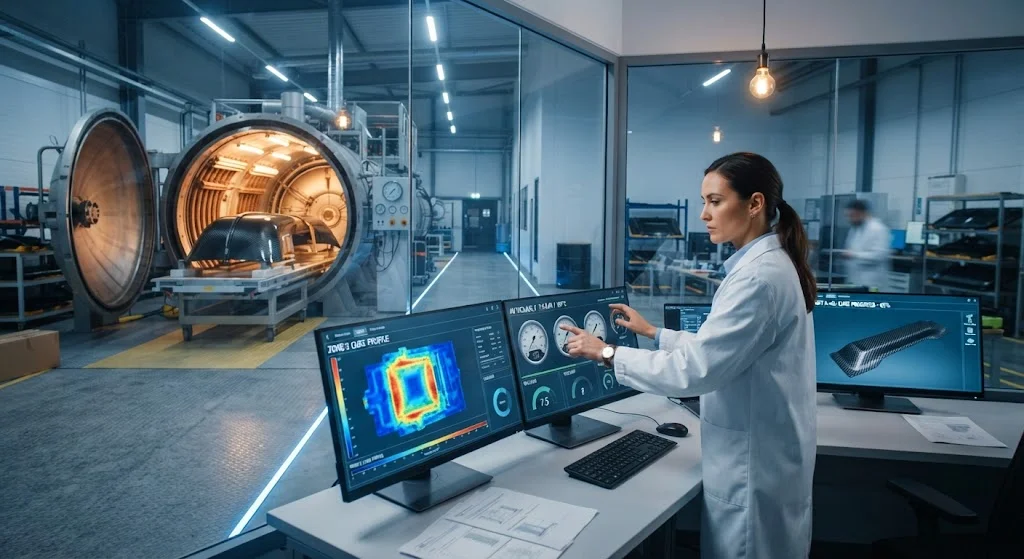
Digital twin technology for carbon fiber manufacturing represents one of the most significant advances in composite production quality management in the past decade. Traditional carbon fiber manufacturing relies on periodic inspection and post-cure testing to identify defects—a reactive
Introduction
Digital twin technology for carbon fiber manufacturing represents one of the most significant advances in composite production quality management in the past decade. Traditional carbon fiber manufacturing relies on periodic inspection and post-cure testing to identify defects—a reactive approach that allows non-conforming parts to progress through multiple process steps before detection. A digital twin solves this problem by creating a continuously updated virtual model of the physical manufacturing process, integrating real-time sensor data with physics-based simulations to predict quality outcomes before they occur.
For carbon fiber manufacturers, the appeal is compelling. First, real-time process monitoring eliminates the 24-48 hour delay between autoclave cure and destructive testing, enabling immediate corrective action when process parameters drift. Second, predictive quality models trained on historical data can flag potential defects—porosity, resin-rich areas, fiber misalignment—with 85-95% accuracy before parts reach the inspection stage. Third, the virtual model enables what-if analysis for new materials and process windows without expensive physical trials. This article explains how digital twins are implemented in carbon fiber manufacturing, quantifies their quality and cost benefits, and reviews the sensor technologies and data architectures that make them practical.
Architecture of a Carbon Fiber Digital Twin
A carbon fiber manufacturing digital twin typically consists of three interconnected layers that work together to create a complete process intelligence system:
- Physical layer: Sensors embedded in autoclaves, RTM molds, filament winding machines, and AFP/ATL heads collect real-time data on temperature, pressure, vacuum level, resin flow rate, fiber tension, and cure degree. Modern installations deploy 50-200 sensors per production line, generating 1-5 GB of data per shift.
- Virtual layer: Physics-based models—including finite element analysis for thermal distribution, computational fluid dynamics for resin flow, and cure kinetics models for crosslinking—process the sensor data to predict part quality in real time. These models are calibrated against actual part properties using machine learning algorithms.
- Intelligence layer: Machine learning models trained on historical production data correlate process parameters with final part properties, enabling predictive quality scoring and root cause analysis when deviations occur. The system continuously learns from new production runs, improving prediction accuracy over time.
The three layers communicate through a unified data platform—typically an industrial IoT architecture using MQTT or OPC UA protocols—that ensures data integrity and enables edge computing for time-critical decisions. Production engineers access the twin through dashboards that visualize process status, quality predictions, and recommended actions in real time.
Real-Time Process Monitoring Capabilities
Real-time monitoring is the foundation of digital twin value in carbon fiber manufacturing. The table below compares key monitoring parameters and their impact on quality outcomes:
| Parameter | Sensor Technology | Data Rate | Quality Impact |
|---|---|---|---|
| Temperature distribution | Thermocouple arrays, IR cameras | 1-10 Hz | ±2°C uniformity required for consistent cure |
| Autoclave pressure | Piezoelectric transducers | 100 Hz | ±0.1 bar for void content <1% |
| Vacuum bag integrity | Leak rate sensors | 1 Hz | Leak rate <0.01 mbar/s for aerospace |
| Resin flow front (RTM) | Dielectric sensors, fiber optics | 10 Hz | Complete wet-out without dry spots |
| Fiber tension (AFP/ATL) | Load cells on creel | 1 kHz | Consistent tension ±0.5 N for fiber placement |
| Cure degree | Dielectric, NIR spectroscopy | 1 Hz | Glass transition temperature ±3°C |
When sensor data deviates from process windows, the digital twin triggers alerts at three levels: advisory (trend warning), caution (approaching limits), and critical (process out of specification). In a typical aerospace autoclave operation, the system detects 15-25 process deviations per production cycle—of which 12-20 are advisory, 3-4 are caution, and 1-2 require immediate intervention. Without the digital twin, only the critical deviations would be detected at post-cure inspection, resulting in scrap rates of 3-8%.
Predictive Quality Control and Defect Prevention
The true power of a digital twin lies in its predictive capability—the ability to forecast part quality before the cure cycle completes or the RTM infusion finishes. Machine learning models trained on 500-2,000 production runs can predict final part properties with remarkable accuracy:
- Porosity prediction: Models correlating vacuum level, temperature ramp rate, and resin viscosity predict void content within ±0.5% of actual measured values, enabling operators to adjust pressure or temperature before porosity becomes irreversible.
- Fiber volume fraction estimation: Real-time resin flow monitoring in RTM combined with mold deformation models predicts fiber volume fraction to ±2%, catching resin-rich or resin-starved zones before cure.
- Dimensional accuracy forecasting: Thermal distortion models predict spring-back and warpage after cure, enabling preemptive tool compensation for subsequent operations.
- Mechanical property prediction: Cure cycle data combined with material property databases predicts tensile strength, modulus, and interlaminar shear strength within ±5% of actual test results.
Leading carbon fiber manufacturers report 40-60% reductions in scrap rates after implementing predictive quality control through digital twins. The financial impact is substantial: for a facility producing 500 autoclave cycles per year at an average part value of $5,000, reducing scrap from 5% to 2% saves $750,000 annually.
Integration with Manufacturing Execution Systems
Digital twins deliver maximum value when integrated with manufacturing execution systems (MES) that manage production scheduling, work instructions, and traceability. The integration creates a closed-loop quality system where:
- Predictive maintenance: The twin monitors autoclave heater degradation, vacuum pump wear, and sensor drift, scheduling maintenance before failures cause quality issues.
- Process optimization: Historical data from thousands of production cycles enables the twin to recommend optimized cure cycles for new materials, reducing qualification time by 30-50%.
- Traceability: Every sensor reading, model prediction, and quality decision is linked to specific part serial numbers, creating complete digital thread documentation for aerospace certification.
- Root cause analysis: When a part fails inspection, the twin's historical data enables rapid identification of the process parameter that caused the defect—typically within minutes rather than days of investigation.
This integration transforms quality management from a reactive, inspection-based function to a proactive, prevention-based discipline that continuously improves process capability.
Implementation Challenges and Solutions
Implementing a digital twin for carbon fiber manufacturing requires addressing several technical and organizational challenges:
- Data quality: Sensor calibration drift and missing data points can degrade model accuracy. Solutions include redundant sensors, automated calibration routines, and data validation algorithms that flag suspicious readings.
- Model accuracy: Physics-based models must be calibrated to specific materials and processes. Initial calibration requires 50-100 production runs, but transfer learning techniques can reduce this to 20-30 runs when similar processes exist.
- Computational requirements: Real-time finite element analysis requires significant computing power. Edge computing architectures that run simplified models locally and detailed models on cloud servers balance latency and accuracy.
- Change management: Production operators must trust the twin's recommendations. Phased implementation starting with monitoring-only mode, then advisory alerts, then automated corrections builds confidence over 6-12 months.
Despite these challenges, the return on investment typically justifies the implementation cost within 18-24 months for medium-to-high volume carbon fiber producers.
Frequently Asked Questions
How long does it take to implement a digital twin for an existing carbon fiber production line?
Implementation typically takes 6-12 months for a single production line, depending on existing sensor infrastructure and process complexity. The first 2-3 months focus on sensor installation and data collection, months 3-5 on model development and calibration, and months 6-9 on integration with MES and operator training. A phased approach—starting with monitoring, then adding predictive capabilities—reduces risk and allows the team to build expertise incrementally. For facilities with 10+ years of production data available, model training can be accelerated significantly using historical data.
What is the typical return on investment for a carbon fiber manufacturing digital twin?
ROI depends on production volume and current scrap rates, but typical benefits include 40-60% reduction in scrap ($500K-2M annually for mid-size producers), 20-30% reduction in quality inspection labor, 15-25% reduction in energy consumption through optimized cure cycles, and 30-50% faster qualification of new materials. Most manufacturers report payback periods of 18-24 months. The intangible benefits—improved customer confidence, faster response to quality queries, and enhanced traceability documentation—further strengthen the business case.
Can digital twins be applied to out-of-autoclave carbon fiber processes like RTM and infusion?
Yes, digital twins are particularly valuable for out-of-autoclave processes where process control is more challenging than in autoclave operations. For RTM, the twin models resin flow front progression, predicting dry spots and resin-rich areas before they become defects. For vacuum infusion, the twin monitors vacuum bag integrity and resin flow through complex geometries. The absence of autoclave pressure uniformity makes real-time monitoring and prediction even more critical for achieving consistent quality in OOA processes.
Conclusion
Digital twin technology for carbon fiber manufacturing transforms quality management from a reactive, inspection-based process to a proactive, prevention-based discipline. The ability to monitor process parameters in real time, predict part quality before cure completes, and identify root causes of defects in minutes rather than days delivers measurable improvements in scrap rates, cycle times, and customer satisfaction. As sensor technology becomes more affordable and machine learning models become more accessible, digital twins are moving from large aerospace producers to mid-size carbon fiber manufacturers across automotive, wind energy, and industrial applications.
For engineers and production managers evaluating digital twin technology, the practical starting point is assessing current sensor infrastructure, quantifying the cost of existing quality failures, and identifying the highest-impact monitoring points in your process. Explore our carbon fiber materials and reinforcements, or contact our technical team to discuss how digital twin integration can improve quality outcomes for your composite manufacturing operations.
Part of topic
Related Articles
- Bio-Based Carbon Fiber Precursors: Lignin and Polyethylene for Low-Cost Production
- Large-Tow Carbon Fiber Cost Analysis: 48K vs 60K Price-Performance Comparison
- Carbon Fiber-Resin Interface Bonding: Surface Treatment and Coupling Agent Optimization
- Thermoplastic Carbon Fiber Welding for Automotive: Ultrasonic and Induction Welding Process Windows
- Large-Tow Carbon Fiber Wet Spinning: Process Optimization for 48K/60K Production Efficiency
- 3D Printing with Continuous Carbon Fiber: FDM/FFF Process Parameters and Mechanical Properties
Interested in Our Products?
Contact our team for competitive pricing and technical specifications.
Get a QuoteRelated Products
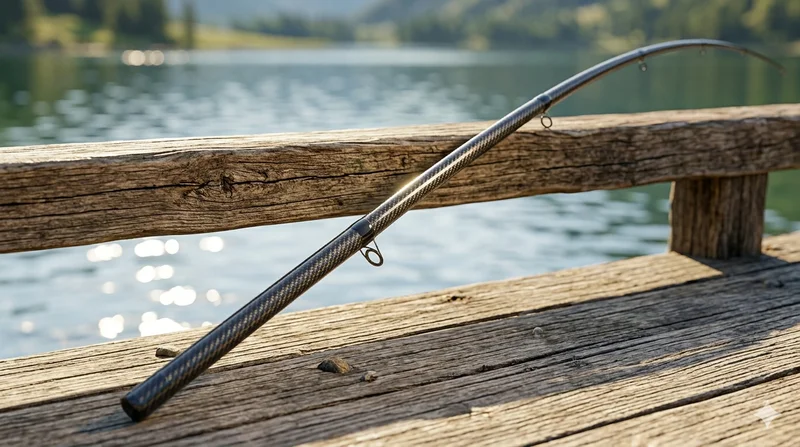
Carbon Fiber Fishing Rod Blank
High-quality carbon fiber fishing rod blank manufactured from multiple grades of Toray carbon fiber cloth. Available in a wide range of lengths, powers, and actions for freshwater and saltwater applications. Suitable for OEM rod building.

Carbon Fiber Plate — 3K Twill T700 1.5mm
Thin 1.5mm carbon fiber plate with 3K twill weave surface. Lightweight and stiff, commonly used for covers, panels, drone bodies, and applications requiring a premium aesthetic appearance.

Carbon Fiber Plate — 3K Twill T700 3.0mm
Medium-thickness 3.0mm carbon fiber plate offering significantly higher load capacity while maintaining attractive 3K twill finish. Suitable for structural brackets, reinforcement plates, and load-bearing panels.

Carbon Fiber Trekking Pole
Lightweight carbon fiber trekking pole manufactured from high-grade carbon fiber tube. Weighs only 160g per pole while providing superior shock absorption and durability for hiking, trail running, and backpacking.

Square Carbon Fiber Tube — 3K Twill T700
Square cross-section carbon fiber tube manufactured with 3K twill weave for torsional strength. Preferred for structural frames, trusses, and support columns where rectangular geometry offers design flexibility.