
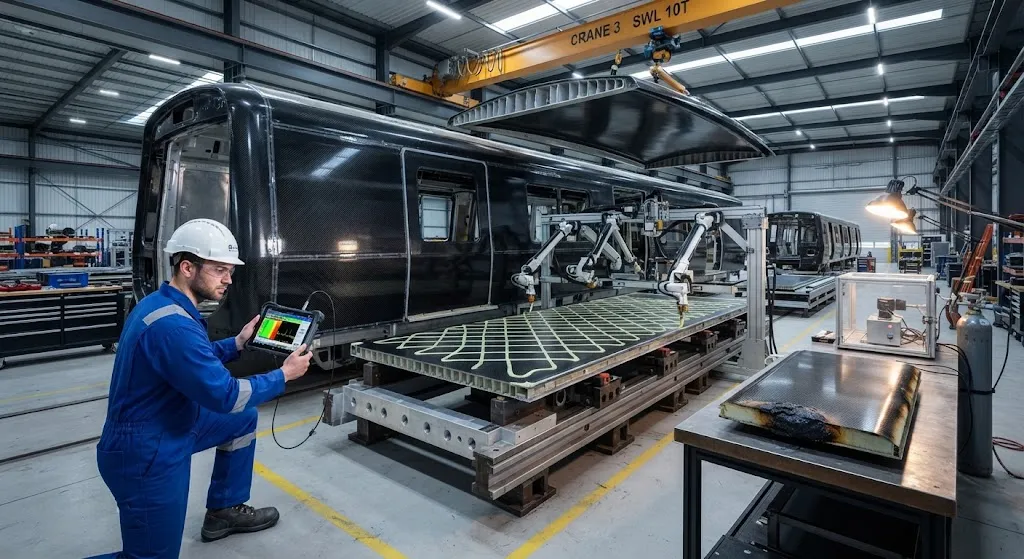
Railway vehicles are heavy by design, and the carbody is the largest single contributor to empty vehicle mass. A conventional steel car body accounts for 35-40 percent of the empty weight of a metro or commuter train, with components such as roofs, side walls, floor structures, and end
Introduction
Railway vehicles are heavy by design, and the carbody is the largest single contributor to empty vehicle mass. A conventional steel car body accounts for 35-40 percent of the empty weight of a metro or commuter train, with components such as roofs, side walls, floor structures, and end underframes built from welded or extruded profiles. Carbon fiber reinforced polymer structures replace those assemblies with sandwich and stiffened-shell constructions that are 30-50 percent lighter, bringing measurable reductions in traction energy, track wear, and peak axle load. The engineering question is no longer whether CFRP carbodies work mechanically — several demonstrator and production programs have proven the concept — but how to clear the fire and certification hurdles and whether the lifecycle cost arithmetic closes.
This article walks through the weight and energy case, the EN 45545 fire standard that has historically been the single largest barrier, the structural certification framework, and a lifecycle cost model that fleet operators can adapt to their own duty cycles.
The Weight and Energy Case
The energy benefit of a lighter carbody compounds across every phase of operation: acceleration, braking, and running resistance. The table below summarizes representative figures for a 22-meter metro car operating on a standard urban duty cycle with frequent stops:
| Parameter | Steel Carbody | Aluminum Carbody | CFRP Carbody |
|---|---|---|---|
| Empty carbody mass (t) | 22-26 | 16-18 | 12-14 |
| Mass saving vs steel | Baseline | 25-35% | 40-50% |
| Traction energy saving vs steel | Baseline | 5-8% | 8-15% |
| Axle load reduction (t/axle) | Baseline | 0.5-0.8 | 1.0-1.5 |
| Typical structural material density (g/cm³) | 7.85 | 2.70 | 1.55 |
Because acceleration energy is proportional to mass, a metro fleet that stops every few hundred meters converts carbody weight almost one-for-one into energy demand during the motoring phase. Regenerative braking recovers a portion, but the recovered fraction also scales with mass, so the net saving remains. Beyond energy, the 1.0-1.5 tonne per axle reduction lowers wheel and rail wear and, on existing track, can relax infrastructure reinforcement requirements that would otherwise accompany a heavier train.
Fire Resistance: The EN 45545 Barrier
Fire safety is the constraint that has historically blocked CFRP carbodies more than any structural concern. The governing standard, EN 45545, sets fire performance requirements for railway vehicles in three hazard levels — HL1 through HL3 — based on the vehicle category, operation type, and evacuation risk. The standard's Part 2 defines material requirements covering flame spread, heat release rate, smoke density, and smoke toxicity for every product used in a vehicle interior and structure.
Unprotected carbon fiber epoxy laminates struggle with several of these criteria, particularly heat release and smoke toxicity, so modern CFRP carbody programs combine material selection and system-level protection:
- Fire-retardant resin systems: phenolic or modified epoxy matrices reduce heat release and smoke generation at the material level, though they often require some compromise in mechanical performance or processing.
- Intumescent and ceramic coatings: surface layers expand under heat to form an insulating char or ceramic barrier, protecting the load-bearing laminate beneath.
- Fire-resistant interlayers: ceramic fabric or mineral wool layers placed between the composite structure and the interior delay heat penetration and limit smoke release into the passenger compartment.
- Compartment zoning: fire barriers and smoke-tight bulkheads contain any fire at source, which can reduce the hazard level required of the main structural laminate.
These approaches are combined with full-scale testing — corner tests, heat release calorimetry, and smoke emission chambers — to demonstrate compliance at the assembly level rather than only at the coupon level.
Structural Qualification and Crashworthiness
Beyond fire, a CFRP carbody must satisfy the same structural and crashworthiness requirements as a metallic one. The relevant framework is EN 12663, which defines the structural requirements of railway vehicle bodies — static strength, fatigue, and stiffness under vertical, longitudinal, and diagonal loading — together with EN 15227, which governs crashworthiness scenarios such as obstacle impacts and end-on collisions.
Composite carbodies meet these requirements through a combination of design and verification. Finite element analysis with composite failure criteria replaces the plastic collapse analysis used for steel, and deterministic allowables are generated from extensive coupon and subcomponent testing. Joints between the composite shell, underframe, and interior equipment are typically bonded and mechanically fastened in a hybrid arrangement, which requires qualification of the adhesive system and the fastener patterns. Non-destructive inspection — phased-array ultrasonic testing and thermography — verifies the integrity of bonded joints that cannot be inspected visually. Certification authorities accept composite structures when the evidence package demonstrates equivalent or better performance than a metallic baseline, which is why demonstrator programs have focused on generating precisely that data.
Lifecycle Economics of a CFRP Carbody
The commercial case for CFRP carbodies is a lifecycle calculation, not a first-cost comparison. The table below lays out the main cost positions for a 16-car metro fleet over a 30-year operating life:
| Cost Position | Conventional Aluminum | CFRP Carbody |
|---|---|---|
| Body shell acquisition cost per vehicle | Baseline | +40-70% |
| Traction energy cost over 30 years | Baseline | -8 to -15% |
| Brake pad and wheel maintenance | Baseline | -10 to -20% |
| Track access and infrastructure charge | Baseline | -5 to -10% |
| Corrosion protection maintenance | Baseline | Near zero (no steel corrosion) |
The premium on the body shell is real — composite tooling, materials, and qualify-verification effort exceed metal fabrication cost — but it is recovered through operating savings that recur every year of the vehicle's life. Fleet operators with strong regenerative braking, high utilization, and track-access charges find the crossover point earliest; programs constrained purely by initial purchase price remain the hardest sell.
Adoption in Current Programs
CFRP carbody technology has moved from concept demonstrators into operator-focused programs across several vehicle classes:
- Metro and suburban trains: carbon fiber car bodies and driver cabs in service or in final testing, with manufacturers such as CRRC Changchun having built the first all-carbon metro carbody in China, targeting the energy and axle-load benefits described above.
- Regional and high-speed trains: composite cab ends and nose cones that cut unsprung and end-structure mass, improving crash energy management while reducing the mass that must be accelerated and braked.
- Interior and secondary structures: composite seat frames, luggage racks, and partition walls that capture weight savings without the certification burden of the primary structure.
- Freight applications: flat wagons and container platforms where tare weight reduction directly increases payload revenue per trip.
Production processes are maturing in parallel: resin transfer molding and vacuum infusion produce large sandwich panels, while automated fiber placement and out-of-autoclave prepregs reduce cycle times. The trend points toward carbodies built from fewer, larger composite parts — fewer joints, fewer fasteners, and a structure that is lighter by design rather than by optimization.
Frequently Asked Questions
How much energy does a carbon fiber carbody actually save?
For a metro car on a frequent-stop duty cycle, a CFRP carbody typically reduces traction energy by 8-15 percent compared to a steel baseline, with the exact figure depending on stop density, occupancy, and the share of regenerative braking. Acceleration energy is proportional to mass, so the heaviest, most stop-heavy routes realize the largest savings.
Can CFRP carbodies pass the EN 45545 fire standard?
Yes, but not without deliberate design. Unprotected carbon epoxy laminates do not meet the full heat-release and smoke requirements of EN 45545 at higher hazard levels, so programs combine fire-retardant resins, intumescent coatings, ceramic interlayers, and compartment zoning, verified by full-scale assembly testing. Compliance is engineered at system level, not taken for granted at material level.
Why are CFRP carbodies not yet widespread despite the weight savings?
The barrier is economic and institutional as much as technical. Body shell cost is 40-70 percent higher than aluminum, certification requires an extensive evidence package that takes years to generate, and fleet procurement has historically favored lowest first cost. Adoption is proceeding where lifecycle savings — energy, maintenance, and track access — cross over the premium, which is now the case on frequent-stop metro networks.
Conclusion
Carbon fiber railway carbodies deliver a measurable performance case — 30-50 percent structural mass reduction, 8-15 percent traction energy savings, and lower track and brake maintenance — and the remaining barriers are well understood. EN 45545 compliance is achieved through combined material and system-level fire protection, EN 12663 structural evidence packages are being built by demonstrator and production programs, and lifecycle economics favor adoption on frequent-stop, high-utilization networks.
For fleet operators and rolling stock manufacturers evaluating CFRP carbodies, the practical next step is a duty-cycle-specific cost model and a qualification plan. Explore our carbon fiber materials for rail and transportation structures, or contact our engineering team to discuss carbody, cab, and interior component programs.
Part of topic
Related Articles
- Carbon Fiber Mooring for Floating Offshore Wind: Fatigue and Corrosion in Deep Water
- Carbon Fiber Bicycle Frame Optimization: Layup Design and Manufacturing for Competitive Racing
- Carbon Fiber CFRP Retrofit for Infrastructure: Bridge and Building Seismic Strengthening
- Carbon Fiber Medical Imaging Equipment: Lightweight Gantry and Couch Structures for MRI/CT
- Carbon Fiber EV Battery Enclosures: Crash Safety and Electromagnetic Shielding Design
- Carbon Fiber Structures for Low-Altitude Economy: UAV Airframes and eVTOL Components
Interested in Our Products?
Contact our team for competitive pricing and technical specifications.
Get a QuoteRelated Products
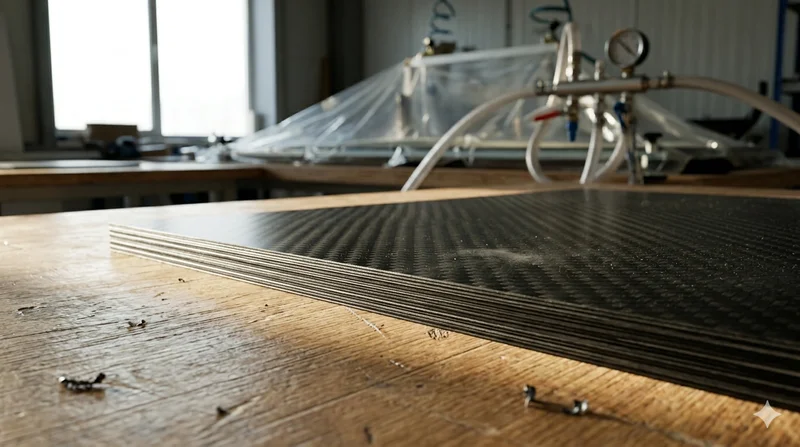
Carbon Fiber Plate — 3K Twill T700 3.0mm
Medium-thickness 3.0mm carbon fiber plate offering significantly higher load capacity while maintaining attractive 3K twill finish. Suitable for structural brackets, reinforcement plates, and load-bearing panels.

Carbon Fiber Plate — 3K Twill T700 1.5mm
Thin 1.5mm carbon fiber plate with 3K twill weave surface. Lightweight and stiff, commonly used for covers, panels, drone bodies, and applications requiring a premium aesthetic appearance.
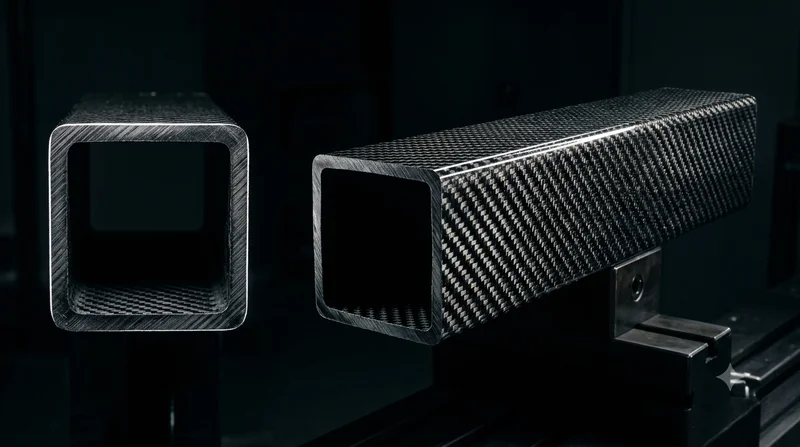
Square Carbon Fiber Tube — 3K Twill T700
Square cross-section carbon fiber tube manufactured with 3K twill weave for torsional strength. Preferred for structural frames, trusses, and support columns where rectangular geometry offers design flexibility.
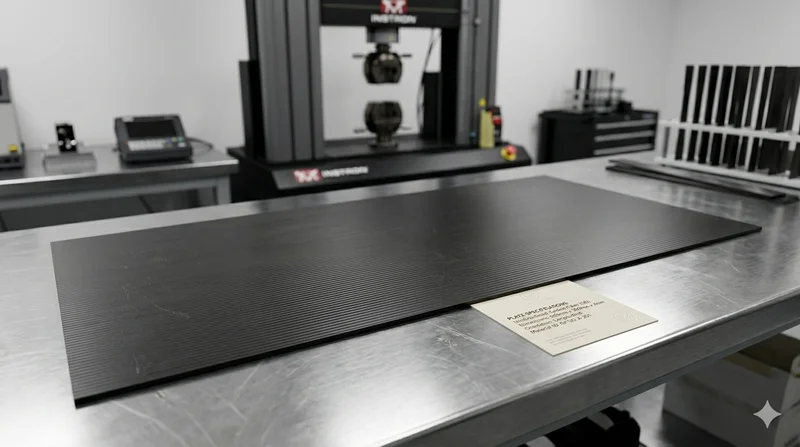
Carbon Fiber Plate — UD Unidirectional T700
Unidirectional carbon fiber plate with all fibers oriented in a single direction for maximum strength along the fiber axis. Essential for structural reinforcements, splints, and applications where load direction is predictable.
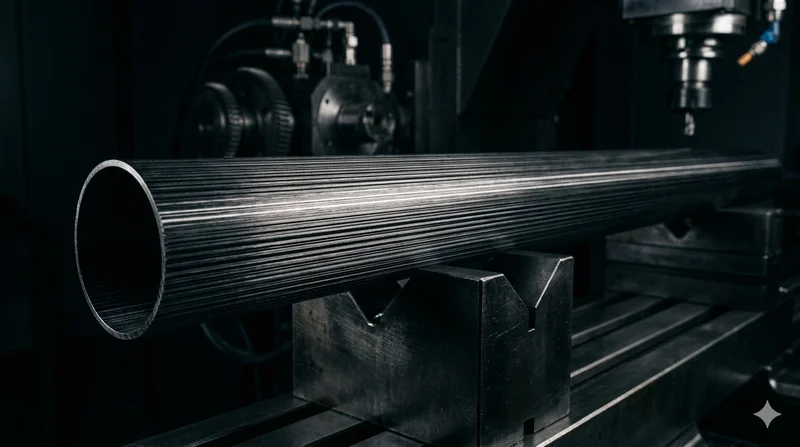
Round Carbon Fiber Tube — UD Unidirectional T700
Unidirectional (UD) round tube with all fibers aligned axially for maximum longitudinal stiffness. Ideal for applications requiring high bending rigidity with minimal weight, such as shafts, struts, and structural reinforcements.