
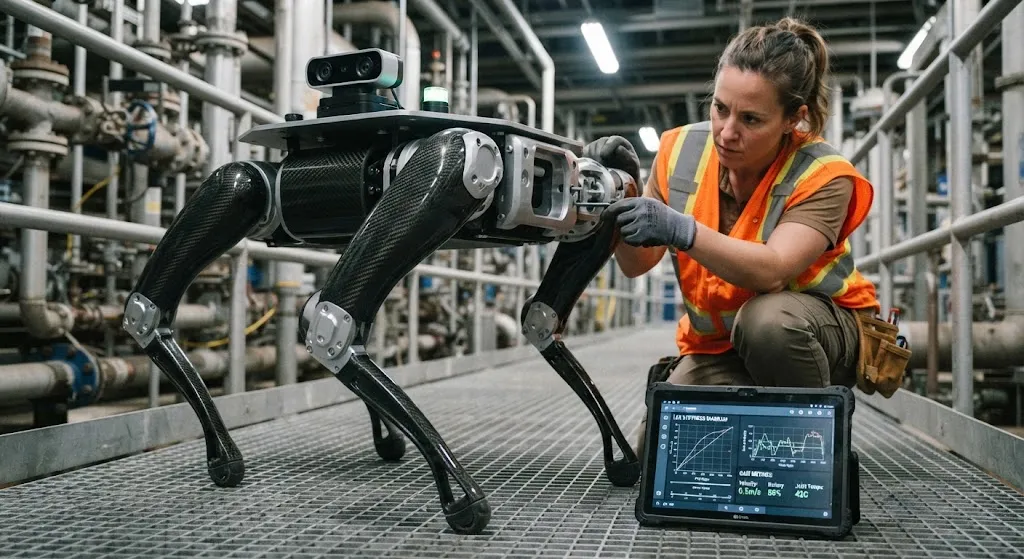
Quadruped robots have moved from research labs into working roles: pipeline inspection in refineries, warehouse patrolling, construction site surveying, and payload delivery over rough terrain. What all these roles have in common is a demand for legs that are light enough to be swung qu
Introduction
Quadruped robots have moved from research labs into working roles: pipeline inspection in refineries, warehouse patrolling, construction site surveying, and payload delivery over rough terrain. What all these roles have in common is a demand for legs that are light enough to be swung quickly, stiff enough to support sudden stopping and direction changes, and tough enough to absorb impacts from stairs, curbs, and uneven ground. The leg is not a cosmetic shell — it is the robot's suspension, spring, and skeleton combined, and its design determines whether the platform can walk, trot, or bound convincingly.
This article examines why carbon fiber has become the structural material of choice for quadruped legs, how high specific stiffness translates into agile locomotion, and what engineers should weigh when designing and sourcing composite leg structures.
Why Legged Robots Are a Structural Problem
Legged locomotion is dominated by inertia and impact, two forces that are brutal to heavy structures. Every leg swing accelerates the limb from rest to gait speed and back; every footfall delivers a ground reaction shock up the leg; and every rapid direction change applies bending loads at the hip, knee, and ankle. A heavier leg costs energy in two places — in swinging it at frequency, and in cushioning its impact on every stride — so leg mass has an outsized effect on battery life and endurance compared with mass in the torso.
The performance measure that matters is specific stiffness: stiffness per unit mass. A leg with high specific stiffness resists bending without paying the weight penalty that would slow its swing. This is precisely where carbon fiber composites outclass metals, and it is why the best-performing platforms pair composite legs with metal joints, combining material stiffness with reliable articulation.
| Material | Tensile Modulus | Density | Specific Stiffness | Leg Role |
|---|---|---|---|---|
| Carbon fiber composite (unidirectional) | 120-230 GPa | 1.5-1.6 g/cm³ | Highest | Upper and lower leg segments, hip and ankle links |
| Aluminum alloy (7075) | 72 GPa | 2.8 g/cm³ | Mid | Joints, brackets, fasteners |
| Titanium alloy (Ti-6Al-4V) | 114 GPa | 4.4 g/cm³ | Higher than aluminum | High-load inserts, pivot shafts |
| Steel | 200 GPa | 7.8 g/cm³ | Lowest | Rare in legs; only for wear surfaces |
The table shows why the composite choice is structural, not aesthetic. A carbon fiber leg segment can match the stiffness of an aluminum one at a fraction of the mass, and where impact toughness is needed at a local point — a foot, a bracket, a pivot — metal inserts carry the concentrated load while the composite tube provides the global stiffness. The hybrid leg is the working pattern in modern quadruped design.
How Specific Stiffness Becomes Gait Performance
The connection between material stiffness and observed agility runs through the leg's natural frequency and its response to ground contact. Three effects dominate:
- Faster leg swing: lower limb mass and higher stiffness let the actuators swing the leg at higher frequency with less energy, enabling faster trot and pace cycles and quicker recovery from a stumble.
- Controlled impact absorption: a stiff-but-compliant composite leg absorbs the landing shock across its length rather than passing a hard pulse to the torso, protecting sensors, payload, and the hip actuator.
- Precise foot placement: stiffness reduces deflection under load, so the controller's commanded foot position matches the actual foot position more closely — critical when stepping onto pipes, ledges, or vehicle racks.
These effects compound. A platform whose legs are 30 percent lighter and noticeably stiffer can run a higher gait cadence, carry the same payload on less battery, and place its feet more reliably on challenging terrain. In field deployments — refinery walkways, warehouse aisles, construction sites — that combination of endurance and precision is what separates a useful robot from a demo.
Design and Manufacturing Considerations
Designing a carbon fiber quadruped leg is a materials-engineering exercise with mechanical constraints. The key decisions start with fiber orientation: unidirectional plies along the leg axis carry the primary bending loads, while ±45° plies provide torsional stiffness and handle the off-axis loads generated during turns. The laminate is laid up around a hollow or foam core to maximize stiffness-to-weight, then cured — typically in a compression mold for production legs, which controls thickness and surface quality at fast cycle times.
- Fiber and resin selection: standard-modulus fiber with an epoxy or toughened resin system balances cost with impact resistance; high-modulus fiber buys more stiffness where weight is most critical.
- Hybridization at load points: aluminum or titanium inserts are co-bonded or bonded at the hip, knee, and ankle to carry bolt loads and wear, with the composite tube providing the surrounding stiffness.
- Impact and fatigue testing: legs are cycle-tested for millions of load steps — drop tests, repeated jog cycles, and full-ground-contact fatigue — before release, because a leg failure in service means a platform loss.
- Dimensional tolerance: mating faces between composite and metal parts need tight tolerances to avoid play in the joint, which would translate directly into foot-placement error.
For robotics manufacturers, the sourcing decision matters as much as the design. Composite legs are custom parts — the laminate schedule, insert geometry, and bond line are specific to each platform — so a supplier that can produce consistent, documented, tolerance-controlled legs is a partner in the design, not just a vendor.
Deployment Realities: Inspection, Logistics and Rough Terrain
The value of composite legs is most visible in the environments where quadruped robots now earn their keep. In refinery and plant inspection, robots climb staircases, cross grating walkways, and step over pipe racks — every surface a different stiffness and friction case, every footfall an impact event. In warehouse and logistics roles, they patrol aisles and climb dock ramps while carrying cameras and scanners, where run time between charges directly gates the shift coverage they can provide. In construction and site surveying, they traverse gravel, mud, and rebar-strewn slabs, combining the highest impact exposure with the least forgiving terrain.
In each case the same material story repeats: the leg must be stiff enough to place its foot precisely on a small target — a stair edge, a pipe, a vehicle rack — and tough enough to survive repeated missteps while learning or navigating. Composite legs also bring a quieter footfall and less vibration transmission to sensitive payloads, a practical advantage for inspection robots carrying microphones and optical instruments. These field requirements are why production robot programs, not just research platforms, now specify carbon fiber legs as a matter of design intent rather than exoticism.
Frequently Asked Questions
Why not build quadruped legs entirely from metal?
Metal legs work, especially for heavy research platforms, but they carry a mass penalty that reduces swing speed and endurance. A carbon fiber leg achieves equivalent stiffness at a fraction of the weight, and the freed mass budget can go to batteries, payload, or actuation. Most modern designs compromise: composite legs for the long segments, metal for joints and load points.
How much lighter is a carbon fiber leg than an aluminum one?
For a leg segment of equal stiffness, a carbon fiber composite part is typically 40-60 percent lighter than an aluminum counterpart, depending on the laminate and whether core or hollow construction is used. On a full leg assembly — including metal joints — the total saving is smaller but still significant, usually in the 20-35 percent range.
Are carbon fiber legs durable enough for outdoor field use?
Yes, when the laminate and inserts are designed for the real service environment. Toughened resin systems, integrated metal inserts at load points, and protective coatings for moisture and UV make composite legs field-durable. Manufacturers validate this with drop tests and multi-million-step fatigue cycling before release, so in-service failures are rare.
Conclusion
Quadruped robots succeed or fail on leg performance, and leg performance is written in specific stiffness. Carbon fiber composites deliver the stiffness-to-weight ratio that makes fast, precise, impact-tolerant locomotion possible, and the hybrid leg — composite segments carrying the structural load, metal inserts absorbing concentrated contact forces — has become the standard architecture for agile legged platforms. For designers, the path is clear: orient the fiber for the primary bending load, hybridize at the joints, and test for the real impact cycles the robot will face.
For robotics engineers evaluating leg materials, the practical first step is comparing specific stiffness and impact behavior against your gait requirements before committing to a manufacturing route. Explore our carbon fiber product range or contact our technical team to discuss laminate options and manufacturing support for robot leg structures.
Part of topic
Related Articles
- Carbon Fiber Mooring for Floating Offshore Wind: Fatigue and Corrosion in Deep Water
- Carbon Fiber Bicycle Frame Optimization: Layup Design and Manufacturing for Competitive Racing
- Carbon Fiber CFRP Retrofit for Infrastructure: Bridge and Building Seismic Strengthening
- Carbon Fiber Medical Imaging Equipment: Lightweight Gantry and Couch Structures for MRI/CT
- Carbon Fiber EV Battery Enclosures: Crash Safety and Electromagnetic Shielding Design
- Carbon Fiber Structures for Low-Altitude Economy: UAV Airframes and eVTOL Components
Interested in Our Products?
Contact our team for competitive pricing and technical specifications.
Get a QuoteRelated Products

Carbon Fiber Plate — 3K Twill T700 3.0mm
Medium-thickness 3.0mm carbon fiber plate offering significantly higher load capacity while maintaining attractive 3K twill finish. Suitable for structural brackets, reinforcement plates, and load-bearing panels.

Carbon Fiber Plate — 3K Twill T700 1.5mm
Thin 1.5mm carbon fiber plate with 3K twill weave surface. Lightweight and stiff, commonly used for covers, panels, drone bodies, and applications requiring a premium aesthetic appearance.

Square Carbon Fiber Tube — 3K Twill T700
Square cross-section carbon fiber tube manufactured with 3K twill weave for torsional strength. Preferred for structural frames, trusses, and support columns where rectangular geometry offers design flexibility.
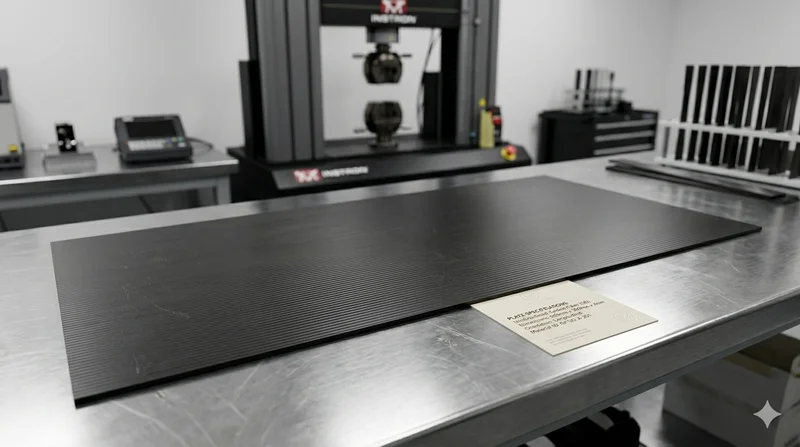
Carbon Fiber Plate — UD Unidirectional T700
Unidirectional carbon fiber plate with all fibers oriented in a single direction for maximum strength along the fiber axis. Essential for structural reinforcements, splints, and applications where load direction is predictable.
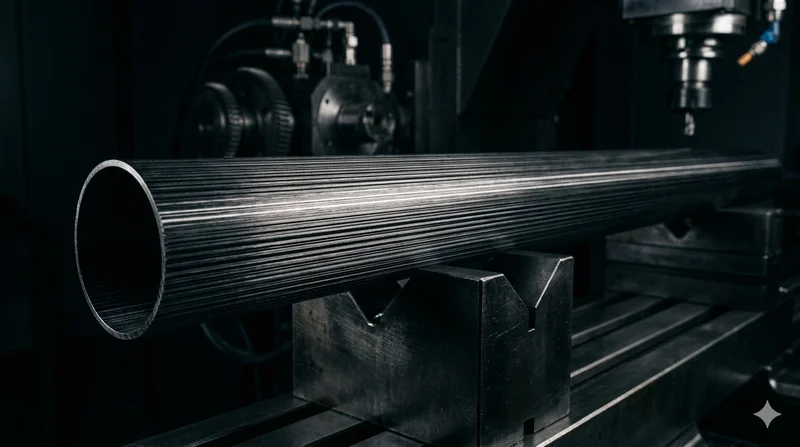
Round Carbon Fiber Tube — UD Unidirectional T700
Unidirectional (UD) round tube with all fibers aligned axially for maximum longitudinal stiffness. Ideal for applications requiring high bending rigidity with minimal weight, such as shafts, struts, and structural reinforcements.