
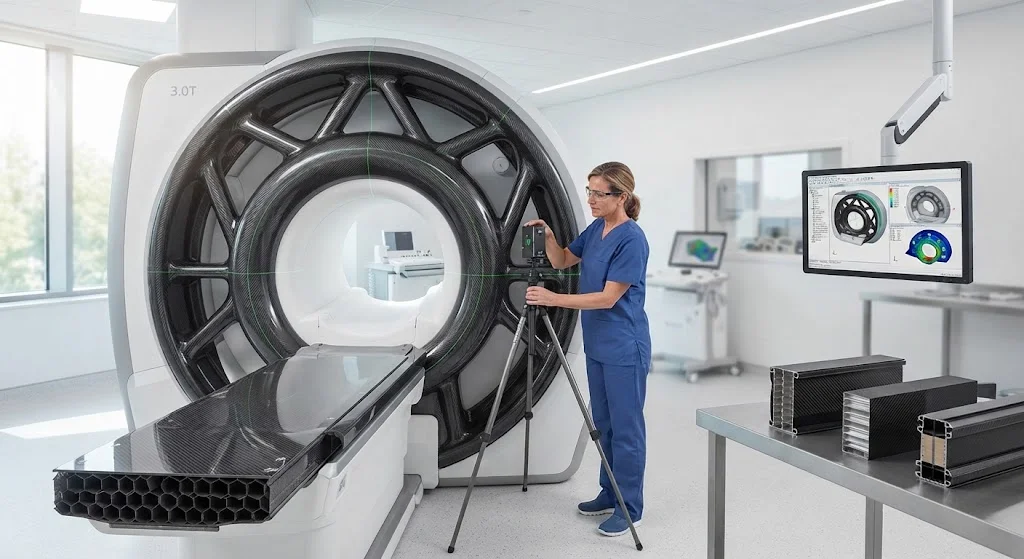
Medical imaging equipment represents one of the most demanding applications of carbon fiber composites, requiring the unique combination of lightweight construction, high structural rigidity, and electromagnetic transparency that only advanced composite materials can provide. Magnetic r
Introduction
Medical imaging equipment represents one of the most demanding applications of carbon fiber composites, requiring the unique combination of lightweight construction, high structural rigidity, and electromagnetic transparency that only advanced composite materials can provide. Magnetic resonance imaging (MRI) and computed tomography (CT) systems depend on precise electromagnetic fields and X-ray transmission, making material selection critical for both image quality and system performance. Carbon fiber's exceptional properties — low density (1.5-1.6 g/cm³), high specific stiffness, and minimal electromagnetic interference — make it the ideal material for gantry structures, patient couches, and supporting frameworks in modern medical imaging systems.
The medical imaging industry is undergoing a transformation driven by the need for more accessible, mobile, and cost-effective diagnostic equipment. Traditional steel and aluminum structures, while adequate for stationary installations, limit the deployment flexibility and increase the logistical challenges of mobile imaging units. Carbon fiber structures address these limitations by reducing weight by 40-60% while maintaining or improving structural performance, enabling new configurations such as portable MRI systems, mobile CT units, and ceiling-mounted gantry systems that were previously impractical with conventional materials.
Material Requirements for Medical Imaging Applications
Medical imaging equipment imposes unique material requirements that differ significantly from aerospace or automotive applications. The primary requirements include:
- Electromagnetic transparency: MRI systems operate using powerful magnetic fields (1.5-7 Tesla) and radiofrequency pulses. Materials must not distort the magnetic field, attenuate RF signals, or create artifacts in the image. Carbon fiber's electrical conductivity is low enough to avoid significant field distortion while providing adequate shielding when properly designed.
- X-ray transmission: CT systems require materials that allow X-rays to pass through with minimal attenuation. Carbon fiber's low atomic number (Z=6) results in excellent X-ray transparency, with attenuation coefficients similar to water and significantly lower than metals.
- Structural rigidity: Both MRI and CT systems require precise alignment of imaging components. Carbon fiber's high specific stiffness (stiffness-to-weight ratio) enables structures that maintain sub-millimeter positioning accuracy while minimizing weight.
- Dimensional stability: Imaging equipment must maintain precise geometry over a wide temperature range (18-24°C operating range) and through repeated use. Carbon fiber's near-zero coefficient of thermal expansion ensures consistent performance.
The table below compares material properties relevant to medical imaging applications:
| Property | Steel | Aluminum | Carbon Fiber Composite | Significance for Imaging |
|---|---|---|---|---|
| Density (g/cm³) | 7.8 | 2.7 | 1.5-1.6 | Lower weight enables mobile/portable systems |
| Specific stiffness (GPa·cm³/g) | 26 | 26 | 100-140 | Higher rigidity per unit weight for precision alignment |
| X-ray attenuation (relative) | High | Moderate | Low | Minimal interference with CT imaging |
| Magnetic permeability | High (ferromagnetic) | Low (paramagnetic) | Very low (diamagnetic) | Minimal field distortion in MRI |
| Thermal expansion (×10⁻⁶/°C) | 12 | 23 | 0-2 | Dimensional stability across temperature range |
| Corrosion resistance | Poor | Moderate | Excellent | No maintenance in hospital environments |
Carbon Fiber Gantry Structures
The gantry is the structural framework that supports the imaging components (magnets, X-ray tubes, detectors) and defines the imaging geometry. Carbon fiber gantry structures offer several advantages over traditional metal constructions:
- Weight reduction: A carbon fiber gantry structure typically weighs 40-60% less than an equivalent steel construction, reducing shipping costs, simplifying installation, and enabling ceiling-mounted configurations that free floor space.
- Rigidity improvement: Carbon fiber's higher specific stiffness means gantry structures can be designed with greater rigidity at lower weight, improving imaging precision and reducing vibration-induced artifacts.
- Electromagnetic compatibility: Carbon fiber gantry structures can be designed with controlled conductivity to provide electromagnetic shielding without the field distortion caused by ferromagnetic materials. This is particularly important for MRI systems where field homogeneity directly affects image quality.
- Design flexibility: Carbon fiber can be molded into complex shapes that optimize structural performance while accommodating the specific geometry of imaging components. This enables gantry designs that would be prohibitively expensive or impossible with metal fabrication.
Modern carbon fiber gantry structures use a combination of sandwich construction (carbon fiber skins with aluminum or Nomex honeycomb core) and monolithic laminates, depending on the structural requirements. The sandwich construction provides excellent stiffness-to-weight ratio for large panel areas, while monolithic laminates are used for high-stress attachment points and precision mounting surfaces.
Patient Couch and Table Design
Patient couches and examination tables represent another critical application of carbon fiber in medical imaging. These structures must support patient weight (up to 250 kg), provide smooth positioning movement, maintain precise alignment with the imaging system, and offer electromagnetic transparency for the imaging volume. Carbon fiber couch designs address all these requirements:
- Load capacity: Carbon fiber couch structures support patient weights of 200-300 kg while maintaining the rigidity required for precise imaging. The high specific strength allows thinner, lighter structures that do not compromise patient comfort.
- Positioning accuracy: Carbon fiber's dimensional stability ensures that couch positioning remains accurate over millions of movements and through temperature variations. This is critical for applications requiring repeatable patient positioning, such as radiation therapy planning.
- Imaging compatibility: Carbon fiber couches are transparent to both RF signals (MRI) and X-rays (CT), allowing full imaging through the couch structure without artifacts or attenuation. This enables supine imaging positions that would be problematic with metal couch structures.
- Infection control: Carbon fiber's smooth, non-porous surface is easy to clean and disinfect, meeting the stringent hygiene requirements of medical environments. Unlike metal structures, carbon fiber does not corrode or degrade with repeated cleaning.
Advanced carbon fiber couch designs incorporate integrated cable routing, quick-change patient surfaces, and modular construction that allows customization for different imaging modalities. Some designs include carbon fiber honeycomb sandwich panels that provide additional cushioning while maintaining structural integrity.
Electromagnetic Shielding and MRI Compatibility
While carbon fiber's electromagnetic properties are advantageous for medical imaging, proper design is essential to avoid interference with imaging performance. Key considerations for MRI compatibility include:
- Conductivity management: Carbon fiber's electrical conductivity (typically 1,000-10,000 S/m) can create eddy currents in the presence of rapidly changing magnetic fields. These eddy currents can cause image artifacts and reduce signal-to-noise ratio. Mitigation strategies include using绝缘 coatings, segmented conductors, or specific fiber orientations that minimize eddy current paths.
- Magnetic susceptibility: Carbon fiber is diamagnetic (magnetic susceptibility ≈ -10×10⁻⁶), which is much lower than paramagnetic materials like aluminum. This low susceptibility minimizes magnetic field distortion, making carbon fiber suitable for use close to the imaging volume.
- RF shielding integration: For applications requiring electromagnetic shielding, carbon fiber structures can incorporate conductive mesh or foil layers that provide broadband EMI shielding without the weight penalty of solid metal enclosures.
- Grounding and bonding: Carbon fiber structures must be properly grounded and bonded to the system ground to prevent charge accumulation and ensure consistent electrical behavior. This requires careful design of grounding paths and bonding connections.
MRI system manufacturers have developed specific guidelines for carbon fiber component design, including maximum conductivity limits, grounding requirements, and testing protocols to verify electromagnetic compatibility. Compliance with these guidelines ensures that carbon fiber structures do not degrade imaging performance while providing the structural benefits of composite materials.
Manufacturing and Quality Considerations
Carbon fiber medical imaging components require manufacturing processes that meet the stringent quality requirements of the medical device industry:
- Autoclave-cured prepreg: The preferred process for high-performance medical imaging structures, providing consistent quality, high fiber volume fraction (55-60%), and excellent surface finish. Autoclave curing at 120-180°C under 3-7 bar pressure ensures complete resin cure and minimal void content.
- Out-of-autoclave (OoA) processes: Vacuum-bag-only curing at lower pressures reduces capital investment while maintaining good quality. Suitable for medium-performance applications where cost is a primary driver.
- Resin transfer molding (RTM): Closed-mold process that provides excellent surface finish and dimensional accuracy, suitable for complex-shaped components that require tight tolerances.
- Quality control: Medical imaging components require 100% non-destructive inspection (ultrasonic, X-ray) to verify laminate quality and detect any defects that could affect performance or patient safety.
Traceability is critical for medical device components, with full material and process documentation required for regulatory compliance. Carbon fiber suppliers to the medical imaging industry must maintain ISO 13485 quality management system certification and provide complete material traceability from raw fiber to finished component.
Frequently Asked Questions
How much weight can carbon fiber save in MRI gantry structures?
Carbon fiber gantry structures typically save 40-60% weight compared to equivalent steel constructions. For a typical MRI system gantry weighing 2,000-3,000 kg in steel, a carbon fiber equivalent would weigh 800-1,800 kg. This weight reduction simplifies installation (often eliminating the need for crane access), reduces structural requirements for the imaging room, and enables mobile MRI configurations that would be impractical with heavier metal structures.
Does carbon fiber interfere with MRI or CT imaging?
When properly designed, carbon fiber structures do not significantly interfere with MRI or CT imaging. Carbon fiber's low X-ray attenuation makes it nearly transparent to CT imaging, while its low magnetic susceptibility minimizes field distortion in MRI. However, carbon fiber's electrical conductivity can create eddy currents in MRI systems, which must be managed through proper design (segmentation, grounding, fiber orientation optimization) to avoid image artifacts.
What is the typical service life of carbon fiber medical imaging components?
Carbon fiber medical imaging components typically have service lives of 15-20 years, matching or exceeding the service life of the imaging system itself. Carbon fiber's excellent corrosion resistance, dimensional stability, and fatigue resistance ensure that components maintain their performance characteristics throughout the system's operational life. Regular inspection and maintenance of bonding and grounding connections is recommended, but the carbon fiber structure itself requires minimal maintenance.
Are carbon fiber medical imaging components compatible with infection control requirements?
Yes, carbon fiber components meet or exceed infection control requirements for medical environments. The smooth, non-porous surface is easy to clean and disinfect using standard hospital cleaning protocols. Carbon fiber does not corrode, pit, or degrade with repeated exposure to cleaning chemicals, unlike some metals. The material's chemical resistance and surface finish make it ideal for applications requiring frequent cleaning and sterilization.
Conclusion
Carbon fiber composites are enabling significant advances in medical imaging equipment design, providing 40-60% weight savings in gantry and couch structures while maintaining the electromagnetic transparency and structural precision required for high-quality MRI and CT imaging. The combination of low density, high specific stiffness, near-zero thermal expansion, and excellent corrosion resistance makes carbon fiber the ideal material for medical imaging applications. As the medical imaging industry continues to evolve toward more accessible, mobile, and cost-effective diagnostic equipment, carbon fiber structures will play an increasingly important role in enabling these advances.
For medical imaging equipment manufacturers and healthcare facilities seeking to optimize their imaging system designs, carbon fiber composites offer proven advantages in weight reduction, performance, and reliability. Explore our carbon fiber product range or contact our engineering team for guidance on composite materials for medical imaging applications.
Part of topic
Related Articles
- Carbon Fiber Mooring for Floating Offshore Wind: Fatigue and Corrosion in Deep Water
- Carbon Fiber Bicycle Frame Optimization: Layup Design and Manufacturing for Competitive Racing
- Carbon Fiber CFRP Retrofit for Infrastructure: Bridge and Building Seismic Strengthening
- Carbon Fiber EV Battery Enclosures: Crash Safety and Electromagnetic Shielding Design
- Carbon Fiber Structures for Low-Altitude Economy: UAV Airframes and eVTOL Components
- Carbon Fiber Satellite Structures: Dimensional Stability for Space Environment Cycling
Interested in Our Products?
Contact our team for competitive pricing and technical specifications.
Get a QuoteRelated Products

Carbon Fiber Plate — 3K Twill T700 1.5mm
Thin 1.5mm carbon fiber plate with 3K twill weave surface. Lightweight and stiff, commonly used for covers, panels, drone bodies, and applications requiring a premium aesthetic appearance.

Carbon Fiber Plate — 3K Twill T700 3.0mm
Medium-thickness 3.0mm carbon fiber plate offering significantly higher load capacity while maintaining attractive 3K twill finish. Suitable for structural brackets, reinforcement plates, and load-bearing panels.

Square Carbon Fiber Tube — 3K Twill T700
Square cross-section carbon fiber tube manufactured with 3K twill weave for torsional strength. Preferred for structural frames, trusses, and support columns where rectangular geometry offers design flexibility.
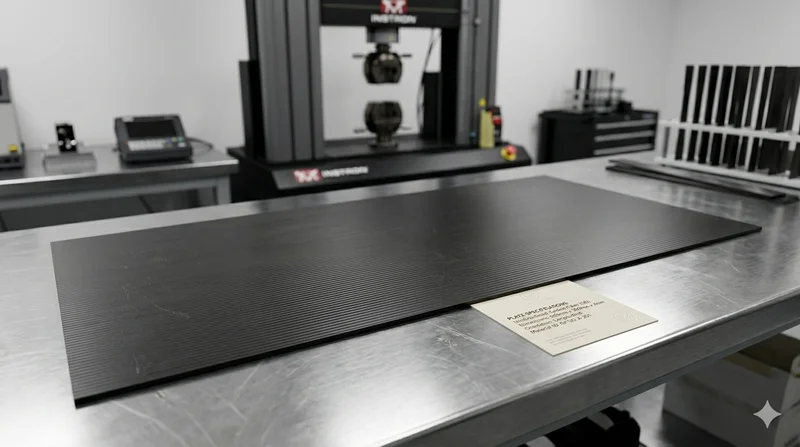
Carbon Fiber Plate — UD Unidirectional T700
Unidirectional carbon fiber plate with all fibers oriented in a single direction for maximum strength along the fiber axis. Essential for structural reinforcements, splints, and applications where load direction is predictable.
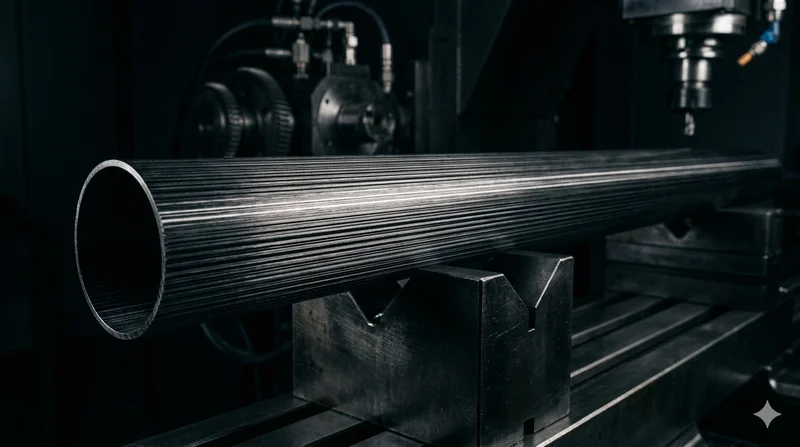
Round Carbon Fiber Tube — UD Unidirectional T700
Unidirectional (UD) round tube with all fibers aligned axially for maximum longitudinal stiffness. Ideal for applications requiring high bending rigidity with minimal weight, such as shafts, struts, and structural reinforcements.