
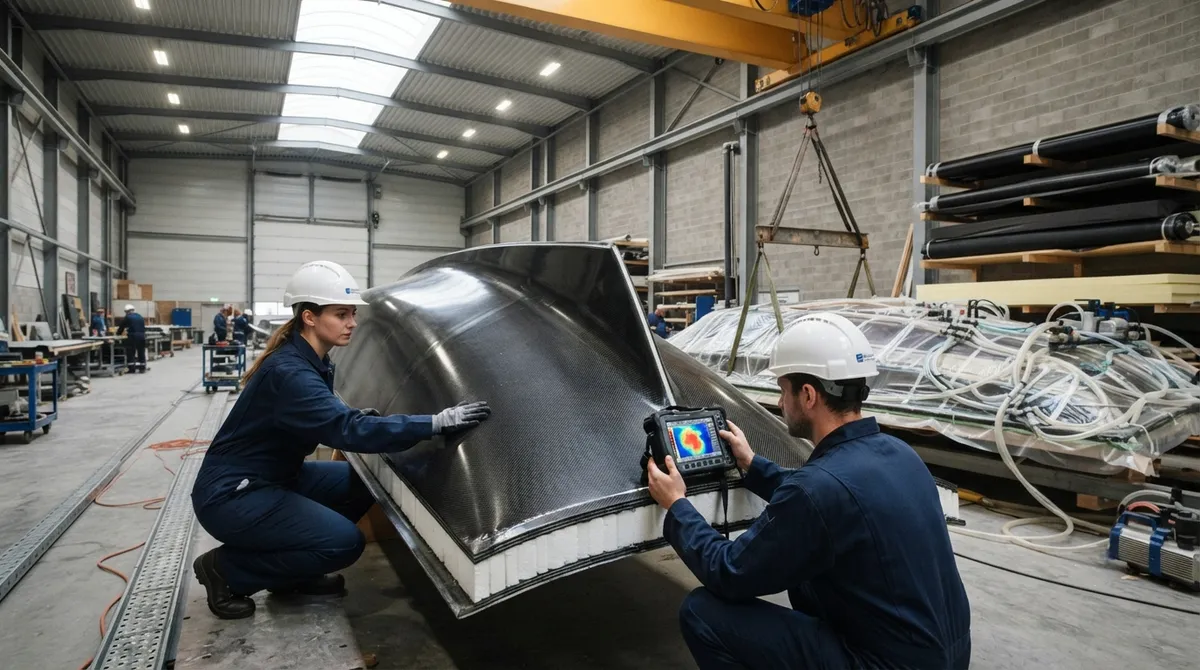
Fast craft — patrol boats, pilot boats, rescue vessels, and offshore racing hulls — are defined by one engineering tension: they must be light enough to accelerate hard and plane efficiently, yet stiff and tough enough to survive wave impacts at 40 knots. Carbon fiber sandwich construct
Introduction
Fast craft — patrol boats, pilot boats, rescue vessels, and offshore racing hulls — are defined by one engineering tension: they must be light enough to accelerate hard and plane efficiently, yet stiff and tough enough to survive wave impacts at 40 knots. Carbon fiber sandwich construction resolves this tension better than any alternative. By bonding thin carbon fiber skins to a thick, low-density foam core, builders create a panel that behaves structurally like a much thicker laminate while weighing a fraction of it.
The sandwich principle is straightforward: the skins carry the bending loads, and the core keeps the skins apart to maximize the second moment of area. In practice, the quality of the finished hull depends on three decisions made long before the boat hits the water — which core to specify, how cleanly the skins are infused, and how the finished panel performs under impact. This article walks through each of these areas with the data and process detail that naval architects, boat builders, and technical buyers need.
Why Fast Craft Use Sandwich Construction
A sandwich panel achieves the same bending stiffness as a far thicker solid laminate at a fraction of the mass, because the core spaces the skins far apart. For a fast craft, the practical results are measurable:
- Weight reduction: A sandwich hull typically weighs 30-40% less than an equivalent single-skin GRP hull of the same stiffness, which directly improves speed, fuel economy, and payload capacity.
- Stiffness gain: Doubling the core thickness increases panel flexural stiffness by roughly eight times, allowing thin, light skins to carry heavy wave-slamming loads.
- Buoyancy and safety: Closed-cell foam cores provide inherent buoyancy and do not absorb water if the outer skin is locally damaged, a critical safety feature for rescue and patrol operations.
- Vibration damping: The core dissipates vibration and noise, improving ride comfort and reducing fatigue in crew and equipment at sustained high speed.
Carbon fiber skins add a further layer of benefit over glass: roughly double the stiffness and a third higher strength at a similar laminate weight, which lets the builder reduce skin thickness further or accept higher design loads. The trade-off is cost and the need for precise process control, which is where core selection and infusion quality become decisive.
Foam Core Selection
The core is the least glamorous part of a sandwich hull but the one that most influences weight, stiffness, and long-term durability. Four core families dominate marine use, and they are not interchangeable:
| Core Material | Density (kg/m³) | Shear Strength (MPa) | Compression Strength (MPa) | Max Service Temp (°C) | Relative Cost |
|---|---|---|---|---|---|
| Cross-linked PVC foam | 80-250 | 1.0-3.0 | 1.3-4.5 | 70-90 | Medium |
| PET foam (recyclable) | 100-220 | 0.8-1.8 | 1.0-2.8 | 130-150 | Low-Medium |
| PMI foam | 50-200 | 1.2-3.2 | 1.5-5.0 | 180-220 | High |
| End-grain balsa | 100-250 | 2.0-3.5 | 4.0-12.0 | 120 | Low |
Cross-linked PVC foam is the workhorse of fast-craft hulls, offering the best balance of shear performance, infusion resistance, and cost for panels up to about 80°C service temperature. PET foam has gained share because it is recyclable and resists the higher exotherm temperatures of thick laminates. PMI foam is specified where peak performance matters most — it tolerates autoclave temperatures and delivers the highest specific properties, at a price that reserves it for racing hulls and military structures. End-grain balsa remains an excellent low-cost option where weight is less critical, but it absorbs moisture over time and is sensitive to resin starved at edges.
For high-speed hulls, the common specification pattern is PVC foam at 80-150 kg/m³ in the bottom panels (where slamming loads are highest) stepping to lighter cores higher in the topsides. Core thickness typically ranges from 15 to 40 mm depending on panel size and design pressure, and every core joint must be scarped and bonded.
Infusion Quality Control
Vacuum infusion has replaced hand lamination in most fast-craft yards because it produces consistent fiber volume fractions and low void content with less styrene exposure. The process is forgiving only when it is disciplined. The failure modes — dry spots, resin-rich zones, and voids — are invisible on the outside of the hull and often appear only years later as skin-to-core debonding. Key control points include:
- Core surface preparation: Foam cores must be primed or machined with a surface film that prevents the skin resin from being absorbed into open cells, which starves the skin-core bond. Perforated or grooved core allows resin flow through the core plane during infusion.
- Vacuum integrity: Infusion vacuums of 95-99% (about 0.1-0.5 bar residual) must be verified with a drop test that holds vacuum for 15-30 minutes before resin is introduced. Leaks at this stage produce voids that no later step can remove.
- Resin flow control: Flow media, resin viscosity of 150-400 mPa·s at the injection temperature, and injection pressure must be matched to part size. Infusion flow rates above about 300 g/min across a large hull panel risk racetracking along core joints and dry edges.
- Fiber volume fraction: Target fiber volumes of 55-62% for the skins are verified by density checks on process coupons; deviations beyond ±2% indicate a flow problem that must be corrected before the next panel.
Post-cure inspection completes the picture: ultrasonic testing scans the hull for voids and skin-core disbonds, and process coupons are mechanically tested so that every hull batch carries its own quality evidence. The best yards treat infusion as a controlled manufacturing process rather than a hand craft, with written parameters for every resin and core combination they use.
Impact Testing and Damage Tolerance
Sandwich hulls live or die on impact performance. Wave slamming at 35-45 knots can generate panel pressures above 200 kPa, and a collision with a floating log or a dock delivers a concentrated impact that the laminate must survive without catastrophic failure. The industry relies on a small set of standard test methods:
- Drop-weight impact: A hemispherical or flat indenter of defined mass drops from a set height onto a clamped panel, producing a calibrated impact energy. Panels are tested at energies from 5 to 50 J depending on the service environment, and the damage is assessed visually and by ultrasonic scan.
- Panel bending after impact: Impacted specimens are loaded in four-point bending to measure residual strength; a well-designed sandwich retains 70-85% of its undamaged strength after a low-energy impact that would crack a monolithic laminate.
- Skin-core debond tests: Double cantilever beam or climbing drum peel tests measure the fracture toughness of the skin-core interface, the most common hidden failure in sandwich hulls.
- Slamming load simulation: Hydrodynamic slam tests or finite element models with slam pressure distributions validate the panel schedule against the actual wave impact spectrum of the craft's operating envelope.
The design objective is damage tolerance, not just strength: a hull that dents locally and keeps the skin-core bond intact can be repaired on site, while a hull that debonds over a large area must be cut out and rebuilt.
Frequently Asked Questions
Why is foam core used instead of balsa in carbon fiber fast-craft hulls?
Foam cores, particularly cross-linked PVC and PET, offer three advantages over balsa in high-speed hulls. First, closed-cell foam does not absorb water, so a damaged outer skin does not lead to progressive moisture ingress and weight gain over the life of the boat. Second, foam cores do not have grain direction, giving uniform properties in all panel orientations and avoiding the starved edges and hard points that balsa grain structure can create. Third, foam cores have better shear strain tolerance, which resists the localized crushing loads from wave slamming. Balsa remains competitive where cost is paramount and weight is less critical, but fast craft that prioritize durability and impact tolerance increasingly specify foam. The weight penalty of foam versus balsa at equal density is small, while the moisture behavior is significantly better.
What causes skin-to-core debonding in marine sandwich hulls and how is it prevented?
Debonding is almost always a processing failure rather than a design failure. The dominant causes are resin starvation of the core surface, contamination or moisture on the core before lamination, and voids created by vacuum leaks during infusion. Prevention starts with priming or surface film on the core so the skin resin cannot be absorbed into open cells, proceeds through a strict vacuum drop test before resin injection, and is confirmed by ultrasonic inspection after cure. Core surface temperatures during cure must also be controlled: high exotherm in thick laminates can melt or distort low-temperature foam, weakening the interface. The most reliable prevention is a documented process specification for each core and resin combination, with process coupons tested for every production batch.
How much lighter is a carbon fiber sandwich hull than a single-skin glass hull?
For equal stiffness and similar design loads, a carbon fiber sandwich hull is typically 30-40% lighter than a single-skin GRP hull and roughly 20-30% lighter than a glass sandwich hull of the same panel schedule. On a 12-meter patrol boat, this can translate into 1,500-3,000 kg of savings — enough to add fuel, armament, sensors, or crew capacity without changing the hull lines. In performance terms, lighter displacement directly improves planing speed and fuel economy: a 10% weight reduction typically yields 3-6% lower fuel consumption at cruising speed, and noticeably better acceleration. The trade-off is cost, which builders accept where the weight saving pays for itself in performance or payload.
Conclusion
Carbon fiber sandwich hulls deliver the stiffness, weight, and impact tolerance that fast craft demand, but only when core selection, infusion discipline, and impact testing are treated as one integrated system. The core sets the stiffness and weight floor, the infusion process determines whether the skins and core act as one structure, and impact testing proves the panel survives the real wave environment. Builders who master all three produce hulls that are lighter, faster, and safer over decades of hard service.
For yards and design offices evaluating materials for their next fast-craft program, the starting point is reliable, certified carbon fiber in the right form for infusion. Browse our carbon fiber products for marine-grade fabrics, unidirectional reinforcements, and sandwich skins, or contact our engineering team to discuss core-and-skin specifications for your hull program.
Part of topic
Related Articles
- Carbon Fiber Tube for Sale: Comparing Listings and Avoiding Bad Specs
- Carbon Fiber Engine Parts: High-Temperature Performance for Racing and Performance Vehicles
- Carbon Fiber Body Parts: Automotive Exterior Panels and Structural Components
- Carbon Fiber Drone Body Manufacturing: Monocoque Design and Production Methods
- Carbon Fiber Drone Parts Supplier: FPV Frames, Arms and Structural Components
- Filament Wound Epoxy Tubes: Industrial Applications from Oil and Gas to Aerospace
Interested in Our Products?
Contact our team for competitive pricing and technical specifications.
Get a QuoteRelated Products

Carbon Fiber Plate — 3K Twill T700 1.5mm
Thin 1.5mm carbon fiber plate with 3K twill weave surface. Lightweight and stiff, commonly used for covers, panels, drone bodies, and applications requiring a premium aesthetic appearance.

Carbon Fiber Plate — 3K Twill T700 3.0mm
Medium-thickness 3.0mm carbon fiber plate offering significantly higher load capacity while maintaining attractive 3K twill finish. Suitable for structural brackets, reinforcement plates, and load-bearing panels.

Square Carbon Fiber Tube — 3K Twill T700
Square cross-section carbon fiber tube manufactured with 3K twill weave for torsional strength. Preferred for structural frames, trusses, and support columns where rectangular geometry offers design flexibility.
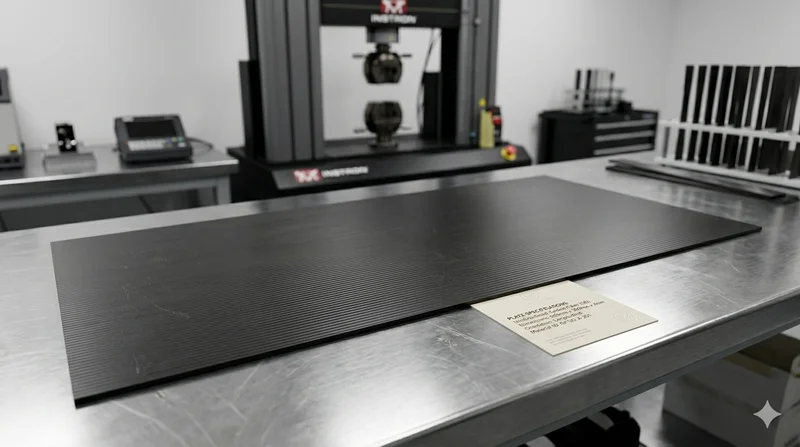
Carbon Fiber Plate — UD Unidirectional T700
Unidirectional carbon fiber plate with all fibers oriented in a single direction for maximum strength along the fiber axis. Essential for structural reinforcements, splints, and applications where load direction is predictable.
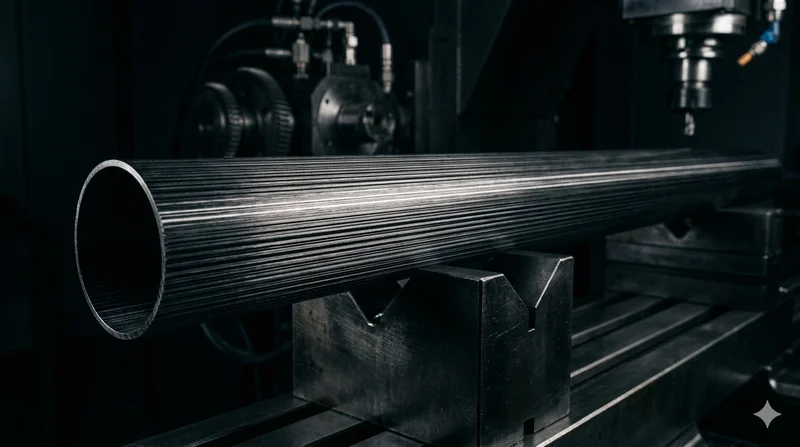
Round Carbon Fiber Tube — UD Unidirectional T700
Unidirectional (UD) round tube with all fibers aligned axially for maximum longitudinal stiffness. Ideal for applications requiring high bending rigidity with minimal weight, such as shafts, struts, and structural reinforcements.