
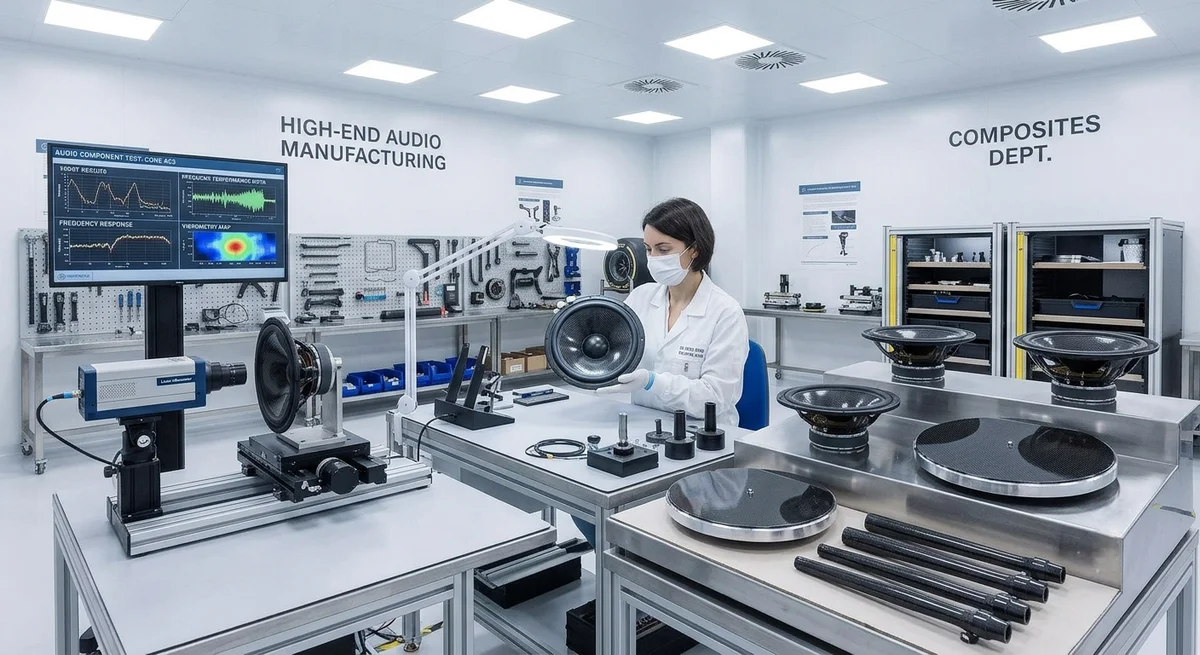
How carbon fiber composites improve high-end audio equipment performance — speaker cone design, turntable tonearm construction, vibration damping, and acoustic component manufacturing for OEM suppliers.
Carbon Fiber in High-End Audio: Engineering Acoustic Excellence
The high-end audio industry, valued at approximately $12.5 billion globally in 2026, has increasingly adopted carbon fiber composites for critical components where mass, stiffness, and damping directly affect sound quality. Carbon fiber's unique combination of high specific stiffness, excellent vibration damping, and near-zero thermal expansion makes it an ideal material for speaker cones, turntable tonearms, and acoustic enclosures. This article provides technical specifications for B2B manufacturers and OEM suppliers serving the high-end audio market.
Material Properties for Audio Components
| Property | Carbon Fiber (2×2 Twill, 200 gsm) | Paper/Pulp (Conventional) | Aluminum | Beryllium | Audio Relevance |
|---|---|---|---|---|---|
| Density (g/cm³) | 1.55–1.60 | 0.8–1.2 | 2.70–2.81 | 1.85 | Lower = faster transient response |
| Young's modulus (GPa) | 65–75 (fabric) | 3–8 | 69 | 287 | Higher = better piston behavior |
| Specific stiffness (×10⁶ m²/s²) | 42–48 | 3–7 | 25 | 155 | Higher = cleaner high-frequency extension |
| Wave speed (m/s) | 6,500–7,000 | 1,500–2,800 | 5,050 | 12,500 | Higher = delayed cone breakup |
| Internal damping (tan δ) | 0.015–0.030 | 0.03–0.06 | 0.001–0.003 | 0.0003 | Higher = reduced ringing/resonance |
| Thermal conductivity (W/m·K) | 5–8 (in-plane) | 0.06–0.10 | 237 | 205 | Important for voice coil heat dissipation |
| CTE (×10⁻⁶/°C) | 0–2 (fabric) | 5–10 | 23 | 11.5 | Lower = less thermal distortion |
Carbon Fiber Speaker Cone Design
Speaker cones must behave as ideal rigid pistons across their operating frequency range. Carbon fiber composites achieve this through three mechanisms:
- High specific stiffness delays breakup modes: A 200 gsm carbon fiber fabric cone (0.25 mm thickness) weighs 0.4 g/cm² and exhibits first breakup mode at 4.5–6.0 kHz — compared to 1.5–2.5 kHz for paper cones and 3.5–4.5 kHz for aluminum cones of equivalent mass. This extends the clean operating bandwidth by 1.5–3 octaves.
- Optimized layup architecture: Typical high-end driver designs use a 3-ply quasi-isotropic layup [0/45/−45] with 150–300 gsm fabric. The 0° plies provide axial stiffness, while ±45° plies control radial modes and improve damping. Some manufacturers add a thin (0.05 mm) damping interlayer of acrylic or butyl rubber between carbon plies.
- Dome vs cone geometry: Carbon fiber domes (inverted or conventional) are preferred for tweeters above 2 kHz, using 100–150 gsm fabric at 0.15–0.30 mm thickness. Cones are used for midrange and woofers below 2 kHz, with 200–400 gsm fabric at 0.25–0.60 mm thickness and optional foam or honeycomb core for high-power woofers.
- Surround and suspension integration: The carbon fiber cone requires specialized edge termination — typically foamed rubber or butyl surrounds with a compliance tailored to the cone's mass. Cone-to-surround bond area: >8 mm width for woofers, >4 mm for tweeters. Adhesive: flexible epoxy (shore A 40–60) for fatigue resistance over 10⁶+ cycles.
Turntable Tonearms: Carbon Fiber Construction
| Parameter | Carbon Fiber Tonearm | Aluminum Tonearm | Magnesium Tonearm | CF Advantage |
|---|---|---|---|---|
| Mass (effective, 9" arm) | 8–12 g | 10–16 g | 7–12 g | 10–25% lighter |
| Resonance frequency (vertical) | 8–12 Hz | 9–14 Hz | 8–12 Hz | Smoother decay |
| Bending stiffness (N/m) | 2,500–3,500 | 1,200–2,000 | 1,500–2,500 | 1.4–2.9× stiffer |
| Torsional stiffness (N·m/rad) | 1,200–1,800 | 600–1,000 | 700–1,100 | 1.2–3.0× |
| Damping factor (log decrement) | 0.040–0.070 | 0.008–0.015 | 0.010–0.020 | 3–7× better |
| Thermal stability (CTE) | Near-zero | 23 ×10⁻⁶/°C | 25 ×10⁻⁶/°C | Critical for tracking stability |
Manufacturing Methods for Audio Components
| Component | Preferred Method | Tooling Cost | Cycle Time | Typical Volume |
|---|---|---|---|---|
| Speaker cone (mid/woofer) | Prepreg compression molding | $2,000–8,000 | 8–20 min | 500–10,000/yr |
| Speaker dome (tweeter) | Vacuum forming (prepreg) | $1,000–3,000 | 15–30 min | 1,000–20,000/yr |
| Tonearm tube | Roll-wrapped pultrusion | $3,000–6,000 | 5–15 min | 1,000–5,000/yr |
| Enclosure/ cabinet | Prepreg lay-up + vacuum bag | $5,000–20,000 | 4–24 hours | 50–500/yr |
| Turntable platter | CF sandwich with foam core | $8,000–15,000 | 1–3 hours | 100–1,000/yr |
Acoustic Component Performance Comparison
- Woofer cones (6.5"): Carbon fiber cone reduces moving mass from 22 g (paper) to 14 g (carbon), increasing sensitivity by 2.5–3.5 dB and extending high-frequency roll-off from 2.5 kHz to 4.0 kHz. Distortion (THD) at 90 dB SPL reduces from 0.8% (paper) to 0.3% (carbon) across the 100 Hz–2 kHz band.
- Tweeter domes (1"): Carbon fiber dome extends breakup frequency from 18 kHz (aluminum) to 28 kHz (carbon), moving the primary resonance well above the audible range. This eliminates the need for steep crossover filters (12 dB/octave vs 24 dB/octave) and improves phase coherence.
- Tonearms: Carbon fiber's 3–7× higher damping factor vs metal eliminates high-Q resonances that color the sound. The near-zero CTE ensures consistent tracking force across temperature changes (0–40°C).
- Speaker enclosures: Carbon fiber sandwich panels (2 mm CF skins + 5 mm foam core) provide 8–12× higher bending stiffness than 18 mm MDF at 60% less weight, with 70–80% lower panel resonance amplitude.
Quality Specifications for Audio-Grade Carbon Fiber
- Fiber surface quality: Audio applications require aerospace-grade surface treatment for consistent resin wet-out. Spec: surface oxygen content (XPS) >25 at%, sizing type compatible with epoxy (0.8–1.2 wt% pick-up).
- Fabric thickness tolerance: ±5% maximum variation across the roll width (narrower tolerance than standard ±10% for structural grades). Thickness non-uniformity creates mass imbalance and resonance frequency drift in cones.
- Areal weight consistency: CV <3% for 200 gsm fabric (standard structural grade allows CV <5%). Each gram of mass variation shifts the cone's Fs by approximately 2–3 Hz.
- Resin system specification: Low-viscosity epoxy (<500 cP at 60°C) for thin-ply impregnation. Tg >140°C (dry) to withstand voice coil heating. T-peel strength >30 N/cm for ply interlayer adhesion.
- Acoustic testing per driver: Frequency response ±1.5 dB (200 Hz–3 kHz), THD <0.5% at 90 dB SPL, Fs tolerance ±5% from nominal.
Q: How does carbon fiber compare to beryllium for high-end tweeter domes?
A: Beryllium (density 1.85 g/cm³, modulus 287 GPa) offers the highest specific stiffness of any practical diaphragm material — its wave speed of 12,500 m/s pushes the first breakup mode beyond 30 kHz for a 1" dome. Carbon fiber's wave speed of 6,500–7,000 m/s places breakup at 24–28 kHz — still above audibility but with a different breakup characteristic (progressive vs beryllium's abrupt breakup). Carbon fiber's key advantage over beryllium is: (1) cost — carbon fiber tweeter domes cost $2–8/unit vs $25–80/unit for beryllium; (2) damping — carbon's tan δ of 0.02 vs beryllium's 0.0003 means smoother roll-off above breakup; (3) manufacturing safety — beryllium dust is toxic, requiring specialized handling and filtration. For loudspeakers priced under $10,000/pair, carbon fiber domes are the optimal choice; beryllium is reserved for flagship models above $20,000/pair.
Q: Is carbon fiber suitable for all speaker cone sizes, or are there limits?
A: Carbon fiber is ideal for small to medium drivers (0.5–8" diameter). For subwoofers (>10"), the cost of carbon fiber becomes prohibitive — a 12" carbon fiber cone costs $45–90 (material + molding) vs $8–15 for a paper cone or $15–25 for an aluminum cone. Additionally, subwoofer cones operate primarily in the piston range (<100 Hz) where the stiffness advantage of carbon fiber is less critical — paper or aluminum cones with long-throw surrounds achieve comparable performance at significantly lower cost. For high-power pro audio subwoofers (18–21"), specialty reinforced paper cones with carbon fiber dust caps are a cost-effective hybrid approach. For full-range drivers in high-end bookshelf speakers (4–6.5"), carbon fiber is the preferred material for its combination of low mass, high stiffness, and self-damping.
Q: What surface finish options are available for carbon fiber audio components?
A: Carbon fiber audio components typically receive one of four surface finishes: (1) Clear epoxy gloss — the most popular aesthetic, preserving the visible twill weave pattern. UV-stabilized epoxy topcoat with 2–3 coats (total 50–80 μm) provides scratch resistance and UV protection. (2) Matte/satin clear — achieved by adding silica matting agents (2–5 wt%) to the final topcoat layer. Preferred for enclosures to reduce visual glare in listening rooms. (3) Painted/opaque — carbon fiber is painted with automotive-grade urethane for brand color matching or stealth aesthetic. The damping benefit of the carbon substrate remains. (4) Exposed raw carbon — the resin-rich surface is polished to a mirror finish without additional topcoat. Requires high-quality tooling and controlled manufacturing conditions. For medical or aerospace audio applications, a Class VI biocompatible or FAR 25.853 fire-rated epoxy topcoat may be required.
Related Articles
- Carbon Fiber Mooring for Floating Offshore Wind: Fatigue and Corrosion in Deep Water
- Carbon Fiber Bicycle Frame Optimization: Layup Design and Manufacturing for Competitive Racing
- Carbon Fiber CFRP Retrofit for Infrastructure: Bridge and Building Seismic Strengthening
- Carbon Fiber Medical Imaging Equipment: Lightweight Gantry and Couch Structures for MRI/CT
- Carbon Fiber EV Battery Enclosures: Crash Safety and Electromagnetic Shielding Design
- Carbon Fiber Structures for Low-Altitude Economy: UAV Airframes and eVTOL Components
Interested in Our Products?
Contact our team for competitive pricing and technical specifications.
Get a QuoteRelated Products
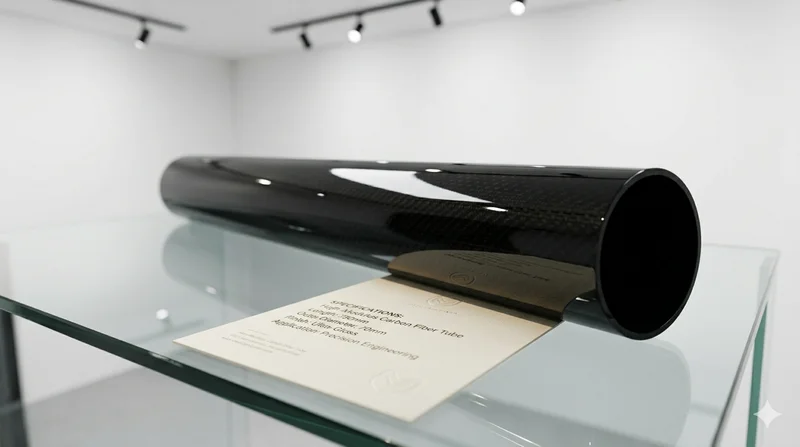
High Modulus Round Carbon Fiber Tube — M40
High modulus round tube manufactured with M40 grade fiber (tensile modulus 400 GPa). Designed for applications where maximum stiffness-to-weight ratio is critical, such as optical systems, precision machinery, and aerospace structures.
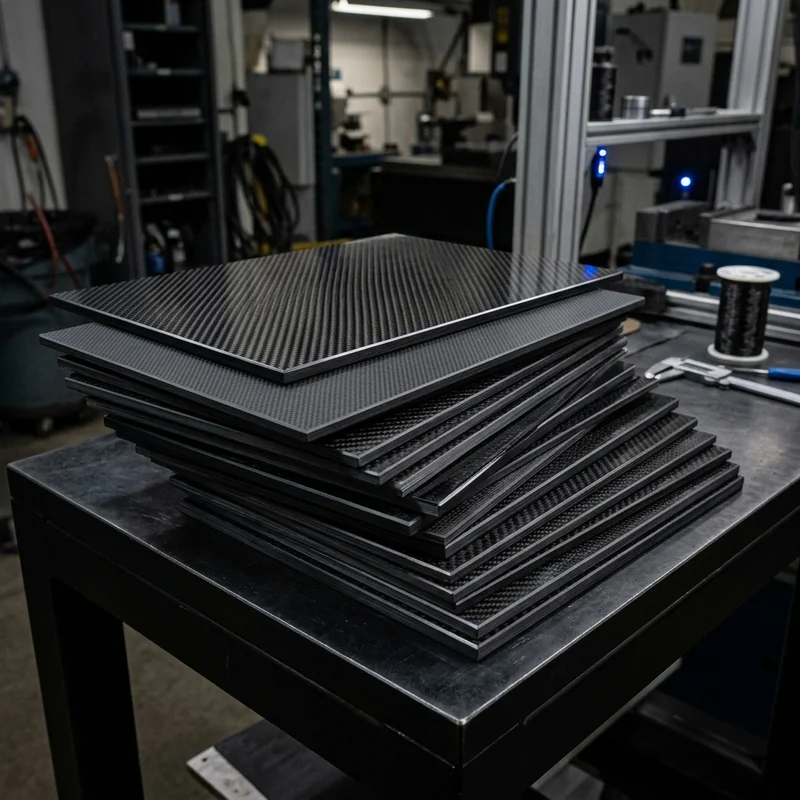
Carbon fiber standard plate-3k stripe
Lightweight, ultra-rigid standard sheets for drone fuselages, robot housings, facades and structural applications.

Carbon Fiber Plate — 3K Twill T700 1.5mm
Thin 1.5mm carbon fiber plate with 3K twill weave surface. Lightweight and stiff, commonly used for covers, panels, drone bodies, and applications requiring a premium aesthetic appearance.

Square Carbon Fiber Tube — 3K Twill T700
Square cross-section carbon fiber tube manufactured with 3K twill weave for torsional strength. Preferred for structural frames, trusses, and support columns where rectangular geometry offers design flexibility.

Carbon Fiber Plate — 3K Twill T700 3.0mm
Medium-thickness 3.0mm carbon fiber plate offering significantly higher load capacity while maintaining attractive 3K twill finish. Suitable for structural brackets, reinforcement plates, and load-bearing panels.