
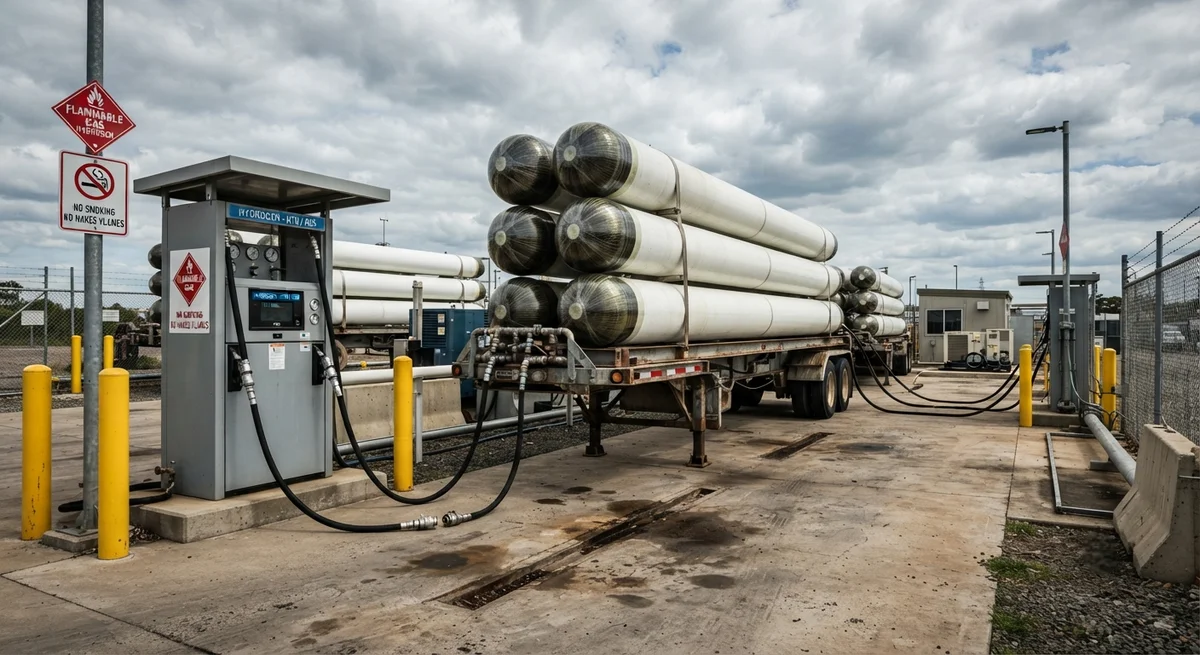
Compare Type IV and Type V carbon fiber hydrogen transport vessels for tube trailers. Technical specifications, payload efficiency, total cost of ownership, and regulatory approval for hydrogen logistics procurement.
Introduction
The global hydrogen economy is expanding rapidly, with the International Energy Agency projecting hydrogen demand to reach 150 million tonnes by 2030. A critical infrastructure challenge is the efficient transport of hydrogen from production sites to end users. Tube trailers — high-pressure vessels mounted on semi-trailer chassis — are the primary method for distributing gaseous hydrogen at scale over distances up to 500 km.
Carbon fiber composite pressure vessels have revolutionised hydrogen transport, enabling significantly higher storage pressures and lighter system weights compared to traditional steel vessels. Two carbon fiber vessel types dominate the market: Type IV (polymer liner with full carbon fiber wrap) and Type V (linerless, all-composite). This article provides a detailed technical and economic comparison to help procurement managers select the optimal vessel type for their hydrogen transport operations.
Type IV vs Type V Vessel Comparison
| Parameter | Type IV (Polymer Liner + CF Wrap) | Type V (Linerless, All-Composite) | Advantage |
|---|---|---|---|
| Operating pressure (bar) | 350–700 | 350–1,000 | Type V — higher ceiling |
| Liner material | HDPE or PA6 (polyamide) | None (linerless design) | Type V — no liner |
| Gravimetric capacity (kg H₂/kg vessel) | 4.5–5.5% (700 bar) | 5.5–7.5% (700 bar) | Type V — 20–40% higher |
| Volumetric efficiency (kg H₂/L) | 0.028–0.032 (700 bar) | 0.030–0.035 (700 bar) | Type V — ~10% higher |
| Burst pressure (bar) | 1,575–2,250 | 1,575–2,625 | Comparable |
| Cycle life (fill/drain cycles) | 15,000–30,000 | 30,000–50,000+ | Type V — longer life |
| Permeation rate (NmL/L/day) | 0.02–0.05 | <0.01 | Type V — lower permeation |
| Weight per 1,000 L water volume (kg) | 180–250 | 140–180 | Type V — lighter |
| Manufacturing cost ($/L of water volume) | $45–75 | $65–110 | Type IV — lower cost |
| Service temperature range (°C) | −40 to +85 | −60 to +120 | Type V — wider range |
| Damage tolerance (impact) | Moderate (liner prevents fibre damage from inner surface) | Good (no liner delamination failure mode) | Application dependent |
| Market maturity | Mature (proven since 2000s) | Emerging (commercial since 2020) | Type IV — proven |
Tube Trailer Configuration Comparison
| Parameter | Traditional Steel Trailer | Type IV Trailer (6× 1,000L vessels) | Type V Trailer (6× 1,000L vessels) |
|---|---|---|---|
| Total H₂ capacity (kg) | 390 (200 bar) | 910–1,040 (700 bar) | 1,040–1,300 (700 bar) |
| Tare weight (kg, incl. chassis) | 28,000–32,000 | 16,000–19,000 | 13,000–16,000 |
| Payload ratio (kg H₂ / kg tare) | 0.012–0.014 | 0.048–0.065 | 0.065–0.100 |
| Road weight compliance (40t GVWR) | Marginal — near limit | Compliant with 20–30% margin | Compliant with 35–50% margin |
| Trailer cost ($) | $180,000–250,000 | $320,000–480,000 | $420,000–600,000 |
| Cost per kg of delivered H₂ capacity ($/kg) | $460–640 | $310–480 | $320–460 |
| Inspection interval | Annual (visual + hydrostatic) | 5-year (acoustic emission) | 5-year (acoustic emission) |
| Estimated service life (years) | 20–30 | 15–25 | 20–30 |
Key Selection Factors
- Payload efficiency: Type V vessels offer 20–40% higher gravimetric capacity than Type IV, meaning a Type V trailer can deliver 15–30% more hydrogen per trip within the same gross vehicle weight limit. For a fleet operating 250 trips per year with an average distance of 300 km, this translates to 39–78 additional tonnes of hydrogen delivered annually per trailer.
- Total cost of ownership: Although Type V vessels have a 30–50% higher initial purchase cost, their longer cycle life (30,000–50,000+ cycles vs 15,000–30,000) and higher payload efficiency result in a 12–18% lower cost per kg of hydrogen delivered over a 15-year operating period, according to analysis by the Hydrogen Delivery Infrastructure Analysis (HDIA) model.
- Permeation and hydrogen loss: Type V vessels, having no polymer liner, exhibit hydrogen permeation rates below 0.01 NmL/L/day — less than half that of the best Type IV vessels. Over a fleet of 100 trailers operating 365 days per year, this reduces annual hydrogen loss by 280–520 kg per trailer.
- Weight constraint compliance: In many jurisdictions, the maximum gross vehicle weight rating (GVWR) for tube trailers is 40 tonnes. Steel trailers approach this limit loaded, limiting capacity. Type IV trailers provide a 20–30% margin, while Type V trailers offer a 35–50% margin, enabling operators to consider additional payload-enhancing configurations such as an extra vessel module.
FAQ
Q: Are Type V vessels approved under UN/ISO transport regulations?
Yes. Type V vessels are covered under ISO 11119-3 (Gas cylinders — Refillable composite gas cylinders) as linerless all-composite designs. Transport approval under ADR (Europe), DOT (US), and UN Model Regulations requires successful completion of the prototype qualification tests including: hydraulic burst test (minimum 2.25× service pressure), ambient and elevated temperature cycling tests (15,000 cycles minimum), impact damage assessment, and fire resistance testing.Q: How does the refuelling infrastructure differ for Type IV vs Type V trailers?
The refuelling interface is identical — both use standard hydrogen dispenser protocols (SAE J2601/ISO 19880-1). The key difference is that Type V vessels can accept a faster fill rate due to their wider temperature tolerance (−60°C to +120°C vs −40°C to +85°C), potentially reducing fill time from 45–60 minutes to 25–40 minutes for a full 700 bar fill.Q: What inspection and recertification requirements apply to Type V tube trailers?
Type V vessels require: (1) visual inspection every 12 months by an authorised inspector; (2) acoustic emission (AE) testing every 5 years per EN 13445-5 or equivalent standard; (3) hydraulic proof test at 1.5× service pressure every 10 years; and (4) full burst test of one vessel from the fleet every 15 years or following a fleet-wide design change. Acoustic emission testing is non-destructive and can be performed in situ without removing vessels from the trailer frame.Q: What is the current manufacturing capacity for Type V hydrogen vessels?
Global production capacity for Type V hydrogen vessels is estimated at 8,000–12,000 units per year as of 2026, with major manufacturers including Hexagon Purus, Quantum Fuel Systems, and NPROXX. This compares to Type IV capacity of approximately 200,000–300,000 units per year. Lead times for Type V vessels are currently 12–18 months, versus 6–9 months for Type IV. Capacity is expected to expand significantly as hydrogen infrastructure investment accelerates.Q: Can existing Type IV trailers be retrofitted with Type V vessels?
Retrofitting is technically possible but generally not economically justified. The vessel dimensions, mounting brackets, pressure regulation systems, and crash protection structures differ between Type IV and Type V designs. The frame and chassis are typically compatible, but the cost savings from reusing the chassis are offset by the engineering validation required for the new vessel configuration. Most operators choose to commission complete new trailers when upgrading to Type V technology.Part of topic
Related Articles
- Carbon Fiber Mooring for Floating Offshore Wind: Fatigue and Corrosion in Deep Water
- Carbon Fiber Bicycle Frame Optimization: Layup Design and Manufacturing for Competitive Racing
- Carbon Fiber CFRP Retrofit for Infrastructure: Bridge and Building Seismic Strengthening
- Carbon Fiber Medical Imaging Equipment: Lightweight Gantry and Couch Structures for MRI/CT
- Carbon Fiber EV Battery Enclosures: Crash Safety and Electromagnetic Shielding Design
- Carbon Fiber Structures for Low-Altitude Economy: UAV Airframes and eVTOL Components
Interested in Our Products?
Contact our team for competitive pricing and technical specifications.
Get a QuoteRelated Products

Carbon Fiber Plate — 3K Twill T700 1.5mm
Thin 1.5mm carbon fiber plate with 3K twill weave surface. Lightweight and stiff, commonly used for covers, panels, drone bodies, and applications requiring a premium aesthetic appearance.

Square Carbon Fiber Tube — 3K Twill T700
Square cross-section carbon fiber tube manufactured with 3K twill weave for torsional strength. Preferred for structural frames, trusses, and support columns where rectangular geometry offers design flexibility.

Carbon Fiber Plate — 3K Twill T700 3.0mm
Medium-thickness 3.0mm carbon fiber plate offering significantly higher load capacity while maintaining attractive 3K twill finish. Suitable for structural brackets, reinforcement plates, and load-bearing panels.
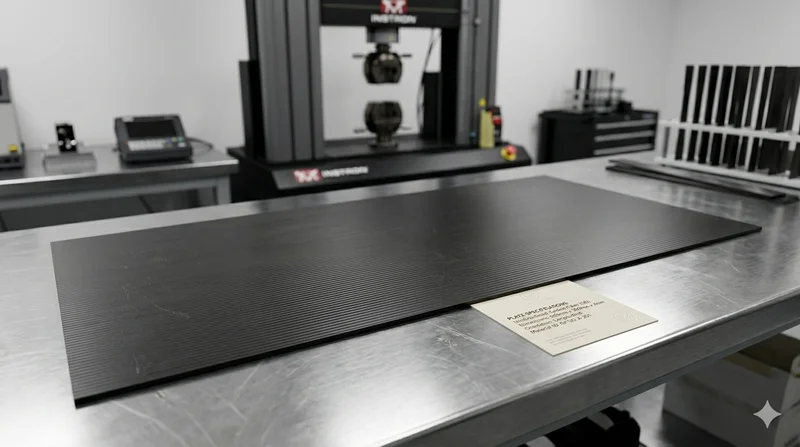
Carbon Fiber Plate — UD Unidirectional T700
Unidirectional carbon fiber plate with all fibers oriented in a single direction for maximum strength along the fiber axis. Essential for structural reinforcements, splints, and applications where load direction is predictable.
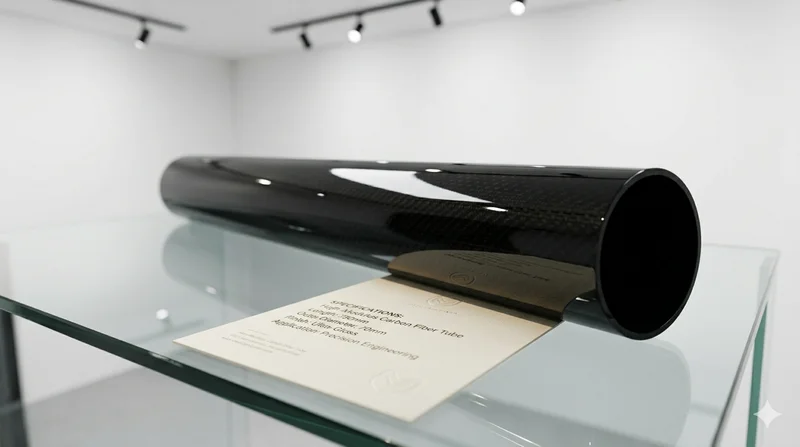
High Modulus Round Carbon Fiber Tube — M40
High modulus round tube manufactured with M40 grade fiber (tensile modulus 400 GPa). Designed for applications where maximum stiffness-to-weight ratio is critical, such as optical systems, precision machinery, and aerospace structures.