
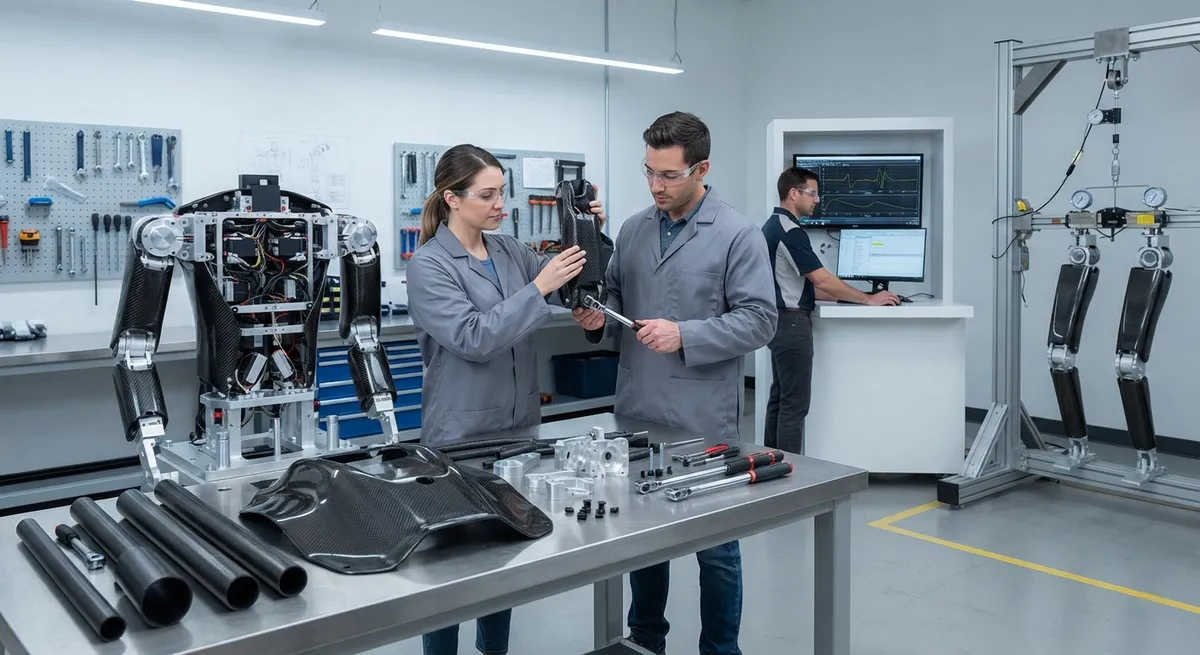
The humanoid robot is no longer a laboratory curiosity. In 2025 and 2026, the world's leading robotics companies — from Figure, Tesla, and Boston Dynamics in the West to Unitree, UBTech, and Fourier in China — moved from single-digit prototype runs to pilot production lines of tens and
Introduction
The humanoid robot is no longer a laboratory curiosity. In 2025 and 2026, the world's leading robotics companies — from Figure, Tesla, and Boston Dynamics in the West to Unitree, UBTech, and Fourier in China — moved from single-digit prototype runs to pilot production lines of tens and hundreds of units. That shift transforms every engineering decision, and none more so than materials. A prototype can be machined from billet aluminum; a product that must be sold at a competitive price, survive years of operation, and carry heavy payloads requires a materials strategy.
Carbon fiber has become central to that strategy. Its combination of high specific stiffness, excellent fatigue behavior, and design freedom makes it the default material for the load-bearing links of humanoid arms and legs, while its ability to be molded into complex shell shapes suits the outer bodywork. This article explains why carbon fiber is appearing in humanoid structures, quantifies the material comparison, and maps the manufacturing routes that make carbon fiber viable for mass production rather than limited to flagship prototypes.
Why Humanoids Need High Stiffness-to-Weight
The fundamental constraint in humanoid robotics is inertia. A robot arm must accelerate, decelerate, and hold position with precision; the heavier each link is, the larger the actuators must be, the more power is consumed, and the more heat is generated. Because actuators, gearboxes, and batteries dominate the budget of a humanoid, every kilogram saved in the structural links compounds: a lighter link allows a smaller motor, which allows a smaller frame, which allows a smaller battery.
This is why stiffness-to-weight ratio, rather than absolute strength, is the primary material metric. A structural arm link must resist bending and twisting under payload, while contributing minimal mass. Carbon fiber composites deliver specific stiffness roughly 3-4 times higher than aluminum and 5-7 times higher than steel, which is why robot designers turn to it as soon as they move past the prototype stage. The tradeoff is cost and manufacturing complexity, which is precisely the problem that volume production must solve.
Carbon Fiber vs. Metals: The Data
The table below compares the materials most commonly considered for humanoid robot structural links and shells. Values are typical ranges for engineering grades:
| Property | Carbon Fiber Laminate (UD, 60% Vf) | Aluminum 6061-T6 | Titanium Ti-6Al-4V | Steel 4340 |
|---|---|---|---|---|
| Tensile strength (MPa) | 1,500-2,500 (fiber direction) | 310 | 950 | 1,200 |
| Tensile modulus (GPa) | 120-160 (fiber direction) | 69 | 114 | 200 |
| Density (g/cm³) | 1.55-1.60 | 2.70 | 4.43 | 7.85 |
| Specific stiffness (GPa per g/cm³) | 75-100 | 25.6 | 25.7 | 25.5 |
| Fatigue behavior | Excellent, no fatigue limit issues in fiber direction | Good, but notch-sensitive | Excellent | Good with heat treatment |
| Design freedom | Moldable to complex shapes | Machined/extruded shapes | Machined, limited shapes | Machined/welded |
| Relative part cost (high volume) | Medium-high | Low | High | Low |
The key column is specific stiffness: carbon fiber's 75-100 GPa per g/cm³ versus roughly 25 for all three metals. A robot link designed to a stiffness requirement — which most precision links are — can be made 3-4 times lighter in carbon fiber, or made stiffer at equal weight. This is the engineering logic that puts carbon fiber in the arms and legs of humanoids rather than reserving it for decorative shells.
Structural Parts in a Humanoid: Where Carbon Goes
Humanoid robots are not uniformly composite. The material map follows load and geometry:
- Upper arm and forearm links: Load-bearing links between shoulder, elbow, and wrist actuators. These are prime carbon fiber candidates — thin-walled tubular or box sections designed for high bending and torsional stiffness at minimal mass.
- Leg links and pelvis: The highest-loaded structure in the robot, carrying the full body mass during gait. Carbon fiber legs reduce the inertia that the hip and knee actuators must overcome, directly improving walking efficiency and payload.
- Wrist, ankle, and end-effector brackets: Complex small parts where carbon fiber's stiffness and low mass help position the payload precisely and reduce end-of-arm inertia.
- Outer shells and covers: Large, thin, doubly-curved panels where composites' moldability, stiffness, and surface quality beat sheet metal and injection-molded plastics at low wall thickness.
- Hand and finger structures: Emerging applications where carbon fiber's combination of stiffness and thin-section capability allows compact, strong finger links.
The balance between carbon fiber and metal in a production humanoid is a cost-driven decision: metals remain in high-load, high-temperature, high-cyclic-stress locations such as gear housings and joint shafts, while carbon fiber takes the structural links and shells where its stiffness-to-weight advantage is decisive.
Manufacturing Routes for Mass Production
The viability of carbon fiber in humanoids depends on manufacturing cost at volume, not just material properties. Four routes dominate:
- Pultrusion and pull-winding: Continuous production of constant cross-section tubes and profiles — ideal for robot arm and leg links. Pultruded carbon tubes are the cheapest high-volume carbon fiber products and are already the backbone of many robot and drone arms.
- Compression molding (SMC/CMT): Sheet molding compound or chopped carbon molding for shells, covers, and brackets, with cycle times of 2-5 minutes per part — competitive with injection molding for large thin panels.
- Prepreg autoclave and out-of-autoclave: Higher-performance laminates for the most stiffness-critical links, at higher cost and longer cycle times; suitable for the structural backbone rather than high-volume parts.
- Filament winding and roll wrapping: Tubes with tailored fiber angles for torsion-critical arm sections, bridging the gap between pultrusion's speed and prepreg's performance.
The mass production economics work when designers standardize: a humanoid platform uses a small set of tube diameters and shell molds repeated across many units. As robot volumes grow from hundreds to tens of thousands of units per year, carbon fiber manufacturing cost per part falls along the same learning curves that brought composites from aerospace to automotive and drone volume.
The Cost Question
Cost remains the central objection to carbon fiber in consumer-scale robotics. A carbon fiber robot arm link can cost 2-5 times an equivalent machined aluminum part at low volumes, but the comparison flips at volume: pultruded tubes are commodity-priced, compression-molded shells amortize tooling over large runs, and the system-level savings from lighter links (smaller actuators, smaller batteries) offset part-level premiums. The economics also favor carbon fiber in humanoids specifically because robots are sold as complete systems — a robot that is 15% lighter and therefore more efficient with the same actuators has a marketable performance advantage, not just a manufacturing cost difference.
For 2026-2027, the realistic production mix is carbon fiber in the high-value stiffness-critical links and shells of premium humanoids, with metals and plastics serving cost-sensitive platforms. As volumes scale and manufacturing routes mature, the carbon fiber share is expected to rise — the same trajectory followed by drones, which moved from aluminum frames to near-total carbon fiber construction within a few years of volume production.
Frequently Asked Questions
Is carbon fiber strong enough for robot arms that carry heavy loads?
Yes, for the loads robots actually carry. A carbon fiber laminate with 1,500-2,500 MPa tensile strength in the fiber direction comfortably exceeds the strength of aluminum and matches high-grade steel on strength while weighing a fraction as much. The more important property for robot links is stiffness: a robot arm must hold position without flexing under payload, and carbon fiber's specific stiffness is 3-4 times aluminum's. The practical limitation is not strength but design — load paths must be oriented along the fiber direction, and connections (bonded inserts, brackets) must be engineered so that local stresses do not exceed the laminate's capabilities. This is standard practice for robot and drone structural design.
Why not just use aluminum, which is cheaper and well understood?
Aluminum is the correct choice in many locations, and every production humanoid uses it somewhere. The reason designers replace aluminum with carbon fiber in specific links is the stiffness-to-weight requirement: at equal stiffness, a carbon fiber link is roughly 3-4 times lighter, and that saving propagates through the whole robot — smaller motors, smaller batteries, lower end-of-arm inertia, and better dynamic performance. Aluminum also suffers from fatigue and notch sensitivity under repeated cyclic loading in thin sections. Carbon fiber wins in the arms, legs, and shells where mass and stiffness dominate; aluminum and steel stay in joints, gear housings, and high-temperature locations. The design decision is per-part, not whole-robot.
Can carbon fiber parts be manufactured cheaply enough for mass-produced humanoid robots?
Yes, if the design is made for the process. Pultruded carbon tubes are already low-cost, high-volume products used across drones and industrial robots, and compression-molded shells reach cycle times competitive with plastic molding. The key is standardization: a robot platform that reuses a small set of tube diameters, profiles, and shell molds across thousands of units can reach carbon fiber part costs in the range that automotive and consumer electronics already achieve with composites. At prototype and pilot volumes, carbon fiber parts are expensive; at the tens-of-thousands-per-year volumes that humanoid programs are planning, the manufacturing routes exist to bring costs down sharply.
Conclusion
Carbon fiber is moving from the showpiece material of humanoid prototypes to the structural material of pilot production. Its decisive advantage — specific stiffness three to four times that of aluminum — directly addresses the inertia problem that dominates robot performance, and its moldability suits the shells and covers that give humanoids their form. The manufacturing routes for volume production already exist: pultrusion for links, compression molding for shells, prepreg for the stiffness-critical backbone. The engineering challenge is not whether to use carbon fiber but where, and the answer is wherever mass and stiffness dominate the design.
For designers selecting materials for robot structures, explore our carbon fiber tubes, plates, and custom composite parts, or contact our engineering team to discuss material selection and manufacturing routes for your humanoid platform.
Related Articles
- Carbon Fiber Tube for Sale: Comparing Listings and Avoiding Bad Specs
- Carbon Fiber Engine Parts: High-Temperature Performance for Racing and Performance Vehicles
- Carbon Fiber Body Parts: Automotive Exterior Panels and Structural Components
- Carbon Fiber Drone Body Manufacturing: Monocoque Design and Production Methods
- Carbon Fiber Drone Parts Supplier: FPV Frames, Arms and Structural Components
- Filament Wound Epoxy Tubes: Industrial Applications from Oil and Gas to Aerospace
Interested in Our Products?
Contact our team for competitive pricing and technical specifications.
Get a QuoteRelated Products

Carbon Fiber Plate — 3K Twill T700 1.5mm
Thin 1.5mm carbon fiber plate with 3K twill weave surface. Lightweight and stiff, commonly used for covers, panels, drone bodies, and applications requiring a premium aesthetic appearance.

Carbon Fiber Plate — 3K Twill T700 3.0mm
Medium-thickness 3.0mm carbon fiber plate offering significantly higher load capacity while maintaining attractive 3K twill finish. Suitable for structural brackets, reinforcement plates, and load-bearing panels.

Square Carbon Fiber Tube — 3K Twill T700
Square cross-section carbon fiber tube manufactured with 3K twill weave for torsional strength. Preferred for structural frames, trusses, and support columns where rectangular geometry offers design flexibility.
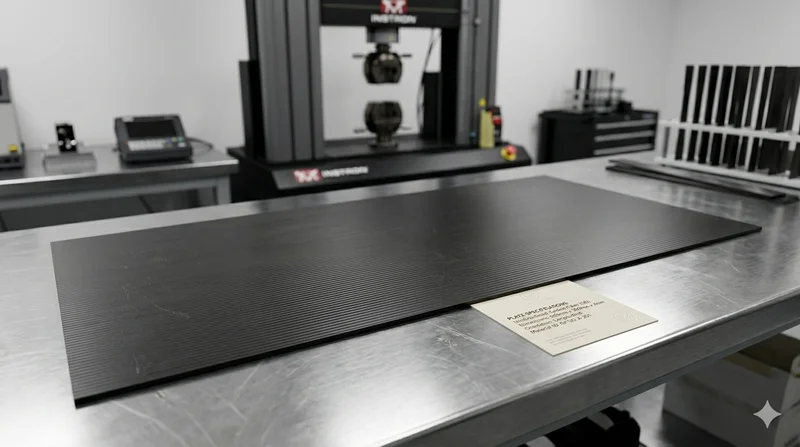
Carbon Fiber Plate — UD Unidirectional T700
Unidirectional carbon fiber plate with all fibers oriented in a single direction for maximum strength along the fiber axis. Essential for structural reinforcements, splints, and applications where load direction is predictable.
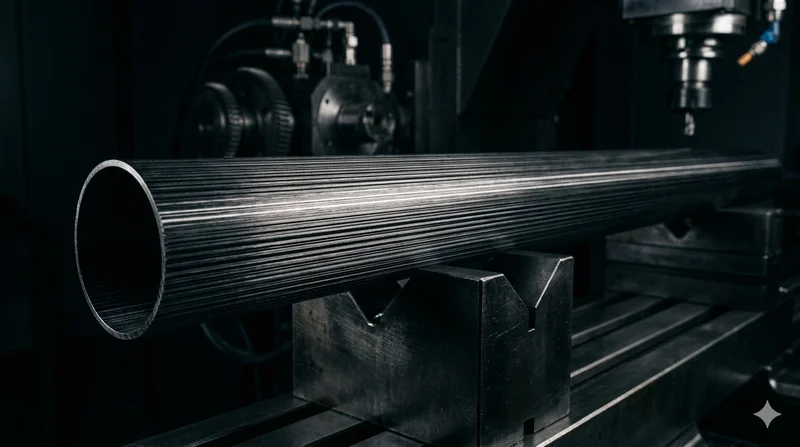
Round Carbon Fiber Tube — UD Unidirectional T700
Unidirectional (UD) round tube with all fibers aligned axially for maximum longitudinal stiffness. Ideal for applications requiring high bending rigidity with minimal weight, such as shafts, struts, and structural reinforcements.