
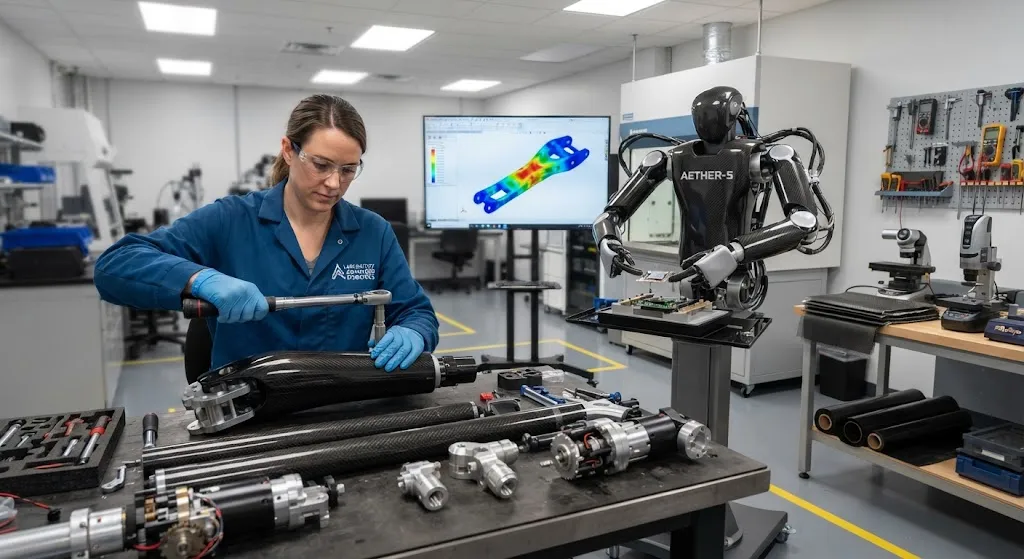
The humanoid robotics industry is transitioning from research prototypes to commercial mass production, with companies like Tesla, Boston Dynamics, Figure AI, and Agility Robotics targeting production volumes of thousands to tens of thousands of units annually. This scale demands a fund
Introduction
The humanoid robotics industry is transitioning from research prototypes to commercial mass production, with companies like Tesla, Boston Dynamics, Figure AI, and Agility Robotics targeting production volumes of thousands to tens of thousands of units annually. This scale demands a fundamental rethinking of structural materials: traditional aluminum and steel components that served well in laboratory prototypes become obstacles to mass production due to their weight, cost, and manufacturing complexity. Carbon fiber composites offer a compelling alternative, providing the stiffness-to-weight ratio needed for dynamic robotic motion while enabling the geometric complexity and production efficiency required for commercial viability.
The unique challenge of humanoid robot structures lies in the combination of requirements: the arm must be stiff enough to maintain positioning accuracy under dynamic loads, light enough to minimize actuator size and energy consumption, durable enough to withstand thousands of hours of operation, and manufacturable at costs that support commercial pricing. Carbon fiber composites address all four requirements simultaneously, making them the material of choice for next-generation humanoid robot arms and actuators.
Structural Requirements for Humanoid Robot Arms
A humanoid robot arm typically comprises six to seven degrees of freedom, with each joint requiring an actuator, structural link, and control electronics. The structural requirements for carbon fiber arm components include:
| Parameter | Requirement | Carbon Fiber Advantage |
|---|---|---|
| Specific stiffness | > 100 GPa/(g/cm³) | Carbon fiber: 170 GPa/(g/cm³) vs aluminum: 26 GPa/(g/cm³) |
| Positioning accuracy | ±0.1 mm at end-effector | High modulus minimizes deflection under load |
| Arm mass | < 3 kg for full arm assembly | 50-60% weight reduction vs aluminum |
| Vibration damping | Settling time < 50 ms | Carbon fiber/epoxy provides inherent damping |
| Cycle life | > 10 million joint cycles | Excellent fatigue resistance under dynamic loading |
| Operating temperature | 0°C to 50°C continuous | Epoxy matrix stable across this range |
The specific stiffness advantage of carbon fiber is the primary driver: at 170 GPa/(g/cm³), carbon fiber provides roughly 6.5 times the stiffness-to-weight ratio of aluminum. This means a carbon fiber arm link can be designed with equivalent stiffness at 40-50% of the aluminum weight, directly reducing the torque requirements for joint actuators and the energy consumption of the robot.
Material Selection and Layup Design
Carbon fiber material selection for humanoid robot arms balances performance, cost, and producibility:
- Fiber type: Intermediate-modulus (IM) carbon fiber (tensile modulus 290-320 GPa) provides the optimal balance of stiffness and strain tolerance for robotic applications. Standard-modulus fiber is insufficient for the stiffness requirements, while high-modulus fiber (370+ GPa) is prohibitively expensive and offers marginal stiffness improvement for the added cost.
- Matrix system: Toughened epoxy systems (e.g., Hexcel 8552, Toray 3900 series) provide the impact resistance and fatigue life needed for dynamic robotic applications. Toughening particles (thermoplastic or rubber) increase damage tolerance without significant modulus reduction.
- Layup architecture: Unidirectional tape or woven fabric, depending on the structural requirement. Unidirectional plies offer maximum stiffness in the primary load direction, while woven fabrics provide better drapability for complex geometries and improved impact resistance.
- Fiber volume fraction: 58-62% typical for autoclave-cured parts, providing optimal mechanical properties while maintaining adequate resin content for fiber wetting and interlaminar strength.
The layup design for a typical arm link uses a quasi-isotropic or near-quasi-isotropic schedule ([0/±45/90]s) to provide balanced stiffness in all directions. For high-performance applications, tailored layups with increased 0° and 90° plies optimize bending stiffness while reducing weight.
Actuator Integration and Joint Design
The integration of carbon fiber structures with robotic actuators presents unique design challenges. The arm links must accommodate motor mounts, bearing housings, cable routing, and sensor installations while maintaining structural integrity:
- Motor mount integration: Actuator mounts are typically co-cured or bonded metallic inserts (aluminum or titanium) that transfer motor torque into the composite structure. The insert design must distribute loads gradually into the laminate to avoid stress concentrations.
- Bearing housing: Joint bearings require precise alignment and retention. Carbon fiber tubes with machined metallic end fittings provide the necessary dimensional accuracy while maintaining lightweight construction.
- Cable and harness routing: Internal channels or surface-mounted guides route motor power cables, encoder signals, and sensor wires along the arm structure. These channels are formed during layup using removable mandrels or post-cure machining.
- End-effector interface: The wrist and hand interfaces require standardized mounting patterns (e.g., ISO 9409-1) with metallic inserts co-cured into the composite structure for repeatable tool changes.
The joint design philosophy for humanoid robots emphasizes modularity: each arm segment is designed as a self-contained module with integrated actuators, sensors, and communication interfaces. This modularity simplifies manufacturing, assembly, and field replacement — critical factors for commercial deployment at scale.
Manufacturing for Mass Production
Transitioning from prototype to mass production requires fundamental changes in carbon fiber manufacturing processes:
| Process | Prototype | Mass Production | Benefit |
|---|---|---|---|
| Curing | Autoclave (hours) | Oven / out-of-autoclave (minutes) | 10x throughput increase |
| Layup | Hand layup | Automated fiber placement / tape laying | Consistency + labor reduction |
| Trimming | CNC machining | Waterjet cutting / die cutting | Faster cycle time |
| Joining | Bonded / bolted | Co-cured assembly | Fewer fasteners + weight reduction |
| Quality | 100% inspection | Statistical process control | Cost reduction + consistency |
Out-of-autoclave (OOA) prepreg systems and resin transfer molding (RTM) are enabling technologies for mass production. OOA prepregs cure in conventional ovens at lower pressures, eliminating the autoclave bottleneck. RTM processes produce near-net-shape parts with minimal machining, reducing material waste and labor content. For high-volume applications exceeding 10,000 units annually, injection molding of short carbon fiber reinforced thermoplastics may become cost-competitive, though with lower mechanical properties than continuous fiber composites.
Performance Validation and Testing
Carbon fiber arm components undergo rigorous testing to validate performance under operational conditions:
- Static testing: Full-scale arm assemblies are loaded to 2x operational torque at each joint, verifying that deflections remain within positioning accuracy requirements and that no structural failure occurs.
- Fatigue testing: Cyclic loading at 1.5x operational torque for 10 million cycles demonstrates durability under continuous robotic operation. Carbon fiber composites typically show negligible stiffness degradation under these conditions.
- Impact testing: Drop-weight impact tests simulate tool drops and collision events, validating that the arm retains structural integrity and functional performance after impact.
- Environmental testing: Thermal cycling, humidity exposure, and chemical resistance testing ensure that the carbon fiber arm maintains performance across the operating environment range.
Cost Analysis and Market Considerations
The economics of carbon fiber for humanoid robot arms depend on production volume and performance requirements:
- Material cost: Carbon fiber prepreg costs approximately $30-50/kg, compared to $5-10/kg for aluminum sheet. However, the weight reduction translates to smaller, less expensive actuators and lower energy consumption over the robot's lifetime.
- Manufacturing cost: Automated layup and OOA curing reduce labor content to competitive levels at volumes exceeding 1,000 units annually. Tooling costs are amortized across production runs.
- System-level savings: A 50% weight reduction in arm mass reduces actuator torque requirements by approximately 40%, enabling smaller, cheaper motors and reducing energy consumption by 25-30% during operation.
- Total cost of ownership: Over a 5-year operational life with 8 hours daily use, the energy savings from lighter arms can offset the material cost premium, making carbon fiber cost-neutral or cost-advantaged at the system level.
Frequently Asked Questions
Why is carbon fiber preferred over aluminum for humanoid robot arms?
Carbon fiber provides approximately 6.5 times the stiffness-to-weight ratio of aluminum, enabling robot arms that are 50-60% lighter while maintaining equivalent positioning accuracy. This weight reduction directly reduces actuator size, energy consumption, and heat generation. Additionally, carbon fiber's inherent vibration damping reduces settling time after rapid movements, improving robot throughput and precision.
What production volumes justify carbon fiber over aluminum for robot arms?
Carbon fiber becomes cost-competitive at production volumes of 500-1,000 units annually when considering total system costs (actuators, energy, maintenance). At volumes below 500 units, aluminum may be more economical on a per-part basis. Above 1,000 units, automated carbon fiber manufacturing processes reduce per-part costs while the system-level benefits of weight reduction accumulate across the production fleet.
How are carbon fiber arm components joined to metallic actuator mounts?
Carbon fiber arm components are typically joined to metallic actuator mounts using co-cured or secondary-bonded inserts. The inserts feature mechanical interlocking features (flanges, knurling) combined with structural adhesive bonding to distribute loads from the metallic mount into the composite laminate. This hybrid approach provides the fatigue resistance of adhesive bonding with the pull-out strength of mechanical fastening.
Conclusion
Carbon fiber composites are poised to become the structural material of choice for commercial humanoid robot arms, driven by the need for lightweight, high-stiffness components that enable precise dynamic motion. The 6.5x stiffness-to-weight advantage over aluminum translates directly into smaller actuators, lower energy consumption, and improved robot performance. Manufacturing technologies — out-of-autoclave curing, automated fiber placement, and resin transfer molding — are enabling mass production at costs competitive with aluminum when system-level benefits are considered. As humanoid robot production scales to thousands of units annually, carbon fiber arms will be a key differentiator in performance, efficiency, and total cost of ownership.
YongXian supplies high-performance carbon fiber fabrics and prepregs for robotic and automation applications. Explore our composite material solutions or contact our engineering team to discuss carbon fiber systems for your humanoid robot program.
Part of topic
Related Articles
- Carbon Fiber Mooring for Floating Offshore Wind: Fatigue and Corrosion in Deep Water
- Carbon Fiber Bicycle Frame Optimization: Layup Design and Manufacturing for Competitive Racing
- Carbon Fiber CFRP Retrofit for Infrastructure: Bridge and Building Seismic Strengthening
- Carbon Fiber Medical Imaging Equipment: Lightweight Gantry and Couch Structures for MRI/CT
- Carbon Fiber EV Battery Enclosures: Crash Safety and Electromagnetic Shielding Design
- Carbon Fiber Structures for Low-Altitude Economy: UAV Airframes and eVTOL Components
Interested in Our Products?
Contact our team for competitive pricing and technical specifications.
Get a QuoteRelated Products

Carbon Fiber Plate — 3K Twill T700 3.0mm
Medium-thickness 3.0mm carbon fiber plate offering significantly higher load capacity while maintaining attractive 3K twill finish. Suitable for structural brackets, reinforcement plates, and load-bearing panels.

Carbon Fiber Plate — 3K Twill T700 1.5mm
Thin 1.5mm carbon fiber plate with 3K twill weave surface. Lightweight and stiff, commonly used for covers, panels, drone bodies, and applications requiring a premium aesthetic appearance.

Square Carbon Fiber Tube — 3K Twill T700
Square cross-section carbon fiber tube manufactured with 3K twill weave for torsional strength. Preferred for structural frames, trusses, and support columns where rectangular geometry offers design flexibility.
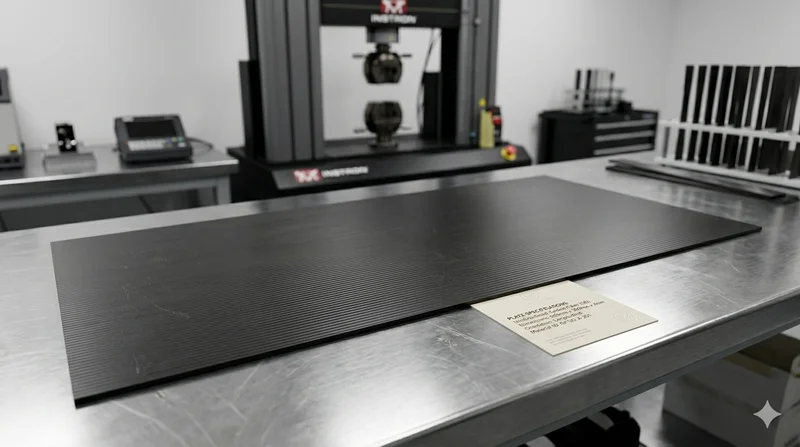
Carbon Fiber Plate — UD Unidirectional T700
Unidirectional carbon fiber plate with all fibers oriented in a single direction for maximum strength along the fiber axis. Essential for structural reinforcements, splints, and applications where load direction is predictable.
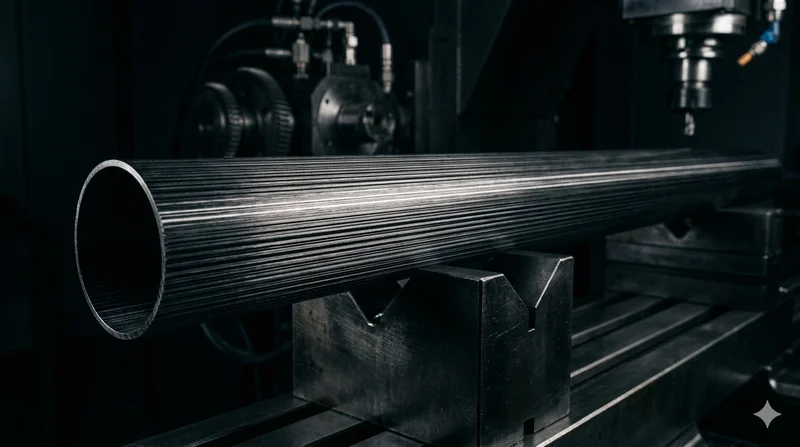
Round Carbon Fiber Tube — UD Unidirectional T700
Unidirectional (UD) round tube with all fibers aligned axially for maximum longitudinal stiffness. Ideal for applications requiring high bending rigidity with minimal weight, such as shafts, struts, and structural reinforcements.