
The carbon fiber industry is entering a decade of demand acceleration driven by three converging forces: the global energy transition pushing wind turbine blade lengths beyond 100 meters, automotive lightweighting mandates intensifying as electric vehicle range requirements tighten, and aerospace pr
Introduction
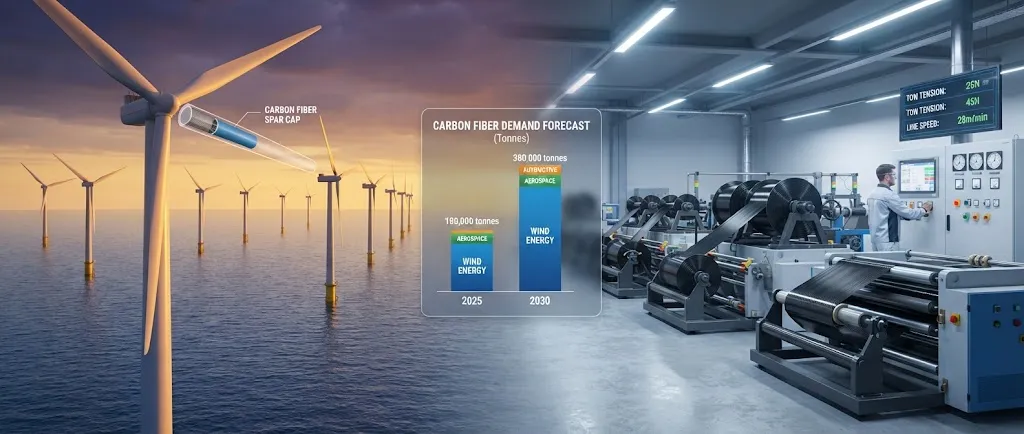
The carbon fiber industry is entering a decade of demand acceleration driven by three converging forces: the global energy transition pushing wind turbine blade lengths beyond 100 meters, automotive lightweighting mandates intensifying as electric vehicle range requirements tighten, and aerospace production rates recovering to and exceeding pre-pandemic levels. Current global demand sits at approximately 180,000-200,000 tonnes in 2025, and multiple independent forecasts converge on 350,000-400,000 tonnes by 2030 — a doubling in five years that will stress every segment of the supply chain from PAN precursor to finished composite parts.
For procurement managers, material engineers, and strategic planners in the carbon fiber value chain, understanding which sectors will absorb this growth, where capacity bottlenecks will emerge, and how pricing will respond is essential for making sourcing decisions today that remain competitive through 2030. This article provides a sector-by-sector demand breakdown, evaluates the manufacturing capacity expansions underway, and analyzes the pricing dynamics that will govern the market through the end of the decade.
Demand Forecast by End-Use Sector
The 2030 demand projection of 350,000-400,000 tonnes is distributed across five major end-use sectors, each with distinct growth drivers and volume trajectories:
| Sector | 2025 Demand (tonnes) | 2030 Forecast (tonnes) | CAGR | Key Driver |
|---|---|---|---|---|
| Wind energy | 65,000-75,000 | 159,000-175,000 | 17-19% | Blade length growth beyond 100m |
| Aerospace | 45,000-50,000 | 72,000-82,000 | 10-11% | A320neo/B737 MAX rate ramp |
| Automotive | 28,000-32,000 | 52,000-60,000 | 12-14% | EV range optimization mandates |
| Industrial / sporting goods | 25,000-28,000 | 38,000-42,000 | 8-9% | Pressure vessels, robotics, medical |
| Other (marine, construction, defense) | 12,000-15,000 | 22,000-28,000 | 12-15% | Infrastructure, naval, hydrogen |
Wind energy dominates the forecast, accounting for approximately 43-46% of total demand by 2030. The driver is blade length: as offshore turbines reach 15-20 megawatt ratings, blade lengths exceed 110-120 meters, and the structural spar cap — the primary load-bearing element — increasingly requires carbon fiber to maintain stiffness without prohibitive weight. A single 120-meter offshore blade contains 25-35 tonnes of carbon fiber in the spar cap alone, and global installations are projected to reach 35-40 gigawatts annually by 2030.
Wind Energy: The Dominant Growth Engine
The wind energy sector's carbon fiber demand is growing faster than any other segment because blade aerodynamics have reached a physical inflection point. Fiberglass spar caps on blades exceeding 80 meters suffer excessive deflection under wind load, requiring impractically thick cross-sections that add mass and reduce energy capture. Carbon fiber, with its three-to-four times higher specific stiffness, enables spar caps that are 40-60% lighter at equivalent stiffness, keeping blade deflection within the clearance envelope of the tower.
The adoption curve is steepening. In 2020, carbon fiber appeared in approximately 15% of new installed wind capacity, primarily in offshore and high-wind onshore sites. By 2025, that share has grown to 30-35%, and by 2030, industry analysts project 50-60% of new installed capacity will use carbon fiber spar caps. The 159,000-tonne forecast assumes 55% adoption across an estimated 35-40 gigawatts of annual installations, with offshore wind contributing roughly 60% of the carbon fiber volume despite representing only 25-30% of installed capacity by gigawatts — because offshore blades are larger and contain more carbon fiber per blade.
Supply chain implications are significant. Wind energy buyers currently source 70-80% of their carbon fiber from large-tow (24K-50K) grades at 10-18 dollars per kilogram, a price point that is only viable because wind energy manufacturers have negotiated long-term contracts with volume commitments. The shift to larger turbines accelerates demand for 24K and 48K tow sizes, straining capacity at producers who have historically focused on smaller, higher-margin aerospace tows.
Aerospace Recovery and New Platform Demand
Aerospace carbon fiber demand is recovering from the pandemic-era production cuts and is projected to reach 72,000-82,000 tonnes by 2030 as single-aisle production rates climb. The Airbus A320neo family is targeting a rate of 75 aircraft per month by 2027, and the Boeing 737 MAX is aiming for 50 per month — combined, these two programs alone will consume approximately 15,000-18,000 tonnes of carbon fiber annually by 2030, compared to roughly 12,000 tonnes in 2019.
Beyond the narrowbody ramp, new aircraft programs entering design and detail design phases add demand that will materialize in the 2028-2032 timeframe. The next-generation single-aisle replacements, expected to enter service around 2035, are designed with composite primary structures that will require 50-55% composite content by weight, up from 20-23% on current-generation aluminum-intensive narrowbodies. These programs are locked in for carbon fiber demand even if production rates remain conservative, because the composite content per aircraft is structurally higher.
Automotive Lightweighting for Electric Vehicles
Electric vehicle lightweighting is the fastest-growing automotive carbon fiber application because every kilogram of body weight reduction translates directly into 0.5-0.8 kilometers of additional driving range. As regulatory mandates in the European Union, China, and the United States push minimum EV range requirements toward 500-600 kilometers, automakers are evaluating carbon fiber for battery enclosures, structural cross-members, and body-in-white panels where weight savings are most impactful.
The volume opportunity lies in semi-structural and interior structural components — seat structures, door modules, instrument panel beams — rather than full carbon fiber body panels, which remain cost-prohibitive at current carbon fiber pricing for mass-market vehicles. Semi-structural applications use chopped or discontinuous carbon fiber in injection molding or compression molding processes, consuming 3-8 kilograms per vehicle at material costs that can be justified by range improvement and battery cost reduction. With global EV production projected at 40-45 million vehicles annually by 2030, even modest per-vehicle carbon fiber content produces significant aggregate demand.
Supply Chain Capacity Expansion
The supply side is responding to the demand forecast with significant capacity expansion, but the timing and scale of additions will determine whether the market tightens or loosens through 2030:
- Chinese producers: Zhongfu Shenying, Guangwei Composites, Jilin Carbon Valley, and Sinopec are collectively adding 60,000-80,000 tonnes of new PAN-based carbon fiber capacity between 2024 and 2028, primarily targeting the 24K-50K large-tow wind energy and industrial grades. If all announced projects reach full production, Chinese capacity alone could approach 120,000-140,000 tonnes by 2028.
- Japanese incumbents: Toray, Mitsubishi Chemical, and Toho Tenax are expanding incrementally, adding 15,000-20,000 tonnes of capacity focused on aerospace and high-performance industrial grades. Their strategy prioritizes margin over volume, targeting the 20-30 dollars per kilogram price band for intermediate-modulus and high-strength grades.
- Emerging producers: New entrants in India (Adani Group), Turkey, and the Middle East are announced but face 3-5 year timelines from announcement to qualified production, making meaningful volume contribution unlikely before 2028.
The net effect is a market that tightens through 2026-2027 as demand growth outpaces new capacity qualification, then potentially loosens in 2028-2030 as Chinese large-tow capacity fully ramps. Pricing is expected to remain firm in the 12-20 dollars per kilogram range for industrial grades through 2027, with potential softening of 5-10% in 2029-2030 as new capacity comes online.
Procurement Strategy Implications
The demand forecast has three immediate implications for procurement strategy. First, long-term contracts with volume commitments for large-tow wind energy grades should be secured before 2027, as the supply-demand balance tightens and producers prioritize customers with guaranteed off-take. Second, qualification of alternative suppliers — particularly Chinese producers for industrial grades — provides both supply security and pricing leverage against incumbent Japanese suppliers. Third, recycled carbon fiber from pyrolysis processing represents a growing supply source that can supplement virgin fiber in applications where 90-95% tensile strength retention is acceptable, with current market pricing 30-60% below virgin material.
Frequently Asked Questions
Will carbon fiber supply be sufficient to meet the 2030 demand forecast of 350,000-400,000 tonnes?
Supply adequacy depends on the pace of Chinese capacity ramp-up. If the 60,000-80000 tonnes of announced Chinese expansion reaches full qualified production by 2028, combined with steady Japanese and emerging producer output, total global capacity could reach 450,000-500,000 tonnes by 2030, providing adequate headroom above the 350,000-400,000 tonne demand forecast. However, capacity announcement to qualified production typically takes 2-4 years, and qualification failures or delays are common. The more likely scenario is a tight market through 2027, followed by gradual loosening in 2028-2030 as new capacity comes online and qualifies. Buyers who lock in supply before 2027 will be best positioned.
How will carbon fiber pricing evolve through 2030?
Pricing will bifurcate by grade and application. Large-tow industrial grades (24K-50K) for wind energy and automotive applications are expected to remain in the 10-18 dollars per kilogram range through 2027, with potential softening to 9-15 dollars per kilogram in 2029-2030 as Chinese capacity ramps. Small-tow aerospace grades (3K-12K) will remain in the 25-80 dollars per kilogram range with limited price pressure, because aerospace qualification barriers prevent substitution with lower-cost alternatives. Intermediate-modulus grades used in high-performance sporting goods and pressure vessels will track between these ranges at 18-35 dollars per kilogram, with pricing driven by specific grade availability rather than bulk market dynamics.
Which regions will see the strongest carbon fiber demand growth through 2030?
Asia-Pacific, led by China, will account for 55-60% of global demand growth through 2030, driven by domestic wind energy installations (China alone is projected to add 80-100 gigawatts of wind capacity annually), rapid EV adoption, and expanding aerospace manufacturing. Europe will contribute 20-25% of growth, driven by offshore wind in the North Sea and Baltic, and stringent automotive CO2 regulations. North America will account for 15-20%, with aerospace production rate increases as the primary driver. The Middle East and India represent emerging demand centers but will remain below 5% of global total through 2030.
Conclusion
The global carbon fiber market is on a trajectory to double from approximately 180,000-200,000 tonnes in 2025 to 350,000-400,000 tonnes by 2030, with wind energy accounting for nearly half of the growth. This demand surge will strain supply chains, particularly for large-tow industrial grades, creating both risks and opportunities for buyers across the value chain. Securing long-term supply contracts, qualifying alternative suppliers including Chinese producers, and evaluating recycled carbon fiber as a supplementary material source are the three highest-priority procurement actions for organizations positioning themselves for the 2030 market.
To discuss carbon fiber supply strategies and material availability for your application, explore our carbon fiber product range, or contact our sales team for volume pricing and lead time information.
Part of topic
Related Articles
- Brazil Carbon Fiber Market 2026: Embraer Aerospace and Bioenergy Demand
- Taiwan Carbon Fiber Market 2026: Bicycle Export Leadership and Semiconductor Equipment
- Mexico Carbon Fiber Market 2026: Aerospace Nearshoring and USMCA Benefits
- Japan Carbon Fiber Market 2026: Toray, Teijin, and Mitsubishi Chemical Global Strategy
- Europe Carbon Fiber Market Share 2026: Aerospace Leadership and Wind Energy Transition
- Türkiye Carbon Fiber Market 2026: Defense Aviation and KAAN Fighter Program
Interested in Our Products?
Contact our team for competitive pricing and technical specifications.
Get a QuoteRelated Products

Carbon Fiber Fishing Rod Blank
High-quality carbon fiber fishing rod blank manufactured from multiple grades of Toray carbon fiber cloth. Available in a wide range of lengths, powers, and actions for freshwater and saltwater applications. Suitable for OEM rod building.

Carbon Fiber Plate — 3K Twill T700 1.5mm
Thin 1.5mm carbon fiber plate with 3K twill weave surface. Lightweight and stiff, commonly used for covers, panels, drone bodies, and applications requiring a premium aesthetic appearance.

Carbon Fiber Plate — 3K Twill T700 3.0mm
Medium-thickness 3.0mm carbon fiber plate offering significantly higher load capacity while maintaining attractive 3K twill finish. Suitable for structural brackets, reinforcement plates, and load-bearing panels.

Carbon Fiber Trekking Pole
Lightweight carbon fiber trekking pole manufactured from high-grade carbon fiber tube. Weighs only 160g per pole while providing superior shock absorption and durability for hiking, trail running, and backpacking.

Square Carbon Fiber Tube — 3K Twill T700
Square cross-section carbon fiber tube manufactured with 3K twill weave for torsional strength. Preferred for structural frames, trusses, and support columns where rectangular geometry offers design flexibility.