
Brazil stands as Latin America's largest economy and the world's third-largest aircraft manufacturer through Embraer, creating a unique carbon fiber market that combines aerospace precision requirements with large-scale industrial applications. The country's carbon fiber consumption is estimated at
Introduction
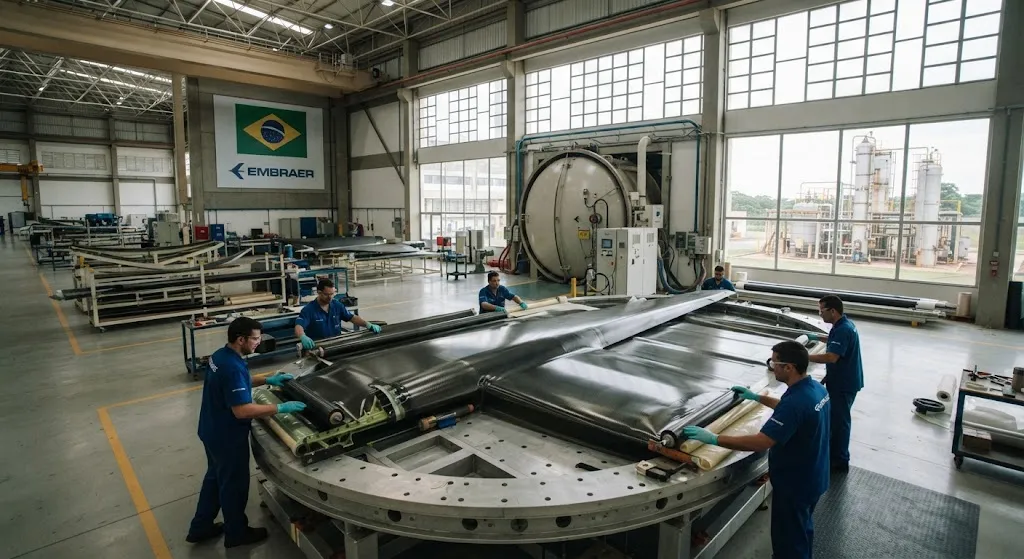
Brazil stands as Latin America's largest economy and the world's third-largest aircraft manufacturer through Embraer, creating a unique carbon fiber market that combines aerospace precision requirements with large-scale industrial applications. The country's carbon fiber consumption is estimated at 3,500-4,500 metric tons in 2026, with aerospace accounting for approximately 40% of total demand — the highest aerospace share of any national market outside the United States, Europe, and Japan. This concentration reflects Embraer's dominance: the company delivered 66 aircraft in 2025 and has order backlogs exceeding 1,000 units, with the E-Jets E2 family requiring approximately 300-500 kg of carbon fiber composite per aircraft.
Beyond aerospace, Brazil's bioenergy sector — the world's largest ethanol producer and a growing force in sustainable aviation fuel (SAF) — is creating new demand for carbon fiber in process equipment, turbine components, and composite infrastructure. The country's mining sector, the world's largest iron ore exporter, adds further industrial demand through exploration equipment and structural applications. This article maps Brazil's carbon fiber landscape across these three demand pillars, examining supply chain structures, import dependencies, and opportunities for international carbon fiber suppliers.
Embraer's Aerospace Supply Chain
Embraer is the anchor customer for Brazil's carbon fiber market, with procurement requirements that ripple through a network of tier-1, tier-2, and tier-3 suppliers across São Paulo state. The company's composite utilization has increased steadily as the E-Jets E2 program replaces the first-generation E-Jets:
| Aircraft Program | Composite Content (% by weight) | Carbon Fiber per Aircraft (kg) | Annual Production Rate |
|---|---|---|---|
| E175-E2 | 18% | ~300 | 45-60 per year |
| E190-E2 | 22% | ~400 | 60-80 per year |
| E195-E2 | 24% | ~500 | 40-55 per year |
| C-390 Millennium | 15% | ~800 | 8-12 per year |
Embraer's procurement strategy sources carbon fiber prepreg and dry fabric primarily from global suppliers — Toray, Hexcel, and Solvay (now Syensqo) maintain dedicated supply agreements — while Brazilian fabricators including GDC (Grupo de Componentes), Atech (a subsidiary of Embraer's defense division), and AEL Sistemas handle layup, curing, and assembly. The company has signaled interest in developing domestic carbon fiber precursor capability through partnerships with Brazilian chemical companies, though no production facility has been announced as of 2026.
The supply chain challenge for international suppliers lies in Embraer's qualification requirements: all materials must pass the company's internal Material Specification (MS) testing, which includes not only standard aerospace tests (ASTM D3039 for tensile, ASTM D3518 for in-plane shear) but also Embraer-specific environmental exposure cycles calibrated to Brazilian tropical and coastal operating conditions. Qualification typically takes 18-24 months from initial sampling to production approval.
Bioenergy and Sustainable Aviation Fuel
Brazil's position as the world's second-largest ethanol producer (after the United States) and the leader in sugarcane-based ethanol creates a unique intersection with carbon fiber applications. The bioenergy sector drives demand through three channels:
- Ethanol processing equipment: Modern sugarcane ethanol refineries use centrifuges, heat exchangers, and distillation columns where carbon fiber composite components reduce weight and improve corrosion resistance in the presence of acidic fermentation byproducts. Brazil's ethanol industry operates over 400 mills, with 15-20% upgrading processing equipment annually.
- Biomass power generation: Bagasse-fired power plants and biomass cogeneration facilities use large-diameter fans, ducting, and turbine components where carbon fiber composites offer weight and fatigue advantages over steel. Brazil's biomass power capacity exceeds 15 GW, with ongoing modernization of aging facilities.
- Sustainable aviation fuel (SAF): Brazil is investing heavily in SAF production from ethanol-derived ethanol-to-jet (ETJ) pathways. SAF production facilities require corrosion-resistant process equipment, and the carbon fiber industry benefits from the broader aviation supply chain development that SAF infrastructure stimulates.
The bioenergy connection also creates a policy advantage: Brazil's RenovaBio program, which sets carbon credit incentives for low-carbon fuels, has indirectly encouraged the adoption of lightweight composite materials in bioenergy infrastructure as mills seek to minimize their overall carbon footprint to maximize carbon credit generation.
Mining and Heavy Industry
Brazil's mining sector, dominated by Vale and a constellation of mid-tier producers, creates industrial demand for carbon fiber through equipment and infrastructure applications. While mining is traditionally a steel-intensive industry, several applications favor carbon fiber composites:
- Exploration and drilling equipment: Carbon fiber drill rods and exploration core tubes reduce weight in remote field operations, improving logistics efficiency in the Amazon and Cerrado regions where most Brazilian mining occurs.
- Conveyor and processing systems: Carbon fiber-reinforced pulleys, idlers, and structural frames reduce rotational inertia and maintenance requirements in high-throughput mineral processing plants.
- Offshore mining support: Brazil's pre-salt offshore oil and gas operations (Petrobras and partners) use carbon fiber risers, umbilicals, and structural components that share technology with deepwater mining applications.
Mining demand is volume-limited but high-value: the harsh operating environments (high humidity, acidic process streams, abrasive materials) create performance requirements that favor premium carbon fiber products over lower-cost alternatives.
Import Dependencies and Trade Structure
Brazil does not produce carbon fiber precursor (PAN) or finished carbon fiber at commercial scale, creating a structural import dependency. The trade structure reveals key supply chain relationships:
| Product Category | Primary Suppliers | 2025 Import Value (est.) | Growth Trend |
|---|---|---|---|
| Carbon fiber tow and fabric | Toray (Japan), Hexcel (USA), SGL (Germany) | $85-110 million | +8-12% annually |
| Prepreg and intermediate materials | Solvay/Syensqo, Toray, Hexcel | $45-65 million | +10-15% annually |
| Composite structures and components | Domestic fabricators (GDC, Atech) | $25-35 million (value-added) | +5-8% annually |
Import tariffs on carbon fiber products range from 0-14% depending on the HS code classification, with aerospace-grade materials often qualifying for reduced duties under Brazil's industrial policy programs (including the PRODECI program for aerospace development). The tariff structure incentivizes domestic value-added processing rather than raw material import, which has driven the growth of Brazilian fabricators who import prepreg and produce finished composite structures.
Opportunities for International Suppliers
The Brazilian carbon fiber market offers several strategic opportunities for international suppliers willing to invest in the market:
- Embraer supply chain participation: Qualification as an approved supplier to Embraer provides access to a growing aerospace market with committed production rates through 2035. The 18-24 month qualification timeline requires upfront investment but creates long-term supply relationships.
- Bioenergy equipment partnerships: Collaborating with Brazilian ethanol mill operators and equipment manufacturers to develop composite solutions for processing equipment creates a differentiated market position that leverages Brazil's unique industrial structure.
- Distribution and technical support: Establishing local inventory and technical support capabilities reduces lead times for Brazilian fabricators who currently wait 8-12 weeks for imported materials, creating competitive advantage through service rather than price.
- Local production feasibility: As Brazil's carbon fiber demand approaches 5,000 metric tons per year, the economic case for local sizing, fabric, or even precursor production becomes increasingly viable, particularly if supported by Brazilian government incentive programs.
The key success factor is understanding that Brazil's carbon fiber market is relationship-driven: Embraer's qualification requirements, the close-knit nature of the Brazilian aerospace community, and the importance of Portuguese-language technical support all favor suppliers who invest in long-term market presence rather than transactional sales approaches.
Frequently Asked Questions
How does Brazil's carbon fiber consumption compare to other Latin American countries?
Brazil accounts for approximately 70-75% of Latin America's total carbon fiber consumption, with Mexico (driven by aerospace nearshoring from the US) accounting for another 15-20%. The remaining 5-10% is distributed across Argentina, Chile, and Colombia, where demand is primarily in wind energy and mining applications. Brazil's dominance reflects both its larger industrial base and the presence of Embraer as a committed anchor customer, which has created a supplier ecosystem that no other Latin American country matches.
What is Embraer's long-term carbon fiber procurement outlook?
Embraer's order backlog of over 1,000 E-Jets E2 aircraft represents approximately 5-7 years of production at current rates, providing high visibility into carbon fiber demand through at least 2032. The company's C-390 military transport program is ramping production from 8 to 12+ aircraft per year, adding approximately 6,400-9,600 kg of annual carbon fiber demand. Beyond these programs, Embraer's Urban Air Mobility division (Eve Air Mobility) is developing eVTOL aircraft that will require carbon fiber composite structures, though production volumes and timelines remain uncertain as of 2026.
Are there Brazilian carbon fiber manufacturers or only importers and fabricators?
As of 2026, Brazil has no domestic carbon fiber fiber production (no PAN precursor or fiber spinning facilities). However, several companies operate as fabricators and converters: GDC (Grupo de Componentes) operates prepregging and autoclave capacity in São José dos Campos; Atech provides composites manufacturing for Embraer's defense division; and a growing number of smaller firms serve the industrial and sporting goods markets. The Brazilian Development Bank (BNDES) has signaled interest in supporting domestic carbon fiber production as part of strategic materials policy, but no concrete investment decisions have been announced.
Conclusion
Brazil's carbon fiber market is defined by the concentration of demand in aerospace (through Embraer), bioenergy (through ethanol and SAF infrastructure), and mining (through industrial equipment), creating a specialized but growing market of 3,500-4,500 metric tons annually. The country's import dependency for carbon fiber materials creates both challenge and opportunity: challenge because supply chain lead times and qualification barriers favor established global suppliers, opportunity because the growing demand base supports new market entrants who invest in local presence, technical support, and long-term customer relationships.
For international carbon fiber suppliers, Brazil represents a market where relationship investment and technical capability matter more than price competition. The 18-24 month Embraer qualification process, the specialized requirements of bioenergy applications, and the Portuguese-language technical support needs all create barriers to entry that reward committed, long-term market participants. Explore our carbon fiber product range or contact our team to discuss supply opportunities for the Brazilian aerospace and industrial markets.
Part of topic
Related Articles
- Taiwan Carbon Fiber Market 2026: Bicycle Export Leadership and Semiconductor Equipment
- Global Carbon Fiber Demand Forecast 2030: 159,000+ Tonnes for Wind Energy Alone
- Mexico Carbon Fiber Market 2026: Aerospace Nearshoring and USMCA Benefits
- Japan Carbon Fiber Market 2026: Toray, Teijin, and Mitsubishi Chemical Global Strategy
- Europe Carbon Fiber Market Share 2026: Aerospace Leadership and Wind Energy Transition
- Türkiye Carbon Fiber Market 2026: Defense Aviation and KAAN Fighter Program
Interested in Our Products?
Contact our team for competitive pricing and technical specifications.
Get a QuoteRelated Products

Carbon Fiber Fishing Rod Blank
High-quality carbon fiber fishing rod blank manufactured from multiple grades of Toray carbon fiber cloth. Available in a wide range of lengths, powers, and actions for freshwater and saltwater applications. Suitable for OEM rod building.

Carbon Fiber Plate — 3K Twill T700 1.5mm
Thin 1.5mm carbon fiber plate with 3K twill weave surface. Lightweight and stiff, commonly used for covers, panels, drone bodies, and applications requiring a premium aesthetic appearance.

Carbon Fiber Plate — 3K Twill T700 3.0mm
Medium-thickness 3.0mm carbon fiber plate offering significantly higher load capacity while maintaining attractive 3K twill finish. Suitable for structural brackets, reinforcement plates, and load-bearing panels.

Carbon Fiber Trekking Pole
Lightweight carbon fiber trekking pole manufactured from high-grade carbon fiber tube. Weighs only 160g per pole while providing superior shock absorption and durability for hiking, trail running, and backpacking.

Square Carbon Fiber Tube — 3K Twill T700
Square cross-section carbon fiber tube manufactured with 3K twill weave for torsional strength. Preferred for structural frames, trusses, and support columns where rectangular geometry offers design flexibility.