
Geothermal energy has a corrosion problem that most renewable technologies never have to face. Wind turbines and solar panels sit in air; geothermal wells pump up brine at temperatures above 150 degrees Celsius, saturated with chlorides, carbon dioxide and hydrogen sulfide. Every meter
Introduction
Geothermal energy has a corrosion problem that most renewable technologies never have to face. Wind turbines and solar panels sit in air; geothermal wells pump up brine at temperatures above 150 degrees Celsius, saturated with chlorides, carbon dioxide and hydrogen sulfide. Every meter of pipe that touches that fluid is fighting chemistry as much as pressure. In the geothermal belts of Turkey, Kenya, Iceland and Indonesia, steel casing failures have historically set the replacement schedule for wells and surface lines, and the corrosion cost is one of the reasons geothermal levelized costs are still discussed as a barrier to expansion.
Composite pipe made from glass fiber and epoxy resin — produced by the same filament-winding process used for carbon fiber drive shafts and pressure vessels — does not have this corrosion problem at all. Glass-reinforced epoxy, or GRE, has been used for decades in oilfield brine handling, and it is now moving into geothermal service in two distinct roles: downhole casing in corrosive wells, and surface piping in brine loops and district heating networks. This article explains the material limits that actually apply, the installation practice that makes composite casing viable, and the economics that determine whether a geothermal developer reaches for steel or for composite pipe.
What Geothermal Fluids Do to Steel
The failure mechanism starts with brine chemistry, not pressure. Geothermal fluids in volcanic-hosted fields carry chlorides at concentrations of tens of thousands of milligrams per liter, dissolved carbon dioxide that drops the pH toward 4-5, and hydrogen sulfide that attacks carbon steel through sulfide stress cracking. The conventional answer — corrosion inhibitors, coatings and heavier wall sections — adds cost and inspection burden and still loses on the well life that operators plan for. The table below summarizes how GRE casing compares with carbon steel on the properties that matter in geothermal service:
| Property | Carbon steel casing (L80 class) | GRE composite casing |
|---|---|---|
| Corrosion resistance in hot brine | Needs inhibitors, coatings and monitoring | Inherently inert, no inhibitors required |
| Density | 7.85 g/cm3 | ~1.9-2.1 g/cm3 |
| Weight per meter, 7-inch nominal | ~43 kg | ~11-13 kg |
| Usable temperature | Beyond 250 degrees C | 110-150 degrees C epoxy; special grades to ~180 degrees C |
| Thermal conductivity | ~43 W/mK | ~0.3-0.5 W/mK |
| H2S / sour service behavior | Sulfide stress cracking risk | Immune |
Two rows of that table explain most of the adoption story. The weight row matters because casing is installed in strings that must be run and re-run; a GRE string is less than one third the weight of the equivalent steel string, which relaxes rig and wellhead load limits. The corrosion row matters because in the deepest, hottest wells the steel option simply requires an engineered corrosion-control program for the life of the well, while the composite option removes the problem at the material level.
Where Composite Casing Fits in the Well
Composite casing is not a universal replacement for steel downhole. The epoxy matrix limits service temperature to roughly 110-150 degrees Celsius for standard grades, with specialized resin systems pushing toward 180 degrees, which confines the material to moderate-temperature wells or to the upper, cooler sections of deep wells. Within that envelope, GRE casing is used for production casing, injection casing and the liner sections where the fluid is hottest in the wellhead sense — and the pressure classes available from filament-wound pipe, typically 20-200 bar depending on diameter, cover the well pressures of the moderate-temperature fields that dominate the development pipeline in Turkey and Kenya.
Installation practice is where composite casing wins or loses. GRE casing runs as a jointed string with threaded or adhesive-bonded connections, and the lightweight sections allow faster running and smaller handling equipment. The low thermal conductivity also reduces heat loss in the upper wellbore, which sounds like a small effect but matters in wells that are drilled to supply direct-use heat rather than power generation. The practical constraint is downhole temperature spikes and thermal cycling: designers derate the pipe where a well is expected to produce hot flashes, and reserve steel for the highest-enthalpy wells where the envelope is exceeded.
District Heating and Surface Brine Lines
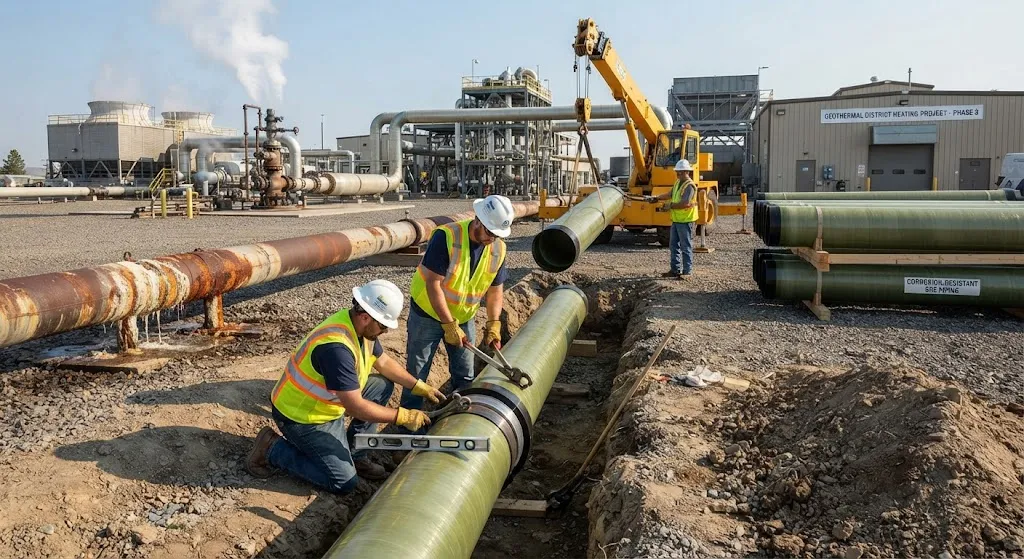
On the surface, GRE pipe is most visible in two applications: brine transfer and injection lines running between wells and power plants, and segments of district heating networks where the soil chemistry or the heat-carrier chemistry defeats steel. District heating in its standard form uses pre-insulated steel pipe buried below ground, and it performs well for decades in benign soils. The failures concentrate where the ground water is aggressive, where the network carries brine directly, or where a corrosive leak is a recurring event. Composite pipe removes the buried-metal problem: the glass and epoxy system cannot rust, and its smooth interior keeps scaling and biofilm formation lower than steel.
- Brine and injection lines: GRE pipe carries the cooled brine from the plant to injection wells, eliminating the corrosion monitoring and inhibitor dosing that steel lines require in that duty.
- Heat distribution laterals: composite pipes are used in low-temperature district laterals where supply temperatures stay within the resin envelope, with welded steel retained for the highest-temperature mains.
- Wellhead and plant yard piping: the light weight of composite sections cuts support structure and installation labor in congested plant areas.
- Retrofit of failed steel: existing metallic lines that leak are increasingly replaced with GRE using the old trench, because the insulation and civil work are already in place.
The result on the surface is the same as downhole: the pipe stops being the maintenance item. For developers who measure corrosion cost as a share of operating expenditure, that is the decisive number, and it is why GRE is winning the corrosive segments of the network even where the headline installation cost is higher than steel scrap-value alternatives.
Frequently Asked Questions
What temperature can GRE composite pipe actually handle?
Standard glass-reinforced epoxy pipe is rated to roughly 110-150 degrees Celsius in continuous service, depending on the resin system and the supplier's design basis. Specialized resin formulations — vinyl ester and modified epoxy systems — extend the envelope toward 180 degrees Celsius. Above that range, the polymer matrix loses structural integrity and the material must be derated or replaced with another approach. In geothermal field practice, GRE is therefore selected for moderate-temperature wells and for the cooler sections of deep wells, while high-enthalpy wells continue to use corrosion-controlled steel or lined alloys.
Is composite casing strong enough for geothermal well pressures?
Filament-wound GRE pipe is manufactured in pressure classes from roughly 20 to 200 bar depending on diameter and wall schedule, which covers the production and injection pressures of the moderate-temperature geothermal wells that dominate development in Turkey, Kenya and Indonesia. The casing is derated for temperature, thermal cycling and the specific downhole geometry of each well, and the design basis is documented through the same API-style standards that govern composite line pipe. For the highest-pressure, highest-temperature wells, steel retains the advantage, which is why composite casing is positioned as a segment solution rather than a universal replacement.
Why does GRE pipe resist corrosion that destroys steel?
Corrosion is an electrochemical process that needs a reactive metal surface and an electrolyte. The glass and epoxy composite has no metal surface to oxidize: the material is electrically non-conductive and chemically inert in brine, carbon dioxide and hydrogen sulfide. The failure modes that limit composite pipe are mechanical and thermal rather than chemical — fatigue under cycling, temperature-driven loss of resin strength, and gouging or impact damage that goes unrepaired. Removing the electrochemical pathway is what makes GRE inherently corrosion-free in the geothermal duty that steel must be actively protected against.
Conclusion
Composite pipe is carving out its place in geothermal energy along two clear corridors. Downhole, GRE casing removes the corrosion program from moderate-temperature wells and cuts installed weight by two thirds; on the surface, GRE brine lines and district heating laterals stop the recurring leak-and-repair cycle that aggressive soils and hot brine impose on steel. The material is not a universal replacement — temperature and thermal cycling set the envelope — but within that envelope it converts the pipe from a maintenance liability into a passive asset, which is exactly the economics that a corrosion-constrained industry is looking for.
If your geothermal, district heating or industrial fluid program needs corrosion-free composite pipe, review our filament-wound tube and pipe solutions or contact our engineering team to discuss GRE casing, brine line and network retrofit projects.
Part of topic
Related Articles
- Carbon Fiber Mooring for Floating Offshore Wind: Fatigue and Corrosion in Deep Water
- Carbon Fiber Bicycle Frame Optimization: Layup Design and Manufacturing for Competitive Racing
- Carbon Fiber CFRP Retrofit for Infrastructure: Bridge and Building Seismic Strengthening
- Carbon Fiber Medical Imaging Equipment: Lightweight Gantry and Couch Structures for MRI/CT
- Carbon Fiber EV Battery Enclosures: Crash Safety and Electromagnetic Shielding Design
- Carbon Fiber Structures for Low-Altitude Economy: UAV Airframes and eVTOL Components
Interested in Our Products?
Contact our team for competitive pricing and technical specifications.
Get a QuoteRelated Products
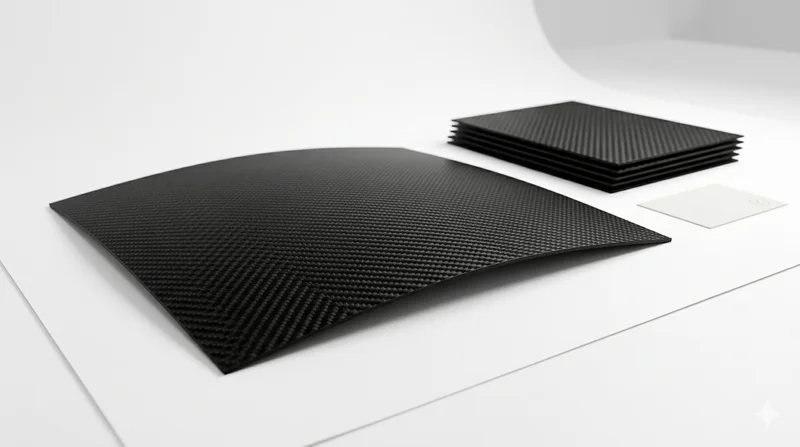
Carbon Fiber Plate — 3K Twill T700 1.5mm
Thin 1.5mm carbon fiber plate with 3K twill weave surface. Lightweight and stiff, commonly used for covers, panels, drone bodies, and applications requiring a premium aesthetic appearance.
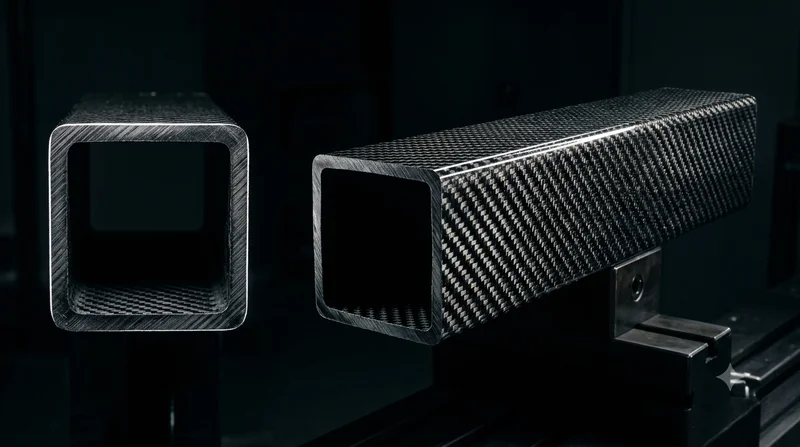
Square Carbon Fiber Tube — 3K Twill T700
Square cross-section carbon fiber tube manufactured with 3K twill weave for torsional strength. Preferred for structural frames, trusses, and support columns where rectangular geometry offers design flexibility.
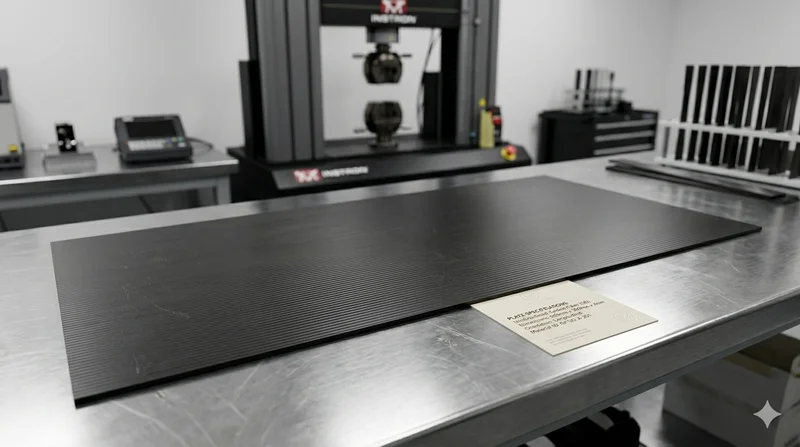
Carbon Fiber Plate — UD Unidirectional T700
Unidirectional carbon fiber plate with all fibers oriented in a single direction for maximum strength along the fiber axis. Essential for structural reinforcements, splints, and applications where load direction is predictable.
Round Carbon Fiber Tube — UD Unidirectional T700
Unidirectional (UD) round tube with all fibers aligned axially for maximum longitudinal stiffness. Ideal for applications requiring high bending rigidity with minimal weight, such as shafts, struts, and structural reinforcements.
Round Carbon Fiber Tube — 3K Plain Weave T700
Standard round carbon fiber tube manufactured from Toray T700 grade fiber with 3K plain weave. Offers balanced strength and stiffness for general industrial applications including robotics, automation, sports equipment, and aerospace structures.