
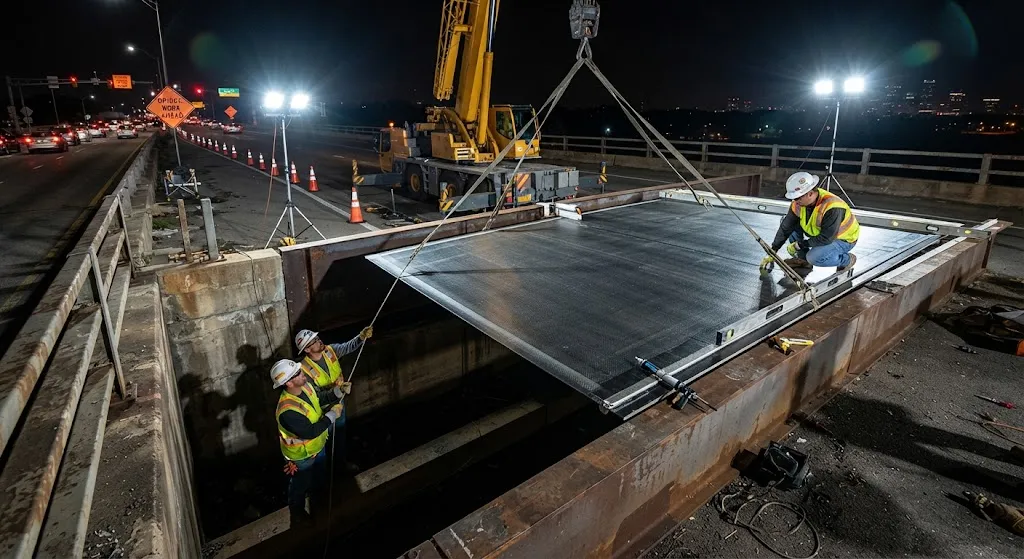
Bridge inventory across North America, Europe and Asia has a common problem: a large generation of highway and pedestrian bridges built in the 1960s through the 1980s is now past or near its original design life, and the deck is failing first. The deck is the bridge element that carries
Introduction
Bridge inventory across North America, Europe and Asia has a common problem: a large generation of highway and pedestrian bridges built in the 1960s through the 1980s is now past or near its original design life, and the deck is failing first. The deck is the bridge element that carries traffic directly, receives the constant spray of deicing salts in cold climates, and absorbs the brunt of freeze-thaw cycling. When a deck deteriorates, owners face a binary choice — full replacement or load posting — and both are expensive. FRP deck panels have emerged over the past two decades as a third path: a prefabricated replacement that is dramatically lighter than concrete, immune to the corrosion mechanism that kills conventional decks, and installable in hours rather than weeks.
This article covers the deck failure problem, the weight advantage that makes FRP replacements feasible without strengthening the substructure, the modular installation that supports night and weekend closures, and the selection and qualification questions owners should resolve before specifying panel systems on real projects.
Why Bridge Decks Fail First
The deck is the most maintenance-intensive element of a bridge. Reinforced concrete decks absorb chloride ions from deicing salts; the chloride migrates to the steel reinforcement, corrosion products expand and crack the concrete, and spalling follows. Steel orthotropic decks, used on large river crossings, suffer from fatigue cracking at weld details and coating failure. The result is a deck population with a predictable failure curve: decks built with 1960s-1980s design standards and salt exposure typically reach their limit state 30-50 years after construction, which is exactly where the global inventory sits now. The comparison below sets FRP panels against the conventional alternatives:
| Deck type | Weight (relative) | Corrosion behavior | On-site installation | Primary failure mode |
|---|---|---|---|---|
| Reinforced concrete slab | 1.0 (baseline) | Rebar corrosion under chloride | Weeks of forming, curing, casting | Spalling, delamination |
| Steel orthotropic deck | 0.5-0.7 | Coating-dependent | Heavy steel erection, field welds | Fatigue cracking at weld details |
| FRP deck panel | 0.2-0.25 | Non-corroding composite | Crane-set panels, adhesive/mechanical joints | Wear surface and joint maintenance |
FRP panels replace the corrosion mechanism with a fatigue and wear-surface management problem, which is a maintenance task rather than a structural emergency. That distinction drives most of the lifecycle economics.
The Weight Advantage
Weight is the property that unlocks the FRP replacement strategy. A full-depth FRP deck panel weighs roughly one-quarter to one-fifth of an equivalent reinforced concrete slab. In bridge terms that difference cascades: dead load reduction of that magnitude can recover lost load rating without touching the girders, stay cables or piers. A bridge posted at a reduced rating because the old deck added weight and the structure had aged can often be restored to its original rating, or even increased, simply by replacing the deck with a lighter one. For pedestrian and light-vehicle bridges the effect is strongest, which is why the earliest installations concentrated there; heavier highway routes followed as panel systems accumulated fatigue data.
The weight advantage also reaches the substructure. Because the replacement deck is lighter, the existing piers, abutments and foundations remain valid in many cases — the deck replacement avoids a full superstructure rebuild. Where seismic design governs, the lower mass reduces the inertial forces the bridge must resist, which is an additional benefit on retrofit projects in active regions.
Modular Installation and Night Lane Closures
The second operational advantage is schedule. FRP decks are prefabricated as panels in a factory, delivered to site, and installed with cranes and smaller crews than cast-in-place concrete requires. Panel-to-panel joints use adhesive bonding, mechanical fasteners, or a combination, and the wear surface is applied either in the factory or as a thin overlay on site. The practical consequence is that a single lane or a single span can be replaced during an overnight or weekend closure, with traffic restored before the next commute. Agencies that cannot afford weeks of full closure — urban crossings, commuter highways, school access routes — can sequence the work lane by lane.
Night-closure installation changes the economic case for deck replacement: the cost of traffic management, which can exceed the deck material cost on busy corridors, collapses when closures shrink from weeks to hours. The prefabrication also concentrates quality control in the factory, where bonding, curing and dimensional checks are performed under controlled conditions rather than on a wet jobsite.
Panel Construction and Selection Criteria
FRP deck systems are not a single product; they split into pultruded and sandwich constructions, each suited to different span and load regimes, and buyers should shortlist on the basis of project-specific criteria:
- Load rating and fatigue data: confirm that panels carry published fatigue test data for the intended truck spectrum, not just static ultimate strength.
- Wear surface system: the top surface determines maintenance interval; require documented bond performance of the overlay system to the panel substrate.
- Joint and connection detail: panel-to-panel and panel-to-girder connections must tolerate thermal movement and construction tolerance in the field.
- Freeze-thaw and moisture: verify resistance to deicing salts and freeze-thaw cycling in the project climate zone.
- Fire and smoke: for tunnels and enclosed deck sections, check resin systems against local fire classifications.
- Impact and abuse resistance: pedestrian barriers, maintenance vehicles and dropped objects impose local loading that sandwich panels should withstand without core damage.
Each criterion maps to a specific specification item, so owners who push for documented data on these six points avoid the most common specification failures: panels that are strong on paper but fatigue-limited, or overlays that debond within a few winters.
Data, Testing and Qualification
The qualification environment for FRP decks has matured considerably. Reference installations on pedestrian bridges, local roads and a growing number of highway crossings provide in-service evidence, and laboratory fatigue testing of full-scale panels under simulated truck loading has become standard practice in the procurement documents of several transport agencies. Owners should look for panels with published service history in climates similar to their own, and should require static and fatigue test reports from an accredited laboratory for the specific panel configuration being bid — not for a generic system family. Installation quality is the other variable: adhesive bonding and joint assembly are field operations, and a documented installer training regime is a legitimate procurement requirement.
Frequently Asked Questions
How much lighter is an FRP deck than a concrete deck?
An FRP deck panel typically weighs one-quarter to one-fifth of an equivalent reinforced concrete slab. That dead-load reduction is often enough to restore a posted bridge to its original rating without strengthening the girders, piers or foundations, and it reduces seismic inertial forces on retrofit projects. The weight advantage is most pronounced on pedestrian and light-vehicle bridges, while heavier highway routes require published fatigue data for the intended truck spectrum before the same economics apply.
Can FRP decks be installed without full bridge closure?
Yes. FRP decks are prefabricated as panels, delivered ready to set, and installed with cranes and smaller crews than cast-in-place concrete, with joints made by adhesive bonding, mechanical fasteners or a combination. Because installation is an overnight or weekend operation per lane or per span, agencies can sequence replacement lane by lane and restore traffic before the next commute. This collapses traffic-management cost, which on busy corridors often exceeds the deck material cost of a conventional replacement.
How long do FRP bridge decks last?
FRP decks remove the corrosion mechanism that kills conventional reinforced concrete decks, so their service life is governed by the wear surface, the joints and the fatigue performance of the panel rather than by chloride-induced spalling. With documented fatigue data for the design truck spectrum and a maintained wear surface, FRP decks have demonstrated service lives exceeding two decades in the earliest installations, with the full structural design life still an active research question that owners track through ongoing monitoring programs.
Conclusion
FRP bridge deck panels convert the most expensive maintenance problem on the bridge inventory — deck deterioration — into a prefabricated, low-weight replacement operation. At one-quarter to one-fifth the weight of concrete, they can restore load ratings without substructure strengthening; with corrosion immunity they remove the dominant failure mechanism; and with overnight installation they cut the traffic disruption that makes conventional deck replacement so costly on busy routes. Owners who qualify panel systems on fatigue data, wear-surface performance and joint details, and who verify installer capability, will find FRP decks a practical, durable answer for the aging bridge fleet.
For bridge programs evaluating composite decks and structural reinforcement, review our carbon fiber and pultruded FRP product range or contact our engineering team for specification support, fatigue data review and supply planning.
Part of topic
Related Articles
- Carbon Fiber Mooring for Floating Offshore Wind: Fatigue and Corrosion in Deep Water
- Carbon Fiber Bicycle Frame Optimization: Layup Design and Manufacturing for Competitive Racing
- Carbon Fiber CFRP Retrofit for Infrastructure: Bridge and Building Seismic Strengthening
- Carbon Fiber Medical Imaging Equipment: Lightweight Gantry and Couch Structures for MRI/CT
- Carbon Fiber EV Battery Enclosures: Crash Safety and Electromagnetic Shielding Design
- Carbon Fiber Structures for Low-Altitude Economy: UAV Airframes and eVTOL Components
Interested in Our Products?
Contact our team for competitive pricing and technical specifications.
Get a QuoteRelated Products

Carbon Fiber Plate — 3K Twill T700 1.5mm
Thin 1.5mm carbon fiber plate with 3K twill weave surface. Lightweight and stiff, commonly used for covers, panels, drone bodies, and applications requiring a premium aesthetic appearance.

Square Carbon Fiber Tube — 3K Twill T700
Square cross-section carbon fiber tube manufactured with 3K twill weave for torsional strength. Preferred for structural frames, trusses, and support columns where rectangular geometry offers design flexibility.
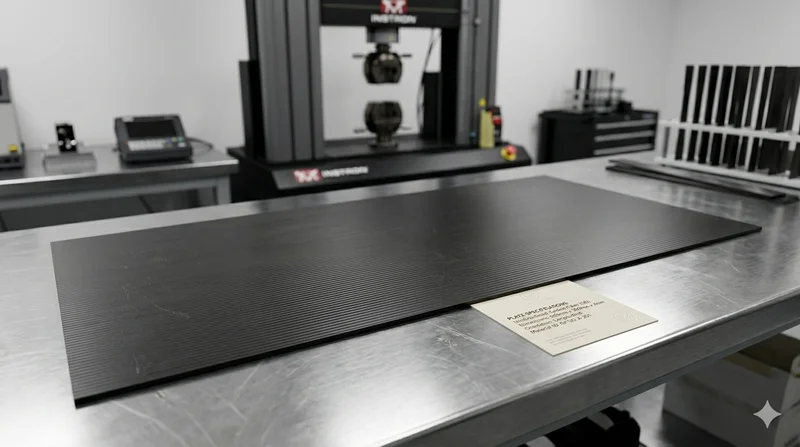
Carbon Fiber Plate — UD Unidirectional T700
Unidirectional carbon fiber plate with all fibers oriented in a single direction for maximum strength along the fiber axis. Essential for structural reinforcements, splints, and applications where load direction is predictable.
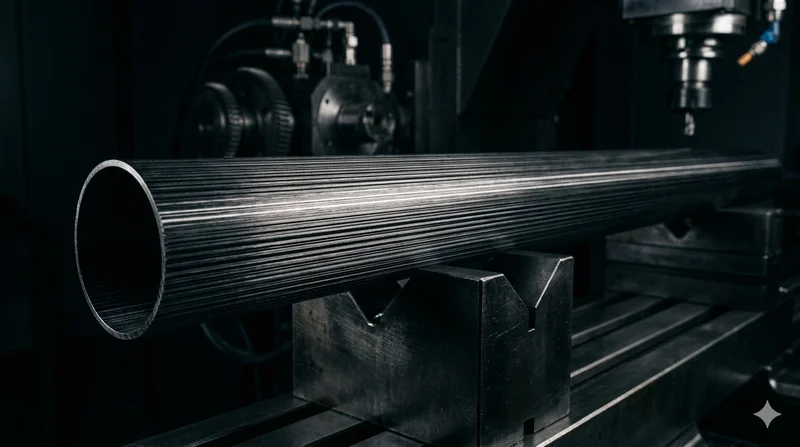
Round Carbon Fiber Tube — UD Unidirectional T700
Unidirectional (UD) round tube with all fibers aligned axially for maximum longitudinal stiffness. Ideal for applications requiring high bending rigidity with minimal weight, such as shafts, struts, and structural reinforcements.
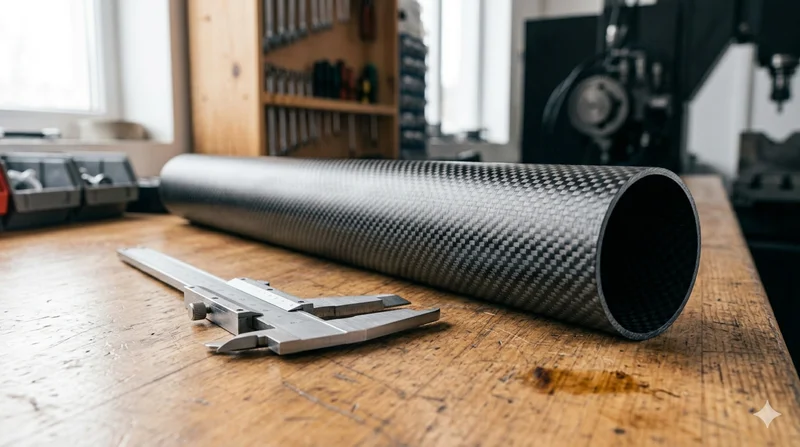
Round Carbon Fiber Tube — 3K Plain Weave T700
Standard round carbon fiber tube manufactured from Toray T700 grade fiber with 3K plain weave. Offers balanced strength and stiffness for general industrial applications including robotics, automation, sports equipment, and aerospace structures.