
Formula 1 stands apart from every other high-performance carbon fiber market. A single season consumes several tons of carbon fiber per team, with chassis, suspension, and aerodynamic components pushed through design cycles measured in days and crash tests measured in centimeters of int
Introduction
Formula 1 stands apart from every other high-performance carbon fiber market. A single season consumes several tons of carbon fiber per team, with chassis, suspension, and aerodynamic components pushed through design cycles measured in days and crash tests measured in centimeters of intrusion. There is no other customer that combines this volume with this rate of iteration and this level of regulatory scrutiny.
For composite suppliers and manufacturers, F1 is the highest-specification B2B environment in motorsport — and arguably in the wider industry. The parts must survive loads that would permanently deform steel, weigh as little as physics allows, and pass crash tests defined by the FIA with margin. This article breaks down the three families of carbon fiber components that define a modern F1 car — the monocoque crash structure, the suspension system, and the aerodynamic package — and explains the material and process logic behind each.
The Monocoque: A Survival Cell Made of Carbon
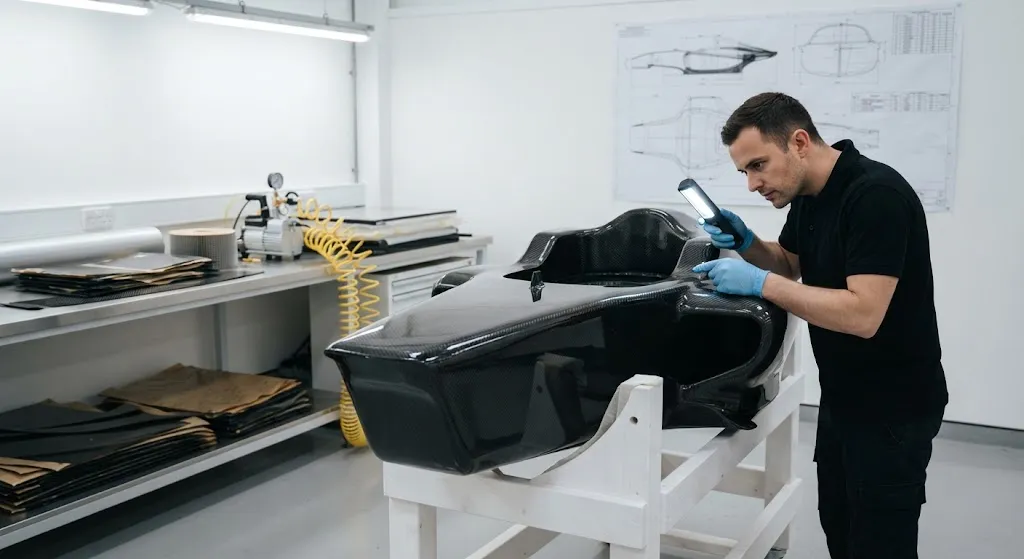
At the center of every F1 car sits the monocoque, a carbon fiber survival cell that protects the driver. The structure is a sandwich construction: high-strength carbon fiber reinforced polymer faces bonded to an aluminum honeycomb core, with local reinforcement in load-intensive regions such as the cockpit sides, the driver's head surround, and the belt anchor points. The choice of material is not complicated by tradition — carbon fiber is chosen because energy absorption and stiffness per kilogram exceed every alternative.
| Component | Primary Material System | Load or Function | Typical Construction |
|---|---|---|---|
| Monocoque survival cell | T700/T800-class CFRP, epoxy | Crash energy, driver protection | Sandwich, honeycomb core |
| Front and side impact structures | High-strength CFRP laminates | Controlled energy absorption | Crushable laminate cones |
| Roll structure and cockpit | CFRP with local titanium inserts | Rollover, intrusion resistance | Thick-section laminate |
| Seat and padding systems | CFRP shell, impact foam | Load transfer to survival cell | Molded shell |
Crashworthiness is verified, not assumed. FIA regulations require a defined program of static and dynamic tests before a chassis is cleared to race: frontal impact with the car propelled into a rigid barrier, side impact against an intrusion cone, static load tests on the roll structure and cockpit opening, and push-off tests simulating rollover forces. The 2026 regulatory cycle raised the energy levels in several of these tests, pushing teams to thicker impact structures and more refined sandwich designs. Every one of these tests is a data-generating event: accelerometer traces, intrusion measurements, and high-speed video feed directly back into the laminate design of the next iteration.
Suspension Uprights: Fatigue-Loaded Structural Composites
The suspension upright connects the wheel to the suspension arms and carries braking, cornering, and bump loads simultaneously. In steel or titanium, an upright is a forging; in carbon fiber, it is a highly engineered laminate that saves hundreds of grams and delivers stiffness tailored to the load path. The part must remain dimensionally stable under braking torque and survive thousands of kilometers of high-frequency loading without fatigue failure — a requirement that eliminates any tolerance for voids, weak resin pockets, or poorly controlled curing.
- Material: Intermediate-modulus carbon fiber in epoxy, with fiber architecture aligned to the dominant load directions through careful ply scheduling.
- Process: Prepreg layup and autoclave curing, giving tight fiber volume fraction control and predictable mechanical properties part to part.
- Validation: Fatigue testing on representative hardware with strain gauges, plus full-scale rig and on-car correlation before race use.
- Integration: Metallic inserts and brake attachment points molded into the laminate, combining composite stiffness with metallic wear and thread capability.
Uprights illustrate the broader trend in F1 suspension: weight moved out of unsprung masses pays back twice, because it improves both chassis response and tire contact. The same logic drives carbon fiber into pushrods, wishbones (where permitted by regulation), steering columns, and brake ducts. Each part is a small volume of material, but the combined weight saving across a car is measured in kilograms — and in race terms, kilograms are tenths of a second per lap.
Aerodynamic Components: Stiffness at Minimum Mass
Most of the visible carbon fiber on an F1 car is aerodynamic. Front wings, rear wings, floors, diffusers, and bargeboards are all composite parts whose sole purpose is to convert airflow into downforce. The engineering challenge is stiffness under enormous aerodynamic loads: at 300 km/h, a front wing experiences loads that would visibly flex a metal structure, and a wing that deflects unpredictably destroys the car's balance. Carbon fiber's high specific stiffness makes it the only material family capable of meeting both the mass and stiffness targets.
| Aero Component | Typical Construction | Design Driver | Materials |
|---|---|---|---|
| Front wing | High-modulus CFRP faces, thin skins | Stiffness at low mass under trim loads | M46J/M55J-class high-modulus tow |
| Rear wing assembly | CFRP mainplane and flaps, DRS integration | Drag reduction, structural integrity | High-strength CFRP |
| Floor and diffuser | Sandwich panels, molded tunnels | Ground-effect load management | CFRP sandwich, honeycomb |
| Bargeboards and vanes | Thin-skin CFRP | Flow conditioning near the sidepod | CFRP, high Tg epoxy |
Aerodynamic parts are also the most iteration-intensive. Regulations change the rules of the aerodynamic game each season, and teams redesign surfaces in weeks, not years. That cadence favors prepreg-based processes with rapid tooling turnarounds and predictable material consistency. Composite suppliers that serve F1 must therefore deliver not just material but process support: consistent areal weights, documented mechanical properties, and the ability to respond to design changes without degrading part quality.
Material Specification and Supply in F1
Teams do not buy carbon fiber as a commodity; they demand qualification-grade consistency. Typical requirements include strict fiber areal weight tolerance, documented mechanical allowables per batch, controlled resin system behavior under autoclave cure, and audit trails from fabric to finished part. The volume per team is several tons per season, but the real premium is in reliability — a single nonconforming batch can cost a race weekend.
- Fiber grades: T700/T800 high-strength tow for crash and structural parts, M-series intermediate-to-high-modulus fiber for stiffness-critical aero surfaces.
- Resin systems: High glass-transition-temperature epoxies that cure reliably in autoclave cycles and retain properties across the operating envelope of an F1 car.
- Formats: Unidirectional prepreg, woven prepreg, and spread-tow thin-ply formats chosen per component stiffness and thickness requirements.
- Traceability: Lot-level records that connect every supplied roll to its cure batch and mechanical test certificate.
For suppliers, F1 is a demanding but powerful reference customer: qualification at this level signals capability that transfers directly to aerospace, motorsport customers at every tier, and high-performance industrial applications. The discipline required — traceable materials, controlled processes, documented allowables — is the same discipline that defines the wider high-performance composite supply chain.
Frequently Asked Questions
How much carbon fiber does an F1 team use per season?
A typical team consumes several tons of carbon fiber material per season across chassis, suspension, and aerodynamic parts. The exact figure depends on how many parts are produced — teams build multiple chassis per season and manufacture dozens of wing and floor iterations as designs evolve. Because many parts are structurally identical in material but optimized for different circuits, the material volume is substantially higher than the weight of the cars themselves. This volume, combined with extreme quality requirements, makes F1 a significant and demanding customer for high-performance prepreg suppliers.
What crash tests does an F1 monocoque have to pass?
FIA regulations define a comprehensive program before a new chassis can race. The frontal impact test propels the complete car into a rigid barrier and measures the deceleration pulse and cockpit intrusion. The side impact test drives an intrusion cone into the cockpit side. Static tests apply defined loads in several positions on the roll structure and cockpit opening, checking for collapse or excessive deformation. Additional tests simulate rollover push-off and belt anchor loads. The 2026 regulations increased the energy levels in key impact tests, requiring thicker energy-absorbing structures and revised sandwich designs. Every chassis must pass with margin, and the results are audited by the FIA.
Why is carbon fiber used instead of titanium for suspension parts?
Weight and stiffness tailoring. A titanium upright is strong but dense; a carbon fiber laminate can be oriented so that stiffness exists exactly where the load path demands it, and nowhere else. The result is a significantly lighter part with comparable or better fatigue behavior in the dominant load directions. Carbon fiber is not a universal replacement for titanium in F1 — metallic inserts are still used at wear and thread points — but the composite carries the structural load around them. Because unsprung mass directly affects suspension response and tire grip, teams aggressively move weight out of uprights, wheels, and suspension arms, and the per-gram saving compounds into lap time.
Do F1 aerodynamic parts use different fiber from crash structures?
Generally yes. Crash structures use high-strength carbon fiber (T700/T800 class) because energy absorption and damage tolerance matter more than stiffness. Aerodynamic surfaces favor intermediate-to-high-modulus fibers (M-series grades) because their job is to hold shape under load — high stiffness at low mass — while meeting strength requirements with margin. The resin systems also differ in emphasis: aero parts run high-glass-transition-temperature epoxies to maintain stiffness over the car's operating envelope, while structural parts prioritize toughness and controlled energy absorption. Both families share the same discipline of traceable materials and documented allowables, but the tailored fiber and resin choice is part of how teams win grams and milliseconds simultaneously.
Conclusion
Formula 1 pushes carbon fiber composites to their practical limits, combining crash-verified structure, fatigue-critical suspension, and stiffness-critical aerodynamics in a single car that is redesigned every season. The monocoque demonstrates that composites can be engineered for predictable energy absorption under FIA-regulated crash tests; the uprights show fatigue-loaded composites operating at race intensity; and the aero package proves that specific stiffness at minimum mass remains carbon fiber's unique advantage. For the supply chain, the lesson is that qualification-grade consistency — traceable materials, controlled processes, documented allowables — is the currency of the sport.
For teams, suppliers, and engineering partners entering the motorsport composite supply chain, the standard is set early and audited constantly. Explore our carbon fiber products for motorsport and high-performance applications, or contact our engineering team to discuss prepreg formats, material qualification data, and supply support for racing programs.
Related Articles
- Carbon Fiber Mooring for Floating Offshore Wind: Fatigue and Corrosion in Deep Water
- Carbon Fiber Bicycle Frame Optimization: Layup Design and Manufacturing for Competitive Racing
- Carbon Fiber CFRP Retrofit for Infrastructure: Bridge and Building Seismic Strengthening
- Carbon Fiber Medical Imaging Equipment: Lightweight Gantry and Couch Structures for MRI/CT
- Carbon Fiber EV Battery Enclosures: Crash Safety and Electromagnetic Shielding Design
- Carbon Fiber Structures for Low-Altitude Economy: UAV Airframes and eVTOL Components
Interested in Our Products?
Contact our team for competitive pricing and technical specifications.
Get a QuoteRelated Products

Carbon Fiber Plate — 3K Twill T700 3.0mm
Medium-thickness 3.0mm carbon fiber plate offering significantly higher load capacity while maintaining attractive 3K twill finish. Suitable for structural brackets, reinforcement plates, and load-bearing panels.

Carbon Fiber Plate — 3K Twill T700 1.5mm
Thin 1.5mm carbon fiber plate with 3K twill weave surface. Lightweight and stiff, commonly used for covers, panels, drone bodies, and applications requiring a premium aesthetic appearance.

Square Carbon Fiber Tube — 3K Twill T700
Square cross-section carbon fiber tube manufactured with 3K twill weave for torsional strength. Preferred for structural frames, trusses, and support columns where rectangular geometry offers design flexibility.
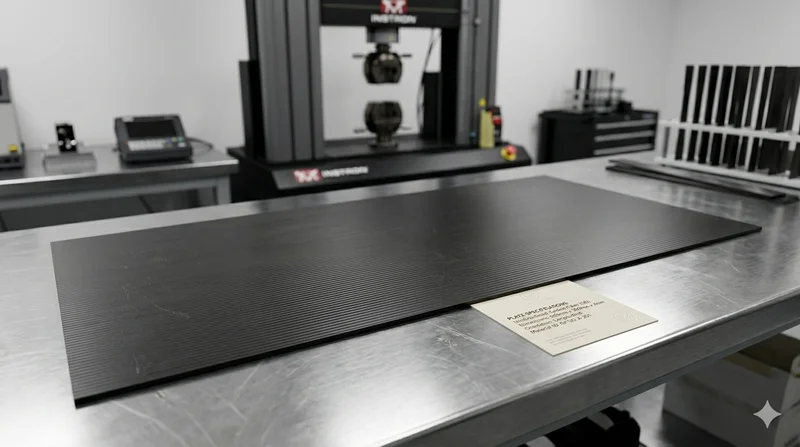
Carbon Fiber Plate — UD Unidirectional T700
Unidirectional carbon fiber plate with all fibers oriented in a single direction for maximum strength along the fiber axis. Essential for structural reinforcements, splints, and applications where load direction is predictable.
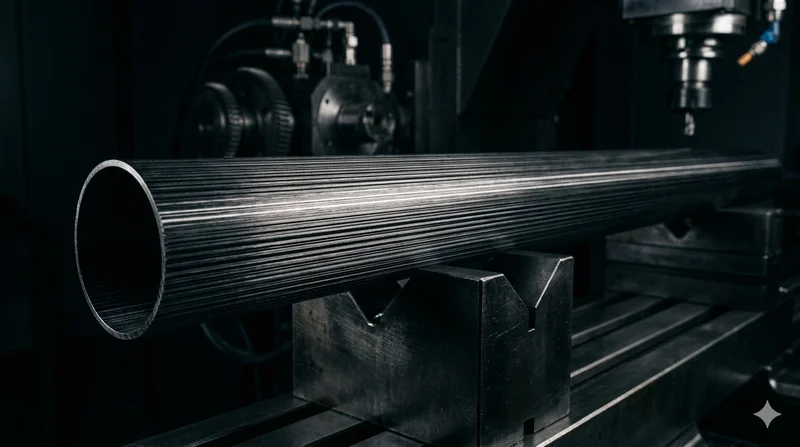
Round Carbon Fiber Tube — UD Unidirectional T700
Unidirectional (UD) round tube with all fibers aligned axially for maximum longitudinal stiffness. Ideal for applications requiring high bending rigidity with minimal weight, such as shafts, struts, and structural reinforcements.