
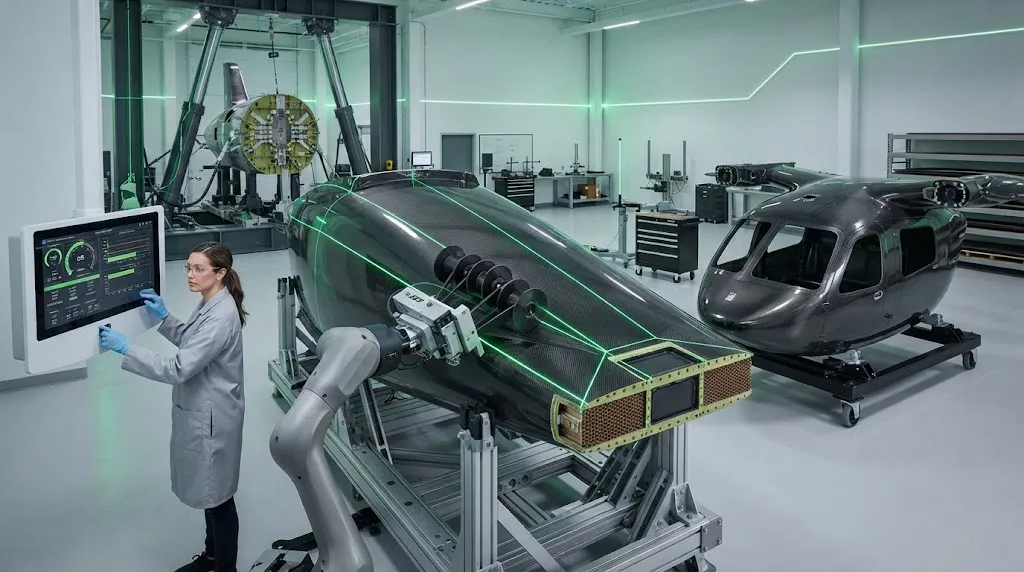
The electric vertical takeoff and landing (eVTOL) aircraft industry is advancing rapidly toward commercial certification, with more than 300 designs globally competing for type certificates from EASA, the FAA, and CAAC. Carbon fiber reinforced polymer (CFRP) composites dominate eVTOL ai
Introduction
The electric vertical takeoff and landing (eVTOL) aircraft industry is advancing rapidly toward commercial certification, with more than 300 designs globally competing for type certificates from EASA, the FAA, and CAAC. Carbon fiber reinforced polymer (CFRP) composites dominate eVTOL airframe construction, typically comprising 60–80% of structural weight, because the technology delivers the specific strength and stiffness required for vertical lift operations while minimizing the weight penalty that directly reduces battery-powered range.
Unlike conventional fixed-wing aircraft where cruise efficiency dominates design, eVTOL fuselages must simultaneously satisfy vertical lift structural loads, crashworthiness requirements for operations over populated areas, bird strike resistance at low altitude, and the weight budgets imposed by current battery energy density limitations of approximately 250–300 Wh/kg at cell level. This article examines the structural design philosophy, crashworthiness certification pathways, weight optimization strategies, and manufacturing scale-up challenges specific to carbon fiber eVTOL fuselage structures.
Structural Design Philosophy for eVTOL Fuselages
An eVTOL fuselage serves multiple functions beyond the conventional cabin pressure vessel role of fixed-wing aircraft. It must accommodate distributed electric propulsion systems, battery packs, flight control electronics, and passenger cabin within a compact airframe optimized for urban operating environments. The structural design philosophy reflects these unique requirements:
- Monocoque or semi-monocoque construction: Most eVTOL designs employ carbon fiber monocoque or semi-monocoque fuselage shells, where the composite skin carries shear and torsion loads while internal frames and stringers handle bending and pressure loads. The monocoque approach maximizes internal volume for battery placement and passenger accommodation.
- Multi-load path architecture: eVTOL fuselages experience combined vertical lift loads from multiple rotors, forward flight loads, and emergency landing loads. The structure must distribute these loads through redundant load paths to prevent catastrophic failure from any single rotor or structural element loss.
- Battery integration zones: The fuselage structure incorporates dedicated battery mounting zones with energy absorption provisions for crash protection. These zones require local reinforcement, thermal barrier integration, and fire containment features that add structural complexity beyond conventional aircraft design.
- Low-speed impact protection: Operations over populated areas require the fuselage to protect occupants during emergency landing scenarios at descent rates up to 5.4 m/s, with energy absorption through controlled composite crushing rather than elastic deformation.
Crashworthiness Certification: EASA SC-VTOL and FAA Part 135
eVTOL crashworthiness certification represents the most challenging aspect of type certification for urban air mobility. Regulatory frameworks are still evolving, but the foundational requirements draw from both helicopter and fixed-wing traditions:
| Requirement | EASA SC-VTOL | FAA Part 135 (Proposed) | Structural Implication |
|---|---|---|---|
| Emergency descent rate | ≤ 5.4 m/s vertical | ≤ 5.4 m/s vertical | Fuselage bottom structure must absorb 5.4 m/s impact energy |
| Occupant survival space | Residual volume ≥ 80% pre-impact | Residual volume ≥ 75% pre-impact | Fuselage must resist intrusion while crushing progressively |
| Seat attachment loads | 20g vertical, 16g forward | 20g vertical, 16g forward | Seat rails and attachment frames must transfer high g-loads |
| Fire containment | 60-second fire resistance post-crash | 60-second fire resistance post-crash | Thermal barriers between battery and cabin required |
| Battery integrity | No thermal runaway propagation | No thermal runaway propagation | Battery enclosure must contain or redirect thermal events |
The carbon fiber fuselage must satisfy two competing demands during a crash event: progressive energy absorption through controlled crushing of the lower fuselage structure, while maintaining occupant survival space in the upper cabin zone. This is achieved through crushable composite zones with triggered geometry, honeycomb energy absorbers at seat attachment points, and reinforced cabin floor structures that resist intrusion.
Unlike metallic structures where yielding provides visible deformation and energy absorption, carbon fiber composites fail through brittle fracture, delamination, and fiber breakage. The design must therefore incorporate damage-tolerant features that ensure predictable, progressive failure rather than catastrophic fragmentation. This requires careful selection of layup orientation, interlaminar toughening agents, and triggering mechanisms that initiate controlled crushing at predictable load levels.
Weight Optimization for Battery Range Extension
Weight is the single most critical design parameter for battery-powered eVTOL aircraft, where every kilogram of airframe weight reduction directly translates into additional flight range or payload capacity. The relationship between structural weight and range is approximately linear within the battery energy density constraints of current technology:
- Skin optimization: Thin-ply carbon fiber laminates (sub-100 μm ply thickness) enable thinner laminate walls with improved buckling resistance, reducing skin weight by 10–15% compared with conventional ply thicknesses. Fiber steering via automated fiber placement (AFP) allows variable-stiffness panels that carry loads more efficiently than constant-stiffness designs.
- Core material selection: Transitioning from aluminum honeycomb to aramid honeycomb or Rohacell foam cores reduces sandwich panel weight by 15–25% while maintaining equivalent flexural stiffness. For crash zones, aluminum honeycomb is retained for its predictable energy absorption characteristics.
- Topology optimization: Computational topology optimization identifies material placement that minimizes weight while meeting structural load requirements. Generative design approaches applied to fuselage frames and ribs have demonstrated 20–30% weight reduction compared with traditional designs.
- Multifunctional structures: Integrating battery enclosure structural functions into the primary fuselage structure eliminates redundant structure, saving 5–10% of total structural weight. This requires careful management of thermal expansion, fire isolation, and electrical insulation requirements within the composite layup.
The target structural weight fraction for production eVTOL aircraft is 35–40% of maximum takeoff weight, with leading programs targeting below 35%. Achieving this requires carbon fiber composite fuselage designs that simultaneously satisfy crashworthiness, fatigue, and environmental resistance requirements while minimizing material usage.
Manufacturing Scale-Up Challenges
Transitioning from prototype eVTOL fuselages to rate production of 500–2,000 units per year presents significant manufacturing challenges that differ from conventional aerospace production:
- Cycle time requirements: eVTOL production targets demand fuselage cure cycles of 4–8 hours rather than the 8–12 hours typical for commercial aircraft. Out-of-autoclave (OoA) resin systems and oven curing are being adopted to reduce cycle time and equipment cost.
- Repeatability: High production rates require consistent quality across every fuselage. Automated fiber placement (AFP) and automated tape laying (ATL) systems are essential for achieving the layup consistency and dimensional accuracy required at rate production.
- Tooling investment: Fuselage tooling for rate production requires high-durability molds capable of thousands of cure cycles. Invar and carbon fiber composite tooling with matched CTE profiles are specified to maintain dimensional accuracy over the production run.
- Supply chain readiness: Rate production requires qualified supply chains for carbon fiber prepreg, honeycomb core, adhesives, and metallic fittings. Long-lead qualification activities must begin 18–24 months before planned rate production entry.
Several leading eVTOL manufacturers — including Joby Aviation, Lilium, and Vertical Aerospace — have established or announced dedicated composite manufacturing facilities designed for rate production, signaling the industry's confidence in achieving certification and entering commercial service within the 2027–2029 timeframe.
Frequently Asked Questions
Why is carbon fiber the primary material for eVTOL fuselages?
Carbon fiber composites offer the highest specific strength and stiffness of any structural material, which is critical for battery-powered eVTOL aircraft where weight directly determines range and payload. CFRP also enables complex curved geometries through moldable construction, provides fatigue resistance for high-cycle urban operations, and allows integration of crash energy absorption features through tailored layup design. No alternative material combination achieves the same weight-performance ratio within current battery energy density constraints.
What crashworthiness standards apply to eVTOL fuselages?
eVTOL crashworthiness certification follows EASA SC-VTOL (Special Condition for VTOL) in Europe and proposed FAA Part 135 operational rules in the United States. Key structural requirements include occupant protection during 5.4 m/s vertical descent emergency landings, seat attachment loads of 20g vertical and 16g forward, post-crash fire containment for 60 seconds, and battery thermal runaway propagation prevention. The fuselage must progressively crush to absorb impact energy while maintaining occupant survival space.
How much weight savings does carbon fiber provide over aluminum in eVTOL fuselages?
Carbon fiber composite fuselages typically achieve 30–40% weight reduction compared with equivalent aluminum structures. For a 2,000 kg MTOW eVTOL aircraft, this translates to 150–250 kg of structural weight savings, which at current battery energy density of 250 Wh/kg provides approximately 37–63 km of additional range or 15–25 kg of additional payload capacity. The weight savings are compounded because lighter structure requires smaller batteries, creating a virtuous weight reduction cycle.
What is the timeline for eVTOL commercial certification?
EASA has indicated it expects to issue the first Type Certificates for eVTOL aircraft in 2026–2027, with FAA certification following in the 2027–2028 timeframe. Commercial operations are projected to begin in 2028–2029 in select urban markets. Manufacturing readiness for rate production must be achieved 18–24 months before planned entry into service to support fleet ramp-up requirements.
Conclusion
Carbon fiber composite fuselage structures are the enabling technology for eVTOL urban air mobility, delivering the weight efficiency required for battery-powered flight while meeting the crashworthiness demands of operations over populated areas. The design challenge lies in balancing progressive energy absorption for crash protection with structural efficiency for range optimization, all within manufacturing processes capable of rate production at 500–2,000 units per year.
As the eVTOL industry advances toward certification and commercial service, the demand for aerospace-grade carbon fiber prepreg, core materials, and manufacturing expertise will accelerate. YongXian supplies carbon fiber fabrics, prepreg materials, and reinforcement solutions for aerospace structural applications. Explore our carbon fiber product range or contact our engineering team to discuss material systems for your eVTOL structural program.
Part of topic
Related Articles
- Carbon Fiber Mooring for Floating Offshore Wind: Fatigue and Corrosion in Deep Water
- Carbon Fiber Bicycle Frame Optimization: Layup Design and Manufacturing for Competitive Racing
- Carbon Fiber CFRP Retrofit for Infrastructure: Bridge and Building Seismic Strengthening
- Carbon Fiber Medical Imaging Equipment: Lightweight Gantry and Couch Structures for MRI/CT
- Carbon Fiber EV Battery Enclosures: Crash Safety and Electromagnetic Shielding Design
- Carbon Fiber Structures for Low-Altitude Economy: UAV Airframes and eVTOL Components
Interested in Our Products?
Contact our team for competitive pricing and technical specifications.
Get a QuoteRelated Products

Carbon Fiber Plate — 3K Twill T700 3.0mm
Medium-thickness 3.0mm carbon fiber plate offering significantly higher load capacity while maintaining attractive 3K twill finish. Suitable for structural brackets, reinforcement plates, and load-bearing panels.

Carbon Fiber Plate — 3K Twill T700 1.5mm
Thin 1.5mm carbon fiber plate with 3K twill weave surface. Lightweight and stiff, commonly used for covers, panels, drone bodies, and applications requiring a premium aesthetic appearance.

Square Carbon Fiber Tube — 3K Twill T700
Square cross-section carbon fiber tube manufactured with 3K twill weave for torsional strength. Preferred for structural frames, trusses, and support columns where rectangular geometry offers design flexibility.
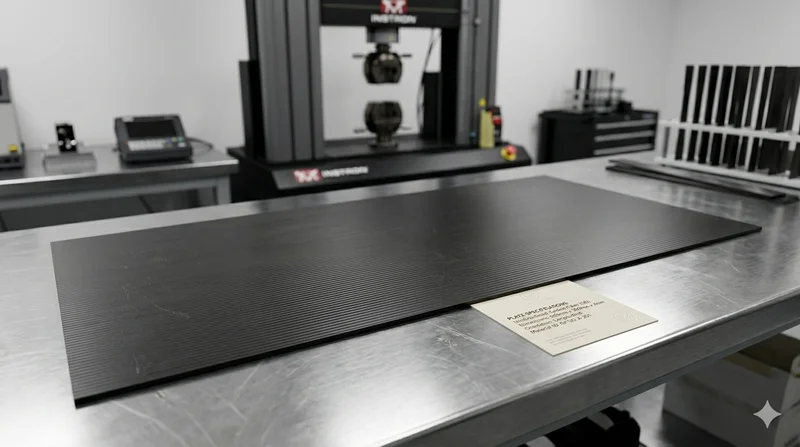
Carbon Fiber Plate — UD Unidirectional T700
Unidirectional carbon fiber plate with all fibers oriented in a single direction for maximum strength along the fiber axis. Essential for structural reinforcements, splints, and applications where load direction is predictable.
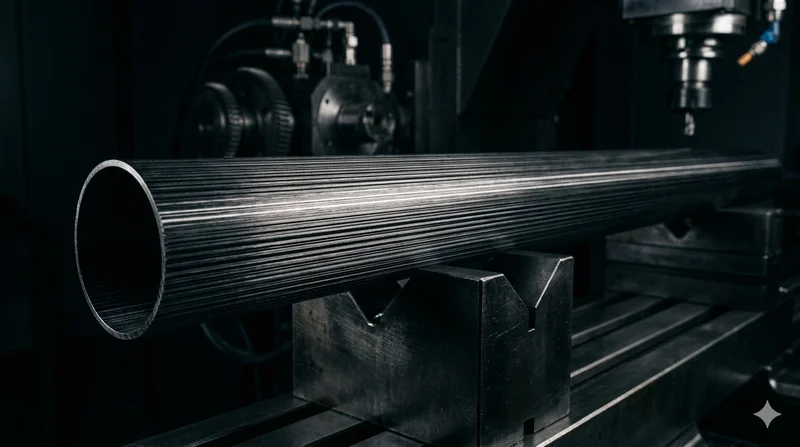
Round Carbon Fiber Tube — UD Unidirectional T700
Unidirectional (UD) round tube with all fibers aligned axially for maximum longitudinal stiffness. Ideal for applications requiring high bending rigidity with minimal weight, such as shafts, struts, and structural reinforcements.