
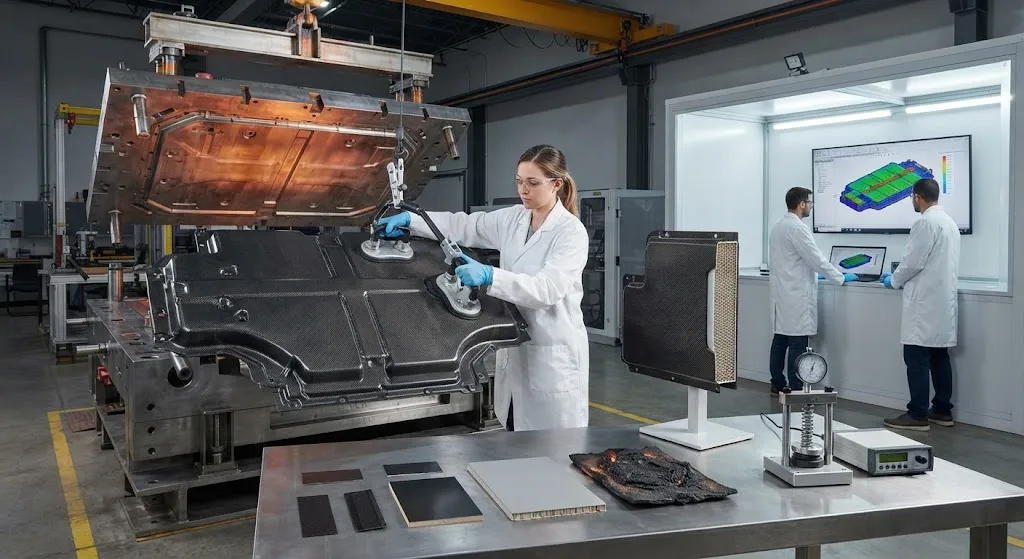
The battery enclosure is the structural and safety backbone of an electric vehicle, protecting the cells in a crash while containing the heat and gas of a thermal runaway event. Automakers increasingly look to carbon fiber to make this structure lighter, because every kilogram saved in
Introduction
The battery enclosure is the structural and safety backbone of an electric vehicle, protecting the cells in a crash while containing the heat and gas of a thermal runaway event. Automakers increasingly look to carbon fiber to make this structure lighter, because every kilogram saved in the enclosure can extend range or reduce battery cost for the same range. Market analyses now rank lightweight battery enclosures among the clearest growth drivers for carbon fiber in the automotive sector.
Yet the adoption case is not automatic. Carbon fiber enclosures cost more per kilogram than the aluminum and steel they replace, and their safety performance depends on how the composite handles crash energy, thermal runaway, and electrical isolation. This article explains what engineers weigh when specifying a carbon fiber battery enclosure, how the cost-per-kilogram break-even works, and where lightweight enclosures move from a concept to a production reality.
Why Enclosure Weight Matters
Battery enclosures are among the heaviest single components of an EV. A large pack enclosure can weigh 80-150 kilograms, and every kilogram of structure competes with kilograms of cells or with driving range. The weight accounting is simple:
| Factor | Steel Enclosure | Aluminum Enclosure | Carbon Fiber Enclosure |
|---|---|---|---|
| Approx. mass (large pack) | 120-150 kg | 80-110 kg | 50-75 kg |
| Density | 7.85 g/cm³ | 2.70 g/cm³ | 1.5-1.6 g/cm³ |
| Specific stiffness | Baseline | ~2-3x higher | Up to ~4-6x higher |
| Crash energy absorption | Ductile, high | Good | Strong but brittle-oriented |
| EMI / electrical behavior | Conductive | Conductive | Needs metallic grounding plane |
On a typical 60-80 kWh pack, a switch from steel to carbon fiber can save 50-70 kilograms. That weight reduction either extends range by a few percent or lets the pack carry the same range with fewer cells, which is where the economics start to close. Because the enclosure is a large, low-curvature, highly loaded panel, composites can be laid up efficiently and exploit their stiffness-to-weight advantage directly.
Crash Performance and Structural Requirements
A battery enclosure must protect cells not only from a direct impact but from the deformation, intrusion, and localized loads that a crash creates. Carbon fiber brings high specific stiffness and strength, but it is inherently brittle, so engineers design the composite crush behavior rather than assume it:
- Progressive crush: Laminates are arranged with triggers, ply orientations, and hybrid layers so that impact energy is absorbed through controlled, progressive crushing rather than sudden fracture.
- Hybrid structures: Many enclosures combine a carbon fiber outer shell with aluminum or polymer crush structures, brackets, and rails that absorb energy where local ductility matters.
- Intrusion resistance: The floor structure must resist floor-pan intrusion and underside stone or curb impacts while keeping the cell area free of conductive debris.
- Mounting and seals: The enclosure carries its own weight, the pack's fuctional sealing, and the vehicle body interface, so stiffness and dimensional stability under load are as important as raw strength.
Because carbon fiber is electrically conductive, the enclosure must also contain a grounding plane and isolation strategy so that a damaged laminate cannot short high-voltage cells. This is a design requirement unique to composites and a common reason engineers combine carbon skins with a separate metallic or coated interior layer.
Thermal Runaway and Fire Containment
Thermal runaway is the failure mode that multiplies a single cell's failure into a pack fire, and the enclosure is the last line of defense containing heat, flame, and vented gas. Carbon fiber's response depends on the resin system and the fire strategy:
| Requirement | Challenge for Composites | Typical Solution |
|---|---|---|
| Flame containment | Resin burns and chars | Fire-resistant or flame-retardant resin, ceramic coatings |
| Heat soak to cabin | High conductivity can transfer heat | Insulating layers between cells and shell |
| Gas venting | Pressure must vent safely | Directed vent channels, burst panels |
| Structural retention | Strength drops at high temperature | Ceramic or mineral char layer preserves shape |
Modern enclosures address thermal runaway by adding a fire-resistant layer inside the carbon shell and designing a controlled vent path, so that when a cell enters thermal runaway the enclosure contains the event, directs the escaping gas away from the passenger compartment, and retains its structural shape long enough for occupants to evacuate. The carbon outer shell provides the stiffness and light weight while a ceramic or insulating inner layer provides the fire barrier, letting each material do what it does best.
The Cost-per-Kg Break-Even
The decisive question for most programs is not whether carbon fiber is lighter, but whether the weight saved justifies the added cost per kilogram. The break-even depends on what a kilogram of enclosure weight is worth to the vehicle:
- Range extension: Saving 60 kg on an 80 kWh pack can add a few percent of range; at high battery prices, that range is worth real money per vehicle.
- Cell reduction: The clearest win is keeping range flat and removing cells instead, cutting the most expensive component in the pack by more than the added enclosure cost.
- Dynamic-tax incentives: In weight-sensitive light commercial and performance segments, reducing the pack's platform mass can reduce the mass-based targets or tax obligations.
- Production cost: Carbon enclosures are difficult and slow to produce with autoclave cure, so cost-per-kg break-even depends heavily on moving to faster out-of-autoclave or thermoplastic processes.
In practice the break-even point sits roughly where the value of a kilogram of pack weight exceeds the added cost of the composite over aluminum. That threshold is crossed first in performance vehicles, commercial vans with tight payload budgets, and premium models where range is a headline selling point. As cell-to-body architectures and fast-curing thermoplastics lower carbon processing cost, the same calculus reaches broader segments.
Production Pathways and Recycled Feedstock
Cost and sustainability are converging on enclosure production. Companies such as Gen 2 Carbon are pursuing closed-loop programs that recycle carbon fiber production waste back into the battery enclosure feedstock, addressing both the scrap typical of preform and layup processes and the composite end-of-life question. Recycling carbon fiber at high quality reduces the embodied carbon of the enclosure and, as recycled fiber pricing falls, moves the cost-per-kg break-even in the same direction.
The processing route matters as much as the fiber source. Out-of-autoclave vacuum infusion and compression molding shorten cycle times relative to autoclave cure, while thermoplastic organosheets allow rapid forming and welding of ribs and stiffeners. Buyers evaluating carbon enclosures should therefore compare the full system cost, including cycle time, tooling, scrap, and scrap recyclability, rather than the fiber price alone. The enclosure that wins is the one that is light, safe, and producible at a rate an EV assembly line actually needs.
Frequently Asked Questions
How much weight can a carbon fiber battery enclosure save?
A carbon fiber battery enclosure can typically save 30-50 percent of the mass of a steel enclosure and roughly 25-40 percent versus aluminum on equivalent structures. For a large pack whose steel enclosure weighs around 120-150 kilograms, moving to carbon fiber can reduce that to roughly 50-75 kilograms, a saving of 50-70 kilograms. That weight either extends range by a few percent or lets the automaker remove cells while keeping range unchanged, which is often the more valuable trade. The exact figure depends on pack size, crash requirements, and how much of the structure uses hybrid aluminum or polymer elements.
Is a carbon fiber battery enclosure safe in a crash?
Yes, when properly engineered. Carbon fiber is inherently more brittle than ductile metals, so the enclosure must be designed for progressive crush rather than assumed to deform plastically. Designers add crush triggers, hybrid metal or polymer load paths, and controlled intrusion resistance so impact energy is absorbed progressively and cells stay protected. Because carbon is electrically conductive, the enclosure also includes a grounding plane and isolation layer to prevent a damaged laminate from shorting high-voltage cells. With these measures in place, carbon fiber enclosures meet the same crash and intrusion standards as metal ones while providing the weight benefit.
How does a carbon fiber enclosure handle thermal runaway?
A carbon fiber enclosure alone does not resist fire well, because the polymer resin burns and chars. Production designs therefore combine the carbon shell with a fire-resistant or flame-retardant inner layer, such as a ceramic, mineral, or coated barrier, plus a controlled vent path and burst panels. When a cell enters thermal runaway, the inner fire layer contains flame and heat while the directed gas exits away from the cabin, and the char-forming layer keeps the shell structurally intact long enough for evacuation. This is a systems approach in which the carbon provides light weight and stiffness while a separate layer provides the fire barrier.
When does the cost of a carbon fiber enclosure make financial sense?
The cost makes sense when the value of a kilogram of saved enclosure weight exceeds the added cost of the composite over aluminum. That happens first where weight is most valuable: performance vehicles, commercial vans with tight payload and range budgets, and premium models where range is a headline selling point. The break-even improves when saved weight lets an automaker remove cells rather than only extend range, when fast out-of-autoclave or thermoplastic processes cut cycle time, and when recycled carbon fiber lowers feedstock cost and embodied carbon. As these factors move together, lightweight enclosures broaden from flagship programs to volume models.
Conclusion
Carbon fiber battery enclosures deliver exactly what electric vehicles need most from a large structure: the lightest way to meet crash and thermal-runaway requirements. The technology is not a simple one-for-one replacement, because crash crush, electrical isolation, and fire containment each demand dedicated design, but the weight saving it unlocks is large enough that automakers now treat it as a core growth driver. The adoption threshold is the cost-per-kilogram break-even, which falls as processing speeds up and recycled feedstock scales.
Whether you are an OEM evaluating a lightweight pack or a supplier building the enclosure, the right structure balances crash energy, fire safety, and producible economics. Explore our carbon fiber materials and preforms for lightweight structural applications, or contact our technical team to discuss resin systems, crash layups, and fast-curing processes for your battery program.
Part of topic
Related Articles
- Carbon Fiber Mooring for Floating Offshore Wind: Fatigue and Corrosion in Deep Water
- Carbon Fiber Bicycle Frame Optimization: Layup Design and Manufacturing for Competitive Racing
- Carbon Fiber CFRP Retrofit for Infrastructure: Bridge and Building Seismic Strengthening
- Carbon Fiber Medical Imaging Equipment: Lightweight Gantry and Couch Structures for MRI/CT
- Carbon Fiber EV Battery Enclosures: Crash Safety and Electromagnetic Shielding Design
- Carbon Fiber Structures for Low-Altitude Economy: UAV Airframes and eVTOL Components
Interested in Our Products?
Contact our team for competitive pricing and technical specifications.
Get a QuoteRelated Products

Carbon Fiber Plate — 3K Twill T700 3.0mm
Medium-thickness 3.0mm carbon fiber plate offering significantly higher load capacity while maintaining attractive 3K twill finish. Suitable for structural brackets, reinforcement plates, and load-bearing panels.

Carbon Fiber Plate — 3K Twill T700 1.5mm
Thin 1.5mm carbon fiber plate with 3K twill weave surface. Lightweight and stiff, commonly used for covers, panels, drone bodies, and applications requiring a premium aesthetic appearance.

Square Carbon Fiber Tube — 3K Twill T700
Square cross-section carbon fiber tube manufactured with 3K twill weave for torsional strength. Preferred for structural frames, trusses, and support columns where rectangular geometry offers design flexibility.
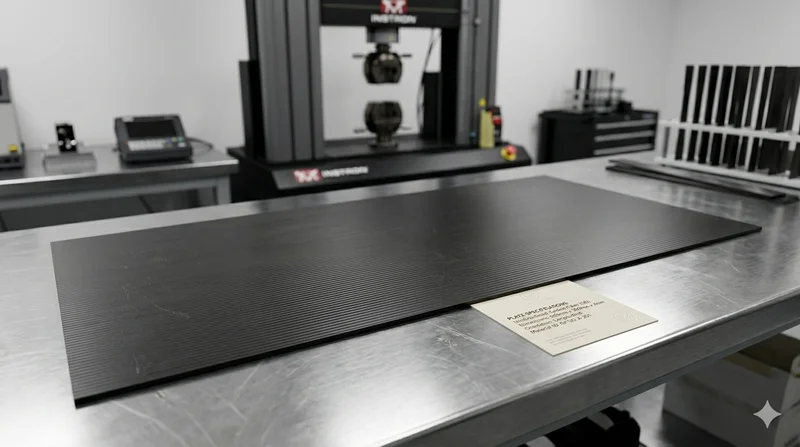
Carbon Fiber Plate — UD Unidirectional T700
Unidirectional carbon fiber plate with all fibers oriented in a single direction for maximum strength along the fiber axis. Essential for structural reinforcements, splints, and applications where load direction is predictable.
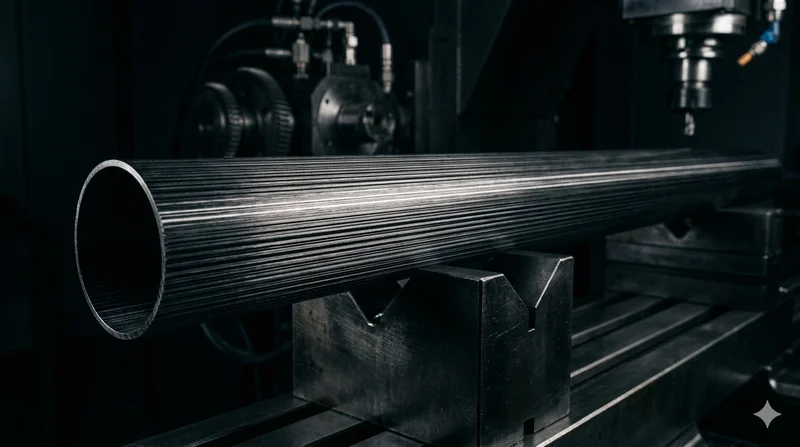
Round Carbon Fiber Tube — UD Unidirectional T700
Unidirectional (UD) round tube with all fibers aligned axially for maximum longitudinal stiffness. Ideal for applications requiring high bending rigidity with minimal weight, such as shafts, struts, and structural reinforcements.